
Reviewed · ANCIENT AGORA & CITY SITES
Private Walking Tour: Ancient Agora, Plaka and Monastiraki monuments
The heart of this tour is the Ancient Agora, where Athenians traded, argued over public matters, and helped shape the idea of democracy. You reach it on foot from Syntagma through cathedral squares, Turkish-era remains, Plaka lanes, a flea market, and food stalls scented with spices.
I like the private format, which gives you room to ask questions and adjust the pace. I also like the unusual opening at Syntagma Metro, where you can see excavated tombs, Roman mosaics, and a 2,000-year-old beehive before reaching the main ruins.
The main drawback is the price: $319.39 per person is a serious outlay for about three hours, and the €20 Ancient Agora admission is extra. This makes the tour easier to justify for a small group that values personal guiding than for a solo visitor watching every euro.
In This Review
- Key points at a glance
- From Syntagma Metro to Athens’ oldest layers
- Mitropoleos Square and the city cathedral
- Monastiraki’s Turkish-era landmarks
- Plaka’s lanes and the Doorway of the Medrese
- Entering the Ancient Agora after 6th-century BC Athens
- Temple of Hephaestus and the surviving ancient skyline
- Stoa of Attalos and the final 45 minutes
- Avyssinias Square, spices, and Athinas Street
- What the private format adds
- Is $319.39 per person a fair price?
- Who should book this Athens walk?
- Booking and cancellation details
- Should you book it?
- FAQ
- Where does the tour start?
- Where does the tour end?
- How long is the walking tour?
- Is the tour private?
- Is the tour offered in English?
- Is the Ancient Agora entrance fee included?
- Can I cancel for a full refund?
Key points at a glance
- Syntagma Metro’s small museum adds an unexpected archaeological stop before the main walk.
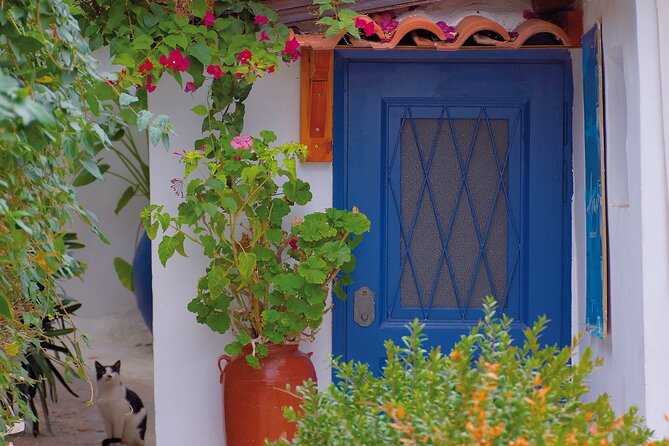
- Monastiraki and Plaka show Athens through Ottoman buildings, old lanes, shops, and market life.
- Ancient Agora gives you the clearest setting for understanding daily and political life in classical Athens.
- Stoa of Attalos houses artifacts from ordinary Athenian life in a reconstructed ancient shopping hall.
- A private English-speaking guide can tailor explanations and answer questions from your own group.
- The tour ends at the Agora, so you can continue exploring after the guide leaves.
From Syntagma Metro to Athens’ oldest layers
The meeting point is Syntagma Square, beside the central Syntagma Metro station. This is a practical place to begin because it is in central Athens and close to public transportation, but you should allow enough time to find the exact meeting spot in the busy square.
The first stop is easy to overlook. Beneath the modern transport system, the station has a small museum displaying finds uncovered during construction. You may see burial tombs, Roman mosaics believed to date to the 5th century BC, and a remarkably old beehive said to be about 2,000 years old.
This short visit sets the tone for the walk. Athens is not a city where the ancient past sits in one fenced-off park. Old remains appear below roads, beside public buildings, and under modern infrastructure. A guide can help you connect those scattered pieces instead of treating each ruin as an isolated object.
The station museum is not listed as a separate timed stop, so do not expect a large museum visit. Think of it as an introduction, probably best suited to people who enjoy small, unexpected finds rather than grand galleries.
More Plaka and old town walks:
- Culinary Backstreets of Plaka – Athens Food Tour
★ 5.0 · 182 reviews - Acropolis monuments, Parthenon and Plaka, Monastiraki walking tour
★ 5.0 · 182 reviews - Traditional Greek Show in Plaka with Dinner
★ 3.6 · 178 reviews
Mitropoleos Square and the city cathedral
From Syntagma, you walk toward Mitropoleos Square and pass the Metropolis, Athens’ cathedral. The church was built in 1862 and serves as the seat of the archbishop of the Greek Orthodox Church in Athens.
This part of the route shifts the focus from ancient Athens to the city’s modern religious identity. The cathedral’s ornate exterior gives you a useful contrast with the stripped-down stone remains you will see later in the Agora.
The stop is a pass-by rather than a full interior visit. If you want extensive time inside the cathedral, confirm the plan with your guide at the start. The tour has a lot to cover, and the emphasis is on seeing several districts and monuments within a three-hour window.
I find this early section useful because it gives you a quick sense of how compact central Athens can be. In a short walk, you move from a metro station containing buried antiquities to a 19th-century church, then toward neighborhoods shaped by Ottoman rule and modern commerce.
Monastiraki’s Turkish-era landmarks
The route continues into Monastiraki, an area filled with shops and narrow lanes. The flea market brings a more everyday side of Athens, with stalls and small stores competing for attention rather than the quiet order of an archaeological site.
You pass Ottoman-era buildings including the Tzistarakis Mosque and the Fethiye Mosque. These structures matter because they complicate the usual picture of Athens as only a classical Greek city. The city was also shaped by Byzantine, Ottoman, and modern Greek periods, and Monastiraki makes those layers visible within a few streets.
The old Turkish neighborhood is not presented as a formal museum district. You see it as part of the living city, alongside shopping lanes and the market. That is one of the tour’s better features. You are not simply moving from one famous monument to another. You get a look at the streets between them.
The market section also has a practical weakness. Shop-filled lanes can be crowded and distracting, and the group may need to pause often to stay together. Since this is a private walk, your guide can give you more direct attention than on a large group excursion, but the surroundings remain active and sometimes noisy.
Plaka’s lanes and the Doorway of the Medrese
From Monastiraki, you move into Plaka, Athens’ Old Town. Here, paved lanes twist through the historic center, creating a very different feel from the open spaces around Syntagma.
One of the more unusual sights is the Doorway of the Medrese, the surviving entrance to a former Turkish theological school. Only a remnant remains, but that is precisely why a guide helps. Without context, it can look like a plain old doorway. With an explanation, it becomes evidence of a period when the neighborhood had a different religious and civic role.
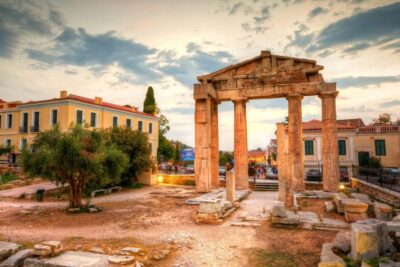
You also see the remains of Hadrian’s Library, built by Emperor Hadrian in AD 132. The remaining columns are a good reminder that Roman Athens was not merely a fading shadow of the classical city. Roman emperors invested in public buildings, culture, and civic life here.
The tour does not promise a full visit through every part of Hadrian’s Library. The description focuses on seeing the remaining columns and taking photographs. If you are especially interested in Roman architecture, ask how much time can be given to the site without cutting into the Agora visit.
Plaka is also where the walk becomes less about individual monuments and more about the shape of the old city. You follow lanes that have carried people through different eras, with modern businesses occupying spaces beside ancient and Ottoman remains.
More ancient city sites in Athens:
- Athens Half Day Tour, Acropolis, Parthenon, Temple of Olympian Zeus & Hephaistus
★ 5.0 · 609 reviews - Athens: Agora and Hephaistos Temple Entrance Ticket
★ 4.0 · 449 reviews - Athens: Ancient Agora E-Ticket and Audio Tour
★ 3.9 · 413 reviews - Athens: Temple of Olympian Zeus Ticket and Audio Tour
★ 3.4 · 188 reviews
Entering the Ancient Agora after 6th-century BC Athens
The main archaeological stop is the Ancient Agora, reached after the walk through Monastiraki and Plaka. Plan on about an hour here, though the pace depends on your guide and your group’s interests.
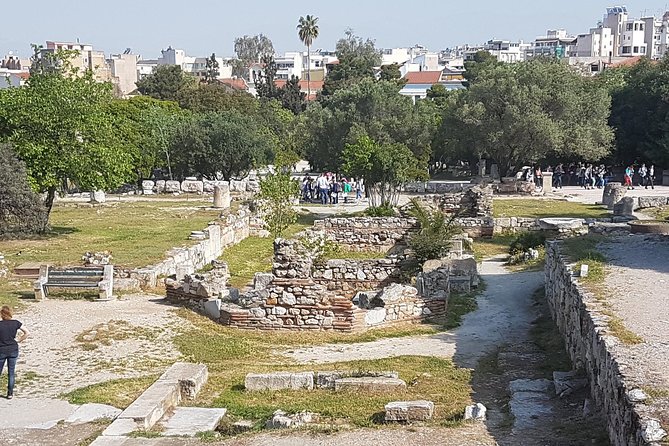
The Agora was the commercial, political, and social center of ancient Athens. It was a marketplace, but it was also a place where citizens gathered to discuss public matters. This is the setting in which the tour explains the development of the site from the 6th century BC and its connection to early democratic life.
I like the Agora because it makes ancient Athens easier to picture. The Acropolis shows monumental religion and power from above. The Agora shows the daily machinery of the city below: buying, selling, meeting, arguing, worshipping, and handling public business.
The ruins are spread across an open archaeological area, so comfortable shoes are important. The walk itself is not described as difficult, and most people can participate, but uneven ground and extended standing are still part of any visit to ancient ruins.
Your guide inspects the remains with you and explains how the space worked. This is where private guiding can earn its cost. A pile of foundations does not automatically explain itself. The value comes from understanding what stood there, who used it, and how the buildings fitted into the civic center.
The €20 entrance fee is not included in the tour price. Include it when comparing the total cost with other Athens walking tours. The guide and private format are included, but your group pays the site admission separately.
Temple of Hephaestus and the surviving ancient skyline
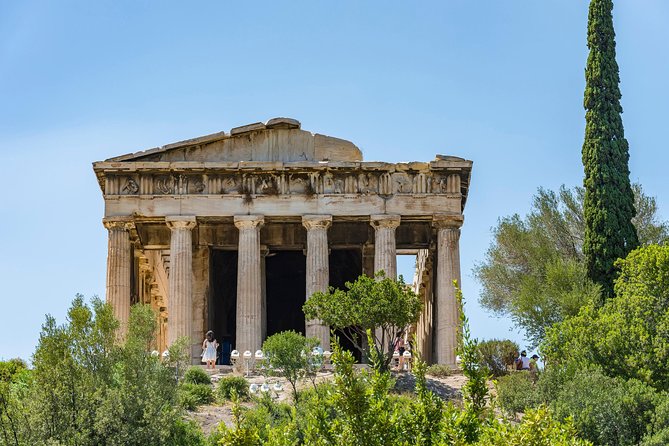
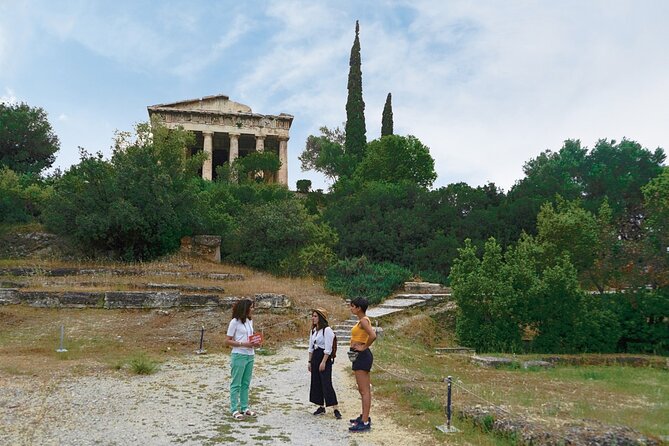
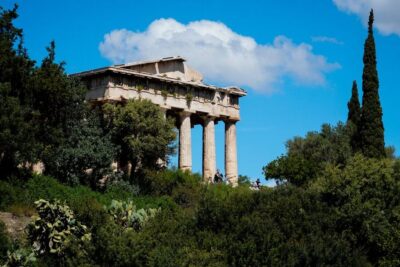
The itinerary also includes the Temple of Hephaestus within the Agora area. It is one of the most memorable structures connected with the site because its form is far easier to read than many of the broken foundations around it.
The temple gives you a chance to see ancient architecture as a building rather than only as scattered stones. Your guide can place it within the wider Agora, showing how a religious monument related to the market and civic spaces around it.
The supplied schedule does not assign a separate duration to the temple. In practice, it is part of the Agora visit, so the amount of time available will depend on your questions and the overall pace. If this is a top priority, say so early.
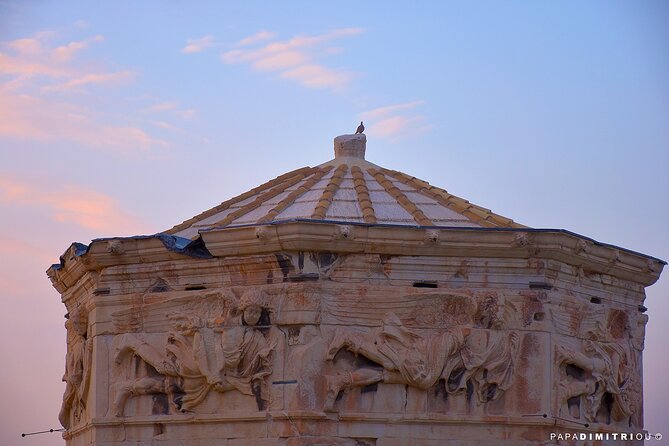
The overview also mentions the Tower of the Winds, an ancient timepiece associated with the forum area. The full route places emphasis on the Agora complex, so confirm with your guide exactly how the tower fits into your visit that day. This is a useful point for anyone choosing the tour mainly for specific monuments rather than for the broader walk.
Stoa of Attalos and the final 45 minutes
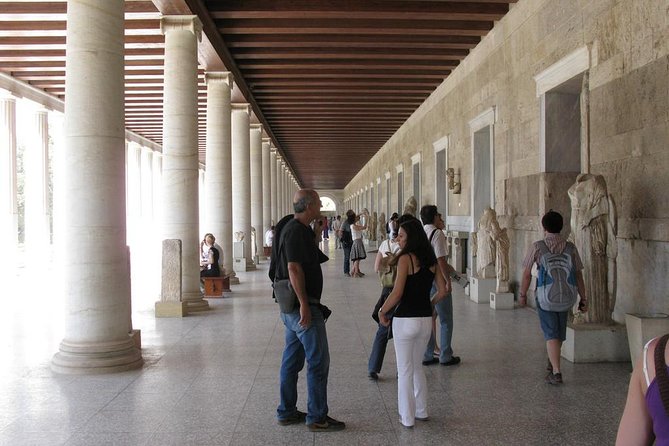
The final major stop is the Stoa of Attalos, a reconstructed ancient shopping hall that now contains the archaeological museum of the Agora. You have about 45 minutes here according to the schedule.
The museum displays artifacts connected with everyday Athenian life. That focus is valuable. Grand statues and temples can dominate an Athens visit, but small objects tell you more about how people worked, shopped, worshipped, and managed ordinary routines.
The reconstructed stoa also helps you understand the original scale of the Agora. Instead of viewing only foundations, you see a long, usable architectural form that suggests how shops and public activity once lined the area.
Admission to the Stoa of Attalos and the Ancient Agora is not included. The stated entrance cost is €20 per person for the Ancient Agora of Athens. The description says the guide leaves after the Museum of Attalos, so you can continue exploring the archaeological site and the old part of the city on your own.
That ending suits independent visitors. You are not rushed straight back to Syntagma, and you can remain in the Agora after the formal tour. The tradeoff is that there is no included return transfer or guided finish elsewhere in Athens.
Avyssinias Square, spices, and Athinas Street
The route passes through Avyssinias Square before reaching Athinas Street. This section brings you back from ancient civic life to the sounds, colors, and smells of present-day Athens.
Near Avyssinias Square, you encounter food and spice stalls. The sensory change is welcome after the stone ruins. You may notice the aromas before you understand the layout, which makes this a good place to slow down and watch the market activity around you.
The tour ends on Athinas Street. That is worth noting if you have a fixed plan afterward. You do not return to Syntagma, and hotel pickup or drop-off is not included.
Because food and drinks are not included, treat the market section as a chance to look and smell rather than as a scheduled tasting. If you want to buy something, you will pay separately. The supplied details do not promise a meal, snack, or formal market sampling.
What the private format adds
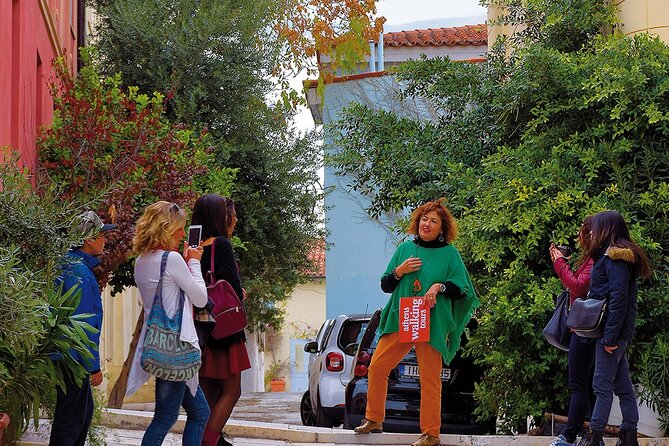
This is a private activity, so only your own group takes part. That matters most in the Agora, where you may want to pause over a particular ruin, ask about democracy, or make the explanations easier for teenagers.
One family group included two teenagers aged 15 and 16, and the guide made the material easy for them to understand and enjoy. That is a useful sign for families, especially if your children are old enough to walk for three hours but not eager for a lecture aimed at specialists.
Kostas is one guide specifically praised for making the experience memorable. Other comments describe guides who were engaging and educational, and one group was pleased to visit places beyond the formal route. You should not assume Kostas will lead your booking, but you can ask whether he is available if his style is important to you.
The private format also makes it easier to ask for practical help during the walk. You can ask where the route is going, which monuments deserve extra attention, or how to continue exploring after the guide leaves. Still, three hours is not a long time for Syntagma, Mitropoleos Square, Monastiraki, Plaka, the Agora, and the Stoa of Attalos. You will get an overview rather than exhaustive time at every location.
Is $319.39 per person a fair price?
At $319.39 per person, this is priced as a premium private tour. The total value depends heavily on group size, since a private guide costs more per person when only one or two people book.
For a larger private group, the price may feel more reasonable because you are dividing the cost while keeping the guide’s attention within your own party. For a solo visitor, the figure is harder to defend unless you place a high value on a personal history lesson and flexible conversation.
Remember to add the €20 Ancient Agora admission per person. Food, drinks, hotel pickup, and hotel drop-off are also outside the package.
The strongest value is not transportation or included extras. It is the route design and personal explanation. You cover several periods of Athens in a small area: ancient Greek civic life, Roman building projects, Ottoman religious architecture, modern Greek Orthodoxy, and today’s market streets.
If you already know Athens well, you may prefer to visit these places independently and spend the saved money on site admission or food. If you are new to the city and want the old center to make sense quickly, the private structure has a clearer case.
Who should book this Athens walk?
I would recommend this tour to couples, families, and small groups who want a guide focused only on them. It is especially useful if you like asking questions or if your group includes teenagers who need clear, lively explanations rather than dense academic detail.
It also suits first-time visitors who want a compact orientation to central Athens. The route links Syntagma, Plaka, Monastiraki, and the Agora in a way that helps you understand how the city’s districts connect.
You should think twice if your main goal is a slow, detailed archaeological study. The route includes many places, and the three-hour limit means some stops are brief or viewed from outside.
The walk is near public transportation, and most people can participate. You should still expect a substantial amount of walking, paved lanes, market streets, and uneven archaeological ground. Wear shoes suited to old stone surfaces and plan for the weather, although no specific weather provisions are listed.
Booking and cancellation details
Confirmation is normally received at booking. If you reserve within two days of the visit, confirmation may arrive within 48 hours and remains subject to availability.
You can cancel for a full refund up to 24 hours before the local start time. Cancellations or changes made less than 24 hours before the experience are not accepted for a refund.
Should you book it?
Book this private Athens walking tour if you want the Ancient Agora explained in context, not simply photographed, and if your group will make good use of a dedicated English-speaking guide. The mix of the Syntagma Metro museum, Ottoman Monastiraki, Plaka, the Agora, and the Stoa of Attalos gives you more than a standard ancient-site visit.
Skip it if $319.39 per person feels too high for three hours, especially after adding the €20 admission. Independent visitors can see much of the route on their own.
For families, small groups, and first-time visitors who want Athens’ old center to connect into one story, I think the private format is the strongest reason to book. Ask about the assigned guide, mention any must-see stops such as the Tower of the Winds or Temple of Hephaestus, and keep extra time after the tour to explore the Agora and nearby streets.
FAQ
Where does the tour start?
The tour starts at Syntagma Square, beside Syntagma Metro station in central Athens.
Where does the tour end?
It ends at the Ancient Agora of Athens after the visit to the Museum of Attalos. The guide then departs, allowing you to continue exploring on your own.
How long is the walking tour?
The experience lasts about three hours. The Ancient Agora visit is scheduled for about one hour, and the Stoa of Attalos visit for about 45 minutes.
Is the tour private?
Yes. Only your own group participates in this private activity.
Is the tour offered in English?
Yes. The tour is offered in English and includes a local guide.
Is the Ancient Agora entrance fee included?
No. The Ancient Agora entrance fee is listed as €20 per person and is paid separately.
Can I cancel for a full refund?
Yes. You must cancel at least 24 hours before the experience start time for a full refund. Changes or cancellations made less than 24 hours before the start time are not accepted for a refund.
More Athens walking tours
- Athens: Acropolis and Parthenon Guided Walking Tour
★ 4.6 · 5,882 reviews - Greek Food Walking Tour in Athens
★ 5.0 · 4,740 reviews - Acropolis: Acropolis and Parthenon Guided Walking Tour
★ 4.7 · 3,442 reviews - Acropolis monuments & Parthenon Walking Tour with Optional Acropolis Museum
★ 5.0 · 2,678 reviews
Freshly added Athens trips
- Athens and Ancient Corinth Private from Athens★ 5.0 · 3 reviews
- Full day Meteora private tour★ 5.0 · 3 reviews
- Double Shore Dive (certified divers)★ 4.5 · 3 reviews
- From Athens: Mycenae and Epidaurus Private Tour★ 4.8 · 3 reviews
- Athens Hills: Mythology Treasure Hunt★ 5.0 · 3 reviews
- Sunset & swimming at Cape Sounio, Poseidon temple★ 5.0 · 3 reviews
- Philosophy Experience at Plato’s Academy Park – basic version★ 5.0 · 3 reviews
- Private Acropolis Tour – Ticket Included★ 5.0 · 3 reviews
Ancient Agora & City Sites, compared.
Athens Half Day Tour, Acropolis, Parthenon, Temple of Olympian Zeus & Hephaistus
Read our review →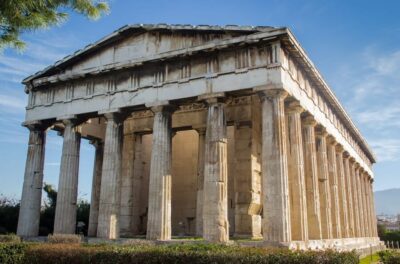

Roman Agora & Ancient Agora E-ticket & 2 Audio Tours
Read our review →
Ancient Athens Segway Tour with Agora and Kerameikos
Read our review →
Ancient Athens, Agora, and Keramikos Segway Tour
Read our review →Browse the lists this tour appears in