

Reviewed · ACROPOLIS TOURS
Acropolis Mythology & Food Tour
The clever idea here is to connect Athens’ famous ancient sights with the places where modern Athenians shop, eat, and meet. You begin at the Arch of Hadrian, climb through the Acropolis story, then walk downhill through Plaka, Monastiraki, Psiri, and the central market.
I like the small maximum of 15 people, which gives a guide room to answer questions without turning the walk into a moving crowd. I also like the mix of mythology and food: the Parthenon gets its proper attention, but the tour does not stop at marble ruins.
The main consideration is price. At $138.55 per person, you’ll also need to account for the archaeological admission fee, listed at €30 per person if arranged through the operator. The tour offers good coverage, but it is not a budget walking tour.
In This Review
- Key points to know before booking
- From Zeus to Athena, the tour’s opening story
- Syntagma shows Athens in motion
- Plaka adds lanes, shops, and older Athens
- Monastiraki mixes ruins, bargains, and street food
- Psiri brings street art and the modern food scene
- Varvakios Market is the most local-feeling stop
- What the food element is really worth
- Is $138.55 a fair price?
- Timing, tickets, and cancellation details
- Who should book this Athens tour?
- Should you book the Acropolis Mythology & Food Tour?
- FAQ
- How long does the Acropolis Mythology & Food Tour last?
- Where does the tour start and finish?
- Is the Acropolis entrance fee included?
- Are food tastings included?
- What is the maximum group size?
- What happens if I cancel?
Key points to know before booking
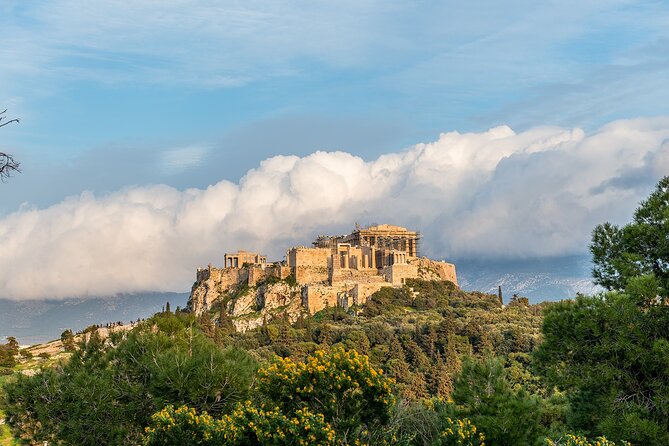
- Early Acropolis visit: The tour begins at 8 a.m., a useful time for seeing the Acropolis before the strongest midday heat.
- Seven contrasting stops: You move from Zeus’s temple and the Acropolis to food streets, street art, and Athens’ central market.
- Food tastings included: Tastings are part of the tour, while any extra food or drinks you buy are your own expense.
- Small group format: The group is limited to 15 people, a sensible size for narrow lanes and archaeological explanations.
- Tickets need care: Acropolis and other archaeological admission fees are not included unless you arrange pre-purchased tickets.
- Ends near Monastiraki: The final stop is Monastiraki Square, convenient for continuing into central Athens on your own.
From Zeus to Athena, the tour’s opening story
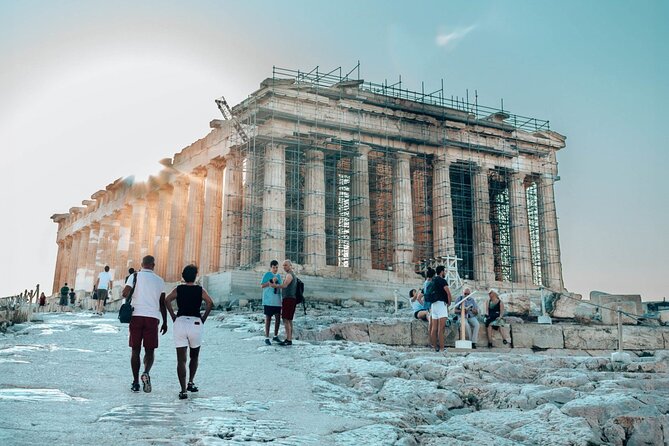
Meet at Hadrian’s Arch on Leof. Vasilisis Amalias at 8 a.m. This is a practical starting point, since the arch sits between the Acropolis and the Temple of Olympian Zeus, placing you right in the middle of ancient Athens from the first minute.
The first stop is the Temple of Olympian Zeus, known to ancient Athenians as the Olympeion. You discuss the temple from outside for about 15 minutes. Its surviving columns give you a quick sense of the scale of the project, even though this part is not a full interior visit.
That short stop works best as an introduction rather than a major attraction on its own. You get the setting and the story, then move quickly toward the Acropolis. Admission is not included here, so you should not expect the tour to take you through the temple grounds unless your ticket arrangement specifically covers it.
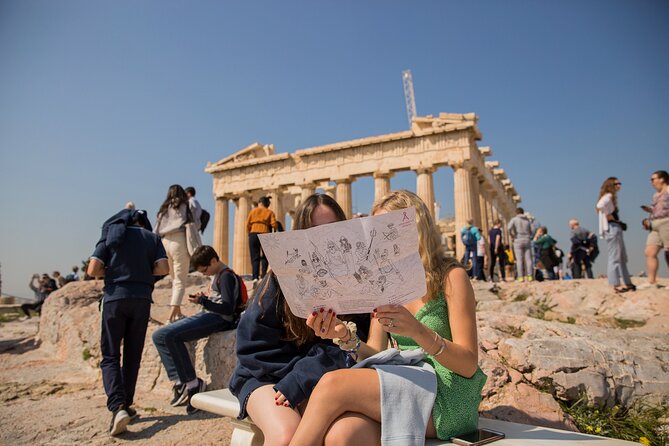
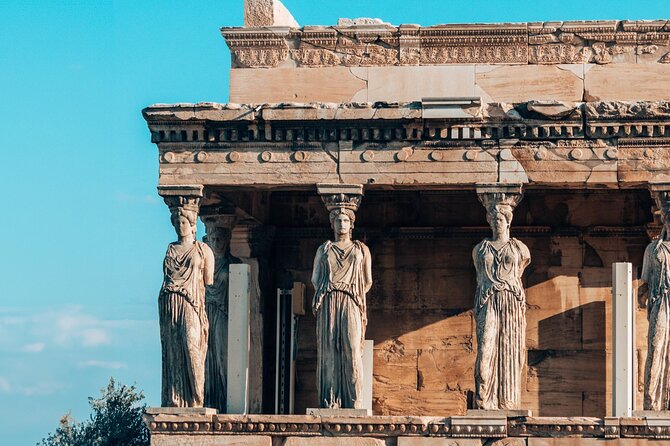
The focus then shifts to the Acropolis, where you spend about two hours. This is the heart of the experience. The guide covers the Parthenon, Temple of Athena Nike, Erechtheion, Propylaia, and Theater of Dionysus, along with the role of Athena as the city’s patron goddess.
Two hours is enough for a serious overview, though not enough for every monument to receive equal attention. That is not a flaw so much as a fact of the site. The Acropolis can easily fill half a day by itself, and this tour has several neighborhoods still ahead.
I would pay close attention to the mythological connections here. The value of a guide is not simply pointing out columns. It is explaining why Athena mattered to Athens, how the sanctuary functioned, and how the monuments fit together. A printed ancient Athens map is included, which should help you follow the city’s old layout as you walk through the modern one.
The Acropolis visit also demands practical preparation. Strollers, backpacks, and large bags are not allowed at the site and should not be brought on the tour. Wear shoes suitable for uneven surfaces, though the supplied information does not specify any particular footwear requirement.
More Acropolis and Parthenon visits:
- Athens: Acropolis & up to 5 Archaeological Sites Combo Pass
★ 4.4 · 12,619 reviews - Athens: Acropolis Ticket with Optional Audio or Live Guide
★ 4.2 · 11,055 reviews - Athens: Acropolis, Parthenon & Acropolis Museum Guided Tour
★ 4.8 · 9,316 reviews
Syntagma shows Athens in motion
After the Acropolis, the route reaches Syntagma Square for about 40 minutes. This is not an ancient ruin stop. It is the civic center of modern Athens, dominated by the Greek Parliament, formerly the Royal Palace.
The square gives the tour a useful change of pace. After spending time with temples and sanctuaries, you see the city’s daily traffic, public life, and busy central crossroads. It helps place the ancient sites in a living capital rather than treating Athens as an open-air museum.
You should expect conversation and orientation here rather than a long formal visit inside a building. The tour information lists admission as free, and the stop is mainly about the square and its role in the city.
This is also a reminder that the tour covers a lot of ground. The advertised duration is about five and a half hours. The route is not a short Acropolis talk followed by one snack. It is a substantial morning of walking, listening, and changing settings.
Plaka adds lanes, shops, and older Athens
The walk continues into Plaka, the old neighborhood below the Acropolis. Allow about 45 minutes for narrow lanes, souvenir shops, ancient remains, and the area’s strong tourist presence.
Plaka is picturesque, but it is also the most commercial section of the route. That combination is useful if you want time for photographs or souvenirs, though less appealing if you are looking for a quiet neighborhood untouched by tourism. The tour’s advantage is that a guide can help connect the visible streets to the older city beneath them.
I like this part because it places the Acropolis in a neighborhood scale. From the summit, Athens can feel enormous. In Plaka, the experience becomes more personal: alleys, storefronts, small monuments, and the stone sides of the Acropolis overhead.
Do not expect Plaka to be the strongest food stop. Its importance here is as a bridge between the ancient sanctuary and the livelier food districts ahead. The tour keeps moving rather than spending the entire morning among souvenir stores.
Monastiraki mixes ruins, bargains, and street food
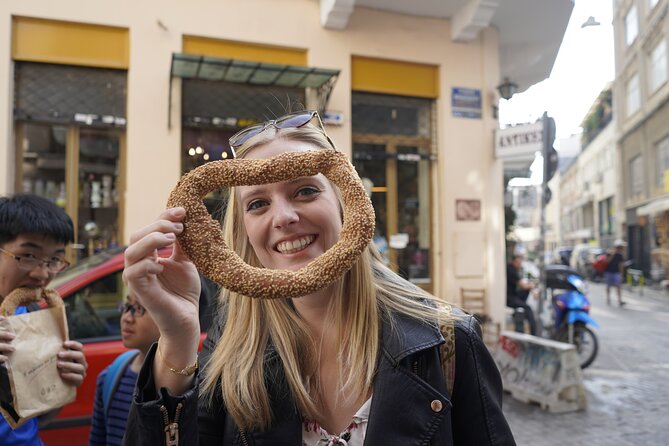
Monastiraki receives about 40 minutes. This district brings together several layers of Athens: Hadrian’s Library, an antique and flea market area, street food, and one of the city’s surviving Ottoman mosques.
There is also an unusual underground detail: a river hidden beneath a metro station. That kind of small urban story is exactly why a walking guide can add value. You might pass through Monastiraki on your own and notice the market, but miss the older infrastructure below the pavement.
The area can feel crowded and commercial, especially around the square and market streets. That is part of its character, but it means you should keep an eye on bags and stay aware of the group as you move through narrow or busy passages.
Monastiraki is one of the better places on this route to connect history with food. You can see how a district built around trade continues to attract shoppers and eaters today. The included tastings help turn that connection into something more than a lecture.
Any additional food or drinks you purchase are not included. That is worth remembering because the market and food streets can encourage spontaneous spending.
More mythology-flavoured Athens days:
- Athens: Mythology of Delphi, Museum and Arachova Guided Tour
★ 4.6 · 4,008 reviews - Athens & Acropolis Highlights: Greek Mythology Small-Group Tour
★ 5.0 · 2,370 reviews - Athens: Acropolis and Mythology Highlights Small Group Tour
★ 4.8 · 2,275 reviews - Athens: Mythology Tour for Families
★ 4.8 · 173 reviews
Psiri brings street art and the modern food scene
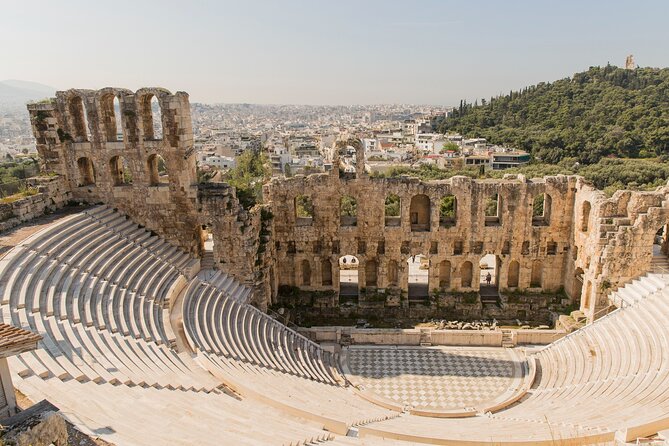
The next stop is Psiri, where the tour spends about 30 minutes. Once associated with local craftsmen and small workshops, the neighborhood is now known for evening food and drink, along with street art.
Psiri gives you a look at a different side of Athens from Plaka. Plaka is tied closely to the Acropolis and the old city’s visitor circuit. Psiri feels more connected to contemporary urban culture, creative businesses, and nightlife.
Thirty minutes is enough for an introduction, not an exhaustive neighborhood tour. You will likely hear how the area changed and see examples of its street art, but the tour does not promise a dedicated gallery visit or a full evening food crawl.
The timing is sensible. Psiri is particularly associated with evening activity, while this tour passes through in the morning. You get the neighborhood’s visual character and food reputation without the late-night schedule. If you want to return for dinner, finishing near Monastiraki makes that easy, though dinner itself is not included.
Varvakios Market is the most local-feeling stop
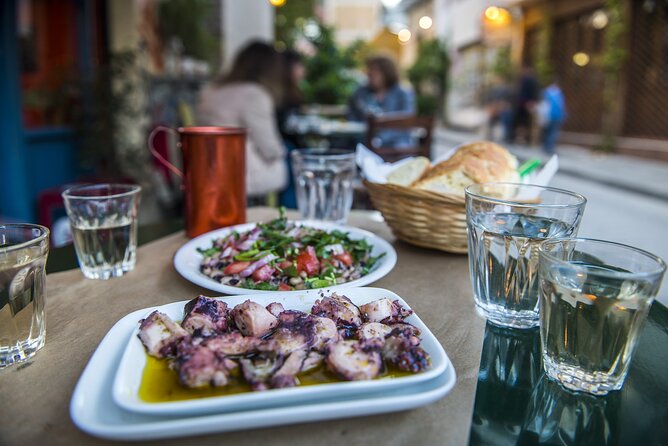
The final stop is the Varvakios Central Municipal Market, Athens’ main food market. The visit lasts about 15 minutes and focuses on the place where locals shop for fresh produce, meat, and fish.
This may be the most revealing stop for anyone interested in everyday Athens. Ancient monuments show what the city valued long ago. The market shows what people buy, cook, and handle today.
Fifteen minutes is brief, so do not expect a slow market tour or a long meal. The stop is better understood as a concentrated look at the city’s food culture. Depending on the pace of the group, you might have time to observe stalls and ask questions, but the supplied details do not promise a specific vendor, dish, or extended tasting here.
The tour ends at Monastiraki Square, at Apollonos 21. That is a convenient finish. You can continue shopping, find lunch, return to your hotel by public transportation, or explore central Athens without arranging a transfer.
What the food element is really worth
Food tastings are included, but the details of the tastings are not specified. That means you should book this for the combination of food and city context, not for a guaranteed list of dishes or a full meal.
The culinary part is valuable because it gives the route a physical connection to Athens. You are not only hearing about markets and food neighborhoods. You are given a chance to taste something as you move through them.
Still, plan for your own lunch afterward. Five and a half hours of walking is a long morning, and included tastings should not be confused with a sit-down meal. Bring money for anything extra that catches your eye.
The food focus also makes this a better choice for repeat visitors or curious first-time visitors who want more than the standard Acropolis route. You see famous monuments, but you also spend time in places shaped by shopping, craft work, street art, and local commerce.
Is $138.55 a fair price?
At $138.55 per person, this is a premium walking tour. The price includes a professional English-speaking guide, a small group capped at 15, the ancient Athens map, and food tastings. Transfers are not included, and archaeological entrance fees are separate.
The biggest cost issue is the €30 archaeological ticket listed by the operator. The information says tickets can be pre-purchased for you if you ask, but you should confirm exactly which sites and time slots are covered before paying. Since the Acropolis is the central attraction, ticket coordination matters.
I see the value in the price if you want one organized morning that combines the Acropolis with several central districts. Booking each piece separately would require your own research, timing, and route planning. The price buys structure, interpretation, and a small group rather than simple entry to a monument.
It is less suitable if you already know Athens well, prefer to explore at your own pace, or mainly want an inexpensive Acropolis visit. You also pay for stops that are free to enter, such as Syntagma, Plaka, Psiri, and Monastiraki. Their value comes from the guide’s explanations and the route, not from admission.
The experience is offered in English. The booking information says it is near public transportation and that most people can participate, but it does not provide a detailed accessibility assessment. Ask the provider directly if you have specific mobility concerns.
Timing, tickets, and cancellation details
The 8 a.m. start is one of the tour’s strongest practical features. Athens can be hot, and an early beginning gives you a better chance of reaching the Acropolis before the toughest part of the day. It also leaves your afternoon open.
Bring an ID card or passport if you are under 25, since proof may be needed for possible discounts at archaeological sites. European students may qualify for reduced admission with proper documentation, a useful saving noted in the booking information.
Ticket timing is important. If you miss your Acropolis time slot because of a late flight, cruise delay, or personal delay, new tickets may need to be bought on the spot. If no suitable slot remains, the tour may not run and the payment is not refundable.
The cancellation terms require careful reading. The general policy says you can cancel free of charge up to 24 hours before the start time. Elsewhere, the ticket information says archaeological tickets are refundable up to 30 days before the tour and non-refundable after that. Because those rules can affect one another, ask the operator which policy applies to your exact booking, especially if pre-purchased tickets are involved.
Who should book this Athens tour?
I would choose this experience if you want the Acropolis explained in context, then want help finding your way through central Athens’ food and market districts. It suits first-time visitors who have one morning available and prefer a planned route to independent map reading.
It is also a good fit for people who enjoy variety. In one morning, you move from a colossal temple to a hilltop sanctuary, a parliament square, old lanes, a market district, street art, and a municipal food market.
Families should note the no-stroller and no-large-bag rule at the Acropolis. People under 25 should carry identification for possible discounts. Anyone with limited stamina should remember that this is a long walking program, even though the information says most people can participate.
I would skip it if you want a slow, food-centered tour with a guaranteed full meal. I would also skip it if you prefer to spend several hours inside the Acropolis alone, since the route gives the archaeological site about two hours before continuing through the city.
Should you book the Acropolis Mythology & Food Tour?
Book it if you value one well-planned morning that brings together ancient Athens and present-day city life. The small group, early start, professional guide, included tastings, and finish near Monastiraki give the tour real practical value.
Before booking, confirm the total cost with archaeological tickets, ask what food tastings are included, and make sure the cancellation terms fit your plans. If those details work for you, this is a strong choice for seeing more than the Acropolis without giving up the city’s main ancient sights.
FAQ
How long does the Acropolis Mythology & Food Tour last?
The tour lasts approximately 5 hours and 30 minutes.
Where does the tour start and finish?
It starts at Hadrian’s Arch, Leof. Vasilisis Amalias 50, Athens, at 8 a.m. It ends at Monastiraki Square, Apollonos 21.
Is the Acropolis entrance fee included?
No. Archaeological admission fees are not included. The operator lists an optional pre-purchased ticket cost of €30 per person and can arrange tickets if you request them.
Are food tastings included?
Yes. Food tastings described as part of the tour are included. Any extra food or drinks you choose to buy are not included.
What is the maximum group size?
The tour has a maximum of 15 participants.
What happens if I cancel?
The general cancellation policy allows a full refund if you cancel at least 24 hours before the start time. Changes or cancellations made less than 24 hours before the start are not accepted for a refund. Archaeological ticket terms may be stricter, so confirm those conditions when booking.
More food stops in Athens
- Greek Food Walking Tour in Athens
★ 5.0 · 4,740 reviews - Athens: Street Food Tasting Tour
★ 4.9 · 2,557 reviews - Small Group Greek Traditional Food Tour in Athens 20+ Tastings
★ 5.0 · 1,759 reviews - Athens: Food Market Visit and Cooking Class with Wine
★ 4.9 · 1,087 reviews
Freshly added Athens trips
- Athens and Ancient Corinth Private from Athens★ 5.0 · 3 reviews
- From Athens: Mycenae and Epidaurus Private Tour★ 4.8 · 3 reviews
- Full day Meteora private tour★ 5.0 · 3 reviews
- Double Shore Dive (certified divers)★ 4.5 · 3 reviews
- Athens Hills: Mythology Treasure Hunt★ 5.0 · 3 reviews
- Sunset & swimming at Cape Sounio, Poseidon temple★ 5.0 · 3 reviews
- Philosophy Experience at Plato’s Academy Park – basic version★ 5.0 · 3 reviews
- Private Acropolis Tour – Ticket Included★ 5.0 · 3 reviews
Acropolis Tours, compared.

Acropolis & up to 5 Archaeological Sites Combo Pass
Read our review →

Acropolis, Parthenon & Acropolis Museum Guided Tour
Read our review →
Acropolis, Parthenon & Acropolis Museum Guided Tour
Read our review →


Acropolis monuments & Parthenon Walking Tour with Optional Acropolis Museum
Read our review →Browse the lists this tour appears in