
Reviewed · ACROPOLIS TOURS
Athens & Acropolis Highlights: Greek Mythology Small-Group Tour
The best reason to book this tour is the way it connects Greek myths with the stones in front of you. Instead of seeing the Parthenon as a famous photo stop, you learn why Athena mattered, how victory shaped the Temple of Athena Nike, and how gods such as Hephaestus fit into daily Athenian life.
I like the route for two clear reasons: the guide gives meaning to familiar ruins, and the small-group format should make it easier to ask questions and keep a good pace. Guides including Irene, Michael, Dani, Christina, and Alexandros have been praised for clear storytelling, visual aids, patience, and thoughtful rest stops.
The main drawback is cost and effort. The $54.42 tour price does not include entry tickets, which add €30 for the Acropolis and €20 for the Ancient Agora. You also face steep climbs, stairs, uneven stone, summer heat, and the chance that a guide may struggle to keep the group together in crowded areas.
In This Review
- Key points to know before you book
- Why mythology makes these ruins easier to understand
- Temple of Olympian Zeus: a strong opening view
- The Acropolis climb and the Theatre of Dionysus
- Temple of Athena Nike: victory in a compact setting
- Erechtheion and Parthenon: two very different temples
- The Ancient Agora: where Athens worked
- Temple of Hephaestus: a fitting final stop
- Guide quality matters more than the theme
- What the $54.42 price really buys you
- Timing, clothing, and practical limits
- Who should book this Athens tour?
- Should you book it?
- FAQ
- How long does the Athens mythology tour last?
- What sites are included in the route?
- Are Acropolis and Ancient Agora tickets included?
- How large is the tour group?
- Where does the tour start and finish?
- What should I bring or avoid bringing?
Key points to know before you book
- Mythology gives the Acropolis a human story: You hear how Athena, Nike, Dionysus, and Hephaestus shaped ancient Athens.
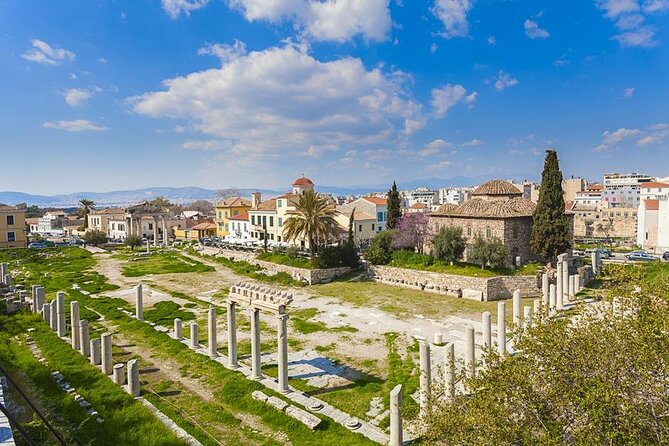
- The route covers the Acropolis and Agora: You visit the city’s sacred hill, political center, and Temple of Hephaestus in about four hours.
- Tickets cost extra: Plan for the listed €30 Acropolis fee and €20 Ancient Agora fee, unless your booking uses a different current rate.
- The walk is active: Expect uphill walking, stairs, uneven surfaces, and little comfort from the exposed ruins.
- The advertised group limit is 15: A small group helps with questions, though staying close to your guide still matters.
- Morning is a smart choice: One guide noted that crowds had grown two or three times larger by the time the group left the Acropolis.
Why mythology makes these ruins easier to understand
Athens can feel like a greatest-hits collection of broken columns if you visit without context. This tour gives you a storyline to follow. The gods are not treated as dusty names from a schoolbook. Their rivalries, roles, and symbols help explain why the city built particular temples in particular places.
You begin near Hadrian’s Arch, at Leoforos Vasilisis Amalias 50, by the Temple of Olympian Zeus. The meeting point is central and near public transport, but check the exact location carefully. The tour does not provide transport from your hotel, and the finish is at the Ancient Agora rather than back at the starting point.
The guide uses the ruins to explain both belief and civic life. You might hear why Athena became Athens’ patron deity, why Nike was shown without wings, or how Hephaestus served craftsmen and merchants. This approach is especially useful if you know the basic myths but have trouble linking them to actual buildings.
I also like that the guides sometimes use visual material. Irene, for example, used printed photographs and visual aids to help show what the sites may have looked like in their original form. That matters at the Acropolis, where the surviving marble is impressive but incomplete.
More Acropolis and Parthenon visits:
- Athens: Acropolis & up to 5 Archaeological Sites Combo Pass
★ 4.4 · 12,619 reviews - Athens: Acropolis Ticket with Optional Audio or Live Guide
★ 4.2 · 11,055 reviews - Athens: Acropolis, Parthenon & Acropolis Museum Guided Tour
★ 4.8 · 9,316 reviews
Temple of Olympian Zeus: a strong opening view
The first stop is the Temple of Olympian Zeus, known in ancient times as the Olympeion. You discuss the site from outside for about 15 minutes, so this is an orientation stop rather than a full temple visit.
The scale is the point. The remaining columns give you a sense of the huge project dedicated to Zeus, one of the most powerful gods in Greek mythology. Its location between the Acropolis and the Ilissos River also helps you picture ancient Athens as a city organized around sacred spaces.
Since admission is not included, the outside explanation keeps the tour moving without adding another ticket to your bill. If you want to explore the temple grounds later, you would need to arrange that separately.
The stop also sets up a useful contrast. Zeus represents supreme power, while the Acropolis ahead is tied most closely to Athena, the city’s patron goddess. The guide can begin showing you how mythology and politics were tightly linked in ancient Athens.
The Acropolis climb and the Theatre of Dionysus
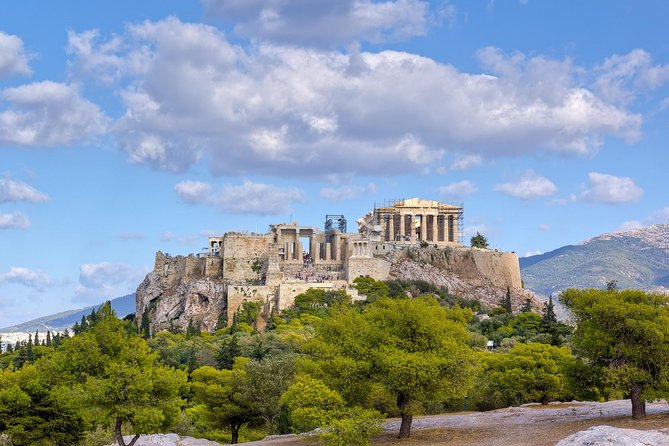
The Acropolis gets roughly 90 minutes, making it the main event. You visit the hill’s major monuments, including the Propylaea, Parthenon, Temple of Athena Nike, and Erechtheion. The climb is not extreme for every person, but it is steep in places, and the stone can be uneven.
Wear firm walking shoes. Bring water and a hat, especially in warm weather. Several guides have been praised for breaking the climb into smaller sections, stopping at points of interest, and looking for shade when possible. That can make a real difference because the hill is exposed and the walking surface is not smooth pavement.
The Theatre of Dionysus is listed as a 15-minute stop. It sits on the southern slope of the Acropolis and connects the site to drama, music, and public performance. Dionysus was linked with wine and the grape harvest, while the theatre hosted the first performances of works by Aeschylus, Sophocles, Euripides, and Aristophanes.
This is one of the tour’s most useful connections. The Acropolis is not only a place of temples. Below and around it, you see the cultural life of Athens taking shape. The theatre gives you a reminder that ancient drama was a public event with religious roots, not simply entertainment in the modern sense.
Temple of Athena Nike: victory in a compact setting
The Temple of Athena Nike receives about 10 minutes. It is small compared with the Parthenon, but its position near the entrance makes it easy to miss if you are focused only on the larger monuments.
The temple honored Athena in her form as a goddess of victory, alongside Nike, the personification of victory. The guide’s mythology focus is helpful here because the wingless statue story gives the monument a memorable detail. The idea was that victory would never fly away from Athens.
You will not spend long at this stop, and crowding can make it harder to hear. Stay close to the guide and ask for a repeat if needed. One person specifically found the lack of a microphone a problem, so hearing may depend on group size, crowd noise, and where you are standing.
More mythology-flavoured Athens days:
- Athens: Mythology of Delphi, Museum and Arachova Guided Tour
★ 4.6 · 4,008 reviews - Athens: Acropolis and Mythology Highlights Small Group Tour
★ 4.8 · 2,275 reviews - Athens: Mythology Tour for Families
★ 4.8 · 173 reviews - The History of Athens: Greek Mythology Private Tour
★ 5.0 · 138 reviews
Erechtheion and Parthenon: two very different temples
The Erechtheion gets about 10 minutes, but it deserves your attention. This temple had an unusual design and served several sacred purposes, including housing an ancient wooden cult statue of Athena. Its asymmetrical form is very different from the orderly shape most people expect from a Greek temple.
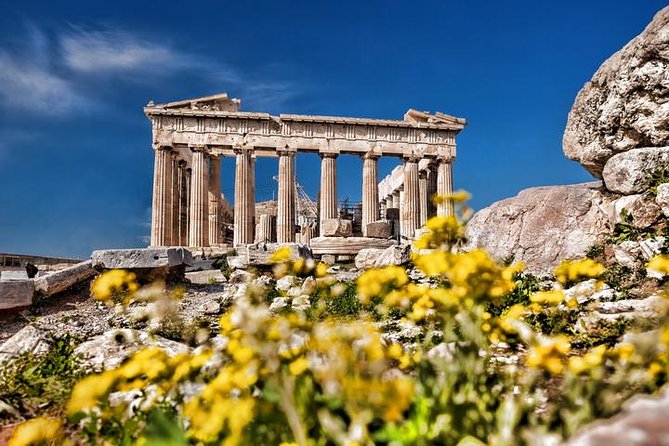
The Parthenon follows with about 20 minutes. Built in the mid-5th century BCE, it was dedicated to Athena Parthenos, or Athena the Virgin. It is often presented as the perfect example of the Doric order, yet the building is more subtle than its reputation suggests.
Your guide can help you look past the obvious photograph. Notice the way the temple was positioned, the relationship between its columns and the hill, and the contrast between its original purpose and its later damage. The tour focuses on myth, architecture, and history together, so you are not left with only a list of dates.
You should also set expectations. Twenty minutes at the Parthenon is enough for explanation and viewing, but not for a slow, solitary visit. The Acropolis is often crowded, and the group must keep moving. If you want quiet time for photographs or detailed inspection, return on your own with a separate visit.
The advertised duration is about four hours, and the Acropolis section alone includes several stops. That makes the schedule useful for a first look, but it is not a substitute for spending a full day around the hill, its museum, and the surrounding archaeological sites.
The Ancient Agora: where Athens worked
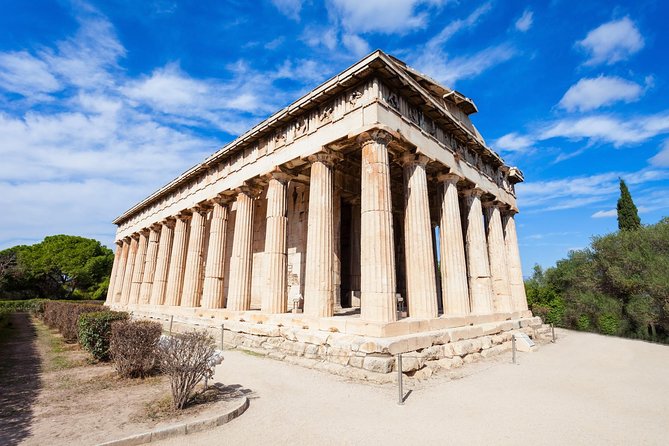
After the Acropolis, the route moves to the Ancient Agora for about an hour. This is where the tour shifts from sacred hilltop monuments to the practical machinery of the city.
The Agora served as Athens’ political, commercial, administrative, social, religious, cultural, and judicial center. That broad role is worth understanding. Democracy, trade, public debate, legal disputes, and ordinary business did not happen in an abstract textbook. They took place in a real public space below the Acropolis.
This part of the tour adds balance. The Acropolis shows how Athens presented its religious and civic ideals. The Agora shows how people conducted the daily business of a city. You get a better sense of ancient Athens when both places are connected.
The hour here should give your guide time to explain the layout and point out what each area was used for. The ground remains uneven, and you may be tired after the Acropolis climb. Still, the change in setting makes the final portion feel less repetitive.
Admission to the Agora is not included. The listed fee is €20 per person for the four-hour option. Ask the operator to pre-purchase your tickets if you want to avoid handling the entry process yourself, but remember that archaeological-site fees are non-refundable and non-exchangeable.
Temple of Hephaestus: a fitting final stop
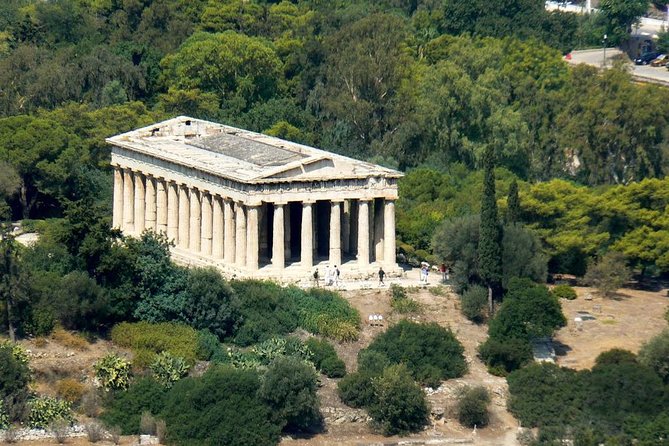
The final stop is the Temple of Hephaestus, described in the route as the Temple of Aries. The temple is dedicated to Hephaestus, protector of metalworkers, and Athena Ergani, associated with potters and small industries.
This is one of the best endings possible for a tour centered on ancient life. The Parthenon gets the fame, but the Temple of Hephaestus is often easier to appreciate as a complete building. You can look at its design and imagine the practical people of the Agora honoring the gods tied to their trades.
You spend about 20 minutes here. The guide explains the temple’s form and function, giving you a final example of how religious buildings served specific communities. It also gives the group a calmer place to finish than the crowded upper Acropolis.
The tour ends at the Ancient Agora, Athens 105 55. You are responsible for making your own way onward, but finishing here puts you near central Athens and the Plaka area.
Guide quality matters more than the theme
This tour depends heavily on the person leading it. The strongest guides make the mythology easy to follow without losing the historical facts. Irene was praised for teaching in clear terms and asking questions that helped people remember the material. Michael was noted for fun stories and frequent stops during the climb.
Dani received praise for keeping the group moving while adding extra details about the gods. Alexandros was described as someone who connected mythology, architecture, history, and modern Athens. Christina was valued for making the mythical figures feel more alive, while Chrysanthi was praised for shade stops, water breaks, and careful timing.
You might also be assigned Angie, Athena, Theo, Marika, Maria, Sophia, Ismini, Demi, Anastasia, or another guide from the local team. The guide’s style may vary. Some are more academic, some more playful, and some place more emphasis on practical care during the walk.
One caution is worth taking seriously. A participant reported losing sight of the guide for more than 10 minutes and found the group management stressful. The advertised maximum is 15 people, but keeping close is still your responsibility, especially around crowded entrances and narrow paths. Look for any sign or marker the guide uses, and agree on a meeting point if you become separated.
What the $54.42 price really buys you
At $54.42 per person, the tour price is reasonable for a four-hour guided visit, but the total cost is higher than the headline figure. The listed entrance fees add €30 for the Acropolis and €20 for the Ancient Agora, bringing the site-fee total to €50 per person.
That means you should compare the tour with the cost of entering on your own, not with the $54.42 alone. You are paying for an English-speaking certified guide, a small group, myth-focused interpretation, and a route that links several major sites without requiring you to plan the order yourself.
I think the value is strongest if you are visiting Athens for the first time, have limited time, or want stories rather than silent sightseeing. If you already have a strong background in Greek archaeology and prefer to move at your own pace, the added fee may feel less worthwhile.
Food, drinks, transport, and entry tickets are not included. The tour does provide a fun ancient Athens map, which is a small but useful extra for understanding where the Acropolis, Agora, and Temple of Olympian Zeus fit together.
Timing, clothing, and practical limits
Morning timing deserves a strong recommendation. One guide noted that the Acropolis crowd had doubled or tripled by the time the group departed. Earlier hours can also help with heat, though no time removes the need for water and sun protection.
Do not bring a stroller, backpack, or large bag to the Acropolis. These are not allowed there and should not be taken on the tour. A small personal item is the safer choice, but follow the current site rules at the time of booking.
Most people can take part, but you need to manage stairs and uneven surfaces. The experience is not a gentle city stroll. The reviews describe it as a moderate amount of walking with a long or steep climb, so plan around your own energy and the weather.
The tour is offered in English and uses mobile tickets. Confirmation normally arrives at booking, though bookings made within one hour of departure are confirmed as soon as possible, subject to availability. You need an identity card or passport if you are under 25 and want to qualify for possible discounts.
Free cancellation is available up to 24 hours before the start time. Inside that window, the payment is not refunded, and changes are not accepted. Poor weather or failure to meet the minimum group size can lead to a new date, another experience, or a full refund.
Who should book this Athens tour?
You should book it if you want the Acropolis explained rather than simply photographed. It is a good fit for families, first-time visitors, mythology fans, and anyone who enjoys asking questions while walking through major sites.
It also works well for a short Athens stay. In four hours, you cover the Temple of Olympian Zeus from outside, the Acropolis monuments, the Theatre of Dionysus, the Agora, and the Temple of Hephaestus. You finish with a clearer map of the ancient city than you would get from visiting one monument alone.
I would be more cautious if you need a slow pace, dislike uneven ground, or want extensive time inside each location. I would also check the group arrangements at the start and stay near the guide, since one poor crowd-management experience can affect an otherwise strong visit.
Should you book it?
For most first visits, yes. The tour’s best feature is not the number of ruins. It is the way a good guide turns Athena, Nike, Dionysus, and Hephaestus into useful keys for understanding the buildings around you.
Book the earliest practical time, budget for the separate €50 in listed site fees, wear solid shoes, carry water, and leave bulky bags behind. If you want mythology, context, and a well-filled half day, this is a strong choice. If you want a private pace or a quiet architectural study, visit independently instead.
FAQ
How long does the Athens mythology tour last?
The tour lasts approximately four hours.
What sites are included in the route?
The route includes the Temple of Olympian Zeus, the Acropolis, the Theatre of Dionysus, the Temple of Athena Nike, the Erechtheion, the Parthenon, the Ancient Agora, and the Temple of Hephaestus.
Are Acropolis and Ancient Agora tickets included?
No. The listed Acropolis admission fee is €30 per person, and the Ancient Agora fee required for the four-hour option is €20 per person. The operator can pre-purchase tickets if you request it.
How large is the tour group?
The advertised maximum is 15 people. It is described as a small-group tour.
Where does the tour start and finish?
The meeting point is at Hadrian’s Arch, Leoforos Vasilisis Amalias 50, Athens 105 58. The tour ends at the Ancient Agora of Athens, Athens 105 55.
What should I bring or avoid bringing?
Wear good walking shoes and bring water and a hat. Strollers, backpacks, and large bags are not allowed at the Acropolis and should not be taken on the tour.
Freshly added Athens trips
- Athens and Ancient Corinth Private from Athens★ 5.0 · 3 reviews
- From Athens: Mycenae and Epidaurus Private Tour★ 4.8 · 3 reviews
- Full day Meteora private tour★ 5.0 · 3 reviews
- Double Shore Dive (certified divers)★ 4.5 · 3 reviews
- Athens Hills: Mythology Treasure Hunt★ 5.0 · 3 reviews
- Sunset & swimming at Cape Sounio, Poseidon temple★ 5.0 · 3 reviews
- Philosophy Experience at Plato’s Academy Park – basic version★ 5.0 · 3 reviews
- Private Acropolis Tour – Ticket Included★ 5.0 · 3 reviews
Acropolis Tours, compared.

Acropolis & up to 5 Archaeological Sites Combo Pass
Read our review →

Acropolis, Parthenon & Acropolis Museum Guided Tour
Read our review →
Acropolis, Parthenon & Acropolis Museum Guided Tour
Read our review →


Acropolis monuments & Parthenon Walking Tour with Optional Acropolis Museum
Read our review →Browse the lists this tour appears in