
Reviewed · ACROPOLIS MUSEUM TOURS
Private 4-hour Walking Tour of Acropolis and Acropolis Museum in Athens
The smartest part of this Athens tour is the order: you begin inside the Acropolis Museum, where the statues and fragments make sense, then climb to the hill and see the temples in their real setting. Your private guide connects mythology, archaeology, and the city views without making you manage a guidebook.
I like the included admission to both sites, which saves you from ticket-line trouble, and I like the private format, which lets your group move at its own pace. The main drawback is the price, $383.55 per person, plus the uphill walking and limited four-hour schedule.
In This Review
- Key points at a glance
- Why the museum-first plan works so well
- Climbing from the Acropolis Museum to the sacred hill
- The Propylaea and the first great view
- The Parthenon, best seen with time to look up
- Athena Nike and the smaller monuments nearby
- The Erechtheion and its famous Caryatids
- What four private hours really buy you
- The guides and the pace of the visit
- Who should book this Acropolis tour
- Should you book it?
- FAQ
- Where does the tour begin?
- Where does the tour end?
- Are Acropolis and museum tickets included?
- How long does the tour last?
- Is this a private group tour?
- Is transportation or food included?
Key points at a glance
- Museum first, monuments second: Start with sculptures and architectural pieces before seeing the Acropolis itself.
- A genuinely private visit: Only your group participates, with a private official guide for about four hours.
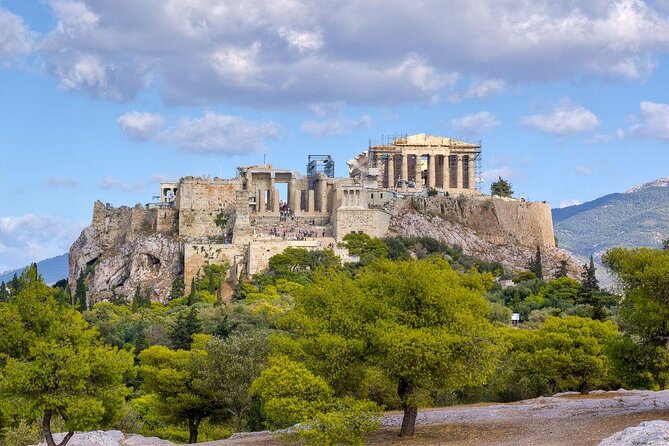
- The Parthenon is only part of the story: You also see the Propylaea, Erechtheion, Temple of Athena Nike, and lesser-known sanctuaries.
- Guides shape the experience: Past tours have been led by Anna, Kathy, Ioanna, Nikos, and Maria.
- Admission is included: Your price covers the Acropolis and Acropolis Museum entrance tickets.
- Plan for a climb: Wear sensible shoes, bring water, and expect uneven ground and uphill walking.
Why the museum-first plan works so well
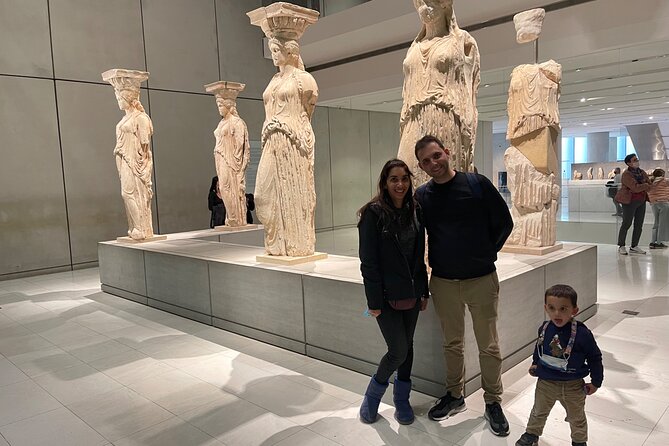
The Acropolis can feel like a pile of marble columns if you arrive without context. The museum solves that problem. Before you climb the hill, you see sculptures, reliefs, inscriptions, and architectural fragments in a clear setting. Then, when your guide points out a missing figure or a familiar pattern on the Parthenon, you have already seen the related work indoors.
The museum’s permanent collection is arranged in five broad sections. One covers the Acropolis slopes, with ordinary objects, pottery, reliefs, offerings, and decorative pieces. These are useful because they show daily religious life, not just grand temples.
The Archaic section includes works made before the Persian Wars. Look for the Moskophoros, the collection of korai, pediments, and votive figures. Your guide can help you read the stiff poses and formal smiles as stages in the development of Greek sculpture rather than treating them as a row of disconnected statues.
The Parthenon section is the star. It includes parts of the frieze, metopes, pediments, and inscriptions tied to the temple. Seeing these pieces at close range gives you a better sense of the skill and planning behind the building above.
The final sections cover the Propylaea, Athena Nike, and Erechtheion, along with material from the fifth century BC through the fifth century AD. Classical, Hellenistic, and Roman remains show that the Acropolis was used and reshaped long after the age most people picture.
One especially useful detail is the museum building itself. Its design mirrors the Parthenon’s orientation and proportions. Excavations found beneath the museum were preserved and made visible through parts of the floor, so you are not only looking at objects from the Acropolis. You are also seeing what lay below the modern building.
The museum visit lasts about an hour. That is enough time for a guided introduction, but not enough for every case and inscription. If you are passionate about archaeology, you may want to return on your own. For a first visit, the focused approach keeps the morning or afternoon moving.
More Acropolis Museum visits:
- Athens: Acropolis, Parthenon & Acropolis Museum Guided Tour
★ 4.8 · 9,316 reviews - Athens: Acropolis, Parthenon & Acropolis Museum Guided Tour
★ 4.8 · 3,579 reviews - Acropolis monuments & Parthenon Walking Tour with Optional Acropolis Museum
★ 5.0 · 2,678 reviews
Climbing from the Acropolis Museum to the sacred hill
Your guide meets you in front of the Acropolis Museum at Dionysiou Areopagitou 15, or at a nearby agreed point. The tour ends back at the meeting point, and transportation is not included, so you should make your own way there.
From the museum, the experience shifts from indoor study to outdoor archaeology. The Acropolis rises 156 meters above sea level, and the route includes an uphill walk over ancient ground. The climb is manageable for most people according to the tour information, but it still takes effort, especially in warm weather.
Bring water. It can be purchased at the site, but carrying a bottle from the start is the easier choice. Use shoes with a firm sole, since the route includes slopes and uneven stone. If your group has different walking abilities, tell the guide at the start. One past group found the guide accommodating when members had physical limitations, and the private setup gives you more room to adjust than a large group tour.
The Acropolis visit is listed at about one hour, but the detailed stops add up to more time. Think of the timing as an approximate plan rather than a stopwatch schedule. Your guide will need to balance explanations, walking, crowds, and the pace of your own group.
The Propylaea and the first great view
The western entrance is the natural dramatic opening to the hilltop. The Propylaea were built under Pericles between 437 and 431 BC, replacing an earlier entrance from the time of Pisistratus.
Architect Mnesicles gave the gateway the look of a pair of Doric temple fronts. The outer portico once had Ionic columns and a blue marble roof decorated with stars. Five doorways cut through the central access wall, with the openings arranged in decreasing order beside the main passage.
This is a good place to pause before rushing toward the Parthenon. The Propylaea were not simply a practical gate. They framed arrival at the sacred enclosure and made the approach itself part of the experience.
Nearby is the Monument of Agrippa, a tall rectangular pedestal made from gray-blue Hymettus marble. It was first built in 178 BC to honor Eumenes II of Pergamon after a chariot-race victory at the Panathenaic Games. A later bronze chariot was dedicated to Marcus Agrippa around 27 BC.
Only the pedestal survives, but it helps you see how the Acropolis continued to receive political monuments long after its major Classical temples were built. Your guide can use this small remnant to explain how Greek and Roman power overlapped on the hill.
The Parthenon, best seen with time to look up
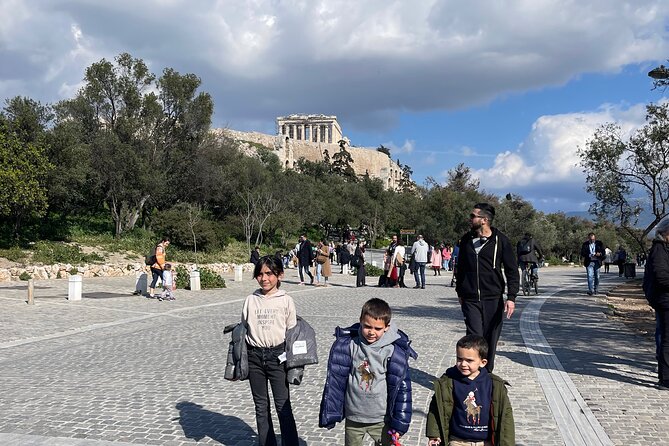
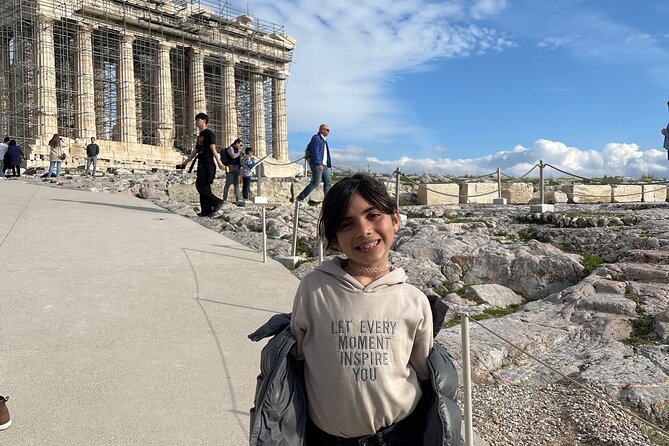
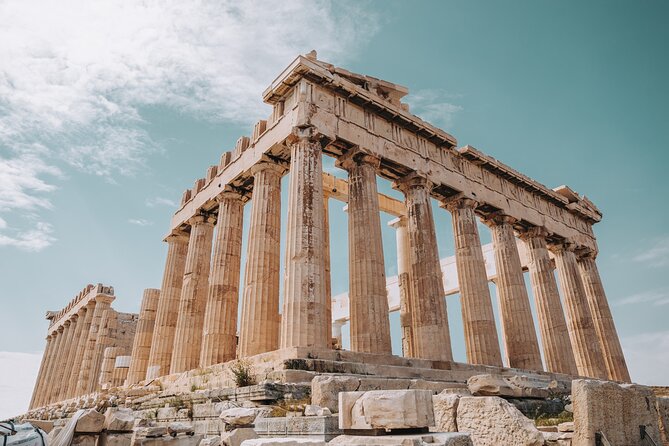
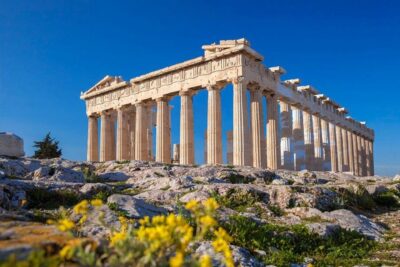
The Parthenon is the reason many people come to Athens, and it earns its fame. Built between 447 and 432 BC, the Doric temple was designed to house a twelve-meter statue of Athena made from wood, ivory, and gold.
You cannot enter the temple, and restoration work remains part of the view. That does not make the visit less worthwhile. The surviving columns, sculptural fragments, and setting on the Acropolis let you grasp the building’s scale and precision.
The planned stop is about 20 minutes. That is enough for a guide to explain the temple’s purpose, construction, decoration, and place in Athenian life, but you should not expect a long silent viewing period. If you want photographs from several angles, use the transitions between stops as your chance.
A private guide is particularly useful here because the Parthenon invites quick, shallow sightseeing. You see the columns, take a picture, and move on. A good explanation slows you down just enough to notice the proportions, the sculptural program, and the way the monument dominates the hill.
More Acropolis and Parthenon visits:
- Athens: Acropolis & up to 5 Archaeological Sites Combo Pass
★ 4.4 · 12,619 reviews - Athens: Acropolis Ticket with Optional Audio or Live Guide
★ 4.2 · 11,055 reviews - Athens: Acropolis and Parthenon Guided Walking Tour
★ 4.6 · 5,882 reviews - Athens: Acropolis Ticket with Audio Guide
★ 4.0 · 3,575 reviews
Athena Nike and the smaller monuments nearby
The Temple of Athena Nike sits beside the Propylaea on a bastion. This small Ionic temple was built between 426 and 421 BC, replacing earlier shrines whose remains are preserved within the bastion.
Its frieze showed gods and battles. The south side depicted the Greek victory over the Persians at Marathon in 490 BC, led by the Athenians. Much of the sculpture is no longer in place, but the museum visit gives you a chance to see related fragments and understand what once decorated the temple.
The listed stop lasts about 15 minutes. That is a sensible amount of time for a compact monument, though it may feel brief if you want to study every sculptural detail.
The Sanctuary of Artemis Brauronia lies south of the Propylaea. Artemis was linked here with women before and after childbirth, and the sanctuary likely worked alongside the larger sanctuary at Brauron in Attica. It was founded in the middle of the sixth century BC.
Today, the remains are mainly cuts in the bedrock that mark the foundations of a pi-shaped Doric stoa. The site takes about 15 minutes and requires imagination. This is exactly where a guide adds value: without an explanation, you may see little more than stone lines in the ground. With one, you can reconstruct the shape of the sanctuary and understand the offerings once made there.
The nearby Temple of Rome and Augustus dates from the late first century BC. It was a small, circular temple with nine Ionic columns, dedicated by Athens to the goddess Rome and Octavian Augustus. Only foundations and architectural pieces remain, but the stop points to the Roman chapter of the Acropolis.
The Erechtheion and its famous Caryatids
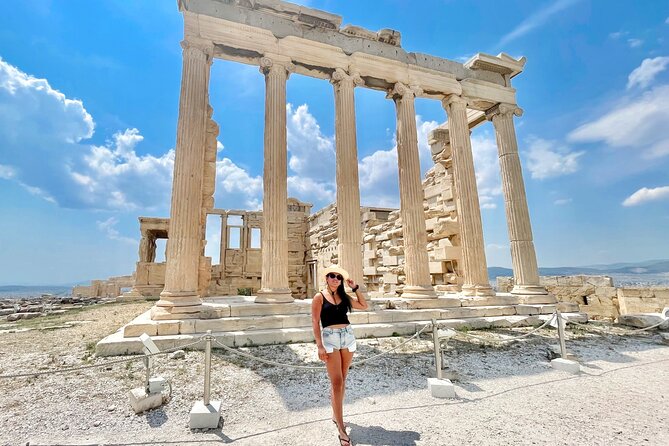
The Erechtheion is one of the most intriguing buildings on the hill because it had to fit an uneven site and preserve older sacred places. It housed rituals connected with Poseidon, Hephaestus, and other cults, including the spot where Poseidon was said to strike the rock with his trident.
Its unusual design includes a northwest portico held by Ionic columns and a southwest porch supported by six female figures, the Caryatids. They appear to carry the roof with calm formality, which is part of their lasting appeal.
The tour allows about 15 minutes here. Your guide can explain why this temple looks less orderly than the Parthenon and why that irregularity is meaningful. The Erechtheion was not a failed attempt at symmetry. It was a careful response to terrain and religious tradition.
The itinerary also identifies a Temple of Athena Nike, but the description refers to the older temple of Athena Polias, damaged by the Persians in 480 BC and never rebuilt. Its remains include the altar cut into the bedrock and traces of a Doric structure. The ancient temple once contained a wooden cult statue of Athena, while pediments showing the Gigantomachy are displayed in the museum.
This second stop can cause some confusion because the name is presented differently from the smaller Ionic Temple of Athena Nike by the entrance. Ask your guide to clarify the distinction. That explanation will make the Acropolis layout easier to follow.
What four private hours really buy you
The cost is $383.55 per person, with a minimum booking of two people. That is a serious price, especially for a couple. You are not paying only for entry. The fee includes both admission tickets, local taxes, and four hours with a private official guide.
The value improves as your group gets larger, since the tour is private and group discounts are offered. A group of four can share one guide instead of booking separate places on a large scheduled walk. The private format also matters if you want to ask questions, move at a relaxed pace, or keep explanations suited to children, older relatives, or people with limited stamina.
The strongest reason to pay is efficiency with meaning. You avoid waiting in long ticket lines, see the museum and hill in a logical order, and get help connecting scattered ruins. You also avoid spending your limited Athens time reading every label or trying to identify monuments from a phone screen.
The weak point is that four hours cannot cover every gallery and every corner of the Acropolis. It is a well-shaped introduction, not a complete archaeology course. You also pay for a guide even if you prefer to explore silently or already know the site well.
The guides and the pace of the visit
The experience is sold with an official private guide, but the guide is assigned rather than chosen from a fixed roster. Past tours have included Anna, Kathy, Ioanna, Nikos, and Maria.
The strongest pattern is clear: guides explain mythology and history in a way that connects objects to places. Anna, for example, used the museum’s design, the visible excavation, and individual sculptures to explain how the collection relates to the Parthenon. Kathy was described as pleasant and willing to let the group set the pace, while Ioanna made four hours feel like the right length.
You should still confirm the meeting point carefully. The guide meets you in front of the museum or nearby, and one group found the location details less clear than they would have liked. A precise meeting arrangement can save time and anxiety, especially near a major site.
The tour is offered in English and confirmation is provided when you book. It is near public transportation, but no transport is part of the tour. Most people can participate, though the climb and uneven surfaces deserve honest consideration.
Free cancellation is available if you cancel at least 24 hours before the start time. Changes or cancellations inside that window are not accepted for a refund.
Who should book this Acropolis tour
I would choose this tour for a first visit to Athens, especially if you want the Parthenon and museum to feel like one connected story. It also suits couples, families, and small groups who prefer questions and conversation over a fixed large-group script.
It is a strong choice if you have only half a day for the Acropolis or if you worry about wasting time at ticket lines. It makes particular sense for a group of four or more, since the private cost can be shared and the guide can respond to different interests.
You may want another approach if $383.55 per person strains your budget, if you already know the Acropolis well, or if you want several hours alone in the museum. The tour’s value comes from personal interpretation and smooth organization, not from adding access to areas closed to ordinary visitors.
Should you book it?
Book this private walk if you want a clear four-hour introduction, included admission, and a guide who can adapt to your group. The museum-first plan is smart, the major monuments are covered, and the private pace is a real advantage on a crowded hill.
Skip it if you are price-sensitive or prefer self-guided sightseeing. For everyone else, especially a small group willing to pay for context and less hassle, this is a well-focused way to meet the Acropolis.
FAQ
Where does the tour begin?
The tour begins at the Acropolis Museum, at Dionysiou Areopagitou 15 in Athens. Your guide will meet you in front of the museum or at a nearby agreed location.
Where does the tour end?
The activity ends back at the meeting point.
Are Acropolis and museum tickets included?
Yes. Admission to the Acropolis and entrance to the Acropolis Museum are included.
How long does the tour last?
The private walking tour lasts approximately four hours.
Is this a private group tour?
Yes. Only your group participates, and a minimum of two people is required per booking.
Is transportation or food included?
No. Food, drinks, and transportation are not included. The tour is offered in English, and the meeting point is near public transportation.
More Athens walking tours
- Greek Food Walking Tour in Athens
★ 5.0 · 4,740 reviews - Acropolis: Acropolis and Parthenon Guided Walking Tour
★ 4.7 · 3,442 reviews - Athens Acropolis and Parthenon Walking Tour
★ 4.5 · 1,355 reviews - Athens Authentic Greek Food Walking Tour (Small Group)
★ 5.0 · 809 reviews
More Athens museums
- Athens: Mythology of Delphi, Museum and Arachova Guided Tour
★ 4.6 · 4,008 reviews - Athens All Included: Acropolis and Museum Guided Tour with Ticket
★ 4.5 · 2,673 reviews - Athens: Acropolis Museum Ticket with optional Audio Guide
★ 4.4 · 2,652 reviews - From Athens: Small-Group Delphi, Museum & Arachova Day Trip
★ 4.8 · 2,476 reviews
Freshly added Athens trips
- Athens and Ancient Corinth Private from Athens★ 5.0 · 3 reviews
- From Athens: Mycenae and Epidaurus Private Tour★ 4.8 · 3 reviews
- Full day Meteora private tour★ 5.0 · 3 reviews
- Double Shore Dive (certified divers)★ 4.5 · 3 reviews
- Athens Hills: Mythology Treasure Hunt★ 5.0 · 3 reviews
- Sunset & swimming at Cape Sounio, Poseidon temple★ 5.0 · 3 reviews
- Philosophy Experience at Plato’s Academy Park – basic version★ 5.0 · 3 reviews
- Private Acropolis Tour – Ticket Included★ 5.0 · 3 reviews
Acropolis Museum Tours, compared.

Acropolis, Parthenon & Acropolis Museum Guided Tour
Read our review →Acropolis, Parthenon & Acropolis Museum Guided Tour
Read our review →
Acropolis monuments & Parthenon Walking Tour with Optional Acropolis Museum
Read our review →
Acropolis Museum Ticket with optional Audio Guide
Read our review →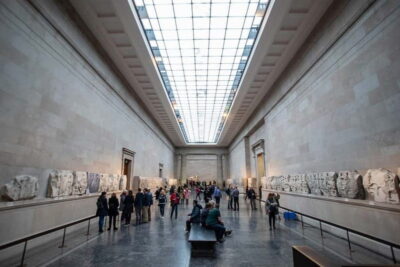
Parthenon & Acropolis Museum with Audio or Live Tour Option
Read our review →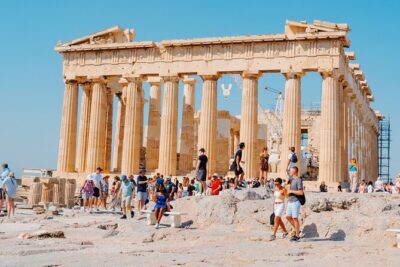
Acropolis, Parthenon and Acropolis Museum Guided Tour
Read our review →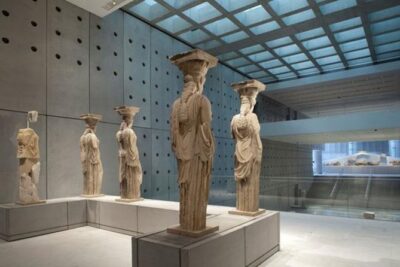
Browse the lists this tour appears in