
Reviewed · ACROPOLIS TOURS
Athens Acropolis and Parthenon Walking Tour
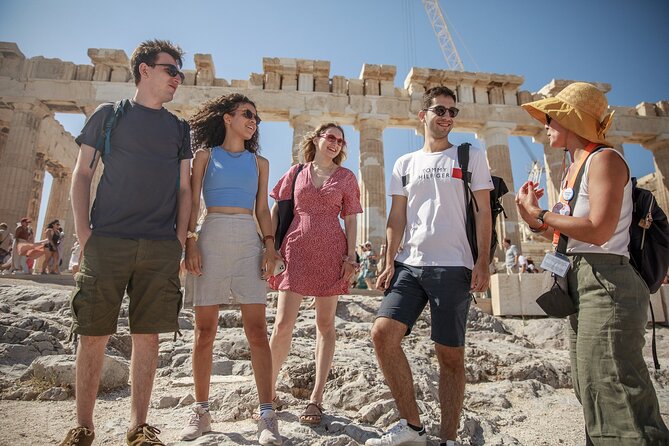
The Parthenon is only part of the story here. In about two hours, you walk past the birthplace of Western drama, the sanctuary of Asclepius, the grand Propylaea, and the graceful Caryatids of the Erechtheion before reaching Athens’ most famous temple. The route gives you the big picture without asking you to spend half a day on the hill.
I like the licensed guide, who turns scattered marble ruins into a readable story, and I like the personal earsets, which help you hear without standing shoulder to shoulder with the guide. The main catch is the uphill walk over uneven stone, often under a hot sun. This is not a hard hike for most people, but it does call for steady feet, water, and an on-time arrival.
In This Review
- Key points before you book
- Why a guide helps on the Acropolis
- Meeting at Dionysiou Areopagitou Street
- The Theatre of Dionysus and the road uphill
- Asclepius, healing, and the ancient theaters
- Entering through the Propylaea
- The Temple of Athena Nike and the first big views
- The Erechtheion and its six Caryatids
- The Parthenon, the final major stop
- What the two-hour format does well
- Price, ticket choice, and overall value
- Who should book this Acropolis walk
- Should you book it?
- FAQ
- How long does the Acropolis and Parthenon walking tour last?
- Is the Acropolis admission ticket included?
- Where does the tour meet?
- Where does the tour finish?
- What monuments are included?
- Is the tour offered in English?
- Is the tour suitable for people with limited mobility or young children in strollers?
Key points before you book
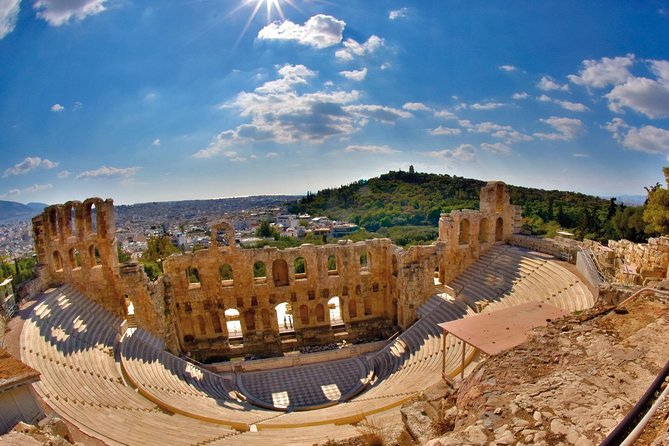
- The two-hour route covers the Acropolis highlights: You see the Theatre of Dionysus, Odeon of Herodes Atticus, Temple of Athena Nike, Propylaea, Erechtheion, and Parthenon.
- A ticket upgrade can save time: Choose the option with admission included if you want the simplest arrival. The ticket is not included in the basic price.
- Clear audio matters on a crowded hill: Each person receives an earset, though equipment can occasionally produce static or cut out.
- The meeting point is easy to reach: Meet at LUKUMAΔΕΣ, Dionysiou Areopagitou 3, near the Acropolis base.
- The route suits history-minded first-time visitors: You get context, mythology, architecture, and time for questions instead of simply wandering among ruins.
- Plan for sun and stone: Wear good shoes, bring water, sunscreen, and a hat. Strollers are not allowed on the archaeological site.
Why a guide helps on the Acropolis
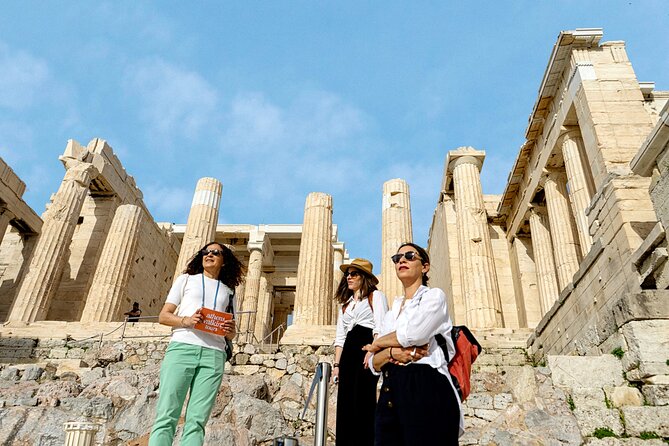
The Acropolis can look simple at first: a hill, several temples, and a famous building at the top. In practice, the site is a crowded collection of layers, repairs, religious stories, political ideas, and architectural choices. Without some explanation, it is easy to admire the view and miss what you are looking at.
A good guide gives each monument a job in the larger story. The Theatre of Dionysus becomes more than a semicircle of seats. The Erechtheion becomes more than a charming porch. The Parthenon becomes more than an ancient photo stop.
This tour uses a group format with a maximum of 24 people. That is not a private visit, but the headsets make the arrangement workable. You can listen while looking around, and the guide does not need to gather everyone tightly at each stop.
The strongest part of the guiding is the mix of facts and storytelling. Guides including Alexia, Elena, Dora, Hermes, Victor, Andrea, and Phillipa have been singled out for clear explanations, good pacing, humor, and patience with questions. Your guide will vary, of course, but the format is built around live commentary rather than a recorded walk.
More Acropolis and Parthenon visits:
- Athens: Acropolis & up to 5 Archaeological Sites Combo Pass
★ 4.4 · 12,619 reviews - Athens: Acropolis Ticket with Optional Audio or Live Guide
★ 4.2 · 11,055 reviews - Athens: Acropolis, Parthenon & Acropolis Museum Guided Tour
★ 4.8 · 9,316 reviews
Meeting at Dionysiou Areopagitou Street
You meet at LUKUMAΔΕΣ, Dionysiou Areopagitou 3, near the base of the Acropolis. The end point is listed at Acropoli, Athens 117 42, so you finish on the Acropolis side of central Athens rather than returning to a hotel.
There is no hotel pickup or drop-off. You need to make your own way to the meeting point, but it is near public transportation and within the main Acropolis sightseeing area.
Arrive early. Acropolis entry times are strict, and the group cannot wait for latecomers. No refund is offered if you miss the entry time. Security screening is similar to an airport check, and in the busiest season it can add 30 minutes or more.
The ticket choice needs careful attention when booking. At about $41.12 per person, the basic price does not automatically include the Acropolis admission fee. The supplied details list the entrance fee at €30 per person unless you select the ticket option. If you book without admission, you receive instructions to obtain a valid ticket, and the details also state that you may need to provide cash to the guide because tickets have been prepaid.
Because those instructions can sound confusing, check the exact ticket terms attached to your booking. The ticket-included option is usually worth considering if you want fewer steps and a smoother arrival.
The Theatre of Dionysus and the road uphill
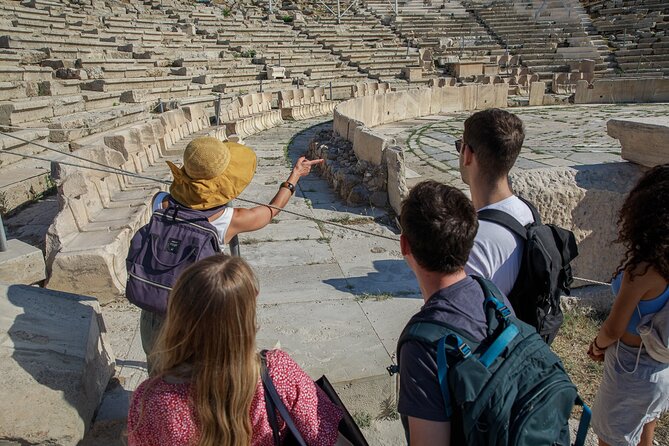
The walk begins on the lower slopes, where the guide introduces the Acropolis before taking you upward. The first major stop is the Theatre of Dionysus, generally described as the birthplace of theater.
Here, the names Aeschylus, Sophocles, and Euripides gain a physical setting. You can picture ancient Athenian audiences gathered for performances that shaped drama and literature for centuries. The theater is also a useful early stop because it gives you a chance to adjust to the climb.
The uphill sections are manageable for many people, but the surface is uneven and can be slippery or awkward underfoot. Several people have found the pace comfortable, including older adults, while others have stressed that you need a moderate level of fitness.
The guide usually pauses along the way, which helps. You are not expected to race straight to the summit. Still, this is an archaeological site, not a smooth city sidewalk. If you have balance concerns, wear shoes with a firm sole and stay close to the group.
Asclepius, healing, and the ancient theaters
The Temple of Asclepius, also called the Asklepeion, adds a less famous but revealing layer to the visit. This sanctuary was linked to Asclepius, the god of medicine, and served as a place where ancient Athenians sought healing and gave thanks for recovery.
It is a quieter stop than the Parthenon, which is exactly why it earns its place. You get a glimpse of everyday hopes and fears, not just grand public monuments. Ancient Athens was shaped by religious practice at every level, from major civic temples to sanctuaries connected with health.
The route also takes in the Odeon of Herodes Atticus. Built in 161 AD, this stone theater still hosts performances. It is a fine reminder that the Acropolis is not frozen in the classical period. The hill contains monuments from different eras, and the Odeon links ancient construction with modern cultural life.
You will also see views toward Philopappos Hill, known as the Hill of the Muses. The Monument of Philopappos honors a Roman benefactor and gives the scene another layer of history. This is a good pause for photographs and for looking back across Athens.
More Athens walking tours:
- Athens: Acropolis and Parthenon Guided Walking Tour
★ 4.6 · 5,882 reviews - Greek Food Walking Tour in Athens
★ 5.0 · 4,740 reviews - Acropolis: Acropolis and Parthenon Guided Walking Tour
★ 4.7 · 3,442 reviews - Acropolis monuments & Parthenon Walking Tour with Optional Acropolis Museum
★ 5.0 · 2,678 reviews
Entering through the Propylaea
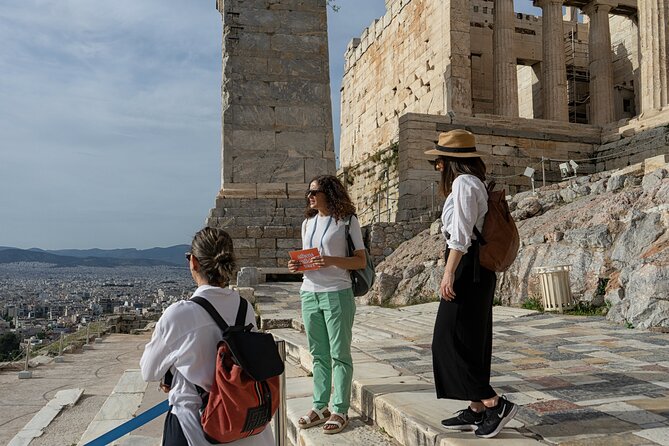
The Propylaea is the monumental gateway to the Acropolis. Architect Mnesikles designed it to create a powerful approach, and it still does that job well.
The gateway frames the movement from ordinary city life into a sacred hilltop precinct. Even with crowds around you, the scale of the marble entrance changes the mood. The guide can point out how the route was designed to build anticipation rather than simply provide a practical doorway.
This part of the walk can feel crowded, especially at popular entry times. The audio system is useful here, though it is not perfect. Most of the time, you should hear the guide without standing directly beside her or him. A few people have encountered static, cutouts, or garbled sound, particularly in windy conditions.
If your earset fails, tell the guide promptly. The equipment is one of the tour’s best features when it works, so it is worth asking for help rather than quietly missing half the commentary.
The Temple of Athena Nike and the first big views
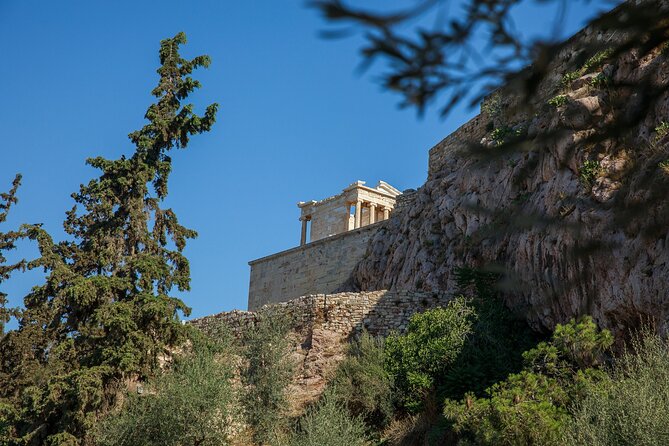
Near the southwestern edge of the Acropolis, the small Temple of Athena Nike sits on a raised bastion. Its position gives it an elegant profile and broad views over Athens.
Athena Nike represents Athena as the goddess of victory. The temple is much smaller than the Parthenon, but its location makes it memorable. This is a good place to understand how the Acropolis combines religious meaning with strategic and visual power.
The open hilltop offers little shade. Guides have sometimes chosen shaded spots for explanations when possible, which can make a real difference in summer. You should still arrive prepared with sunscreen, a hat, and a bottle of water.
There are no toilets once you are inside the archaeological site, according to the practical guidance for this tour. Use facilities before entering and do not assume you can make a quick stop halfway through.
The Erechtheion and its six Caryatids
The Erechtheion is one of the most visually distinctive buildings on the hill. Its uneven plan reflects the many sacred traditions connected with the spot, and it was dedicated to both Athena and Poseidon.
The Caryatid Porch is the star. Six sculpted female figures support the porch in place of ordinary columns, creating one of the Acropolis’ most graceful views. The guide can explain the difference between the original sculptures and the figures you see today, as well as the building’s links to Athenian myth.
This is a place where a guide adds real value. The architecture is beautiful on its own, but the stories explain why the building feels less regular and formal than the Parthenon. Take time to look at the details rather than treating it as a quick photo stop.
The stop is relatively short, so listen closely and save questions for the guide. You will have opportunities for photographs, but crowds can make it difficult to get a completely clear view.
The Parthenon, the final major stop
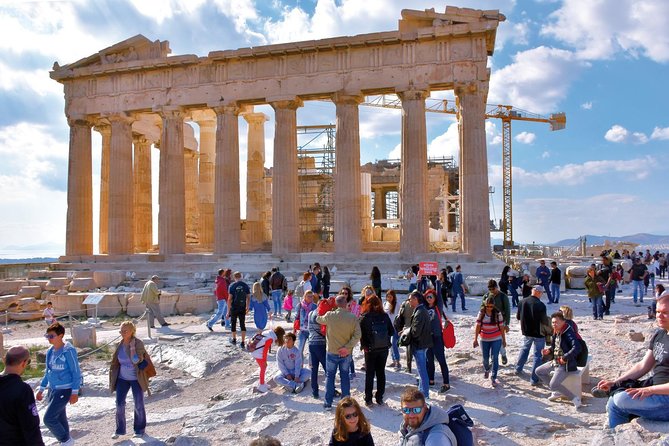
The Parthenon receives about 25 minutes on the route, giving you time to study the building from different angles. It was dedicated to Athena Parthenos and became the central symbol of classical Athens.
Your guide will explain its role in Athenian culture and point out architectural features that are easy to miss from ground level. You will not experience the building as an intact temple. It has suffered damage, removal of sculpture, pollution, weather, and repeated changes of use. Yet the surviving structure still makes clear why it has influenced architecture around the world.
Crowds are part of the experience. You may need to wait for a clear photograph, and the wind can make it harder to hear. The earsets help, but they cannot remove every problem caused by weather and noise.
The best way to approach the Parthenon is to listen first, then take a few minutes to look without rushing. Notice the scale, the placement on the hill, and the way the temple relates to the other buildings around it. The guide gives you the framework; your own time looking completes the visit.
What the two-hour format does well
Two hours is enough for an introduction, not a complete study of the Acropolis. That is the right way to think about this tour.
I like the format for a first visit, a short stay in Athens, or a morning when you want to continue to another sight afterward. You cover the main monuments and hear the basic stories without spending an entire day on one archaeological site.
The tradeoff is depth. You will not have unlimited time at every ruin, and the listed stop durations add up to a brisk sequence of explanations and movement. If you want long photography sessions, quiet reflection, or detailed architectural analysis, visit independently after the tour or allow extra time on another day.
The tour may also be combined with an Acropolis Museum option, depending on the package you select. Do not assume the museum is part of this exact two-hour archaeological-site visit. Check the booking option carefully, since several comments refer to museum-inclusive versions while others clearly describe the Acropolis only.
Price, ticket choice, and overall value
At $41.12 per person, the price is reasonable for a licensed guide, group organization, headsets, an Athens map, and a city guide magazine. The value is strongest if you want context and prefer not to sort out the Acropolis route alone.
The ticket issue changes the calculation. If admission is not included, the separate €30 entrance cost makes the total much higher. The ticket-included option costs more upfront, but it can save time and reduce the risk of arriving without the required ticket.
You also receive a map and magazine for planning other time in Athens. They are modest extras, but useful if this is your first day in the city and you want ideas for self-guided exploring afterward.
Free cancellation is available until 24 hours before the start time. Changes made inside that window are not accepted, and late cancellations are not refunded. Poor weather or failure to meet the minimum group size can lead to a new date, another experience, or a full refund.
Who should book this Acropolis walk
This tour fits you best if:
- You are visiting the Acropolis for the first time.
- You have about two hours and want the main monuments explained.
- You prefer live stories and questions to reading signs on your own.
- You can handle an uphill walk over uneven ground.
- You want a group tour rather than a private guide.
- You appreciate help with entry and navigation.
It is less suitable if you need a stroller, dislike group pacing, or want a long, quiet visit at each monument. Baby strollers are not allowed on the site, and there is no cloakroom at the side entrance used by the tour. A baby pouch is recommended instead.
The experience is offered in English. Comfortable clothing matters because conditions can change quickly on the exposed hill. Rain does not necessarily ruin the visit, but wet stone and wind make shoes and audio quality more important.
Should you book it?
I would book this tour if you want a clear, efficient introduction to the Acropolis and Parthenon. The guide’s storytelling, the many short stops, and the personal audio units give you much more than a quick walk past old stones.
Choose the ticket-included option if you value simple logistics. Arrive early, use the restroom first, bring water, and expect a real uphill walk. If you want the freedom to linger, take extensive photographs, or study the site at your own pace, visit independently after learning the basics, or choose a longer private experience.
For most first-time visitors with limited time, this is a sensible way to meet Athens’ ancient center without getting lost in the details or missing the meaning behind the monuments.
FAQ
How long does the Acropolis and Parthenon walking tour last?
The tour lasts approximately two hours.
Is the Acropolis admission ticket included?
Only the selected ticket option includes admission. The basic option does not include the Acropolis entrance fee, which is listed as €30 per person unless the ticket option is selected.
Where does the tour meet?
The meeting point is LUKUMAΔΕΣ at Dionysiou Areopagitou 3, Athens 117 42, near the base of the Acropolis.
Where does the tour finish?
The tour ends at Acropoli, Athens 117 42.
What monuments are included?
The route includes the Acropolis, Theatre of Dionysus, Temple of Asclepius, Odeon of Herodes Atticus, Temple of Athena Nike, Propylaea, Erechtheion, and Parthenon. It also includes views of Philopappos Hill.
Is the tour offered in English?
Yes. The experience is offered in English.
Is the tour suitable for people with limited mobility or young children in strollers?
You need a moderate level of physical fitness because the route includes uphill walking and uneven surfaces. Baby strollers are not allowed on the Acropolis archaeological site, and a baby pouch is recommended instead.
Freshly added Athens trips
- Athens and Ancient Corinth Private from Athens★ 5.0 · 3 reviews
- From Athens: Mycenae and Epidaurus Private Tour★ 4.8 · 3 reviews
- Full day Meteora private tour★ 5.0 · 3 reviews
- Double Shore Dive (certified divers)★ 4.5 · 3 reviews
- Athens Hills: Mythology Treasure Hunt★ 5.0 · 3 reviews
- Sunset & swimming at Cape Sounio, Poseidon temple★ 5.0 · 3 reviews
- Philosophy Experience at Plato’s Academy Park – basic version★ 5.0 · 3 reviews
- Private Acropolis Tour – Ticket Included★ 5.0 · 3 reviews
Acropolis Tours, compared.

Acropolis & up to 5 Archaeological Sites Combo Pass
Read our review →

Acropolis, Parthenon & Acropolis Museum Guided Tour
Read our review →
Acropolis, Parthenon & Acropolis Museum Guided Tour
Read our review →


Acropolis monuments & Parthenon Walking Tour with Optional Acropolis Museum
Read our review →Browse the lists this tour appears in