

Reviewed · HISTORICAL TOURS
Walk through the history of Athens
Athens makes more sense when you connect its grand neoclassical avenues with the ancient monuments at its heart. This 2.5-hour walk does exactly that, leading from Panepistimiou Avenue and the Hellenic Parliament toward Kallimármaro, Zappeion, the Temple of Olympian Zeus, and the Acropolis.
I like the route for two clear reasons: it gives you a useful first look at Athens before you tackle the Acropolis, and it ends near Plaka, the Acropolis Museum, and the pedestrian street Dionysiou Areopagitou. The small maximum of 14 people should also make questions and guide contact easier.
The main caution is that the tour only shows the Acropolis from outside and does not include entry tickets. Guide service has also been uneven in the wider Greca Travel experience, so confirm your meeting details and guide language carefully before setting out.
In This Review
- Key points to know before you book
- From Panepistimiou Avenue to the Athens of today
- Syntagma Square and the Hellenic Parliament
- Kallimármaro, the stadium built from white marble
- Zappeion and the Olympic revival
- The Temple of Olympian Zeus and Roman Athens
- Finishing beneath the Acropolis
- What the 2.5-hour format really means
- Price, guide quality, and overall value
- Who should book this Athens walk?
- Should you book Walk through the history of Athens?
- FAQ
- Where does the tour start?
- Where does the tour end?
- How long does the experience last?
- What language is the guide?
- Is Acropolis admission included?
- Can I enter the Temple of Olympian Zeus during the tour?
- How large is the group?
- Is the tour suitable for most people?
- Can I cancel for a refund?
Key points to know before you book

- A city walk with a strong historical arc: Start among 19th-century neoclassical buildings and finish beneath the ancient Acropolis.
- Six compact stops: The schedule allows about 10 minutes at each listed point, so this is an overview rather than a slow visit.
- The guard change at Syntagma: You have time to watch the traditional soldiers at the Hellenic Parliament.
- Olympic Athens gets its due: Kallimármaro and Zappeion connect ancient Greek ideals with the modern Olympic movement.
- Acropolis tickets are extra: The walk ends at the Acropolis Metro Station, not inside the archaeological site.
- Spanish or English guiding: Select your preferred language when booking, and expect a group of no more than 14 people.
From Panepistimiou Avenue to the Athens of today

The walk begins outside Titania Hotel Athens at Panepistimiou 52. This puts you in central Athens, among some of the city’s most important neoclassical architecture.
Your first look includes the Numismatic Museum, the Archaeological Company Building, the Catholic Church of St. Dionysius, the Athens Ophthalmological Hospital, and the Central Bank of Greece. These buildings help explain a side of Athens that can be missed if you spend all your time around the Acropolis.
The ancient monuments are the obvious draw, but 19th-century Athens tells another important story. After Greece became an independent modern state, Athens was reshaped as a national capital. Its public buildings borrowed heavily from classical forms, using columns, symmetry, and pale stone to link the new country with the ancient world.
You spend roughly 10 minutes at the Numismatic Museum area, and admission is not included. That short stop is enough for an introduction to the buildings, but not enough for a museum visit. If coins and economic history interest you, you may want to return independently at another time.
This opening section is best for getting your bearings. You are not simply being carried from one famous monument to the next. You are watching Athens change from a modern European capital into a city dominated by ancient remains.
More ancient history days in Athens:
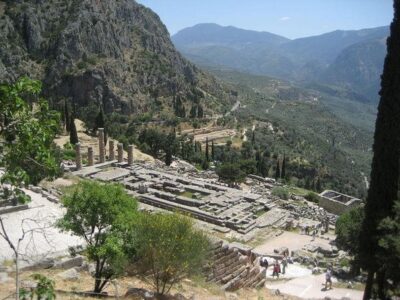
- Historical Delphi One Day Tour with Arachova Stop & Expert Guide
★ 4.5 · 1,247 reviews - Historic Athens: Small Group Electric Bike Tour
★ 4.9 · 740 reviews - The History of Athens: Greek Mythology Private Tour
★ 5.0 · 138 reviews
Syntagma Square and the Hellenic Parliament
From Panepistimiou Avenue, the walk moves to Syntagma Square, the public center of modern Athens. The Hellenic Parliament occupies the former royal palace at the eastern side of the square, giving the stop both political and ceremonial weight.
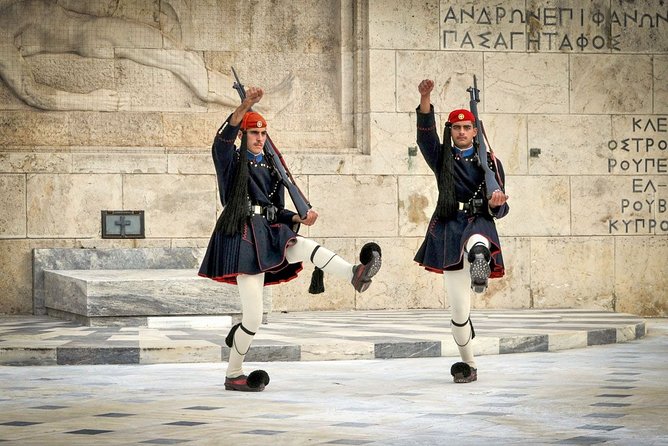
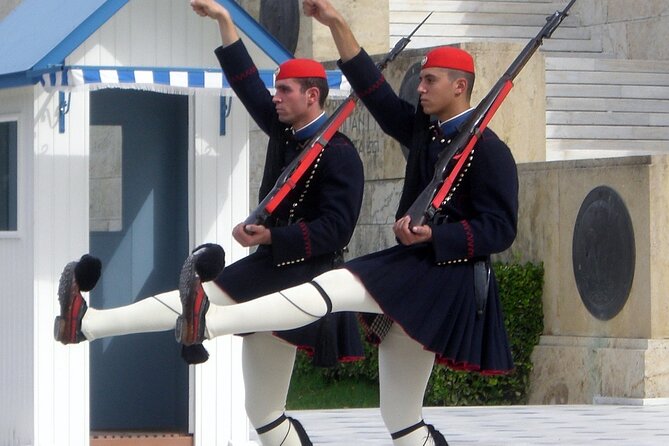
You have time to watch the changing of the guard, performed by the traditionally dressed soldiers known as evzones. The ceremony is free to watch, but the exact timing and length can affect how much of it you see. Your guide should help position the group and explain what is happening.
This is one of the most useful stops for first-time visitors because it links present-day Greek government with national tradition. The square is not just a photo stop. It is a place where modern civic life, public demonstrations, formal ceremony, and daily city movement meet.
The scheduled visit lasts about 10 minutes. That keeps the walk moving, but it also means you should not expect a long explanation of Greek politics or a full ceremony every time. If the guard change is especially important to you, ask for the precise timing when you book or confirm the tour.
Kallimármaro, the stadium built from white marble

The next major sight is Panathenaic Stadium, commonly called Kallimármaro, meaning good marble. You view it from a panoramic point rather than entering the stadium, and admission is free for this stop.
Kallimármaro is one of Athens’ most striking modern landmarks because it is built entirely from white marble. It was the site of the first edition of the modern Olympic Games, giving the stadium a direct connection to the revival of the Olympic tradition.
I like this part of the walk because it prevents the Olympic story from being treated as a footnote. Athens is not only an ancient city with ruins. It also played a major role in shaping the modern image of Greece through sport, ceremony, and national identity.
The drawback is simple: a 10-minute panoramic stop is brief. You will not have time to explore the seating, track, or interior details. If you want to enter, the tour does not include that ticket, so plan a separate visit.
The panoramic viewpoint should appeal to anyone who wants a strong photograph without adding another full admission visit to the day. It is also a good moment to pause, since the route includes several outdoor sites and can feel warm in Athens’ strong sun.
Zappeion and the Olympic revival
Near Kallimármaro, the route passes the Zappeion. This elegant building was the first structure built specifically for the modern Olympic Games. Today it is used for official and private ceremonies, meetings, and other formal events.
Zappeion helps fill in the period between ancient Greece and modern Athens. The building was not created as an ancient ruin or a museum display. It was designed for a modern national event that looked back to Greek antiquity while creating something new.
The scheduled stop is again about 10 minutes. You should expect to see and discuss the building from the outside, rather than spend time at a formal event or extended interior visit. The supplied details do not promise admission inside.
I find this stop valuable because it gives the walk a clear theme. The route is not a random list of Athens landmarks. It moves through three layers of the city: classical ideals, the 19th-century national capital, and the international Olympic movement.
Your guide’s storytelling matters most here. A good guide can explain why a building used for ceremonies belongs in the same historical conversation as the stadium and the ancient temples. Guides named Magdalene and Jenni have been associated with especially strong history-based explanations and thoughtful care for the group, including adapting well to a family with a 16-month-old child.
More Athens walking tours:
- Athens: Acropolis and Parthenon Guided Walking Tour
★ 4.6 · 5,882 reviews - Greek Food Walking Tour in Athens
★ 5.0 · 4,740 reviews - Acropolis: Acropolis and Parthenon Guided Walking Tour
★ 4.7 · 3,442 reviews - Acropolis monuments & Parthenon Walking Tour with Optional Acropolis Museum
★ 5.0 · 2,678 reviews
The Temple of Olympian Zeus and Roman Athens
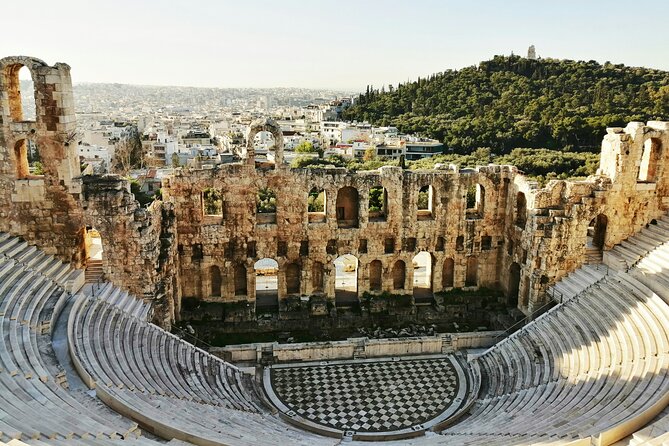
The walk then approaches the Temple of Olympian Zeus, one of the most impressive ancient remains in central Athens. Only a few columns survive, but their scale gives you a clear sense of the original ambition.
The temple was connected with Zeus, the chief god of the ancient Greek pantheon. During the Roman period, Emperor Hadrian had a statue of himself placed next to a monumental statue of Zeus. The Zeus figure was described as 13 meters high and decorated with gold and ivory, modeled on the famous sculpture by Phidias.
That detail matters because it shows how Roman rulers used Greek culture for their own political purposes. Hadrian admired Greek civilization and presented himself as a friend of Athens, but the placement of his statue beside Zeus also made a strong statement about imperial power.
Admission to the archaeological site is not included. The tour passes by the temple and gives you a chance to appreciate it from the route, but you should not confuse this with an entry visit.
At about 10 minutes, this is an introduction rather than a full archaeological lesson. You will want more time if you hope to study the remaining columns, explore the grounds, or read the site information. Still, the stop works well in the larger sequence because it prepares you for the Acropolis by showing another monumental expression of ancient Athens.
Finishing beneath the Acropolis
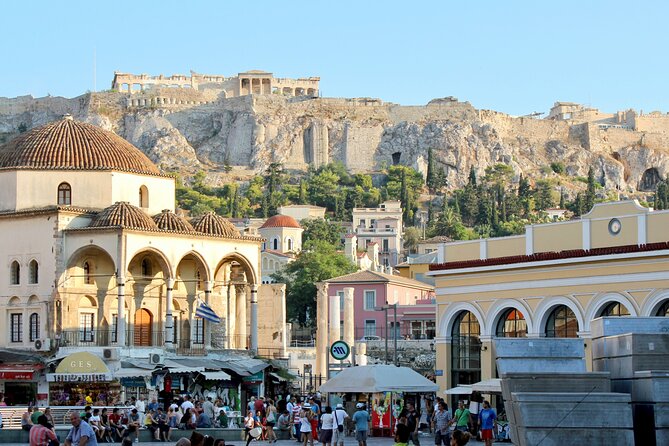
The walk ends at Acropolis Metro Station, near Dionysiou Areopagitou, a pedestrian street with a direct view toward the Acropolis and the Parthenon. The official schedule allows about 10 minutes here.
This ending is well chosen. You finish with the city’s most famous sight in view, but without being rushed straight into the archaeological site. The guide can help you understand where the Acropolis sits in relation to the streets and neighborhoods around it.
The final stop is also practical. From here, you can continue to the Acropolis archaeological site, visit the Acropolis Museum, or walk through Plaka. You can also stop for lunch at one of the neighborhood tavernas or browse shops for typical gifts.
Acropolis admission is not included, and this tour does not replace a proper Acropolis visit. Think of the walk as a historical introduction and orientation. If you want to enter the Parthenon complex, buy or arrange that admission separately and allow enough time for it.
Because the walk ends at a transport hub, you are not left in an unfamiliar part of Athens. The Acropolis Metro Station gives you an easy reference point for continuing your day, though the tour itself does not provide onward transport.
What the 2.5-hour format really means

The listed duration is about two hours and 30 minutes. Six stops are each allocated roughly 10 minutes, with the remaining time used for walking and explanation.
That pace makes the experience efficient. You cover a broad central-Athens route without committing to a full-day program. It can work well on your first morning in the city, especially if you want context before visiting the Acropolis later.
It also means you should keep your expectations realistic. This is not a museum tour, an archaeological excavation visit, or a long stop at every landmark. You will see several sites, hear their place in the city’s story, and move on.
The group limit of 14 is a useful middle ground. It is small enough to feel more personal than a large coach group, but not so small that you should expect a private tour. If you want to ask questions, do so as you walk rather than saving everything for the end.
Wear comfortable shoes and prepare for outdoor walking. The supplied information confirms that most people can participate and that service animals are allowed. It also notes access to public transportation, which is helpful at both the central starting point and the Acropolis ending point.
Price, guide quality, and overall value
At $31.13 per person, the tour is priced as an affordable guided orientation rather than a premium private experience. The value depends mostly on the quality of the guide and how much you want historical context while walking.
I think the price is fair if you plan to visit the Acropolis on your own and want help making sense of the city first. You get a Spanish or English assistant, a route through several important landmarks, and a small group capped at 14 people. You also avoid paying for admission to sights you may prefer to visit separately.
The value is weaker if you expect entry to the Acropolis, the Temple of Olympian Zeus, or the Numismatic Museum. None of those admission tickets is included. You are paying for the guided route and interpretation, not a package of archaeological entrances.
Guide quality is the biggest variable. Strong guides can turn a short stop at Zappeion or a view of Kallimármaro into a memorable piece of the city’s story. Magdalene has been praised for making history feel alive and for giving a useful overview of Plaka, while Jenni has been praised for explaining many small city details and adapting well to a family’s needs.
At the same time, Greca Travel’s broader service record includes complaints about organization, missed meetings, and communication. That does not prove this particular walk will go wrong, but it is a good reason to keep your confirmation available, check the start time, and make sure the company has the right contact number.
Free cancellation is available until 24 hours before the start time. Changes or cancellations inside that window are not accepted for a refund. The experience can also be canceled for poor weather or if the minimum number of participants is not reached, in which case you are offered another date or a full refund.
Who should book this Athens walk?
I would recommend it to a first-time Athens visitor who wants a readable introduction to the city before spending several hours at the Acropolis. The route gives you a useful framework: modern Athens begins with neoclassical ambition, civic life gathers at Syntagma, the Olympic story appears at Kallimármaro and Zappeion, and ancient power returns at the Temple of Olympian Zeus and the Acropolis.
It also suits people who prefer a short guided activity rather than a full-day commitment. The Spanish option makes it useful for Spanish-speaking visitors, while the English option keeps the format accessible to a broad audience.
Families may find the manageable length helpful, though the tour remains a walking activity with outdoor stops. The guide’s ability to adapt will matter, and Jenni’s reported care with a child suggests that family needs can be handled well when communicated clearly.
I would hesitate if you want a deep visit to the monuments themselves. The stops are short, several are viewed from outside, and the important admission tickets are extra. In that case, use this walk as an introduction and plan separate time for the Acropolis and any other site you want to enter.
Should you book Walk through the history of Athens?
Book it if you want a compact historical walk, a Spanish or English guide, and a route that connects Athens’ neoclassical center with its Olympic and ancient landmarks. The ending near Plaka and the Acropolis Museum is especially handy for planning the rest of your day.
Skip it if you want guaranteed entry to the Acropolis or a slow, detailed archaeological tour. Before paying, confirm your language, meeting point at Titania Hotel Athens, start time, and contact details. With those basics in order, the $31.13 price offers a sensible way to get oriented in Athens without spending a full day.
FAQ
Where does the tour start?
The tour starts at Titania Hotel Athens, Panepistimiou 52, Athens 106 78, Greece.
Where does the tour end?
It ends at Acropolis Metro Station, near Dionysiou Areopagitou and the Acropolis area.
How long does the experience last?
The walk lasts approximately two hours and 30 minutes.
What language is the guide?
You can select an assistant in Spanish or English.
Is Acropolis admission included?
No. Tickets to the Acropolis archaeological site are not included.
Can I enter the Temple of Olympian Zeus during the tour?
No entry is included for the Temple of Olympian Zeus. The route passes by the site, and its admission ticket is not included.
How large is the group?
The activity has a maximum of 14 participants.
Is the tour suitable for most people?
Yes. The information states that most participants can take part. Service animals are also allowed, and the route is near public transportation.
Can I cancel for a refund?
You can cancel up to 24 hours before the local start time for a full refund. Cancellations or changes made less than 24 hours before the start time are not refunded.
Freshly added Athens trips
- Athens and Ancient Corinth Private from Athens★ 5.0 · 3 reviews
- From Athens: Mycenae and Epidaurus Private Tour★ 4.8 · 3 reviews
- Full day Meteora private tour★ 5.0 · 3 reviews
- Double Shore Dive (certified divers)★ 4.5 · 3 reviews
- Athens Hills: Mythology Treasure Hunt★ 5.0 · 3 reviews
- Sunset & swimming at Cape Sounio, Poseidon temple★ 5.0 · 3 reviews
- Philosophy Experience at Plato’s Academy Park – basic version★ 5.0 · 3 reviews
- Private Acropolis Tour – Ticket Included★ 5.0 · 3 reviews
Historical Tours, compared.
Historical Delphi One Day Tour with Arachova Stop & Expert Guide
Read our review →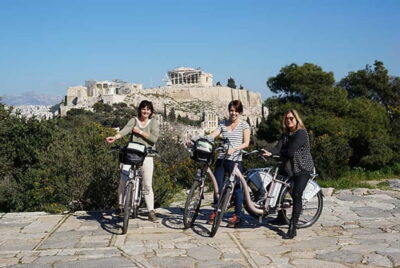
Historic Athens: Small Group Electric Bike Tour
Read our review →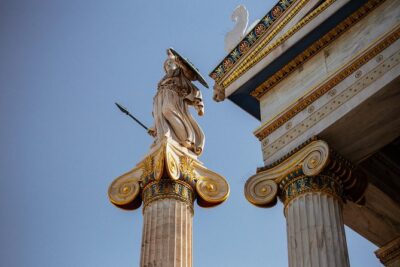
The History of Athens: Greek Mythology Private Tour
Read our review →
Athens Highlights by E-Bike: Small-Group Historic Tour
Read our review →


Half Day Historical Athens City Private Taxi Service Tour
Read our review →Meteora Caves & Monasteries History Day Trip by Train
Read our review →Browse the lists this tour appears in