
Reviewed · HISTORICAL TOURS
Small-Group Women History in Ancient Greece Walking Tour
Ancient Athens is often presented through its temples, generals, philosophers, and democracy. This two-hour walk asks a sharper question: Where were the women in that story? With guide Maelle, you follow their lives through myth, marriage, education, politics, work, and public space, from Monastiraki to a fine Acropolis viewpoint on Philopappos Hill.
I like two things here. First, the tour fills a real gap left by standard Athens sightseeing, with stories of Aspasia, Sappho, and Agnodice alongside familiar figures such as Athena and Penelope. Second, the small group, capped at 12 people, gives the walk a more personal feel and leaves room for questions. The main consideration is physical: this is an outdoor walk with hills and uneven ground, and it is not recommended for people with mobility issues.
In This Review
- Key points to know before you book
- Why this Athens walk feels different
- Starting at Monastiraki Square
- Hadrian’s Library and women’s education
- Marriage, Eros, and the church near Monastiraki
- Athena at the Gate of Athena Archegetis
- A women-only festival at Dioskouron
- The Ancient Agora from outside
- The Areopagus and Agnodice’s risk
- The Pnyx and the missing female vote
- Philopappos Hill and the Acropolis view
- The guide’s approach and the small-group setting
- Is $44.71 a fair price?
- Who should book this walk?
- Should you book the Women’s History in Ancient Greece Walking Tour?
- FAQ
- How long is the Women’s History in Ancient Greece Walking Tour?
- Where does the tour begin?
- Where does the tour end?
- How many people can join the tour?
- Does the tour enter the Ancient Agora?
- What women from ancient Greece are discussed?
- Is the tour suitable for people with mobility issues?
- Is public transportation available near the tour?
- Are service animals allowed?
- What happens if bad weather cancels the tour?
Key points to know before you book

- A rare women-centered view of Athens: The walk looks at daily life, rights, marriage, education, work, and public authority.
- Maelle leads the experience: Her presentation brings together mythology, social history, and modern questions about women’s lives.
- Nine stops connect stories to place: You move from Monastiraki and Hadrian’s Library to the Areopagus, Pnyx, and Philopappos Hill.
- The Ancient Agora is viewed from outside: You do not enter the archaeological site during this tour.
- The finish is scenic: Philopappos Hill provides a broad view toward the Acropolis.
- Small and fairly priced: At $44.71 per person, the tour offers two hours of focused guiding, with group discounts available.
Why this Athens walk feels different
Many Athens tours explain the city through monuments and famous men. This one uses the same streets to show how laws, customs, religion, and public life shaped women’s choices. That change in viewpoint is the real reason to book it.
You will hear about women who lived under severe restrictions, but the story is not limited to silence and domestic life. Mythological figures such as Athena, Pandora, and Penelope reveal how Greek culture imagined women. Historical figures such as Sappho, Aspasia, and Agnodice show women working as poets, thinkers, political influences, and doctors.
That mix matters. Myth is not the same as biography, and the tour gives you a way to consider both without treating them as one thing. You also hear about women whose names rarely appear in a standard overview of Athens, including female slaves, courtesans, wives, and women excluded from formal politics.
I especially like that the walk does not isolate women’s history from the rest of Athens. The marketplace, voting area, law court, and religious sites all become part of the discussion. You learn not only who women were, but also where they could go, what work they could do, and which parts of public life were closed to them.
More ancient history days in Athens:
- Historical Delphi One Day Tour with Arachova Stop & Expert Guide
★ 4.5 · 1,247 reviews - Historic Athens: Small Group Electric Bike Tour
★ 4.9 · 740 reviews - The History of Athens: Greek Mythology Private Tour
★ 5.0 · 138 reviews
Starting at Monastiraki Square
The meeting point is Pl. Monastirakiou 2, in the busy and easy-to-find Monastiraki area. You begin with roughly 10 minutes on the emblematic square, a practical place to meet near public transportation.
Monastiraki works well as a starting point because it places you in the middle of modern Athens before the tour turns toward the ancient city. The contrast helps. You are not entering a sealed museum display. You are walking through streets where old foundations, later buildings, shops, churches, and daily city life occupy the same space.
The group is limited to 12 people. That is small enough for a guide to hear questions and adjust the pace of a conversation, though the experience is still a group walk rather than a private tour. Since the tour is often booked well ahead, around 37 days in advance on average, I would not leave it until the last moment if your Athens dates are fixed.
Hadrian’s Library and women’s education
The first substantial stop is Hadrian’s Library, where you spend about 10 minutes discussing the education of girls and women in ancient Athens. The site gives the subject a useful setting: a place associated with learning, books, and intellectual life.
The important point is not simply that education existed. It is who could access it, what kind of learning was considered useful, and how social expectations shaped a girl’s future. This is where figures such as Sappho can help widen your picture of the ancient world. She represents a female poetic voice that survived despite a society where formal power was largely held by men.
The stop is short, so expect a focused explanation rather than a lengthy archaeological visit. You are looking at the place from the route, not taking part in a full guided tour of the library’s interior. That keeps the walk moving but means visitors who want detailed architectural study will need a separate visit.
Marriage, Eros, and the church near Monastiraki
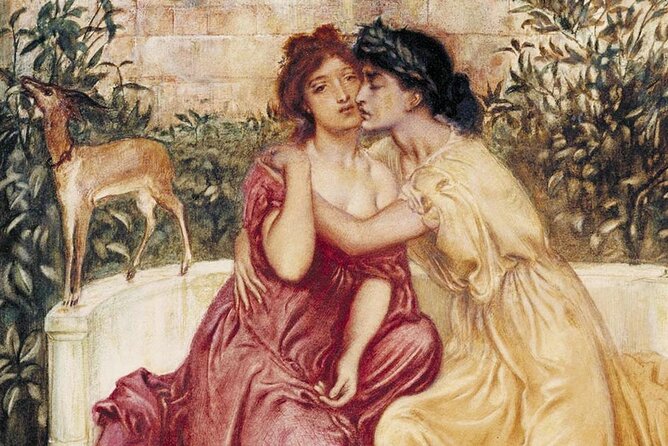
At the Holy Church of the All-Great Taxiarchs and the Virgin Mary Gregorousa, the tour turns to marriage in Athens and Sparta. About 15 minutes here explores what marriage meant for women and how the idea of Eros, passionate love, fit into ancient Greek thought.
This is one of the more useful stops because marriage was not just a private romance. It affected family alliances, household duties, children, property, and a woman’s place in society. Comparing Athens and Sparta also prevents you from treating ancient Greece as one uniform culture. The rules and expectations could differ from city to city.
The discussion of Eros adds another layer. Ancient stories often celebrate desire, but real women still faced social rules that left them with little control over marriage or public behavior. The tension between idealized love and restricted daily life is exactly the sort of detail that makes the subject feel human rather than abstract.
More Athens walking tours:
- Athens: Acropolis and Parthenon Guided Walking Tour
★ 4.6 · 5,882 reviews - Greek Food Walking Tour in Athens
★ 5.0 · 4,740 reviews - Acropolis: Acropolis and Parthenon Guided Walking Tour
★ 4.7 · 3,442 reviews - Acropolis monuments & Parthenon Walking Tour with Optional Acropolis Museum
★ 5.0 · 2,678 reviews
Athena at the Gate of Athena Archegetis
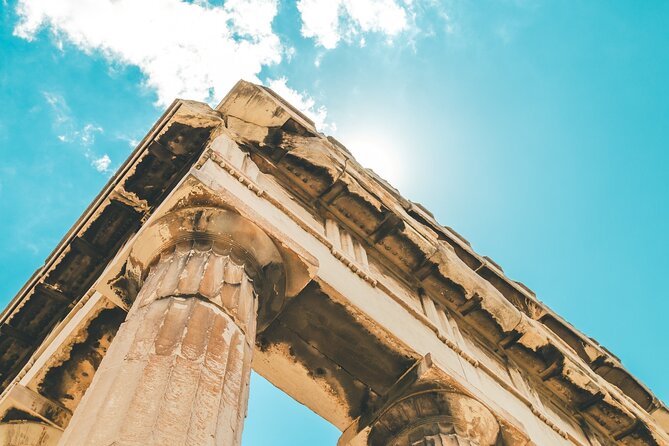
The Gate of Athena Archegetis provides about 15 minutes on married life in Athens and Sparta, along with the myths tied to Athena. This is a strong place to connect the goddess most closely associated with Athens to the women who lived under the city’s laws.
Athena was powerful, wise, and central to the identity of the city. Yet mortal Athenian women did not share the goddess’s freedom or authority. That contrast raises a useful question: what does a society mean when it honors a powerful female deity while limiting the choices of real women?
You will also hear more about household life and the expectations placed on wives. For many people, this is where the tour makes the gap between mythology and social reality especially clear. The city could celebrate women symbolically while excluding them from many practical decisions.
A women-only festival at Dioskouron
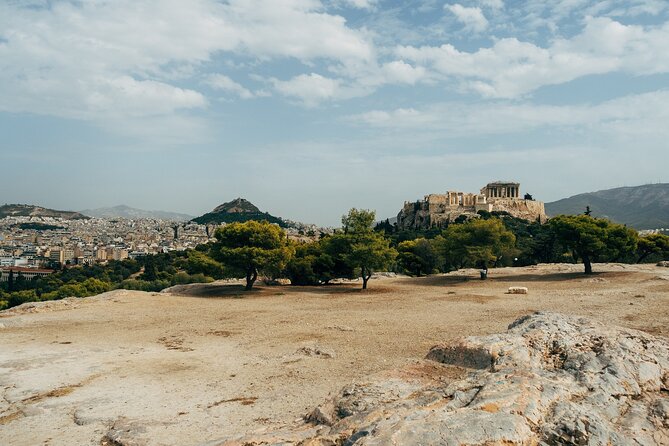
The stop at Dioskouron lasts about 10 minutes and introduces a mysterious ancient festival dedicated exclusively to women. It is a welcome change of scale.
Instead of focusing only on laws or famous individuals, this part considers shared female religious life. Festivals could offer women a setting outside the household, even when most public institutions were controlled by men. The fact that the festival was reserved for women makes it especially interesting, although the information provided for the tour does not promise a full archaeological explanation of the site itself.
This is also a good example of the tour’s method. You are not simply ticking off monuments. You are using ordinary-looking places in central Athens to ask what women did together, where they gathered, and how religion could create room for forms of community.
The Ancient Agora from outside
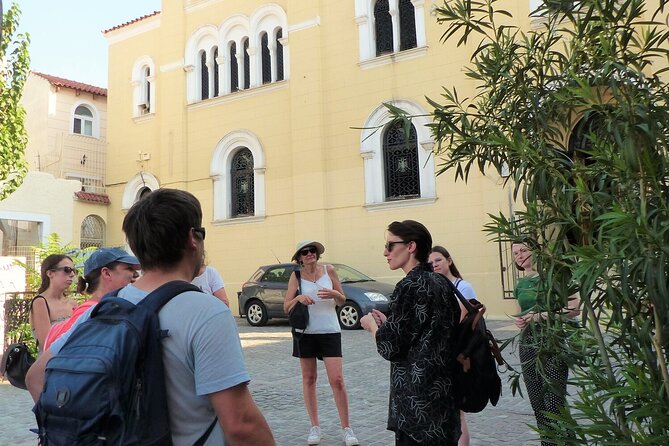
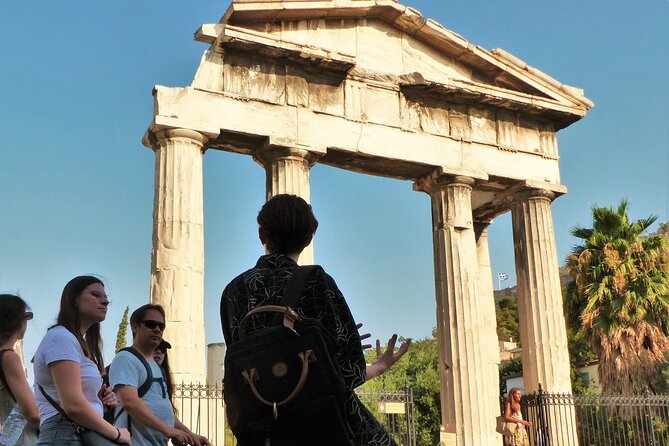
At the Ancient Agora, you spend about 15 minutes looking toward the marketplace and center of public life. The tour does not enter the archaeological site, an important detail if you are expecting an Agora ticket or an interior visit.
Even from outside, the location gives the discussion real force. The Agora was tied to trade, politics, legal business, and social contact. It was also a place where the limits on women became visible. You learn about women’s presence in public space and about the lives of female slaves and courtesans, groups whose experiences could differ sharply from those of citizen wives.
The stop helps you avoid a simple picture of ancient Athens as men outside and women at home. Women’s lives varied according to status, class, occupation, and legal position. Some had very little freedom. Others could gain influence through work, relationships, religion, or wealth, though they still faced a male-controlled system.
If you want to visit the Agora itself, plan that separately. The outside view works well for the story, but it is not a substitute for seeing the archaeological remains.
The Areopagus and Agnodice’s risk
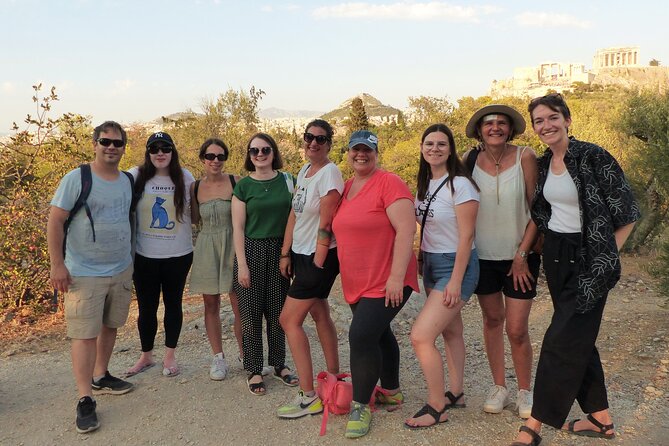
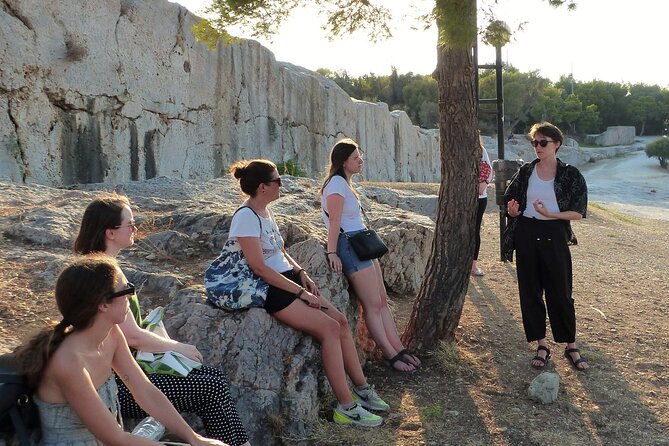
At the Areopagus, the tour spends about 10 minutes discussing the place where serious offenders were tried and the story of a woman who risked a death sentence to change women’s rights. This is where Agnodice becomes especially important.
Her story is one of the tour’s most memorable examples of a woman pushing against the rules of her society to practice medicine. I like this stop because it moves beyond the familiar list of female poets and goddesses. It asks what happened when a woman wanted to enter a profession controlled by men.
The Areopagus is also a physical reminder that law shaped daily life. Rights were not theoretical. They could affect a person’s work, reputation, safety, family, and chance to speak publicly. The site’s uneven rock and exposed setting are part of the practical challenge of the walk, so wear shoes that feel secure.
The Pnyx and the missing female vote
At the Pnyx, you spend about 15 minutes at the place associated with the beginnings of Athenian democracy. The lesson is blunt: only male citizens could vote.
That fact can get softened in a general democracy tour, but here it is central. Athens created a political system praised for citizen participation while excluding women from the vote. The contradiction gives you a clearer idea of both the achievement and the limits of Athenian democracy.
This stop also introduces Aspasia, a woman who influenced politics in Athens during its Golden Age. Her connection to Pericles and her reputation as a thinker make her one of the best figures for showing how influence could exist outside formal office. A woman did not need a vote to shape conversations around powerful men, though her position could still be judged harshly.
The Pnyx is among the tour’s most important locations because the setting and subject match so closely. You are standing where political participation was celebrated while hearing about the people shut out of it.
Philopappos Hill and the Acropolis view
The final stop is Philopappos Hill, also called the Hill of the Muses, with about 10 minutes devoted to the area and the view. The tour ends here rather than returning to Monastiraki.
The closing view toward the Acropolis gives the walk a pleasant finish, and it is practical too. The hill is close enough to the center to reach on foot, with access to the metro if you need it afterward. You may want to allow extra time for the view instead of rushing away as soon as the formal tour ends.
This final location also suits the theme. The Muses are linked with inspiration, and the Acropolis below gathers many of the symbols discussed during the walk: Athena, civic identity, religion, power, and the complicated place of women in the ancient city.
Do remember that reaching the hill means walking uphill. The experience is not recommended for people with mobility issues, and the route is better suited to anyone comfortable with a two-hour urban walk that includes uneven surfaces and an incline.
The guide’s approach and the small-group setting
Maelle is the named guide, and her approach is a major part of the experience. The tour depends on explanation rather than entry tickets or elaborate equipment, so the quality of the storytelling matters a great deal.
Her style, as described through the experience itself, combines historical detail with questions that connect ancient customs to themes still visible today. The strongest aspect is not simply naming women from the past. It is showing how their lives fit into wider systems of family, law, education, religion, work, and politics.
You should also expect an interactive tone. The experience is described as informative, inclusive, funny, and open to questions. That makes the small group especially useful. With no more than 12 people, the walk should feel less like a speech delivered to a crowd and more like a guided conversation, though the exact pace can vary by group.
Families may find the subject works well for older children and teenagers. A 15-year-old with an interest in women’s rights and history would have plenty to think about, and the stories give younger visitors a clear way into ancient Greece beyond battles and monuments.
Is $44.71 a fair price?
At $44.71 per person, this is not the cheapest way to spend two hours in Athens, but it is a reasonable price for a focused small-group experience. You are paying for a specialist theme, a named guide, a route through nine locations, and context you would be unlikely to assemble while walking alone.
There are no admission tickets included because the stops are viewed from public areas, and the Agora is specifically seen from outside. If your main goal is to enter archaeological sites, this is not the best value. You would need separate tickets and perhaps another guide.
For a first visit, I see the strongest value when you have already seen, or plan to see, Athens’ major monuments and want something less predictable. The tour adds a missing social layer to the Acropolis, Agora, Pnyx, and surrounding streets. It can also work as an early Athens activity because the route helps you understand the city before you visit more major sites.
The tour accepts mobile tickets, offers group discounts, and provides confirmation at booking. Free cancellation is available up to 24 hours before the start time. Since the experience requires good weather, a cancellation caused by poor weather brings the choice of another date or a full refund.
Who should book this walk?
I would choose this tour if you want:
- A women-centered account of ancient Greece
- More mythology connected to real social conditions
- A small group rather than a large city walk
- A guide-led route that does not repeat the usual monument script
- Stories about women’s education, marriage, work, law, medicine, poetry, and political influence
- A final Acropolis view without spending the whole time inside an archaeological site
I would choose something else if you need step-free access, want to enter every archaeological location, or prefer a tour devoted mainly to architecture and excavation details. The two-hour route is focused on interpretation, not on long visits inside monuments.
Should you book the Women’s History in Ancient Greece Walking Tour?
Yes, if you want Athens to feel more complete than a parade of famous buildings and famous men. The combination of Maelle’s presentation, the small group, and the route from Monastiraki to Philopappos Hill gives you a thoughtful way to understand who was allowed to learn, vote, work, marry, gather, and speak in ancient Greece.
Book it early if your schedule is firm, and wear comfortable shoes. Keep your expectations clear: you will see the Agora from outside, visit public spaces rather than enter a series of sites, and finish uphill. For anyone interested in women’s history, mythology, ancient society, or the limits of Athenian democracy, this is a smart $44.71 addition to an Athens visit.
FAQ
How long is the Women’s History in Ancient Greece Walking Tour?
The tour lasts approximately two hours.
Where does the tour begin?
It begins at Pl. Monastirakiou 2 in Monastiraki, Athens.
Where does the tour end?
The tour ends at Philopappos Hill, at Filis 215, Athens. The area offers a view toward the Acropolis and is close to the city center by foot, with metro access if needed.
How many people can join the tour?
The group has a maximum of 12 people.
Does the tour enter the Ancient Agora?
No. The Ancient Agora is viewed from outside, and there is no entrance to the archaeological site during this tour.
What women from ancient Greece are discussed?
The tour includes mythological figures such as Athena, Penelope, and Pandora, as well as Sappho, Aspasia, and Agnodice.
Is the tour suitable for people with mobility issues?
It is not recommended for people with mobility issues. The route includes walking through Athens and ends on Philopappos Hill.
Is public transportation available near the tour?
The tour is near public transportation. The ending point also has easy access to the metro if needed.
Are service animals allowed?
Yes, service animals are allowed.
What happens if bad weather cancels the tour?
If poor weather causes cancellation, you will be offered a different date or a full refund. You can also cancel for a full refund up to 24 hours before the experience starts.
Freshly added Athens trips
- Athens and Ancient Corinth Private from Athens★ 5.0 · 3 reviews
- From Athens: Mycenae and Epidaurus Private Tour★ 4.8 · 3 reviews
- Full day Meteora private tour★ 5.0 · 3 reviews
- Double Shore Dive (certified divers)★ 4.5 · 3 reviews
- Athens Hills: Mythology Treasure Hunt★ 5.0 · 3 reviews
- Sunset & swimming at Cape Sounio, Poseidon temple★ 5.0 · 3 reviews
- Philosophy Experience at Plato’s Academy Park – basic version★ 5.0 · 3 reviews
- Private Acropolis Tour – Ticket Included★ 5.0 · 3 reviews
Historical Tours, compared.
Historical Delphi One Day Tour with Arachova Stop & Expert Guide
Read our review →
Historic Athens: Small Group Electric Bike Tour
Read our review →
The History of Athens: Greek Mythology Private Tour
Read our review →
Athens Highlights by E-Bike: Small-Group Historic Tour
Read our review →


Half Day Historical Athens City Private Taxi Service Tour
Read our review →Meteora Caves & Monasteries History Day Trip by Train
Read our review →Browse the lists this tour appears in