
Reviewed · ACROPOLIS TOURS
Parthenon & Acropolis Guided Tour in Spanish -Option Tickets
The best reason to book this Spanish-language Acropolis tour is that it gives the hill a clear order and a human voice. You begin at the Theatre of Dionysus, climb past sanctuaries and ancient theaters, enter through the Propylaea, and finish among the Parthenon and Caryatids instead of wandering between ruins without a plan.
I like the early start, which can make a real difference in Athens’ heat and crowds. I also like the guides’ storytelling, especially Efi and Simon, who explain history, art, politics, and Greek myths in an engaging way. The main consideration is pace: two hours is enough for the key monuments, but not for a slow, detailed study of every stone.
In This Review
- Key points at a glance
- Why an early Spanish tour makes sense
- The southern slope and the Theatre of Dionysus
- The Asklepieion and ancient healing
- The Odeon of Herodes Atticus
- Entering through the Propylaea
- The Temple of Athena Nike
- The Parthenon, Athens’ great symbol
- The Erechtheion and the famous Caryatids
- What the two-hour pace feels like
- Price, tickets, and what you receive
- Who should book this Acropolis experience?
- Should you book the Spanish Acropolis tour?
- FAQ
- Is the tour conducted in Spanish?
- How long does the Acropolis tour last?
- Where is the meeting point?
- Does the tour include the Acropolis entrance ticket?
- What monuments are included?
- Is the tour suitable for wheelchair users or strollers?
Key points at a glance
- Spanish from start to finish: A certified guide explains the monuments, myths, and ancient Athenian life in Spanish.
- Early access matters: Begin at the southern slope before the hottest part of the day and avoid the regular ticket line when the ticket option is selected.
- The full Acropolis route: See the Theatre of Dionysus, Asklepieion, Odeon of Herodes Atticus, Propylaea, Temple of Athena Nike, Parthenon, and Erechtheion.
- Strong storytelling: Guides including Efi and Simon bring the rivalry between Athena and Poseidon, the Caryatids, and ancient theater to life.
- Time for your own photos: The tour finishes at the top, where you can remain and enjoy the views at your own speed.
- Good value at $33: The price is reasonable for a focused two-hour tour, but check that your selected booking option includes the entrance ticket.
Why an early Spanish tour makes sense
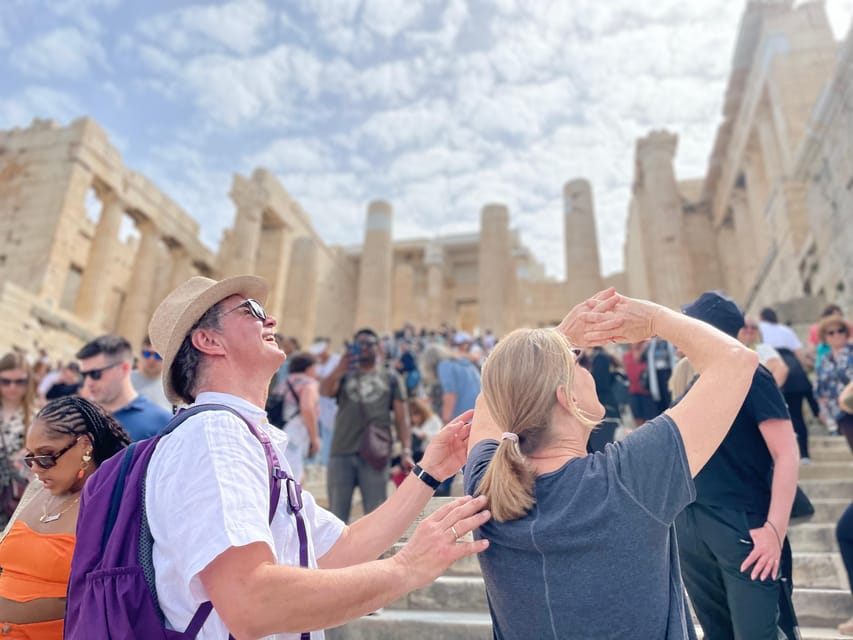
The Acropolis is one of those places where a guide can change the whole experience. Without context, you see columns, foundations, and marble fragments. With a good explanation, you understand how temples, theaters, shrines, politics, religion, and public life fitted together on this rocky hill.
This tour begins early from the southern entrance, across from the Acropolis Museum and close to the Acropolis metro stop. That location is practical if you are staying in central Athens or arriving by metro. Look for the TOP TOURS GREECE office sign and the guide holding it near the meeting point.
The early timing is not just a marketing detail. Athens can become hot on the exposed upper hill, and the Parthenon area can feel crowded later in the morning. Starting at the southern slope lets you handle much of the uphill route before the strongest sun. One guide even made a point of finding shaded spots during the summer, a small service that matters when you are standing still while listening.
The tour lasts two hours. That is a useful length for a first visit, a family outing, or a short stay in Athens. You get a guided route through all the major monuments, then time at the top for your own pictures. You will not get an archaeological seminar on every carved block, but you will leave with a solid grasp of what you saw.
More Acropolis and Parthenon visits:
- Athens: Acropolis & up to 5 Archaeological Sites Combo Pass
★ 4.4 · 12,619 reviews - Athens: Acropolis Ticket with Optional Audio or Live Guide
★ 4.2 · 11,055 reviews - Athens: Acropolis, Parthenon & Acropolis Museum Guided Tour
★ 4.8 · 9,316 reviews
The southern slope and the Theatre of Dionysus
The route starts at the Theatre of Dionysus, where the guide spends about ten minutes setting the stage for ancient Athenian public life. This is traditionally recognized as the world’s oldest theater, built in the fifth century BC and dedicated to Dionysus, the god linked with wine and theater.
Its reported capacity of 17,000 spectators helps you picture the scale. This was not a small performance space for a select few. Theater formed part of civic and religious life, and the guide connects the setting with the culture that produced Greek drama.
I like beginning here because the theater gives you an immediate sense of how the Acropolis functioned as more than a collection of temples. You are looking at a place tied to performance, festivals, public gathering, and shared Athenian identity.
The drawback is that the opening stop is brief. Ten minutes is enough for an explanation and a look, but not enough to study the seating, stage area, and surrounding slope in detail. If theater history is your main interest, plan to return after the guided visit.
The Asklepieion and ancient healing
Next comes the Asklepieion of Athens, a sanctuary connected with Asclepius, the god of medicine. The guide explains the site and its health-related finds in about ten minutes.
This stop adds welcome variety. The Acropolis is often reduced to the Parthenon, but ancient life also included prayer for health and recovery. The sanctuary helps you see how religion and medicine overlapped in the ancient Greek world.
The area may feel less instantly dramatic than the Parthenon, yet it rewards attention. Listen for the explanation of the building’s purpose and the discoveries linked to health. The guide’s role is especially useful here because the remains alone do not tell you much.
The Odeon of Herodes Atticus
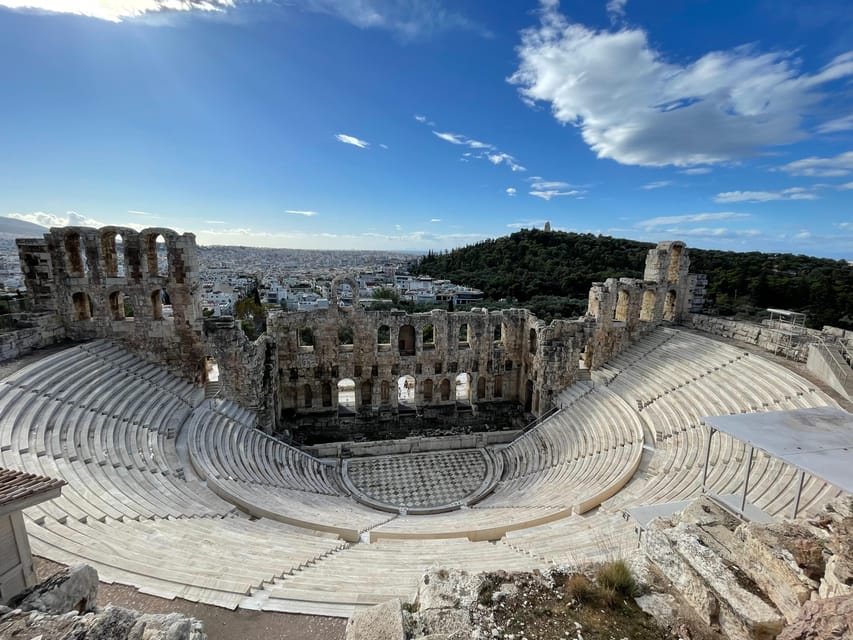
The route continues to the Odeon of Herodes Atticus, a grand theater still used for concerts today. It once had a roof, a detail that helps you imagine how different the building looked in antiquity.
The guide allows about ten minutes here. You will see the curved seating area and the impressive stage structure from the Acropolis route. Its continuing use gives the monument a direct link with modern Athens. This is not only a ruin behind a rope. It remains part of the city’s cultural life.
You may want extra time for photographs, but the guided stop is mainly about orientation and history. The group moves onward rather than lingering for a full architectural inspection.
A few more Athens days worth a look
- Athens: Acropolis Ticket with Audio Guide
★ 4.0 · 3,575 reviews - Athens All Included: Acropolis and Museum Guided Tour with Ticket
★ 4.5 · 2,673 reviews - Athens: Acropolis Museum Ticket with optional Audio Guide
★ 4.4 · 2,652 reviews - Athens: Acropolis Ticket & Optional Self-Guided Audio Tours
★ 4.1 · 2,542 reviews
Entering through the Propylaea
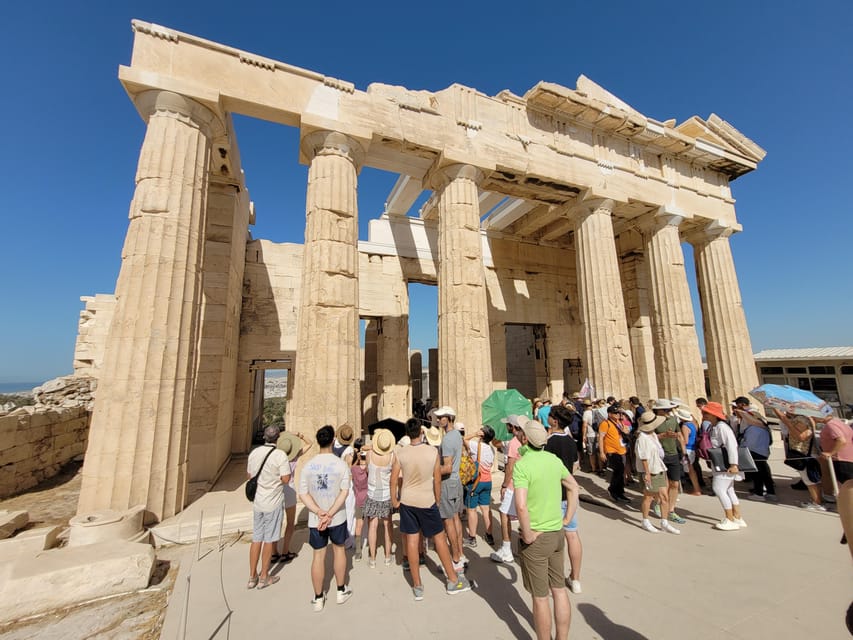
The Propylaea is the grand gateway to the Acropolis, and passing through it gives the climb a sense of arrival. The guide points out the Doric and Ionic architectural styles and explains how this entrance framed access to the sacred hill.
This is one of the tour’s strongest transitions. You move from the theaters and healing sanctuary into the central monument area, passing through the approach used by ancient worshippers and civic processions.
The stop lasts about ten minutes. Take a moment to look up and around as you pass through. The Propylaea is easy to rush because everyone wants to reach the Parthenon, but its scale and design deserve a pause.
The path can be uneven and sloped, so comfortable shoes are wise. The tour is on foot, and the Acropolis is not suitable for wheelchair users. Non-folding wheelchairs, electric wheelchairs, baby strollers, bags, and food and drinks are not allowed under the stated conditions.
The Temple of Athena Nike
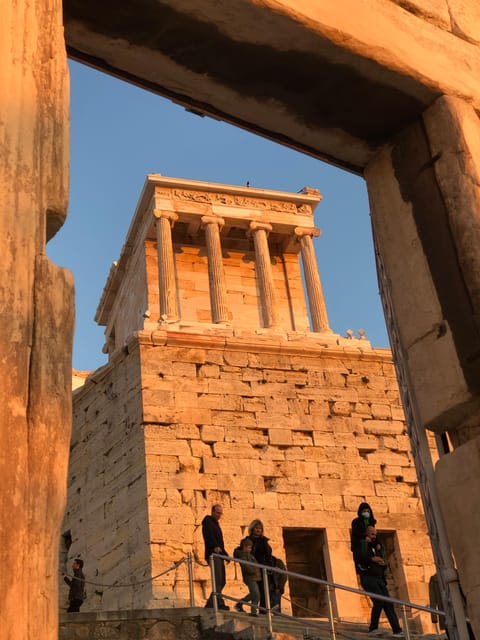
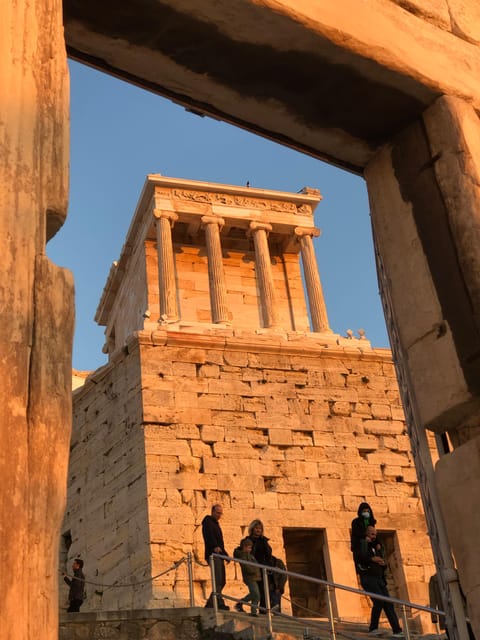
The Temple of Athena Nike receives a shorter explanation of about five minutes. Its position near the entrance makes it easy to overlook, but the guide helps you understand why this small temple matters.
Athena Nike honored Athena in her role as a goddess of victory. Its compact size contrasts with the huge Parthenon, and that contrast makes the Acropolis feel more like a working sacred complex than a single grand building.
Because this is a short stop, you will not spend long examining every feature. Still, the guide’s explanation gives the temple a place in the larger story before you move to the main attraction.
The Parthenon, Athens’ great symbol
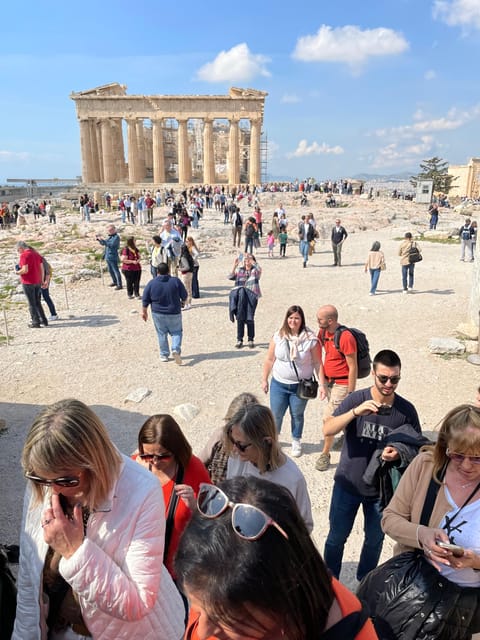
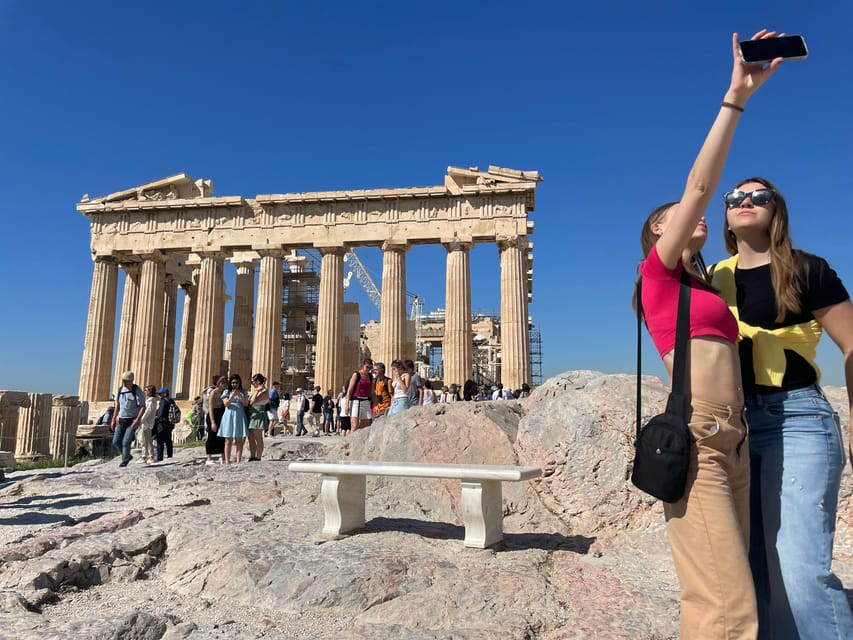
The Parthenon receives the longest stop, about twenty minutes, and rightly so. Built in honor of Athena, the city’s protective goddess, it is the monument most people picture when they think of Greece.
The guide explains its role, design, and place in Athenian society, along with the myths tied to the city. You hear about the famous contest between Athena and Poseidon, when each offered a gift to win Athens. The olive tree associated with Athena and the water source associated with Poseidon remain part of the city’s founding story.
I value the mythological material because it keeps the building from becoming a dry lesson in dates and columns. The guide also connects architecture with belief and power, helping you understand why the Parthenon mattered to the people who built it.
The twenty-minute explanation is useful, but the Parthenon deserves more time than any tour can provide. You will be viewing it from outside, with conservation work and missing sculpture forming part of the modern scene. The guide can explain the site’s importance, but you should not expect access inside the temple or a quiet, empty photo angle.
Take pictures from several sides as you move. The upper hill gives you more than a close view of the columns. You can also look across Athens and out toward the surrounding region. The tour finishes nearby, and you can stay at the top afterward for additional photographs.
The Erechtheion and the famous Caryatids
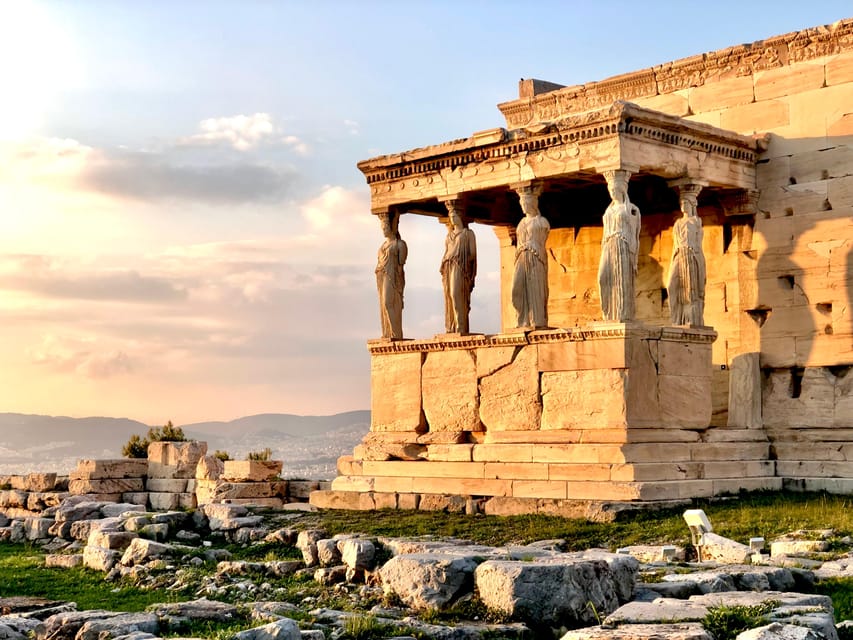
The Erechtheion is one of the most memorable stops because of its unusual design and the Porch of the Caryatids. The guide spends about ten minutes explaining the building and then gives special attention to the feminine-shaped columns.
The Caryatids are architectural figures that serve as supports, combining sculpture and structure in a way that makes the porch instantly recognizable. You will learn why the figures are important and how they fit into the larger sacred area.
The Erechtheion also carries the marks of the contest between Athena and Poseidon. The building is linked with the olive tree and water source associated with those gods, so the earlier myth becomes more meaningful when you reach this point.
The stop at the porch is another place where a guide helps. From a distance, the figures can look like decorative statues. A clear explanation shows how unusual their architectural job is and why the building does not follow the simple, balanced shape of the Parthenon.
You should remember that the Caryatids visible at the Acropolis are protected, and one original Caryatid is in the Acropolis Museum. The tour itself does not include the museum. If you have time afterward, the museum across from the southern entrance is a worthwhile addition, but you will need a separate ticket and visit.
What the two-hour pace feels like
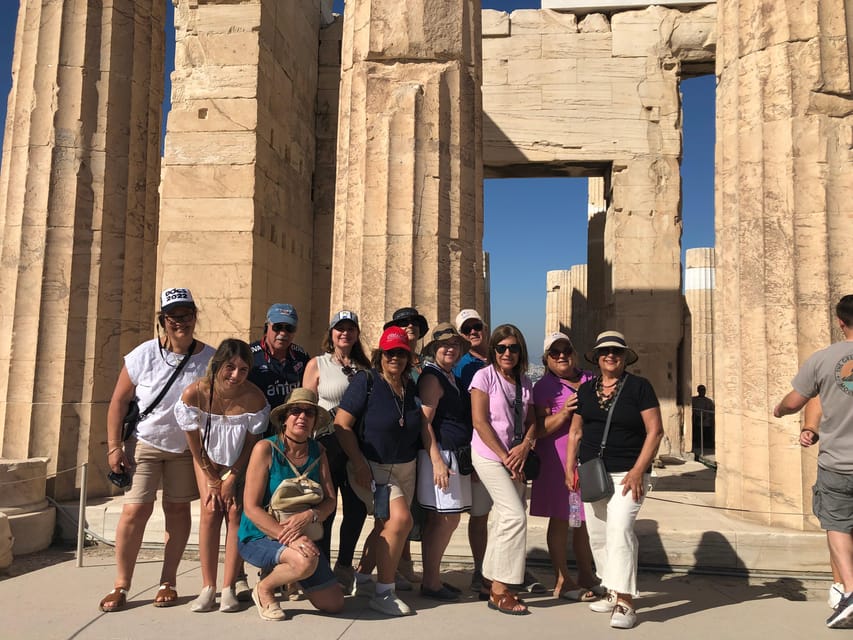
The scheduled stops add up to roughly two hours: ten minutes at the Theatre of Dionysus, ten at the Asklepieion, ten at the Odeon, ten at the Propylaea, five at the Temple of Athena Nike, twenty at the Parthenon, and ten each at the Erechtheion and Caryatid porch. The remaining time covers walking, transitions, and pauses.
This is a moderate pace rather than a race. You keep moving, but the tour is designed to explain the major points without exhausting you. Several guides, including Efi and Simon, have been praised for keeping a good rhythm, answering questions, and making the material easy to follow.
Efi is especially noted for bringing together geopolitics, art, mythology, and Athenian history. She has also been praised for helping families stay engaged, including children. Simon is described as warm and highly informed, with a friendly manner that helps the tour feel personal rather than stiff.
A guided visit depends heavily on the individual guide, and no company can promise a particular person every time. Still, the repeated emphasis on clear explanations, passion, good timing, and kindness is encouraging. If Spanish is important to you, this is a major advantage over joining a mixed-language group or trying to follow an English tour with limited confidence.
Price, tickets, and what you receive
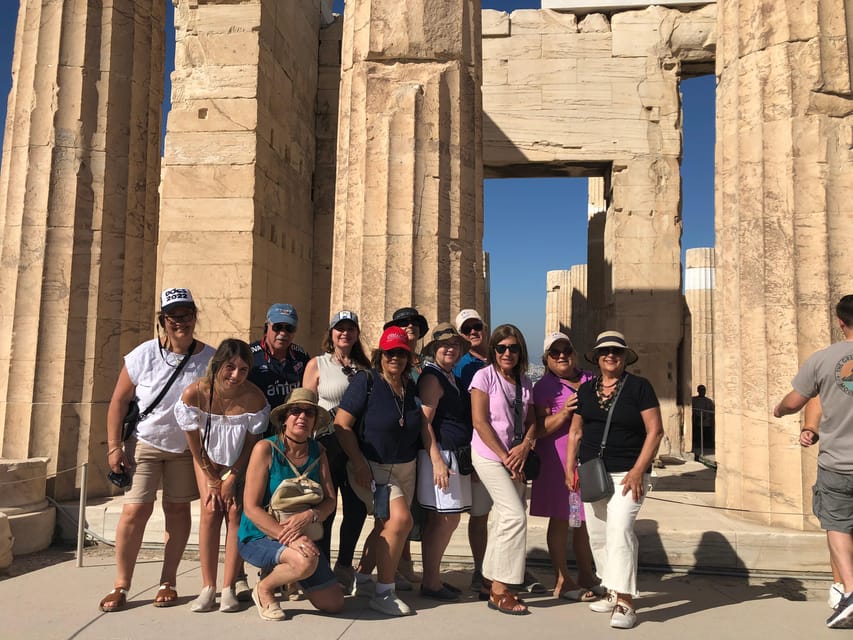
At about $33 per person, this is a fair price for a two-hour guided visit to Athens’ main ancient monument. You are paying for an official Spanish-speaking guide, headphones, early access, and a planned route through all the major Acropolis monuments.
Pay close attention to the ticket selection. Entrance is included only if you choose the option that includes the entrance ticket. The listed price may reflect the selected option, but it is wise to confirm the final booking details before paying.
The skip-the-ticket-line feature can be valuable during busy periods. It does not mean you walk past every security check or enter without following site rules. It means you avoid buying the ticket separately and join the tour through the designated entry process.
No hotel pickup or transfer is included. Food and drinks are also excluded, and food and drinks are not allowed inside the Acropolis under the stated rules. Eat and drink before you enter, and bring only what the site permits.
The tour provides headphones so you can hear the guide clearly. That is useful on an open hill where wind, distance, and nearby groups can make live commentary hard to catch.
Who should book this Acropolis experience?
I would choose this tour if you want the main story in Spanish and prefer a guide to organize the climb. It suits first-time visitors, families, couples, and anyone who wants context without spending half a day on one archaeological site.
It is also a good match for a short Athens stop. In two hours, you cover the major monuments and still have time afterward for the summit views or a separate visit to the Acropolis Museum.
You may want a different format if you prefer to wander alone, spend a long time photographing one building, or study inscriptions and architectural details at length. The route is focused and purposeful, not a slow private examination.
Wear sensible walking shoes and prepare for sun. The hill is exposed, and you will spend time standing while the guide speaks. The early start helps, but it does not remove the need for water before entry, sun protection, and a realistic expectation of uphill walking.
Cancellation is flexible up to 24 hours before the start for a full refund, and you can reserve now and pay later. Those terms are useful if your Athens schedule is still shifting.
Should you book the Spanish Acropolis tour?
Book it if you want a well-paced introduction to the Acropolis, prefer Spanish explanations, and value mythology and history presented together. The route covers the essential monuments, the early start reduces some heat and crowd pressure, and the time at the summit lets you enjoy the site beyond the guide’s final words.
At $33, the experience offers good value when the entrance ticket is included in your chosen option. Just remember that two hours will give you the story and the highlights, not every detail. For most first visits, that is a sensible trade.
FAQ
Is the tour conducted in Spanish?
Yes. The experience includes a live, officially qualified tour guide in Spanish.
How long does the Acropolis tour last?
The tour lasts two hours. After the guided portion, you can remain at the top of the hill as long as you like for photographs and views.
Where is the meeting point?
The meeting point is beside the southern entrance of the Acropolis, across from the Acropolis Museum and a few meters from the Acropolis metro stop. Look for the TOP TOURS GREECE office sign.
Does the tour include the Acropolis entrance ticket?
The entrance ticket is included only when you select the ticket-inclusive option during booking. Check the option details before confirming.
What monuments are included?
The route includes the Theatre of Dionysus, Asklepieion, Odeon of Herodes Atticus, Propylaea, Temple of Athena Nike, Parthenon, Erechtheion, and Porch of the Caryatids.
Is the tour suitable for wheelchair users or strollers?
No. The activity is not suitable for wheelchair users, and non-folding wheelchairs, electric wheelchairs, and baby strollers are not allowed.
Freshly added Athens trips
- Athens and Ancient Corinth Private from Athens★ 5.0 · 3 reviews
- From Athens: Mycenae and Epidaurus Private Tour★ 4.8 · 3 reviews
- Full day Meteora private tour★ 5.0 · 3 reviews
- Double Shore Dive (certified divers)★ 4.5 · 3 reviews
- Athens Hills: Mythology Treasure Hunt★ 5.0 · 3 reviews
- Sunset & swimming at Cape Sounio, Poseidon temple★ 5.0 · 3 reviews
- Philosophy Experience at Plato’s Academy Park – basic version★ 5.0 · 3 reviews
- Private Acropolis Tour – Ticket Included★ 5.0 · 3 reviews
Acropolis Tours, compared.

Acropolis & up to 5 Archaeological Sites Combo Pass
Read our review →

Acropolis, Parthenon & Acropolis Museum Guided Tour
Read our review →
Acropolis, Parthenon & Acropolis Museum Guided Tour
Read our review →


Acropolis monuments & Parthenon Walking Tour with Optional Acropolis Museum
Read our review →Browse the lists this tour appears in