
Reviewed · GREEK MYTHOLOGY TOURS
Mythology, Philosophy and Democracy Tour
The most interesting thing about this Athens walk is its connecting idea: myth led to questions, questions led to philosophy, and philosophy helped shape democracy. Instead of treating ancient ruins as separate photo stops, Panos links them into one long story about how Athenians thought, argued, governed, and lived.
I like the visit to Pnyx Hill, where citizens gathered for public debate, and the way the tour ends on Philopappos Hill with broad views toward the Acropolis. The other big plus is Panos himself, whose wit, enthusiasm, and ability to relate ancient problems to modern life give the walk more bite than a standard city tour.
The main caution is the physical setting. This is a roughly three-hour walk with hills and outdoor stops, and Athens can be fiercely hot. The pace is described as easy, but you’ll still want water, sun protection, and sensible shoes.
In This Review
- Key points at a glance
- Why this walk is different from a standard Athens tour
- Kerameikos, where pottery and public memory meet
- The Ancient Agora and the habit of public argument
- Monastiraki, Roman Athens, and the Tower of the Winds
- Hadrian’s Library and Plaka’s narrow streets
- Pnyx Hill and the birth of democratic debate
- Philopappos Hill and the best views of the Acropolis
- Price, group size, and what you receive
- Who will get the most from this Athens experience
- Should you book the Mythology, Philosophy and Democracy Tour?
- FAQ
- How long does the Mythology, Philosophy and Democracy Tour last?
- How much does the tour cost?
- Who guides the tour?
- What language is the tour offered in?
- How large is the tour group?
- Where does the tour begin and end?
- Are admission tickets included?
- What happens if I need to cancel?
Key points at a glance
- Ancient Athens in one connected story: Mythology, philosophy, mathematics, politics, literature, and democracy are treated as parts of the same intellectual journey.
- Kerameikos offers a quieter start: This former pottery district and cemetery is often missed, yet it connects directly to Pericles and his famous funeral speech.
- Pnyx Hill is the political centerpiece: You visit the place often described as the world’s first parliament, where Athenian citizens gathered to debate public affairs.
- Panos is central to the experience: His style combines serious historical detail with humor, questions, and links to modern political and social life.
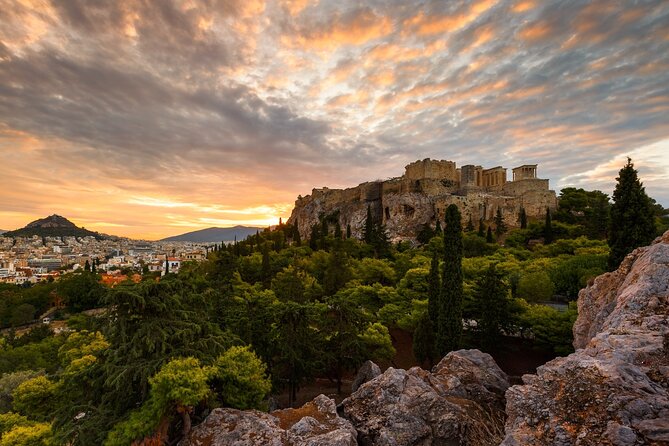
- The finish rewards the uphill walk: Philopappos Hill gives you some of the tour’s best views of the Acropolis and Athens, especially later in the day.
- Small groups keep it personal: The maximum group size is 12, and the tour is offered in English for $50.69 per person.
Why this walk is different from a standard Athens tour
Many Athens walks move from ruin to ruin, naming an emperor here and a temple there. This one takes a more thoughtful route. You are not simply shown where ancient buildings once stood. You are asked to consider why people began challenging inherited beliefs, how public debate worked, and how ideas from ancient Greece still shape political life today.
That approach suits you if you want more than a quick introduction to the Acropolis. Several parts of Athens are familiar names, including Monastiraki, Plaka, and the Ancient Agora. Yet the focus here is not only on what you see. It is on what happened in these places and why it mattered.
Panos is the guide identified for this experience, and his role appears to be much more than reading dates from a script. His delivery is described as witty, thoughtful, and stimulating, with plenty of space for conversation. He also adjusts the discussion to the interests of the group, which matters on a subject that can range from mythology and literature to mathematics and political theory.
I especially like the way the walk can help you make sense of Athens before visiting the Acropolis. The Parthenon is magnificent, but its meaning becomes clearer when you understand the civic world that produced it.
More mythology-flavoured Athens days:
- Athens: Mythology of Delphi, Museum and Arachova Guided Tour
★ 4.6 · 4,008 reviews - Athens & Acropolis Highlights: Greek Mythology Small-Group Tour
★ 5.0 · 2,370 reviews - Athens: Acropolis and Mythology Highlights Small Group Tour
★ 4.8 · 2,275 reviews
Kerameikos, where pottery and public memory meet
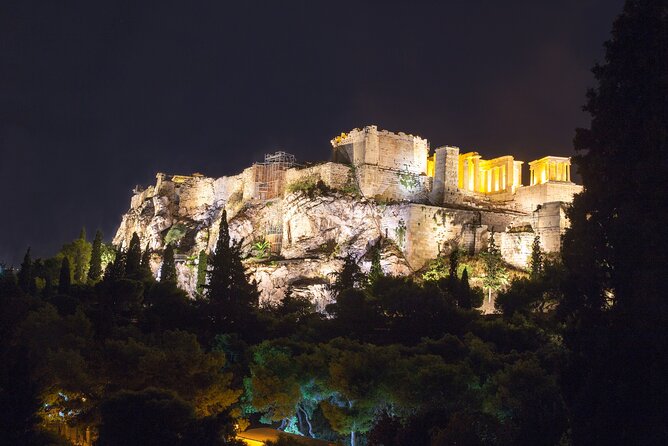
The walk begins at the Statue of Theseus and heads to Kerameikos, one of the most useful stops for understanding Athens beyond its famous monuments. The name refers to ceramics, since pottery workshops once filled this area. It also served as the city’s cemetery for centuries.
That combination gives Kerameikos a different mood from the central squares. You are looking at a place tied to daily work, burial customs, civic identity, and public memory. Important Athenians were buried here, and the area offers a direct reminder that ancient Athens was not only a city of temples and philosophers. It was also a working city where ordinary routines and public rituals shaped life.
Kerameikos is linked to Pericles and his famous Epitaphios, or funeral speech, given for the first Athenian casualties of the Peloponnesian War. The speech praised the virtues of Athens and its democratic system. That makes this a strong opening stop because the tour’s main subject begins with a real place and a real political moment.
You spend about 25 minutes here. Admission is listed as free, though the tour information does not clarify whether the walk enters every archaeological area or focuses on accessible points around the site. Ask your guide at the meeting point if that distinction matters to you.
The Ancient Agora and the habit of public argument
The Ancient Agora was the heart of Athens. It was a marketplace, meeting ground, and civic center where politicians, philosophers, writers, and everyday citizens crossed paths.
This is where the tour shifts from public memory to public discussion. Socrates, Plato, Solon, Themistocles, Pericles, Thucydides, Sophocles, and Aristophanes are all tied to the intellectual and political life of Athens. The point is not that they all used the Agora in exactly the same way. The point is that ideas were tested in public, through speeches, questions, disputes, and persuasion.
You have only about 10 minutes listed at the Ancient Agora, so do not expect a full archaeological tour of every structure. Instead, think of this as a focused explanation of what the Agora meant to Athenian life. If you want a longer visit to the archaeological grounds, you may need to return on your own.
That limited timing is one of the tour’s tradeoffs. The broad subject matter is exciting, but no single site receives a long treatment. The reward is the larger arc, as the walk keeps moving through the city rather than settling into one monument.
Monastiraki, Roman Athens, and the Tower of the Winds

From the Ancient Agora, the route continues at an easy pace through Monastiraki Square and its flea market. This is a useful change of tone. After burial grounds and civic debate, you get street life, antique shops, and tourist stores in one of Athens’s most recognizable areas.
The stop is listed at about 10 minutes, so you are not being given a dedicated shopping session. Instead, Monastiraki helps connect ancient Athens with the modern city around it. You see how the old center remains part of everyday Athens, with people moving through the same broad urban zone for commerce, food, and conversation.
The Roman Agora lies north of the Acropolis and east of the Ancient Agora. Its presence helps explain how Athens changed under Roman rule while keeping its old cultural importance. The stop is brief, but it adds a useful layer to the story. Ancient Athens was not frozen in its classical period. It continued to be used, adapted, and reinterpreted.
Nearby, the Tower of the Winds is one of the tour’s most appealing details. Built by the astronomer Andronicus of Kyrristos in the first century BC, the octagonal structure functioned as a wind indicator and a clock. It also served as an early meteorological station.
The clock used sunlight, with a hydraulic mechanism for cloudy days. The supplied description says the water system produced a sound every hour. That small detail makes the structure easier to picture as working technology rather than just an attractive stone building.
This is a good example of the tour’s wider theme. Greek thought was not limited to gods, legends, and abstract arguments. It also involved observation, measurement, mathematics, and practical attempts to understand the natural world.
Same city, a completely different century:
- Athens: Acropolis & up to 5 Archaeological Sites Combo Pass
★ 4.4 · 12,619 reviews - Athens: Acropolis Ticket with Optional Audio or Live Guide
★ 4.2 · 11,055 reviews - Athens: Acropolis, Parthenon & Acropolis Museum Guided Tour
★ 4.8 · 9,316 reviews - Athens: Cape Sounion & Poseidon Temple Sunset Half-Day Trip
★ 4.8 · 8,241 reviews
Hadrian’s Library and Plaka’s narrow streets

Hadrian’s Library was built by the Roman emperor Hadrian in AD 132 on the north side of the Acropolis. It was once the second-largest library in the world, according to the tour description.
The stop lasts about 10 minutes, so the emphasis is likely on its role in the intellectual life of Roman Athens rather than a long architectural inspection. The library also reinforces a useful point: Greek ideas continued to matter under Roman power, and Athens remained associated with learning long after its democratic golden age had passed.
Then the route turns toward Plaka, a scenic neighborhood of small houses and narrow streets. Plaka is not presented as a major lecture stop. Its value is visual and atmospheric. The lanes provide a pleasant transition from archaeological Athens to the lived-in city.
I like this part because it keeps the tour from feeling like a string of fenced-off ruins. You get monuments, public spaces, working streets, and residential corners. That mixture helps you see Athens as a city with many historical layers rather than a museum spread across a modern capital.
Pnyx Hill and the birth of democratic debate
Pnyx Hill is the intellectual and political center of the walk. It is described as the first parliament in the world, and it offers wide views across the surrounding area.
This was the place where Athenian citizens gathered to discuss public matters. The idea of democracy here was direct and physical. You did not simply hear that citizens had a political voice. You stood on the hill where public speech and collective decision-making were part of civic life.
The tour gives about 25 minutes to Pnyx. That should provide enough time for Panos to explain the setting and its importance while allowing you to look across the city. The hill also helps make the connection between philosophy and politics more concrete. Asking what makes a good life is one kind of philosophical question. Asking who should make public decisions, and how, takes that questioning into civic life.
Do keep the conditions in mind. Pnyx is outdoors, and the overall route includes uphill walking. A morning or evening departure may be more comfortable than the hottest part of the day. One family found the heat difficult but appreciated water and ice cream stops arranged by Panos. Those breaks may depend on the day and group, so bring your own water rather than counting on them.
Philopappos Hill and the best views of the Acropolis
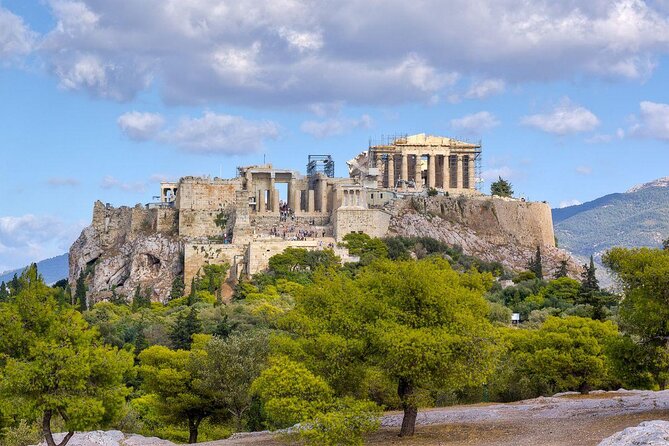
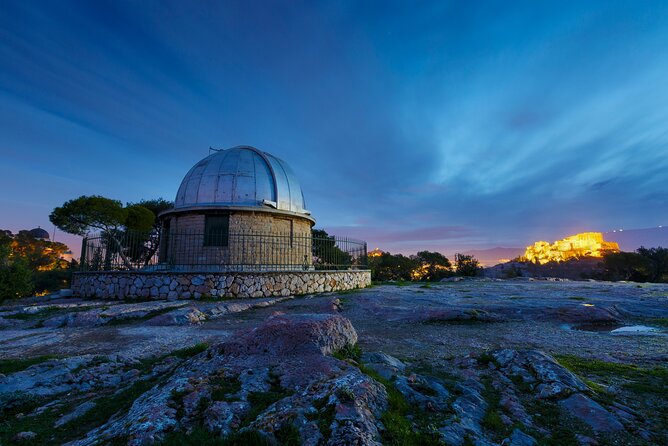
The tour ends on Philopappos Hill, also called the Hill of the Muses. The final stop is listed at about 45 minutes, making it the longest pause of the day.
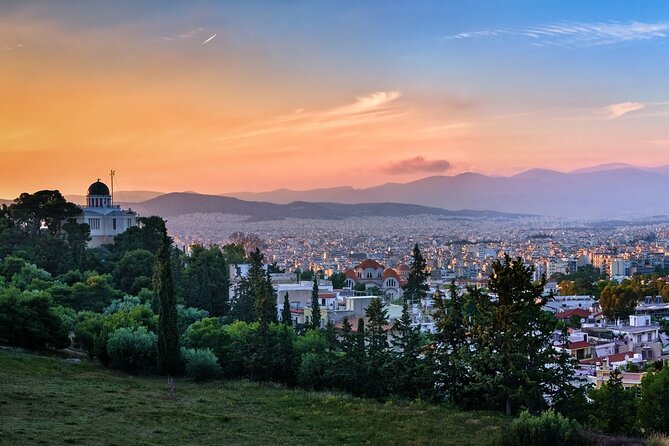
That extra time is well used. The hill offers major views of the Acropolis and Athens, including especially striking evening and nighttime outlooks. It gives the tour a calm ending after the dense ideas of the earlier stops.
The endpoint is also practical. You finish at Philopappos Hill rather than returning to the starting point near the Statue of Theseus. Plan your next move before setting out, especially if you have dinner reservations or another timed visit. The tour information lists the endpoint as Philopappos Hill on Fylís Street in Athens.
For me, the ending works because it brings the whole walk back to place. You have heard about speeches, civic life, philosophy, science, and the long changes of the city. Then you look over Athens and see the Acropolis from a different angle. It is a strong visual finish, but the walk is not just a sightseeing route with a viewpoint attached. The view has more meaning after the discussion at Pnyx and the earlier stops.
Price, group size, and what you receive
At $50.69 per person, the tour is not the cheapest way to walk around central Athens. Its value depends on how much use you make of the guide’s interpretation.
All listed stops have free admission, so you are paying mainly for the three-hour guided experience rather than entrance tickets. That can be good value if you want a clear intellectual framework, personal conversation, and places you might otherwise pass without understanding. It is less useful if you prefer to move quickly, take photos, and read signs at your own pace.
The group is limited to 12 people. That is a sensible size for a discussion-based walk. A guide can hear questions, adjust the pace, and keep the group together without the feel of a large procession.
The tour is offered in English and includes a mobile ticket. Confirmation arrives when you book. Service animals are allowed, public transportation is nearby, and the activity states that most people can participate. Still, the route is outdoors and includes hills, so personal comfort with walking and warm weather matters.
Free cancellation is available up to 24 hours before the start time for a full refund. Changes made within 24 hours are not accepted, and late cancellations are not refunded. The experience requires good weather and a minimum number of participants. If weather or numbers force cancellation, you are offered another date or experience, or a full refund.
Who will get the most from this Athens experience
I would choose this tour for you if you enjoy asking why, not only what. It suits adults, older teenagers, university students, and families with children who can follow a serious discussion. One family found it educational for children, and another participant specifically valued the way the guide encouraged critical thinking.
It is also a good choice if you have several days in Athens and want to build a mental map of the ancient center. The route touches major names but also gives time to less familiar places, especially Kerameikos, Pnyx, and Philopappos Hill.
You may want something else if your main goal is a detailed archaeological visit. The Ancient Agora, Roman Agora, Hadrian’s Library, and other sites receive short stops, often about 10 minutes. This is a thematic city walk, not a long museum-style examination of every ruin.
Wear comfortable shoes and carry water. Consider booking for a cooler part of the day, since heat can affect how much you enjoy the discussion and the hills. If you are visiting the Acropolis, taking this walk first can give you useful context for the monuments you see afterward.
Should you book the Mythology, Philosophy and Democracy Tour?
Book it if you want Athens to make sense as more than a collection of ancient stones. Panos brings together mythology, philosophy, political thought, mathematics, literature, and daily life, while the route places those ideas in the streets and hills where they matter.
The best reasons to go are the connected storytelling, the small group, the Pnyx visit, and the final Acropolis views from Philopappos Hill. The main reasons to hesitate are the outdoor heat, uphill walking, and short time at several archaeological stops.
For a first or second day in Athens, I think this is a smart choice, especially before visiting the Acropolis. It gives you questions to carry into the rest of the city, and that is often more useful than another list of dates.
FAQ
How long does the Mythology, Philosophy and Democracy Tour last?
The tour lasts approximately three hours.
How much does the tour cost?
The listed price is $50.69 per person.
Who guides the tour?
The guide named in the experience information is Panos, from Athens Classic Tour.
What language is the tour offered in?
The tour is offered in English.
How large is the tour group?
The experience has a maximum of 12 travelers.
Where does the tour begin and end?
The tour begins at the Statue of Theseus in Athens and ends at Philopappos Hill.
Are admission tickets included?
The listed admission cost for each stop is free. The experience information does not specify that every archaeological area receives an interior visit.
What happens if I need to cancel?
You can cancel at least 24 hours before the start time for a full refund. Cancellations or changes made less than 24 hours before the start time are not accepted for a refund. If bad weather or an insufficient number of participants cancels the tour, you are offered another date or experience, or a full refund.
Freshly added Athens trips
- Athens and Ancient Corinth Private from Athens★ 5.0 · 3 reviews
- From Athens: Mycenae and Epidaurus Private Tour★ 4.8 · 3 reviews
- Full day Meteora private tour★ 5.0 · 3 reviews
- Double Shore Dive (certified divers)★ 4.5 · 3 reviews
- Athens Hills: Mythology Treasure Hunt★ 5.0 · 3 reviews
- Sunset & swimming at Cape Sounio, Poseidon temple★ 5.0 · 3 reviews
- Philosophy Experience at Plato’s Academy Park – basic version★ 5.0 · 3 reviews
- Private Acropolis Tour – Ticket Included★ 5.0 · 3 reviews
Greek Mythology Tours, compared.

Mythology of Delphi, Museum and Arachova Guided Tour
Read our review →
Athens & Acropolis Highlights: Greek Mythology Small-Group Tour
Read our review →
Acropolis and Mythology Highlights Small Group Tour
Read our review →
The History of Athens: Greek Mythology Private Tour
Read our review →
Greek Mythology Treasure Hunt for Kids – Athens Private Tour
Read our review →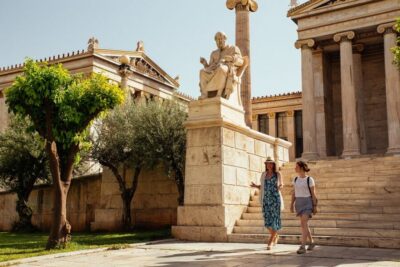
Browse the lists this tour appears in