

Reviewed · GREEK MYTHOLOGY TOURS
Greek Mythology for Kids: Private Tour
A good mythology tour does more than recite names from a textbook. This one turns Athens into a storybook, with children chasing clues, solving riddles, acting out legends, and learning why gods, heroes, monsters, and ancient buildings still matter. The route links the Acropolis area with the Arch of Hadrian, Zappeion, the Panathenaic Stadium, the National Garden, and Syntagma Square.
I like the private format, because the guide can keep the pace suited to your own children. I also like the hands-on rewards, including a mythology booklet, board game, activity materials, and a medal that each child can keep. Guides such as Niki, Antonia, Effie, Bianca, and Martina have been praised for keeping children involved for more than three hours.
The main drawback is the amount of walking. The tour lasts four hours and includes several long walking sections, so it is not suitable for people with mobility impairments. At $170 per person, it is also a serious family expense, though the private guide and teaching materials make more sense for families who want a focused activity rather than a standard city walk.
In This Review
- Key points before you book
- Why mythology works better than a standard city tour
- Starting near the Acropolis Metro Station
- Lysicrates Monument and the first story clues
- Hadrian’s Arch and the changing city
- Zappeion and the Panathenaic Stadium
- The National Garden as a break from monuments
- Finishing at Syntagma Square with Pandora’s Box
- How the private format affects the experience
- What the $170 price means for a family
- Timing, walking, and family comfort
- Who should book this mythology walk?
- Should you book Greek Mythology for Kids?
- FAQ
- How long does the Greek Mythology for Kids tour last?
- Where does the tour meet?
- Where does the tour finish?
- Is this a private tour?
- What language is the tour in?
- Which Athens sights are included in the walking route?
- Are entrance fees included?
- What do children receive during the tour?
- What should I wear?
- Can I cancel for a full refund?
Key points before you book

- Greek myths become a moving game: Children learn about Hercules, Athena, Icarus, Pandora, and the Minotaur while walking through central Athens.
- The guide works only with your private group: This allows activities and questions to match your children’s age and energy.
- Expect riddles, role-play, and treasure-hunt challenges: The format gives lively children something to do between explanations.
- The route covers major central sights: You pass Lysicrates Monument, Hadrian’s Arch, Zappeion, the Panathenaic Stadium, the National Garden, and Syntagma Square.
- Children take home several keepsakes: Materials, a mythology booklet, a board game, and a medal are included.
- Wear proper walking shoes: The four-hour route is not a good match for limited mobility or children who tire quickly.
Why mythology works better than a standard city tour
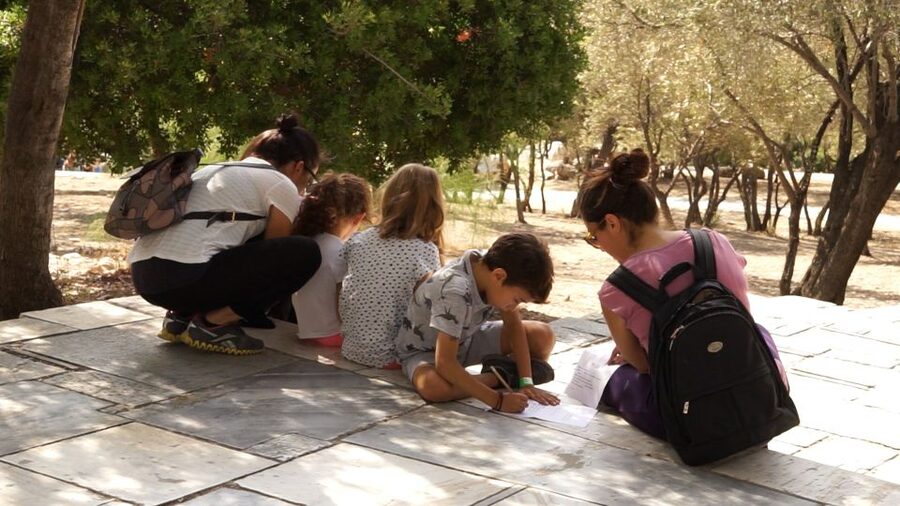
Greek mythology is full of strong hooks for children. There are flying boys, bull-headed monsters, jealous gods, heroic battles, impossible quests, and a box that releases every trouble into the world except Hope. A guide can use those stories to explain ancient beliefs without making the children sit through a long lecture.
The tour focuses on the gods and goddesses of Mount Olympus, along with well-known figures such as Hercules, Athena, and Icarus. Children also learn about the Minotaur, the monster said to live in the labyrinth, and Pandora’s Box. These tales give young visitors a simple way to connect with Athens before they tackle more formal archaeology.
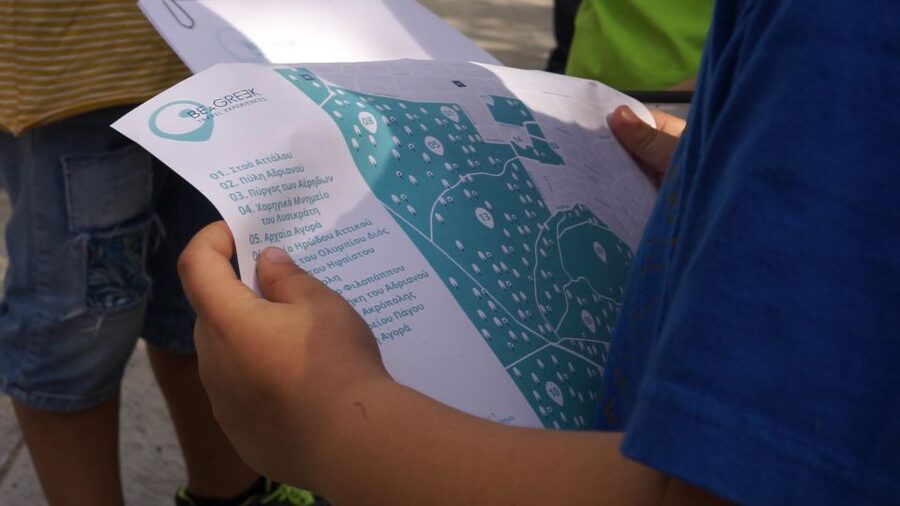
The strongest feature is the use of games and role-play. Children follow maps, answer riddles, complete challenges, and take part in a treasure hunt. That matters because attention often fades during a walking tour, especially when adults are looking at stones and children are wondering when the next snack break will come.
The format has worked for a range of ages. One guide kept two boys aged 10 and 13 interested for more than three and a half hours. Another family used the tour with children aged 7 and 9, then visited the Acropolis afterward. That does not guarantee the same result for every family, but it suggests the activity can hold the attention of primary-school children and young teenagers when the guide keeps the pace lively.
More mythology-flavoured Athens days:
- Athens: Mythology of Delphi, Museum and Arachova Guided Tour
★ 4.6 · 4,008 reviews - Athens & Acropolis Highlights: Greek Mythology Small-Group Tour
★ 5.0 · 2,370 reviews - Athens: Acropolis and Mythology Highlights Small Group Tour
★ 4.8 · 2,275 reviews
Starting near the Acropolis Metro Station
The meeting point is outside Acropolis Metro Station on Makrigianni Street. The tour begins in the Acropolis area, so you should arrive ready to walk rather than expecting a vehicle-based excursion. The endpoint is Syntagma Square, which makes the route useful for families staying in central Athens or planning to continue sightseeing downtown.
Your guide introduces the ancient Greek world through stories of gods, heroes, heroines, natural events, and the quarrels of the Olympians. The focus is not only on memorizing who is related to whom. The better lesson is learning how the ancient Greeks used myths to explain storms, cities, the sea, the stars, courage, greed, and hope.
The private setting is especially useful here. If your child is fascinated by monsters, the guide can spend more time on the Minotaur. If another child prefers heroes or clever goddesses, the discussion can shift. English is the stated tour language. One booking included Spanish conversation, but you should not assume that Spanish is always available unless the provider confirms it.
Lysicrates Monument and the first story clues

The first named stop is the Choragic Monument of Lysicrates, a small but memorable monument in the Plaka area. It is connected with ancient theatrical competitions and gives the guide a useful setting for explaining how public performances and storytelling mattered in Athens.
For children, the value is not just the monument itself. This is a good place to show that ancient Athens was not only about temples and battles. Drama, contests, public honor, and storytelling were part of civic life. A guide can connect those ideas to the myths children are already learning.
The stop also helps the group settle into the tour. The first few activities can establish the pattern: listen to a short story, solve a clue, act out an idea, and move on. That rhythm is more effective for children than stopping at every monument for a long explanation.
Hadrian’s Arch and the changing city
The route then continues to Hadrian’s Arch, known in Greek as Porte d’Hadrien. This Roman gateway marks the transition between the old Greek city and the later Roman development of Athens. It is a handy visual lesson in how cities change hands, expand, and collect new layers over time.
The arch is also a useful contrast to the mythic material. Greek gods belong to an older world, while Hadrian’s monument reflects the Roman period. Your children can begin to see that Athens was not created in one single age. Different rulers and cultures added their own buildings and ideas.
The drawback is that the experience is outdoors and exposed to the city. The guide can make the site lively, but you should still expect normal urban conditions, traffic noise, and pauses beside public monuments rather than a quiet museum classroom. Comfortable clothing and sports shoes are advised for both children and adults.
A few more Athens days worth a look
- Best of Athens Half Day Private Tour
★ 5.0 · 3,714 reviews - Athens Full Day Private Tour
★ 5.0 · 2,903 reviews - Athens Airport Private Arrival Transfer with Meet & Greet
★ 4.5 · 1,495 reviews - Athens Airport to Athens Hotels Private Arrival Transfer
★ 5.0 · 947 reviews
Zappeion and the Panathenaic Stadium
Zappeion provides another central Athens setting for stories and games. Its grand architecture and open surroundings give the group room to continue the activities while connecting the modern city with older traditions of ceremony and public life.
The Panathenaic Stadium is likely to be one of the most appealing stops for children. It is a striking marble stadium with an obvious connection to athletic contests. Even without an entrance ticket, the exterior and surrounding views offer a strong chance to talk about competition, physical skill, victory, and the ancient Olympic world.
The mythology games fit naturally here. Hercules can lead into strength and heroic trials. Athena can introduce strategy and wisdom rather than brute force. The guide can also use the setting to ask children what makes a hero: winning, helping others, solving a problem, or showing courage.
Entrance fees are not included. That point matters if you hope to go inside any attraction during the tour. The activity is designed as a walking experience through central Athens, so budget separately if you want paid entry at a particular site.
The National Garden as a break from monuments
The National Garden changes the feel of the route. After several urban landmarks, the garden gives children a more relaxed setting for games, clues, and stories. It also helps break up the sightseeing so the tour does not feel like four straight hours of standing beside buildings.
This is where the game-based structure earns its keep. A child who has been patient through several explanations can get a fresh burst of energy from a riddle or treasure-hunt task. The guide may use the setting to revisit the myths and see what the children remember.
The tour materials add a useful sense of progress. Children can keep the work they produce during the activities, along with the mythology booklet and board game. Those items are not just souvenirs. They help the story continue after the walk, which is valuable when a child wants to retell the Minotaur tale or quiz a sibling about the Olympian gods.
Finishing at Syntagma Square with Pandora’s Box
The final stop is Syntagma Square. The tour ends here, so you finish in a central part of Athens rather than returning to the Acropolis area. That can be convenient if you want to continue toward central shops, restaurants, or other city sights, though the activity itself does not include onward transport.
The closing story concerns Pandora’s Box and Hope. It is a thoughtful ending for children because it moves beyond monsters and heroic strength. The lesson is that even after trouble enters the world, Hope remains, giving people courage.
That final idea gives the tour more purpose than a simple list of myths. Children learn names and plots, but they also encounter ideas about bravery, curiosity, responsibility, jealousy, cleverness, and resilience. Those themes are why Greek mythology continues to work so well as a first introduction to ancient culture.
How the private format affects the experience
A private group is the biggest practical advantage. You are not sharing the guide’s attention with a busload of strangers, and the children do not need to match the pace of a large group. If one child asks many questions while another prefers the games, the guide has more room to adjust.
Several guides associated with the experience have received strong praise for their work with energetic children. Antonia was particularly effective with two older boys during a long session, while Bianca handled an active group through maps, riddles, and games. Niki was praised for keeping children engaged throughout, and Effie managed a four-and-a-half-hour family experience that continued with a visit to the Acropolis afterward. Martina also led a family experience that included Spanish conversation.
These names reflect individual guide experiences, not a promise that you will receive a specific person. Still, they point to the quality that matters most here: an educator who knows when to tell a story and when to give children a task.
What the $170 price means for a family
At $170 per person, this is not a cheap way to see Athens. A family of four would pay $680 before any entrance fees or personal expenses. You should compare that cost with the value of a private four-hour activity, rather than with the price of a basic group walking tour.
The price makes more sense if your children are likely to resist conventional sightseeing. You are paying for a guide trained to work with children, activity materials, a booklet, a board game, a medal, and refreshments such as coffee or another traditional drink for each person. The guide also gives structure to a route that could otherwise become a tiring sequence of monuments.
It makes less sense if your children already enjoy quiet archaeological explanations, or if you only have a short time in Athens and want to spend it inside the Acropolis sites. No entrance fees are included, and the tour does not replace a dedicated Acropolis visit. It works better as a child-focused introduction to Greek stories and central Athens.
Timing, walking, and family comfort
The tour lasts four hours. The route lists walking sections between the Acropolis area, Lysicrates Monument, Hadrian’s Arch, Zappeion, the Panathenaic Stadium, the National Garden, and Syntagma Square. That is a substantial outing for younger children, even though the guide uses games to keep the pace active.
Wear comfortable shoes and sports clothing. Children should have enough energy for a long city walk, and adults should be prepared to stay involved rather than treating this as a drop-off activity. The tour is not suitable for people with mobility impairments.
A useful planning choice is to schedule the tour when your children are usually alert. The experience depends on participation, so a tired child may get less from the riddles and role-play. You can also keep the rest of that day lighter, especially if you plan to visit the Acropolis afterward.
Cancellation is flexible up to 24 hours before the start for a full refund, and you can reserve now and pay later. Starting times vary, so you need to check availability when booking.
Who should book this mythology walk?
I would choose this tour for families with children roughly in the primary-school and early teenage years, especially if your children enjoy puzzles, storytelling, treasure hunts, or acting out characters. It is also a good fit for parents who want cultural content but know their children will not sit through a formal history talk.
It may suit an energetic family better than a stroller-paced sightseeing plan. The long walk and four-hour duration require stamina, and the activity is not designed for visitors with mobility limitations.
I would skip it if your main goal is detailed archaeology, interior visits, or a quiet adult-focused tour. The route gives you views and context around major sights, but the heart of the experience is participation. You and your children should be ready to answer questions, follow clues, and play along.
Should you book Greek Mythology for Kids?
Book it if you want your children to remember Athens through stories rather than dates and building names. The combination of a private guide, treasure-hunt challenges, riddles, role-play, and take-home materials gives the tour a clear purpose: make ancient Greece understandable and fun for young minds.
Think carefully about the price and the walking distance. For a family that needs a flexible, child-centered introduction to the city, $170 per person can be reasonable. For a family seeking low-cost sightseeing or detailed access to monuments, it is harder to justify.
The best reason to book is simple: your children can meet Athena, Hercules, Icarus, the Minotaur, and Pandora while walking through real Athens. That connection between story and place is what can turn a family day of sightseeing into a memory the children carry home.
FAQ
How long does the Greek Mythology for Kids tour last?
The tour lasts four hours.
Where does the tour meet?
The meeting point is outside Acropolis Metro Station on Makrigianni Street.
Where does the tour finish?
The tour finishes at Syntagma Square.
Is this a private tour?
Yes. The activity is operated for a private group.
What language is the tour in?
The stated tour language is English.
Which Athens sights are included in the walking route?
The route includes the Acropolis area, the Choragic Monument of Lysicrates, Hadrian’s Arch, Zappeion, the Panathenaic Stadium, the National Garden, and Syntagma Square.
Are entrance fees included?
No. Entrance fees to points of interest are not included.
What do children receive during the tour?
Activity materials, a mythology booklet, a board game, and a medal are included. Children may keep the materials made during the activities.
What should I wear?
Wear comfortable clothing and comfortable shoes, preferably sports shoes, because the activity includes substantial walking.
Can I cancel for a full refund?
Yes. You can cancel up to 24 hours in advance for a full refund. You can also reserve now and pay later.
Freshly added Athens trips
- Athens and Ancient Corinth Private from Athens★ 5.0 · 3 reviews
- From Athens: Mycenae and Epidaurus Private Tour★ 4.8 · 3 reviews
- Full day Meteora private tour★ 5.0 · 3 reviews
- Double Shore Dive (certified divers)★ 4.5 · 3 reviews
- Athens Hills: Mythology Treasure Hunt★ 5.0 · 3 reviews
- Sunset & swimming at Cape Sounio, Poseidon temple★ 5.0 · 3 reviews
- Philosophy Experience at Plato’s Academy Park – basic version★ 5.0 · 3 reviews
- Private Acropolis Tour – Ticket Included★ 5.0 · 3 reviews
Greek Mythology Tours, compared.

Mythology of Delphi, Museum and Arachova Guided Tour
Read our review →
Athens & Acropolis Highlights: Greek Mythology Small-Group Tour
Read our review →
Acropolis and Mythology Highlights Small Group Tour
Read our review →
The History of Athens: Greek Mythology Private Tour
Read our review →
Greek Mythology Treasure Hunt for Kids – Athens Private Tour
Read our review →

Browse the lists this tour appears in