
Reviewed · WALKING TOURS
Athens: Highlights Walking Tour Tickets Not Included
Athens reveals its best stories on foot, and this tour links the modern city with the ancient one in a single 198-minute walk. You begin with the Parliament and changing of the guards, pass through the National Gardens and Plaka, then climb toward the Acropolis and its famous monuments.
I like the broad route, which gives you more than the Parthenon alone, and I like having a guide explain details at places such as the Pnyx, Mars Hill, and the Dionysus Sanctuary. The main catch is cost and site access: the EUR 20 Acropolis ticket and EUR 5 museum ticket are extra, and past bookings indicate that the guide may explain some monuments from outside rather than accompany you through every entrance.
In This Review
- Key points to know before booking
- From Parliament to the changing of the guards
- A quieter walk through the National Gardens
- Temple of Zeus and Hadrian’s Arch
- Plaka and the Melina Merkouri connection
- The Dionysiou Areopagitou walkway and the climb
- Inside the Acropolis story
- The monuments below the Acropolis
- What the USD 49 price really covers
- Guide quality and the language question
- Timing, comfort, and what to carry
- Who should book this Athens walk?
- Should you book it?
- FAQ
- How long does the Athens Highlights Walking Tour last?
- What is the price per person?
- Are Acropolis tickets included?
- Is the Acropolis Museum ticket included?
- What language is the tour offered in?
- Does the tour include hotel pickup and drop-off?
- What places are visited on the route?
- What should I bring?
- Can I cancel for a full refund?
- Can I reserve the tour without paying immediately?
Key points to know before booking
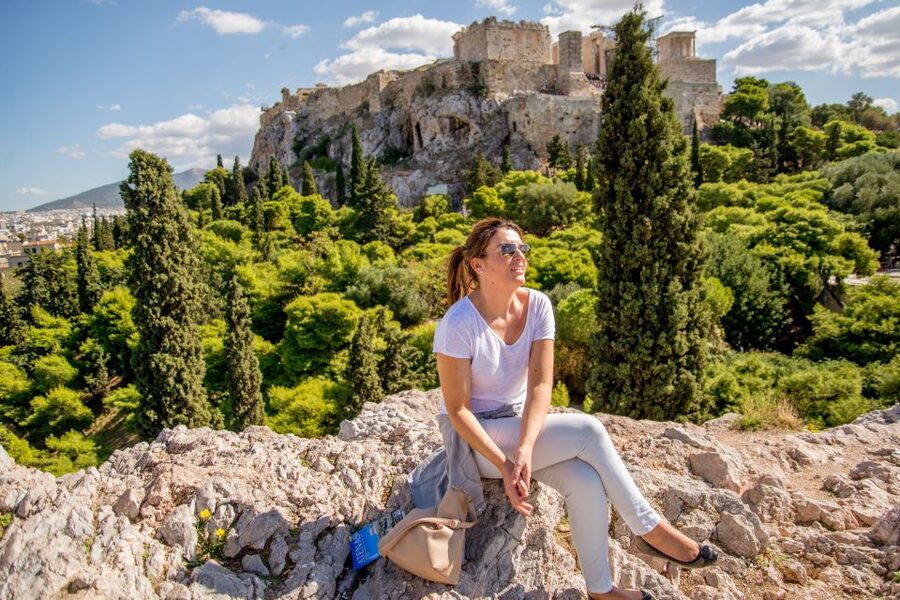
- A full central Athens route: Parliament, the National Gardens, Zappeion Hall, Temple of Zeus, Plaka, the Acropolis, and the Ancient Agora all fit into one outing.
- The changing of the guards comes first: You begin near the Greek Parliament and Monument of the Unknown Soldier.
- The Acropolis climb is on foot: Comfortable shoes, water, and light clothing matter, especially in warm weather.
- The guide speaks English: Guides named in past bookings include Nelly, Victor, and Laura, though guide assignments can change.
- Tickets are not part of the price: Budget another EUR 20 for the Acropolis and EUR 5 for the Acropolis Museum if you plan to enter both.
- The tour is strongest for orientation: It gives you a clear map of ancient Athens, but you may want separate time inside the major sites.
From Parliament to the changing of the guards

The tour starts in central Athens at the Greek House of Parliament. Before the ancient stones appear, you watch the changing of the guards at the Monument of the Unknown Soldier.
This is a useful opening because it shows you modern Greek ceremony before you spend the rest of the morning or afternoon among classical ruins. The guards follow a formal routine, and the monument sits in a prominent position in front of Parliament. Your guide can provide the setting and explain what you are seeing, rather than leaving you to guess why this square matters.
The opening stop also helps you get your bearings. Athens can feel scattered when you first arrive, with major sights spread across busy streets, pedestrian lanes, and hills. Starting near Parliament gives you a practical reference point for the National Gardens, Plaka, Syntagma, and the Acropolis.
The exact timing of the guard ceremony can affect what you see, so do not treat this first stop as the main reason to book. The real value comes from how it leads into the wider route.
More Athens walking tours:
- Athens: Acropolis and Parthenon Guided Walking Tour
★ 4.6 · 5,882 reviews - Greek Food Walking Tour in Athens
★ 5.0 · 4,740 reviews - Acropolis: Acropolis and Parthenon Guided Walking Tour
★ 4.7 · 3,442 reviews
A quieter walk through the National Gardens
From Parliament, you continue through the National Gardens. This section offers a break from the hard stone and traffic of central Athens.
The route passes St. Paul’s Anglican church and continues toward Zappeion Hall, a handsome neoclassical building. The walk is not just filler between headline sights. It shows how Athens mixes nineteenth-century civic buildings, formal gardens, religious architecture, and ancient remains in a fairly compact area.
I like this portion because it slows the pace before the Acropolis climb. You are still walking, but the setting is less demanding than the exposed archaeological areas ahead. It also gives your guide room to connect modern Athens with the city’s older layers.
Do not expect a long garden visit or a formal interior tour of Zappeion Hall. These are viewing stops along the route. Their purpose is to build a sense of place and connect the landmarks, not to provide a separate in-depth visit.
Temple of Zeus and Hadrian’s Arch
In front of Zappeion Hall, you see the surviving columns of the Temple of Olympian Zeus and Hadrian’s Arch. These are two of the clearest reminders that Athens was shaped by more than the classical age.
The Temple of Zeus was built on a grand scale, and the remaining columns make its original size easier to imagine. Hadrian’s Arch marks a symbolic transition between older Athens and the expanded Roman city associated with Emperor Hadrian.
This is one of the places where the guide’s explanation matters. A few tall columns can look like an isolated ruin if you do not know what they represented. With context, the site becomes part of a larger story about changing power, architecture, and the growth of Athens.
The price does not include the Temple of Zeus entrance fee, and the supplied information does not promise that the guide enters. That makes this stop especially important to clarify at the start. You may receive an explanation from outside, then decide if you want to return independently for a closer look.
Plaka and the Melina Merkouri connection
The walk continues toward Plaka, the old neighborhood below the Acropolis. Here you see a portrait of Melina Merkouri, the Greek actress, singer, and political figure who became closely associated with the campaign to return the Parthenon sculptures to Greece.
Plaka is a good transition point. Its lanes bring you closer to the Acropolis while keeping the focus on living Athens rather than only on monuments. The tour does not promise a long shopping stop, meal, or free time in the neighborhood, so think of this as a guided passage with a cultural reference.
I find this kind of brief stop useful because it puts a modern face on the country’s relationship with its ancient monuments. The Acropolis is not simply an old site for taking pictures. It remains tied to Greek identity, public debate, and national pride.
A few more Athens days worth a look
- Athens: Acropolis Ticket with Optional Audio or Live Guide
★ 4.2 · 11,055 reviews - Athens: Acropolis Ticket with Audio Guide
★ 4.0 · 3,575 reviews - Athens All Included: Acropolis and Museum Guided Tour with Ticket
★ 4.5 · 2,673 reviews - Athens: Acropolis Museum Ticket with optional Audio Guide
★ 4.4 · 2,652 reviews
The Dionysiou Areopagitou walkway and the climb
From Plaka, you reach Dionysiou Areopagitou, a pedestrian walkway running beside the Acropolis archaeological zone. This is where the tour begins its more demanding section.
The walk toward the Acropolis is uphill, and the route includes ancient sites and open viewpoints. You should wear shoes with good support and bring water. Comfortable clothing is listed as a requirement, and that advice is practical rather than decorative. The tour lasts more than three hours, so even a moderate climb feels different from a short stroll between nearby sights.
As you gain height, you get broad views over central Athens. The guide can point out surrounding monuments and explain how the Acropolis relates to the lower city. This is one of the better reasons to choose a walking tour instead of visiting the Parthenon in isolation.
The pace and heat will matter. The tour data does not specify group size, rest stops, or the exact starting time, so check the available departure options and plan around the conditions of your visit.
Inside the Acropolis story
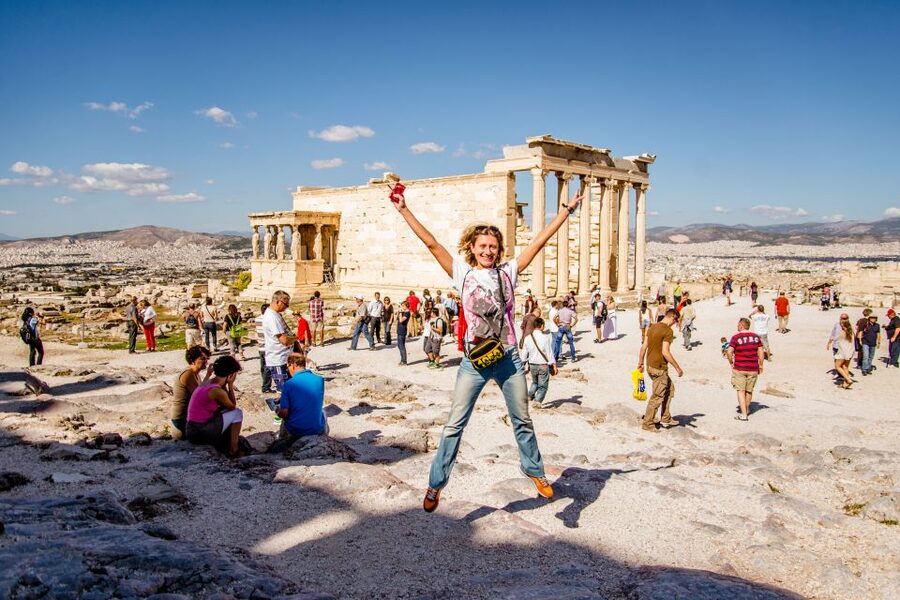
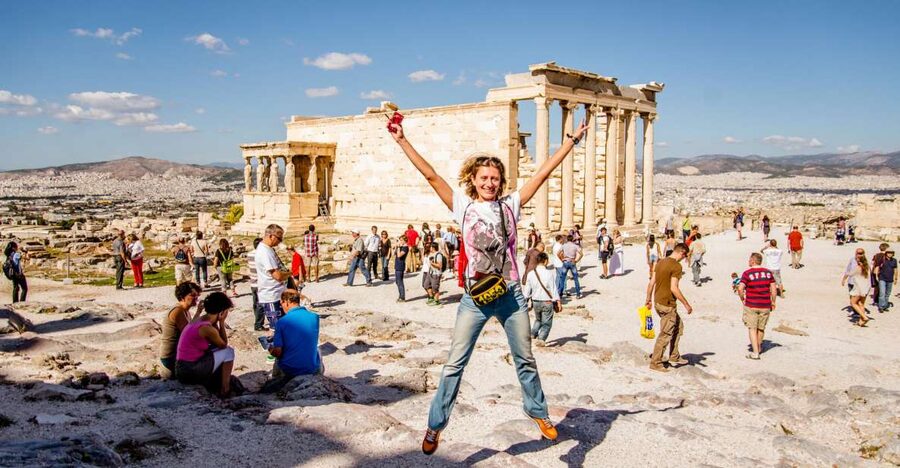
At the Acropolis, the central focus is the Parthenon. This temple is the image most people carry in their minds before arriving in Athens, but the surrounding buildings are what make the visit feel complete.
Your guide explains the Parthenon, the Propylaia entrance, the Temple of Nike, and the Erechtheion, sometimes written incorrectly as Erection in tour descriptions. Each monument serves a different purpose and has a different visual character.
The Propylaia forms the monumental gateway to the Acropolis. The small Temple of Nike sits near the entrance and is easy to miss if you rush directly toward the Parthenon. The Erechtheion is known for its unusual plan and the famous porch with female figures, though the tour information does not promise a specific close-up or interior access.
The guide’s main value here is helping you separate the buildings and understand why they were placed where they are. Without that help, it is easy to remember only a group of weathered columns. With a clear explanation, you can look at the hill as an organized sacred complex.
There is an important limitation. The EUR 20 Acropolis entrance fee is not included in the USD 49 tour price. Past bookings also indicate that the guide did not always enter the Acropolis or the Temple of Zeus with the group. In those cases, the explanation took place before entry. If you want detailed commentary beside every ruin, ask the operator exactly how the guide handles admission on your date.
The monuments below the Acropolis
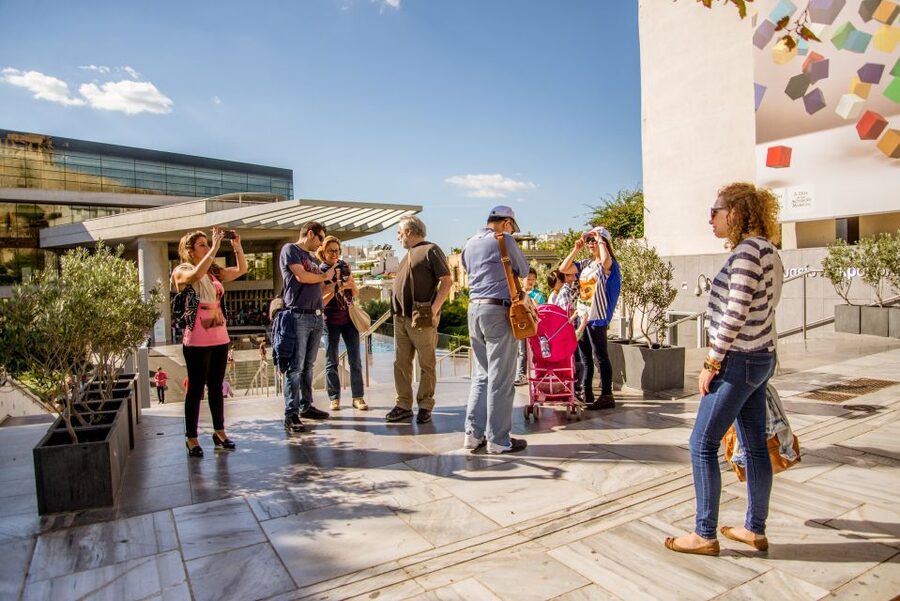
The tour also covers sites surrounding the Acropolis, including the Sanctuary of Dionysus, Philopappos Hill, Mars Hill, the Observatory, Pnyx Hill, the Odeon of Herodes Atticus, and the Ancient Agora.
The Sanctuary of Dionysus links the Acropolis to the beginnings of Greek theater. It is a natural place to discuss performance, civic life, and the role of festivals in ancient Athens.
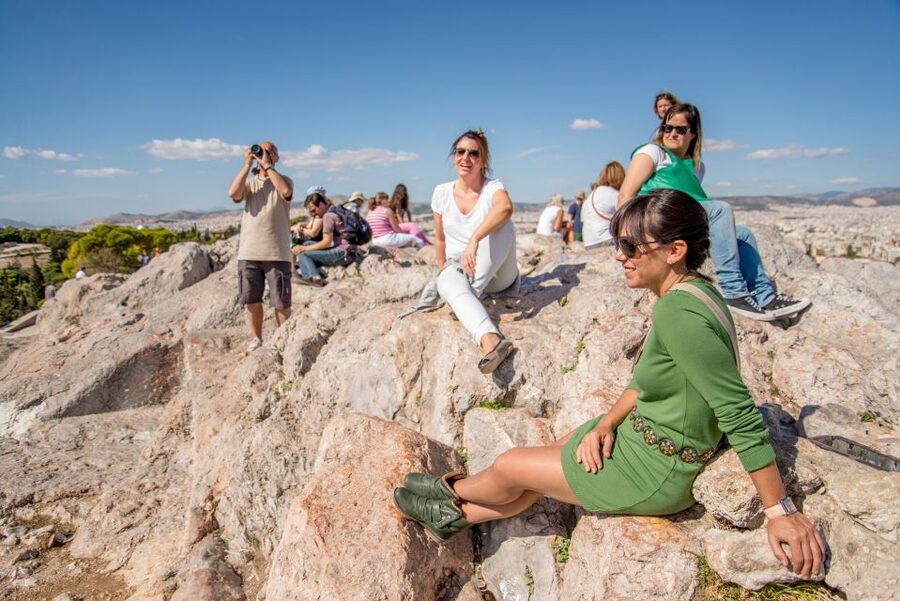
Mars Hill, also called the Areopagus, provides another viewpoint and a strong connection to the political and religious history of the city. The stone surface can be uneven, so take care with your footing. The tour information does not specify a long stop at the top, but the guide includes it among the surrounding monuments.
Philopappos Hill and the Observatory add wider views and help you understand the shape of Athens beyond the Acropolis. Pnyx Hill is especially valuable for anyone interested in democracy, since it is associated with the civic life of ancient Athens. These places are not as instantly recognizable as the Parthenon, yet they give the tour more depth.
The Odeon of Herodes Atticus is a striking theater built into the southern slope of the Acropolis. Depending on access and the day’s route, you may view it from outside. The Ancient Agora then broadens the story from temples and monuments to the daily and political center of ancient Athens.
Because the ticket information specifically lists the Acropolis and Acropolis Museum, do not assume every site on the route is entered. Some may be explained from viewpoints or public paths. That is not necessarily a flaw, but it changes the experience from an all-access archaeological visit into a guided orientation walk.
What the USD 49 price really covers
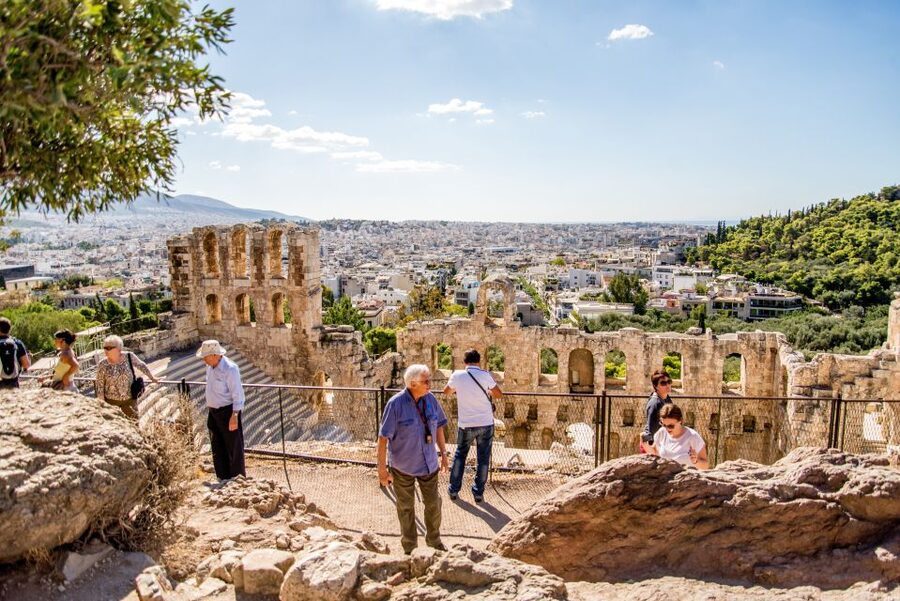
The listed price is USD 49 per person. It includes an English-speaking guide and taxes, but not the two main entrance fees.
If you enter both the Acropolis and Acropolis Museum, add EUR 25 per person. That makes the tour a more substantial purchase than the headline price first suggests. Personal expenses and hotel pickup or drop-off are also excluded.
I see the value in the guiding rather than in admission savings. You are paying for a route that connects many parts of central Athens and for explanations that can make the ruins easier to understand. If you already plan to visit the Acropolis on your own and prefer to read at your own pace, paying for this walk may feel less worthwhile.
The tour is a better fit if you have limited time in Athens, want a first-day overview, or prefer a human guide to a self-guided app. It also works well for an independent visit afterward because you will know where the major sites sit in relation to one another.
Guide quality and the language question
This is an English-language tour with a live guide. Past guide names include Nelly, Victor, and Laura. Nelly was specifically praised for being friendly, attentive, and willing to use some Spanish even though the scheduled language was English. Victor was described as entertaining and considerate, while Laura was singled out for giving a competent tour.
Those details suggest that the personal quality of the guide can shape the day. The overall rating is 4.4 from 21 reviews, with several strong scores for friendly explanations and useful cultural information.
There is also a fair warning: one past booking found the guide’s English difficult to follow. Another person felt the service description suggested more direct access than was delivered. I would not ignore those points. The guide may be excellent at explaining the route, but you should confirm whether commentary continues inside the ticketed sites.
The tour is offered in English only. Do not book it expecting a scheduled Spanish, Italian, German, or Swedish option.
Timing, comfort, and what to carry
At 198 minutes, this is a little over three hours. That length allows the route to cover much more than a quick Acropolis visit, but it also means you need to prepare for sustained walking.
Bring:
- Comfortable walking shoes
- Water
- Comfortable clothes
- A camera
The route includes an uphill approach and open archaeological areas. The supplied information does not give a seasonal weather plan, indoor alternatives, or details about seating, so you should consider heat and your own walking ability before booking.
The schedule varies, and you need to check availability for the starting time. There is no pickup or drop-off. Plan to reach the meeting point independently, and allow enough time to find the Greek Parliament area.
Free cancellation is available up to 24 hours in advance for a full refund. You can also reserve now and pay later, which helps if you are still arranging the rest of your Athens schedule.
Who should book this Athens walk?
I would choose this tour for a first visit to Athens, especially if you want the city’s main ancient sights placed into one clear route. It is also a good choice for anyone who likes questions answered on the spot and wants more than a photo stop at the Parthenon.
It may suit you if:
- You have roughly half a day for central Athens
- You want to see both modern and ancient landmarks
- You enjoy walking and can manage an uphill route
- You prefer an English-speaking guide
- You want a broad introduction before visiting sites in more detail
I would hesitate if your priority is a slow, detailed interior visit at every archaeological stop. The extra admission cost matters, and the guide may not enter all ticketed areas. In that case, a dedicated Acropolis tour with clearly stated inside access could be a better match.
Should you book it?
Book this walk if you want a well-packed introduction to central Athens, with the Parliament, National Gardens, Plaka, Temple of Zeus, Acropolis, hills, theater, and Agora tied together by one guide. The friendly guide reports, particularly for Nelly, Victor, and Laura, add to its appeal, though no specific guide is guaranteed.
Before paying, add the EUR 25 in possible admission fees and confirm whether your guide enters the Acropolis and other ticketed sites. If you accept the tour as a walking overview rather than an all-access archaeological lecture, the route offers solid value and a useful first look at Athens.
FAQ
How long does the Athens Highlights Walking Tour last?
The tour lasts 198 minutes, or about 3 hours and 18 minutes.
What is the price per person?
The listed price is USD 49 per person.
Are Acropolis tickets included?
No. The Acropolis entrance fee is EUR 20 per person and must be paid separately.
Is the Acropolis Museum ticket included?
No. The museum entrance fee is EUR 5 per person and is not included.
What language is the tour offered in?
The live tour is offered in English.
Does the tour include hotel pickup and drop-off?
No. Pickup and drop-off are not included.
What places are visited on the route?
The route includes Parliament, the Monument of the Unknown Soldier, the National Gardens, St. Paul’s Anglican church, Zappeion Hall, the Temple of Zeus, Hadrian’s Arch, Plaka, Dionysiou Areopagitou, the Acropolis, the Parthenon, the Erechtheion, the Propylaia, the Temple of Nike, the Dionysus Sanctuary, Philopappos Hill, Mars Hill, the Observatory, Pnyx Hill, the Odeon of Herodes Atticus, and the Ancient Agora.
What should I bring?
Bring comfortable shoes, water, comfortable clothes, and a camera.
Can I cancel for a full refund?
Yes. You can cancel up to 24 hours in advance for a full refund.
Can I reserve the tour without paying immediately?
Yes. The reserve-now, pay-later option lets you hold a place without paying at the time of booking.
Freshly added Athens trips
- Athens and Ancient Corinth Private from Athens★ 5.0 · 3 reviews
- From Athens: Mycenae and Epidaurus Private Tour★ 4.8 · 3 reviews
- Full day Meteora private tour★ 5.0 · 3 reviews
- Double Shore Dive (certified divers)★ 4.5 · 3 reviews
- Athens Hills: Mythology Treasure Hunt★ 5.0 · 3 reviews
- Sunset & swimming at Cape Sounio, Poseidon temple★ 5.0 · 3 reviews
- Philosophy Experience at Plato’s Academy Park – basic version★ 5.0 · 3 reviews
- Private Acropolis Tour – Ticket Included★ 5.0 · 3 reviews
Walking Tours, compared.




Acropolis monuments & Parthenon Walking Tour with Optional Acropolis Museum
Read our review →

Athens Authentic Greek Food Walking Tour (Small Group)
Read our review →
Early Morning Acropolis & Old Athens Guided Walking Tour
Read our review →
Browse the lists this tour appears in