
Reviewed · ACROPOLIS TOURS
Athens: Acropolis and Ancient Agora Guided Walking Tour
The best part of this four-hour Athens walk is its pairing of two great sites that explain different sides of ancient life. The Acropolis shows you religion, power, and art at their grandest, while the Ancient Agora brings you down to the level of daily politics, trade, debate, and civic life.
I like the South Slopes approach, which gives you scenic views and a less crowded route toward the Acropolis. I also like that the Acropolis and Agora tickets are included, along with wireless hearing devices, so you can follow the guide without straining to hear over the city.
The main consideration is the walking. You will climb uneven ancient paths, spend time in strong Greek sun, and cover several major monuments in four hours. This tour is not suited to wheelchair users, people with mobility impairments, or children under six.
In This Review
- Key points to know before booking
- Why this Acropolis and Agora combination works
- Starting at Porinou Street near the Acropolis
- Walking through the Theatre of Dionysus
- Seeing the Odeon of Herodes Atticus
- Reaching the Acropolis through the Propylaea
- The Erechtheion and its Caryatids
- Thirty minutes with the Parthenon
- A short break on the Acropolis
- Descending to the Ancient Agora
- The Temple of Hephaestus and Stoa of Attalos
- Is the $102 price good value?
- Who should choose this four-hour walk?
- Should you book the Acropolis and Agora tour?
- FAQ
- How long does the tour last?
- Where does the tour begin?
- Where does the tour finish?
- Is admission included?
- What language is the tour conducted in?
- Is the tour suitable for people with mobility impairments?
Key points to know before booking
- Two essential archaeological sites: Visit the Acropolis and Ancient Agora in one well-planned half-day.
- A scenic southern approach: Reach the Acropolis via the South Slopes, with views across Athens as you climb.
- Major monuments included: See the Parthenon, Erechtheion, Temple of Athena Nike, Propylaea, and Theatre of Dionysus.
- Useful audio equipment: Wireless hearing devices help you catch the guide’s explanations throughout the walk.
- Tickets and line access included: Entry to both sites is covered, with a separate entrance intended to avoid long waits.
- A demanding but rewarding walk: Bring water, sunscreen, a hat, and shoes with a firm grip.
Why this Acropolis and Agora combination works
Many Athens tours focus only on the Acropolis. This one adds the Ancient Agora, and that changes the shape of the day.
At the Acropolis, you see the ceremonial and religious face of Athens. The hill is a powerful setting for temples, monuments, and wide city views. At the Agora, you encounter the working center of ancient civic life. This is where citizens gathered, debated public matters, traded goods, and took part in the political culture associated with Athens.
I find that combination more useful than seeing either site alone. The Acropolis can feel like a collection of grand ruins if you do not understand its place in the city. The Agora gives you the missing ground-level story. Together, the sites help you connect Greek religion, public life, architecture, and democracy.
The tour lasts about four hours. That gives your guide enough time to explain the important monuments without turning the day into an exhausting full-day archaeological march. Still, this is not a gentle stroll. You will climb the Acropolis slopes, walk over uneven surfaces, and remain outdoors for much of the visit.
The tour is in English and led by a licensed guide. Guides named Anastasia and Yanis, also called John, have led departures, with Anastasia noted for clear and effective explanations and Yanis for an informative, friendly approach. Your assigned guide may differ, but the format is built around live interpretation rather than a prerecorded audio tour.
More Acropolis and Parthenon visits:
- Athens: Acropolis & up to 5 Archaeological Sites Combo Pass
★ 4.4 · 12,619 reviews - Athens: Acropolis Ticket with Optional Audio or Live Guide
★ 4.2 · 11,055 reviews - Athens: Acropolis, Parthenon & Acropolis Museum Guided Tour
★ 4.8 · 9,316 reviews
Starting at Porinou Street near the Acropolis
The meeting point is at Porinou 5, just a two-minute walk from the Acropolis metro station. That is a helpful arrangement if you are using public transportation or staying in central Athens, since you do not need a hotel pickup.
Arrive 15 minutes early. Porinou Street is close to major tourist sights, and Athens traffic around the Acropolis can slow you down. You want time to find the Athens Walks office, check in, and meet the guide without starting the tour rushed.
The tour does not include hotel pickup, meals, drinks, or personal expenses. Plan to eat before you arrive or carry water and a small snack if needed. Food is not the focus once you enter the archaeological sites, and the schedule is designed around sightseeing rather than a café break.
Walking through the Theatre of Dionysus
The first major stop is the Theatre of Dionysus, where the guided portion lasts about 15 minutes. Set on the southern side of the Acropolis, it helps introduce the connection between Athens, performance, religion, and public life.
This is a good opening stop because the South Slopes are not simply a path to the top. They contain their own archaeological remains and tell part of the story of how ancient Athenians used the hill. Your guide points out archaeological features and plants along the route while explaining the rituals and activities once connected with the slopes.
You will also begin gaining views over Athens as you climb. Bring your camera, but remember that flash photography is not allowed. The slope can feel exposed in bright weather, so sunscreen, a hat, and water are practical rather than optional extras.
Seeing the Odeon of Herodes Atticus
The walk to the Odeon of Herodes Atticus takes about 15 minutes. The itinerary lists this as a walking stop, so expect the guide to keep the group moving while pointing out the monument and its setting.
The Odeon is one of the memorable structures on the southern side of the Acropolis. Its location adds a strong sense of scale: you are looking at a performance space built into the side of the sacred hill, with the modern city spread below.
This part of the tour is also a reminder that the Acropolis area was not used for one purpose alone. Religious ceremonies, public gatherings, theater, and civic identity all met here. You may wish the tour allowed more time at each southern slope monument, but the four-hour schedule has to balance these sites with the main summit and the Agora.
More ancient city sites in Athens:
- Athens Half Day Tour, Acropolis, Parthenon, Temple of Olympian Zeus & Hephaistus
★ 5.0 · 609 reviews - Athens: Agora and Hephaistos Temple Entrance Ticket
★ 4.0 · 449 reviews - Athens: Ancient Agora E-Ticket and Audio Tour
★ 3.9 · 413 reviews - Athens: Temple of Olympian Zeus Ticket and Audio Tour
★ 3.4 · 188 reviews
Reaching the Acropolis through the Propylaea
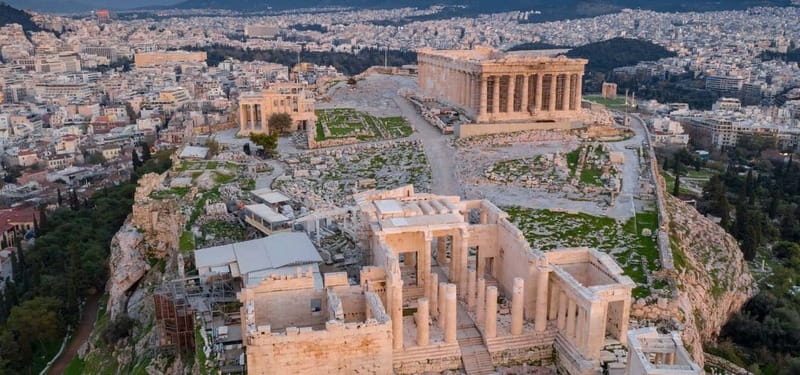
The Temple of Athena Nike and Propylaea come next. The Temple of Athena Nike receives about five minutes of walking time, followed by a 10-minute guided visit to the Propylaea.
The Temple of Athena Nike is small compared with the Parthenon, but its position and detailed design make it an important stop. It honored Athena as a goddess of victory. Your guide can help you notice why smaller monuments still mattered in the overall design of the Acropolis.
The Propylaea forms the monumental gateway to the summit. Passing through it gives the Acropolis visit a clear sense of arrival. The route also helps you understand how carefully the ancient builders framed the approach to the temples.
Expect uneven stone surfaces and some crowding around the entrance area. The included wireless hearing devices matter here. Instead of standing shoulder to shoulder with the guide, you can keep a little distance and still follow the explanation.
The Erechtheion and its Caryatids
The Erechtheion receives about 15 minutes of guided attention. It is one of the most distinctive buildings on the Acropolis, with an unusual layout and the famous Caryatids, sculpted female figures used as architectural supports.
This is a place where a good guide adds real value. The Parthenon is instantly recognizable, but the Erechtheion can seem confusing at first glance. Its irregular form and multiple sacred associations make more sense when someone explains what you are seeing and why the building does not follow the simple symmetry you might expect from a Greek temple.
Your guide will also discuss the influence of these monuments on later art and architecture. That connection is worthwhile because the Acropolis is not only an ancient site. It has shaped the way later generations imagine classical Greece.
Take photographs here, but avoid flash photography. The stop is relatively short, so listen first and photograph afterward if you want to keep pace with the group.
Thirty minutes with the Parthenon
The Parthenon receives the longest guided stop on the Acropolis, about 30 minutes. This is the central event of the tour, and rightly so.
Dedicated to Athena, the temple reflects the wealth, ambition, religious beliefs, and artistic skill of ancient Athens. Your guide explains its construction and its role as a symbol of Greek culture and democracy. The building is also a lesson in how much can be lost over time. You see a surviving monument, but not the complete original structure, decoration, or setting.
The value of a live guide here is not simply learning dates. You need help reading the building. Look at the columns, the sculpture fragments, the proportions, and the way the temple sits on the summit. A guide can point out the details that are easy to miss when you are focused on taking a wide photo.
The Parthenon stop is long enough for a meaningful explanation, though anyone who wants a slow architectural study may want more time. This tour is designed to give you an informed overview of the Acropolis rather than hours for independent sketching or photography.
A short break on the Acropolis
The schedule allows about 15 minutes of break time at the Acropolis. Use it to drink water, take in the views, and catch your breath before heading toward the Agora.
This pause is especially useful in hot weather. The route involves climbing, and the pale stone reflects sunlight. Wear light, weather-appropriate clothing, use sunscreen, and carry a refillable water bottle if possible.
The views across Athens are one of the strongest parts of the South Slopes and summit route. You get a sense of how the Acropolis relates to the modern city rather than experiencing it as an isolated ruin. The break also gives you a little personal time after the guide-led explanations.
Descending to the Ancient Agora
The Ancient Agora receives about 30 minutes of guided touring. This is where the tour shifts from monumental religion to public life.
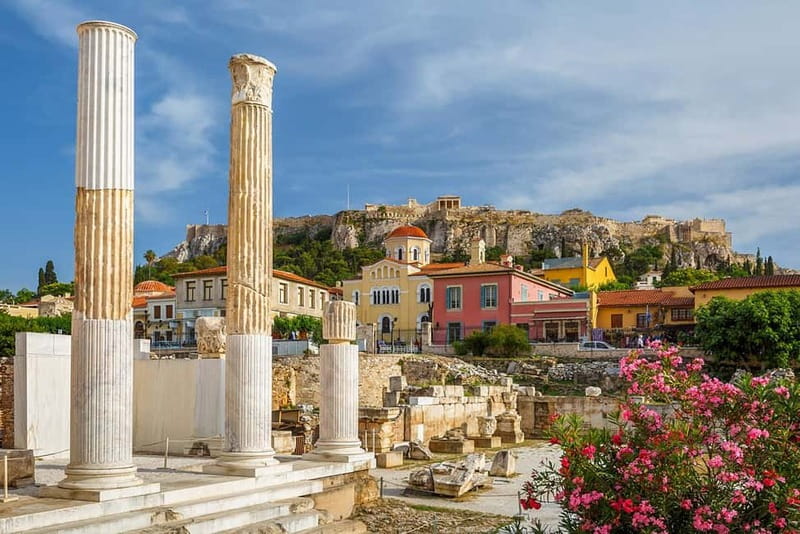
The Agora was the heart of ancient Athens. Citizens, philosophers, politicians, and merchants used this area for political, social, and commercial activity. Your guide explains how the space functioned as a gathering place and why it mattered to the development of Athenian democracy.
I especially like this second site because it gives context to the word democracy, which can otherwise remain abstract. The Agora was a real place where civic life happened. Walking through its ruins helps you picture public decisions as part of an ordinary urban setting, not just as an idea discussed in a textbook.
The 30-minute guided portion provides a useful introduction, but the Agora is broad and contains more than you can absorb in a quick visit. If you plan to return independently, ask your guide for suggestions before the tour ends.
The Temple of Hephaestus and Stoa of Attalos
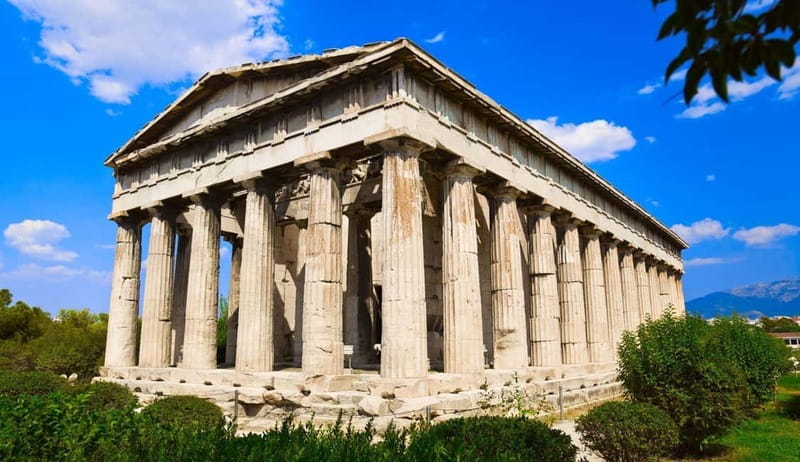
The Temple of Hephaestus is reached during a 10-minute walk through the Agora. It is dedicated to Hephaestus, the god associated with craftsmanship, and is one of the best-preserved ancient temples in the area.
Its condition makes it a valuable counterpoint to the Parthenon. At the Acropolis, you focus on a famous monument shaped by centuries of change and damage. At the Agora, the Temple of Hephaestus helps you see more clearly what a Greek temple’s form can look like when much of its structure remains.
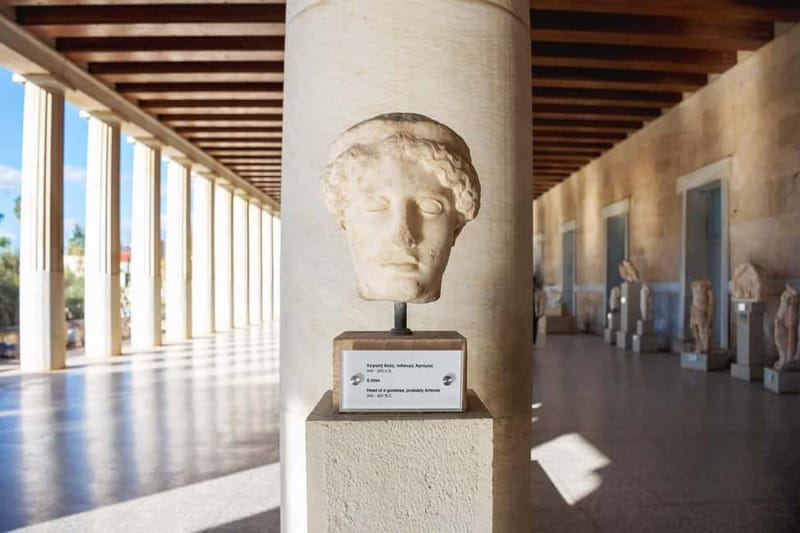
You will also see the Stoa of Attalos, a reconstructed colonnaded building that now houses a museum with artifacts from the Agora. The museum gives physical detail to the ruins outside. Statues, objects, and architectural pieces help show how the area looked and how Athenians used it.
The tour finishes at the Ancient Agora. Your guide can offer recommendations for cafés and restaurants, which is convenient after four hours on foot. Since the activity does not include food or drinks, this is a good point to plan lunch or a cooling stop.
Is the $102 price good value?
At $102 per person, this is not a budget walk. The price needs to be judged against what it covers: a licensed English-speaking guide, entry to the Acropolis, entry to the Ancient Agora, skip-the-line access through a separate entrance, and wireless hearing devices.
If you were already planning to buy both admission tickets and pay for a guided visit, the package can make sense. You are also getting a carefully linked route instead of arranging two separate site visits and working out the connection yourself.
The value depends on how you like to sightsee. I think it is strongest for a first visit to Athens, especially if you want historical context and prefer to keep your day organized. It is less attractive if you mainly want unrestricted time for photography, or if you already have a strong background in classical Greek history.
The separate entrance and included tickets can also save time, though no archaeological site is completely free of queues or crowds. The tour is not a private experience, and the timing at each stop is set by the group schedule.
Who should choose this four-hour walk?
This tour suits you best if you want to see the two major ancient sites in central Athens with one guide and one booking. It is a sensible choice for a short city break, a first day in Athens, or anyone who wants the major monuments explained rather than simply photographed.
It also works well if you are interested in how democracy developed as a public practice. The Acropolis gives you the symbolic and religious setting. The Agora gives you the civic setting.
You should think twice if you have limited mobility. The tour includes a moderate amount of walking, climbing, and uneven ground. It is not suitable for wheelchair users or people with mobility impairments, and children under six cannot join.
Comfortable shoes are essential. Add a hat, sunscreen, water, and a camera. Check the forecast before you go, since much of the tour takes place outdoors and shade may be limited.
The activity allows free cancellation up to 24 hours before the start time, and you can reserve now and pay later. Those policies help if your Athens schedule is still shifting, but the practical priority is choosing a departure that gives you enough energy for four hours outside.
Should you book the Acropolis and Agora tour?
Book it if you want a clear, guided introduction to ancient Athens and value seeing the Acropolis and Agora together. The route covers the Parthenon, Erechtheion, Temple of Athena Nike, Propylaea, Theatre of Dionysus, Temple of Hephaestus, and Stoa of Attalos in one focused morning or afternoon.
I would choose it for a first visit, particularly because the Agora adds the public-life story that the Acropolis alone cannot provide. I would skip it only if you need a wheelchair-accessible route, dislike scheduled sightseeing, or want to spend most of your time exploring independently.
Arrive early, wear serious walking shoes, and bring water. Do that, and the $102 fee buys more than entry tickets: it gives you a useful framework for understanding why these two Athens sites still matter.
FAQ
How long does the tour last?
The tour lasts four hours. Starting times vary, so check availability when booking.
Where does the tour begin?
The meeting point is the Athens Walks office at Porinou 5, about a two-minute walk from the Acropolis metro station.
Where does the tour finish?
The activity finishes at the Ancient Agora of Athens.
Is admission included?
Yes. Entry to the Acropolis and Ancient Agora is included, along with skip-the-line access through a separate entrance.
What language is the tour conducted in?
The live tour guide speaks English.
Is the tour suitable for people with mobility impairments?
No. The tour is not suitable for people with mobility impairments or wheelchair users because it involves a moderate amount of walking and uneven ancient paths.
More Athens walking tours
- Athens: Acropolis and Parthenon Guided Walking Tour
★ 4.6 · 5,882 reviews - Greek Food Walking Tour in Athens
★ 5.0 · 4,740 reviews - Acropolis: Acropolis and Parthenon Guided Walking Tour
★ 4.7 · 3,442 reviews - Acropolis monuments & Parthenon Walking Tour with Optional Acropolis Museum
★ 5.0 · 2,678 reviews
Freshly added Athens trips
- Athens and Ancient Corinth Private from Athens★ 5.0 · 3 reviews
- From Athens: Mycenae and Epidaurus Private Tour★ 4.8 · 3 reviews
- Full day Meteora private tour★ 5.0 · 3 reviews
- Double Shore Dive (certified divers)★ 4.5 · 3 reviews
- Athens Hills: Mythology Treasure Hunt★ 5.0 · 3 reviews
- Sunset & swimming at Cape Sounio, Poseidon temple★ 5.0 · 3 reviews
- Philosophy Experience at Plato’s Academy Park – basic version★ 5.0 · 3 reviews
- Private Acropolis Tour – Ticket Included★ 5.0 · 3 reviews
Acropolis Tours, compared.

Acropolis & up to 5 Archaeological Sites Combo Pass
Read our review →

Acropolis, Parthenon & Acropolis Museum Guided Tour
Read our review →
Acropolis, Parthenon & Acropolis Museum Guided Tour
Read our review →


Acropolis monuments & Parthenon Walking Tour with Optional Acropolis Museum
Read our review →Browse the lists this tour appears in