
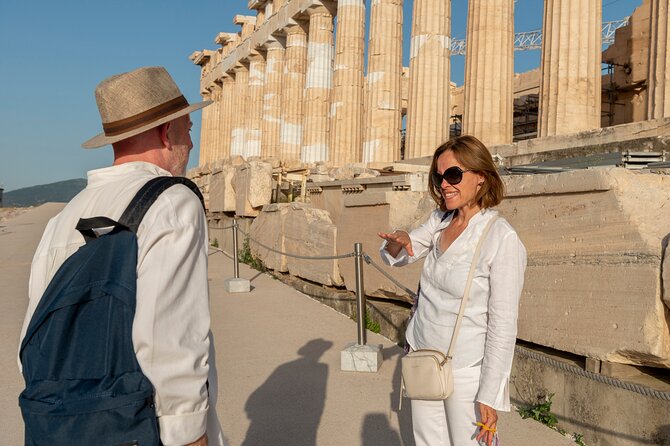
Reviewed · ACROPOLIS TOURS
Ancient Agora and Acropolis Private Tour with Licensed Expert
The smartest thing about this private Athens tour is its pairing of the Acropolis and Ancient Agora. You see the monuments of power above the city, then walk through the old civic center where Athenians traded, worked, worshipped, and argued. I like the private format and the chance to ask questions as you go. I also like the efficient three-hour plan, especially for a first morning in Athens.
The main caution is timing. The description gives about 80 minutes for the Acropolis and 80 minutes for the Agora, while also describing roughly 80 minutes at the Acropolis Museum. That is more than a three-hour visit once walking and ticket checks are added. Confirm exactly what your booking includes, and remember that admission tickets cost extra.
In This Review
- Key points at a glance
- Why pair the Acropolis with the Ancient Agora?
- Meeting at Acropoli Metro Station
- The Acropolis begins with the Theater of Dionysus
- Passing through the Propylaea
- The Temple of Athena Nike and the Parthenon
- The Erechtheion and the Odeon of Herodes Atticus
- What the Acropolis Museum adds
- Walking down to the Ancient Agora
- The Stoa of Attalos and Temple of Hephaestus
- Guides, questions, and family pacing
- Price, tickets, and overall value
- Other booking choices
- Who should book this private Athens tour?
- Should you book it?
- FAQ
- Where does the tour meet?
- How long does the private tour last?
- Are admission tickets included?
- Can the provider arrange tickets for me?
- Is the tour suitable for someone with reduced mobility?
- What happens if I need to cancel?
Key points at a glance
- Private guiding: Only your group takes part, so you can ask questions and set a comfortable pace.
- Acropolis essentials: See the Propylaea, Parthenon, Erechtheion, Temple of Athena Nike, Theater of Dionysus, and Odeon of Herodes Atticus.
- Ancient Agora context: Visit the old marketplace, reconstructed Stoa of Attalos, and Temple of Hephaestus.
- Central meeting point: Start at street level outside Acropoli Metro Station, 7 Makrygianni Street, near the Acropolis Museum.
- Strong guide feedback: Mandio, Manto, Shorty, and Vicky are praised for humor, clear explanations, patience, and family-friendly pacing.
- Ticket planning matters: Skip-the-line tickets can be arranged for an extra fee, but you must answer the provider’s message after booking.
Why pair the Acropolis with the Ancient Agora?
Athens makes more sense when you connect its hilltop monuments with the city below. The Acropolis was a sacred center crowned by temples. The Ancient Agora was the practical heart of civic life, with shops, workshops, shrines, public buildings, and places for people to meet.
That contrast gives this tour a useful shape. At the Acropolis, you focus on religion, artistic ambition, and the power of classical Athens. At the Agora, you get closer to ordinary public life and the physical setting where political and commercial activity took place.
I like this pairing more than an Acropolis-only visit for most first-time visitors. The Parthenon is the headline sight, but the Agora helps you understand how the city functioned beneath it. You are not simply collecting famous stones. You are seeing two sides of Athens.
The private format also changes the feel of the visit. With your own guide, you can pause for a photo, ask about mythology, or request a simpler explanation when the history gets dense. The tour is still brisk, but it does not have to follow the rigid rhythm of a large group.
More Acropolis and Parthenon visits:
- Athens: Acropolis & up to 5 Archaeological Sites Combo Pass
★ 4.4 · 12,619 reviews - Athens: Acropolis Ticket with Optional Audio or Live Guide
★ 4.2 · 11,055 reviews - Athens: Acropolis, Parthenon & Acropolis Museum Guided Tour
★ 4.8 · 9,316 reviews
Meeting at Acropoli Metro Station
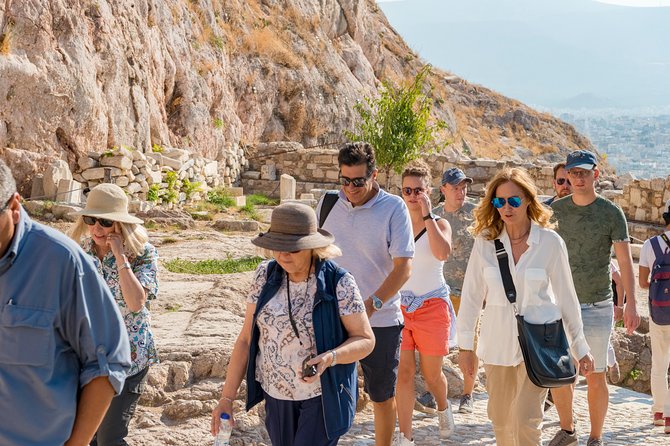
Your guide meets you at street level outside Acropoli Metro Station at 7 Makrygianni Street. This is close to the Acropolis Museum and easy to reach by public transportation.
The meeting point is more than a place to gather. It gives your guide room to introduce the Acropolis before you climb toward it. You can look at the surrounding wall, including sections associated with the earlier Mycenean civilization, while hearing how the hill shaped Athens over time.
That opening matters. Without it, the Acropolis can feel like a collection of separate monuments. A short introduction helps you understand the hill as a sacred complex, a defensive site, and a symbol of Athenian identity.
Arrive ready to walk. The route includes slopes, archaeological paths, stairs, and the distance between the Acropolis and Agora. The operator says the tour is not suitable for people with reduced mobility. Most visitors can participate, but comfortable shoes are a sensible choice.
The Acropolis begins with the Theater of Dionysus

The route usually starts with the Acropolis and lasts about 80 minutes. One of the first major stops is the Theater of Dionysus, built in the fourth and fifth centuries BC on the natural slope of the hill.
Its large capacity, estimated at 25,000 people, gives you a quick sense of the scale of ancient public life. This is also the place associated with the first performances of famous Greek plays. Your guide can connect the physical theater to the development of drama, rather than treating it as just another ruin.
The theater is a good opening stop because it shows that the Acropolis was not only about temples. Religion, performance, civic identity, and public gatherings all met on these slopes.
Passing through the Propylaea
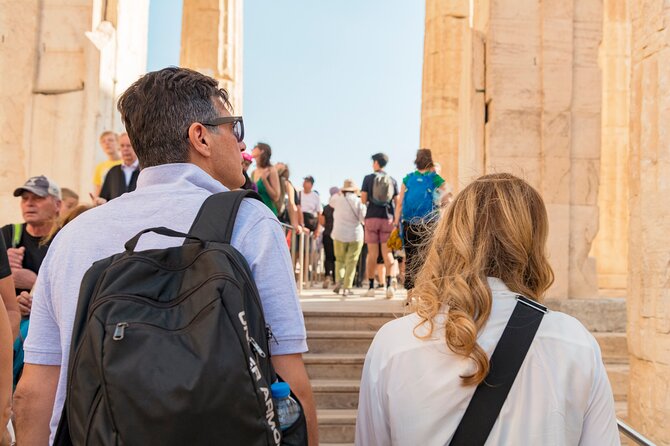
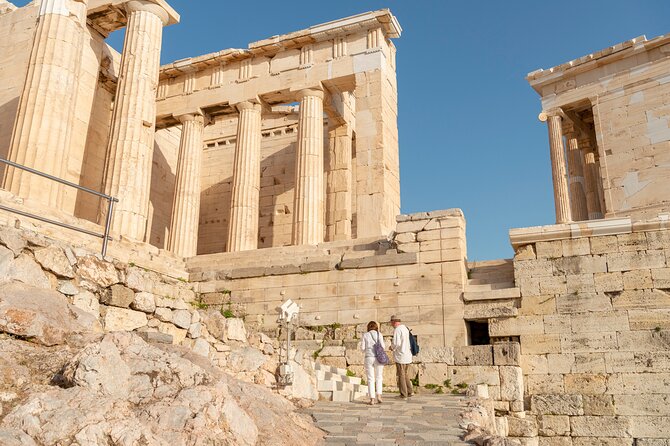
From the theater, you ascend toward the Propylaea, the monumental gateway to the Acropolis. The climb brings the main temples into view and recreates, in a small way, the approach ancient visitors would have taken.
The experience depends on weather and crowds. The Acropolis can become hot and crowded, so an early start is a practical choice. One morning departure described by the operator began early enough to make the climb more comfortable before the site filled up.
The old account of the colossal bronze Athena statue is part of the visual story here. Ancient visitors were said to see the tip of her raised spear catching sunlight from the sea. Your guide can use that image to explain how myth, architecture, and the city’s maritime power were tied together.
More ancient city sites in Athens:
- Athens Half Day Tour, Acropolis, Parthenon, Temple of Olympian Zeus & Hephaistus
★ 5.0 · 609 reviews - Athens: Agora and Hephaistos Temple Entrance Ticket
★ 4.0 · 449 reviews - Athens: Ancient Agora E-Ticket and Audio Tour
★ 3.9 · 413 reviews - Athens: Temple of Olympian Zeus Ticket and Audio Tour
★ 3.4 · 188 reviews
The Temple of Athena Nike and the Parthenon
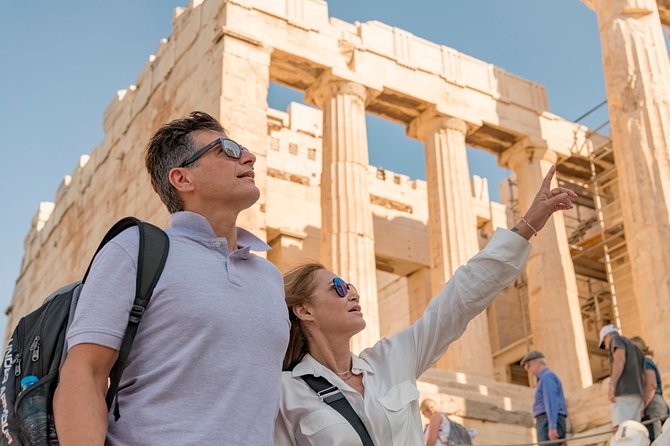
The Temple of Athena Nike is a small Ionic temple dating to around 420 BC. Its position near the entrance gives it an important role, even though it is much smaller than the Parthenon.
The temple was dedicated to Athena as a bringer of victory. Its restored appearance helps you read the design, but you should keep in mind that the Acropolis is a long-lived archaeological site, not a perfectly preserved ancient complex.
The Parthenon receives the most attention, as it should. Built during the high point of fifth-century Athens, it combined religious purpose with extraordinary architectural planning. Your guide explains its construction, myths, ceremonies, and place in Athenian history.
I value having a guide here because the Parthenon can otherwise become a quick photo stop. The building’s proportions, columns, sculpture program, and changing use are easier to appreciate when someone points out what you are seeing. The 80-minute schedule is enough for a solid introduction, but not for every detail.
The Erechtheion and the Odeon of Herodes Atticus
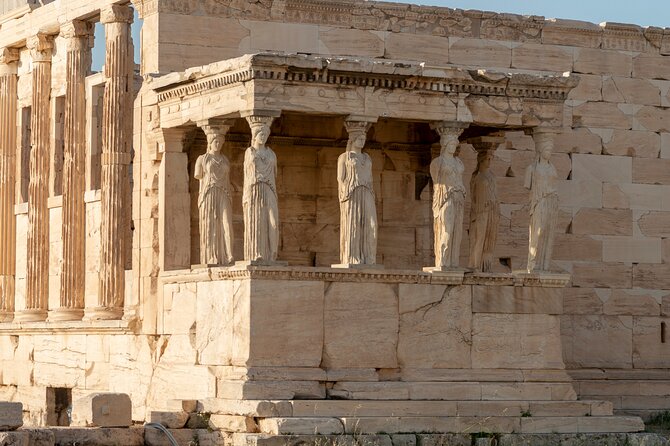
The Erechtheion is one of the most distinctive buildings on the Acropolis. It was dedicated to both Zeus and Athena, and its unusual layout reflects the many sacred traditions attached to the hill.
The famous sculpted female figures associated with the building are now seen in the Acropolis Museum rather than exposed fully on the monument. That is one reason the museum can add real value, if it is included in your selected version of the tour.
You also see the Odeon of Herodes Atticus, a marble theater built in AD 161 by Herodes Atticus in memory of his wife. Unlike many ancient performance spaces, it remains a working theater today. Its setting below the Acropolis makes it one of the most memorable views on the route.
The Acropolis section packs in major monuments at a fast pace. That is useful if your time in Athens is short, but it can feel rushed if you want long periods for sketching, photography, or quiet reflection.
What the Acropolis Museum adds
The itinerary describes about 80 minutes at the New Acropolis Museum, located a short distance from the hill. It houses original works, models, videos, and interactive displays connected to the Acropolis.
The museum is especially useful for details that cannot remain outdoors. You see sculptures and architectural elements in a controlled setting, with enough context to understand how they once fit into the temples.
The museum also helps explain the mythology behind the Acropolis buildings. A guide can point out the most important pieces and keep you from spending your limited time on less relevant displays.
There is an important planning issue here. The stated three-hour tour is split between roughly 80 minutes at the Acropolis and 80 minutes at the Agora, yet the museum section is also described as approximately 80 minutes. Ask before booking if the museum is part of your exact option, included only in certain departures, or intended as a separate component.
Walking down to the Ancient Agora
The Ancient Agora lies at the base of the Acropolis, but the route between the two sites involves walking. The operator specifically says this version is not suitable for people with reduced mobility.
The change in setting is worthwhile. You leave the grand temples behind and enter the former marketplace and civic center of Athens. Workshops, temples, shops, and public monuments once filled this area.
This is where the tour becomes more social and practical. Instead of looking only at major religious buildings, you consider how people bought goods, worked, met friends, followed public affairs, and took part in the life of the city.
The Agora is also often less intense than the Acropolis. The exact crowd level varies, but the open setting can give you more room to look around. One highly praised feature of the tour is the ability to move at your own pace and allow time for photographs.
The Stoa of Attalos and Temple of Hephaestus
The Stoa of Attalos is a reconstruction of an ancient commercial building. It now houses a museum with objects found at the Agora, making it a useful stop between the open-air ruins.
The stoa helps you picture the Agora as a working center of commerce. Traders and craftspeople once operated in spaces like this, so the building gives the site a stronger human scale than a field of foundations alone.
The Temple of Hephaestus is the architectural highlight of the Agora. It is described as the most complete surviving temple of Greek antiquity, and its preserved form makes it easier to understand how a classical temple was arranged.
Compared with the Parthenon, the Temple of Hephaestus is less famous and often easier to appreciate at close range. I like seeing it after the Acropolis because the comparison shows different levels of preservation and different settings within ancient Athens.
Guides, questions, and family pacing
A private tour is only as good as the person leading it. The guide names connected with this experience include Mandio, Manto, Shorty, and Vicky, though the specific guide assigned to you will depend on availability.
The strongest praise centers on lively explanations, humor, and the freedom to ask questions. Shorty is described as witty and engaging, while Manto is praised for keeping the experience interactive. Vicky is noted for holding children’s attention and answering questions from the whole family.
That matters at an archaeological site where dates and names can quickly blur together. A good guide turns mythology into a story and architecture into something you can read.
Families with teenagers may find the private setup particularly helpful. You can ask the guide to explain a topic in a more direct way, stop for photos, or move on when attention starts to fade. The tour is also suitable for couples or small groups who want more conversation than a standard group walk allows.
For groups of six or more, a whisper communication system is included. This can make it easier to hear the guide near busy monuments, though the experience remains private rather than a large shared tour.
Price, tickets, and overall value
The listed price is $185.86 per person. That is a serious cost once you add admission tickets, but the value depends on your group size and priorities.
For two people, a private guide is an expensive way to see Athens. For a family or small group, the cost spreads across the party and may compare more favorably with several individual tours. You are paying for time with a licensed expert, a private format, and help making sense of two major archaeological sites.
Admission tickets are not included. The provider can arrange skip-the-line tickets after booking for an added fee, and the message should not be ignored. Tickets may sell out days or weeks ahead and are tied to a particular date and entry time.
If you arrange tickets yourself, make sure they match the tour time. The provider says it is not responsible for delays if you have not replied to its ticket message or bought the appropriate slots.
The tour offers free cancellation up to 24 hours before the start time. Changes or cancellations inside that window are not accepted for a refund.
Other booking choices
The operator also offers an Acropolis-only option lasting about 1.5 hours. An afternoon departure is suggested for fewer crowds and the warm, honey-colored light that can make the old stone especially attractive.
There is also a 1.5-hour Acropolis and Ancient Agora option, with a meeting point at the main entrance of the Agora. Check the exact option carefully, since it is different from the three-hour version described here.
A four-hour private vehicle tour covers more of central Athens. Stops include the Acropolis, Plaka, Temple of Zeus, Hadrian’s Arch, Olympic Stadium, Athens Trilogy, Syntagma Square, and the traditional Evzone guards. Pickup is available from a cruise ship, central Athens hotel, or another address, with a licensed guide accompanying you at the Acropolis and other sites.
Who should book this private Athens tour?
Book it if you want context rather than a quick checklist of monuments. It suits first-time visitors, families, couples, and small groups who enjoy asking questions and adjusting the pace.
It also works well if you have only one major morning for ancient Athens. The Acropolis and Agora give you both the symbolic center and the everyday civic center of the city.
Think twice if you want a slow museum visit, extensive free time, or a low-cost option. The ticket cost is extra, the walking is real, and the published timing needs clarification because the museum description does not fit neatly into the stated three-hour schedule.
Should you book it?
I would book this tour if the private guide is your priority and you confirm the ticket and museum details before paying. The best parts are the personal questions, the family-friendly pacing, and the useful link between the Parthenon and the Agora.
For a tight budget, choose a group tour or visit with an audio guide. For everyone else, this is a strong way to make a demanding Athens morning more understandable, provided you start early, wear good shoes, and leave enough time for the sites to breathe.
FAQ
Where does the tour meet?
The guide meets you at street level at Acropoli Metro Station, 7 Makrygianni Street, Athens. The meeting point is close to the Acropolis Museum.
How long does the private tour last?
The main tour lasts approximately three hours. The plan is described as about 80 minutes at the Acropolis and 80 minutes at the Ancient Agora, but the separate museum description also lists about 80 minutes, so confirm the exact schedule for your booking.
Are admission tickets included?
No. Archaeological site admission tickets are not included in the listed price. Skip-the-line tickets can be arranged after booking for an additional cost.
Can the provider arrange tickets for me?
Yes. The provider will contact you after booking to ask if you need tickets purchased. You should check your messages and reply, since entry tickets can sell out and must match a specific date and time.
Is the tour suitable for someone with reduced mobility?
No. The operator says the tour includes walking between the Acropolis and Agora and is not suitable for people with reduced mobility. Most other visitors can participate, and service animals are allowed.
What happens if I need to cancel?
You can cancel up to 24 hours before the experience for a full refund. Cancellations or changes made less than 24 hours before the start time are not accepted for a refund.
Freshly added Athens trips
- Athens and Ancient Corinth Private from Athens★ 5.0 · 3 reviews
- From Athens: Mycenae and Epidaurus Private Tour★ 4.8 · 3 reviews
- Full day Meteora private tour★ 5.0 · 3 reviews
- Double Shore Dive (certified divers)★ 4.5 · 3 reviews
- Philosophy Experience at Plato’s Academy Park – basic version★ 5.0 · 3 reviews
- Athens Hills: Mythology Treasure Hunt★ 5.0 · 3 reviews
- Sunset & swimming at Cape Sounio, Poseidon temple★ 5.0 · 3 reviews
- Private Acropolis Tour – Ticket Included★ 5.0 · 3 reviews
Acropolis Tours, compared.

Acropolis & up to 5 Archaeological Sites Combo Pass
Read our review →

Acropolis, Parthenon & Acropolis Museum Guided Tour
Read our review →
Acropolis, Parthenon & Acropolis Museum Guided Tour
Read our review →


Acropolis monuments & Parthenon Walking Tour with Optional Acropolis Museum
Read our review →Browse the lists this tour appears in