
Reviewed · ACROPOLIS TOURS
Acropolis, Plaka & Ancient Agora Guided Tour
The clever part of this Athens tour is its route. You enter the Acropolis from the south slope, passing the Sanctuary of Dionysus and the ancient theater before climbing toward the Parthenon. Afterward, you walk downhill to the Ancient Agora, where Socrates and Plato once taught and where the excellent Attalos Museum adds objects to the stones outside.
I like the way the tour links two sites that are often visited separately. I also like the practical pacing: guides such as Vasaliki have stopped in the shade to explain the monuments, and Sissy’s archaeological background helped one family make sense of both the Acropolis and Agora. You get time for photos at the Acropolis, too.
The main drawback is that this is a serious 3.5-hour walk on slopes, steps, and uneven ground. There is no leisurely lunch, only a short pause for a snack or drink, and the tour is not suitable for wheelchair users or people with mobility impairments. Ticket choices also require care, especially if you book the option without admission.
In This Review
- Key points to know before booking
- Why this route makes sense in Athens
- Meeting at Dionyssiou Areopagitou Street
- The south slope and the Dionysus Theater
- Reaching the Acropolis monuments
- Free time for photos at the Acropolis
- Walking down to the Ancient Agora
- Hephaestus Temple and the Agora’s smaller monuments
- The Attalos Museum and everyday ancient Athens
- Timing, tickets, and the real cost
- Who will get the most from this tour
- Should you book the Acropolis and Agora tour?
- FAQ
- How long is the Acropolis, Plaka, and Ancient Agora tour?
- What language is the tour conducted in?
- What time does the Acropolis portion begin?
- What time does the Ancient Agora portion begin?
- Where is the meeting point?
- How early should I arrive?
- Are admission tickets included?
- Does skip-the-ticket-line access remove all waiting?
- Can I bring a stroller or large bag?
- Is the tour suitable for wheelchair users?
Key points to know before booking
- The south-slope entrance adds the Dionysus Theater: You see one of Athens’ most important performance sites before reaching the hilltop monuments.
- The Acropolis portion begins around 11 a.m.: Expect strong sun, security screening, and strict timed entry rules.
- The Ancient Agora follows at about 1 p.m.: The route connects Athens’ sacred hill with its old civic and commercial center.
- The Attalos Museum gives the Agora context: Ancient weights, measures, and everyday objects help explain how the market worked.
- The guide makes the difference: English-speaking licensed guides, including Vasaliki, Sissy, and Tina, have been praised for clear explanations and an easy pace.
- Admission depends on your booking choice: With Ticket includes the required entries. Without Ticket means you must buy the correct official tickets yourself before booking.
Why this route makes sense in Athens
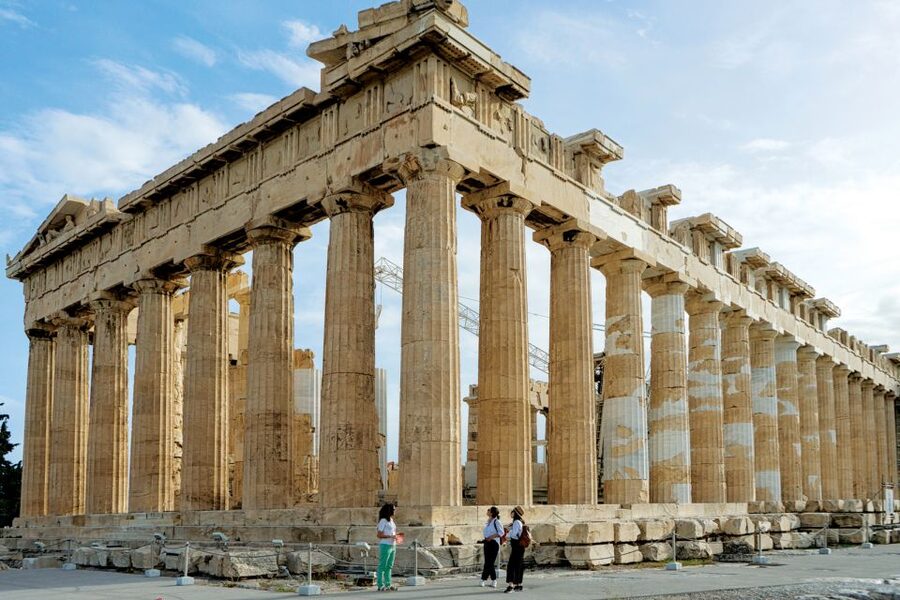
The Acropolis is Athens’ headline sight, but it can feel like a pile of famous names if you walk through alone. The Parthenon, Erechtheion, Propylaia, and Temple of Athena Nike are visually powerful, yet their purposes and connections are not always obvious from a distance.
This tour gives you the setting first. You begin near Hadrian’s Arch, at 3 Dionyssiou Areopagitou Street, then follow the pedestrian approach toward the south side of the Acropolis. That direction matters because it brings you to the Sanctuary of Dionysus and the Dionysus Theater before the climb becomes the main event.
The second half changes the subject. The Acropolis represents religious and civic power on a hilltop. The Agora shows daily public life below: trade, political debate, philosophy, law, and administration. I like this pairing because it gives you two different views of ancient Athens in one morning and early afternoon.
At $66 per person, the value depends on whether your selected option includes admission. If tickets are included, the price is easier to assess because you are paying for the guide, site access, and a connected route. If you choose Without Ticket, the lower headline price may not be the final cost, and you must arrange the official Acropolis and Agora tickets yourself.
More Acropolis and Parthenon visits:
- Athens: Acropolis & up to 5 Archaeological Sites Combo Pass
★ 4.4 · 12,619 reviews - Athens: Acropolis Ticket with Optional Audio or Live Guide
★ 4.2 · 11,055 reviews - Athens: Acropolis, Parthenon & Acropolis Museum Guided Tour
★ 4.8 · 9,316 reviews
Meeting at Dionyssiou Areopagitou Street
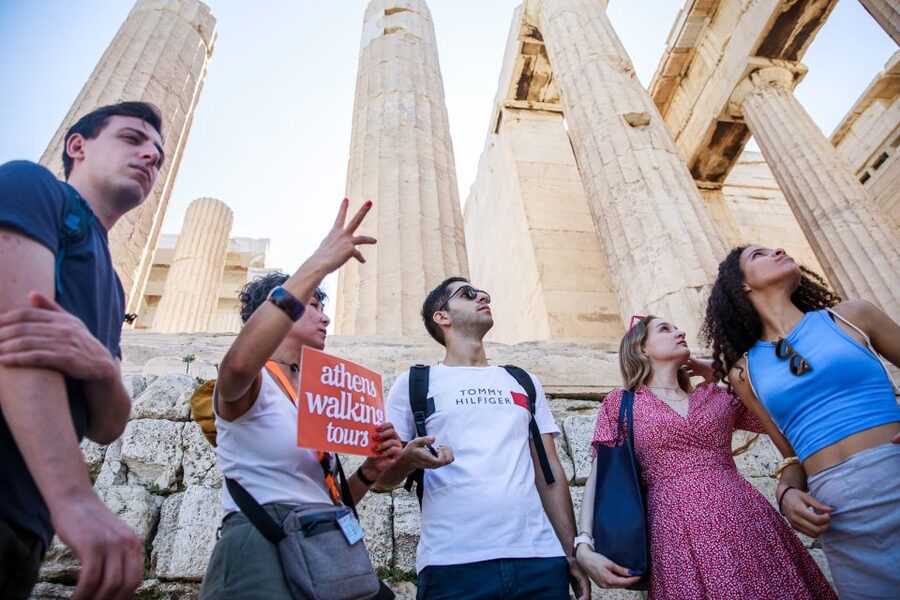
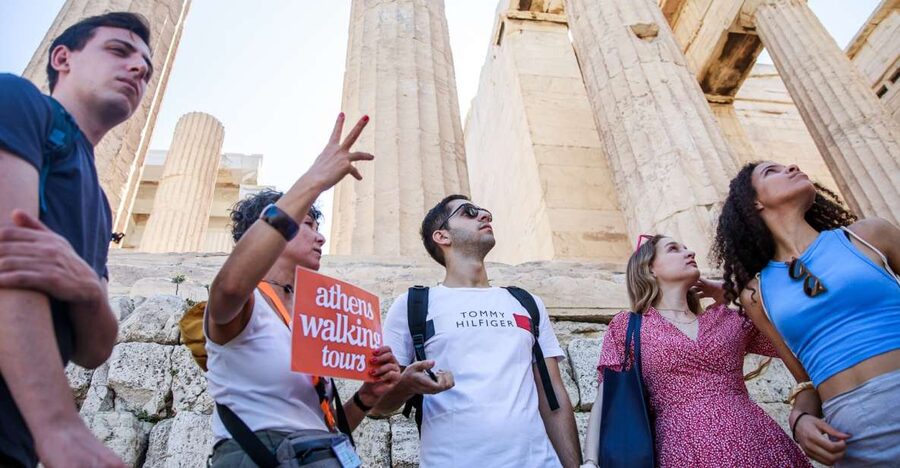
The meeting point is at 3 Dionyssiou Areopagitou Street. Look for the orange Athens Walking Tours sign at the start of the pedestrian walkway leading toward the Acropolis from Hadrian’s Arch and Syngrou Avenue.
Arrive 20 minutes early. That is not wasted time in Athens, where the correct entrance and ticket time matter. The Acropolis uses strict entry slots, and the group cannot wait for late arrivals. If you miss the required entry, there is no refund.
Bring your passport or ID card, and bring a student card if you are using a student ticket category. Cash is also listed among the recommended items. Leave luggage and large bags behind, since they are not allowed, and baby strollers are not permitted on this experience.
The south slope and the Dionysus Theater
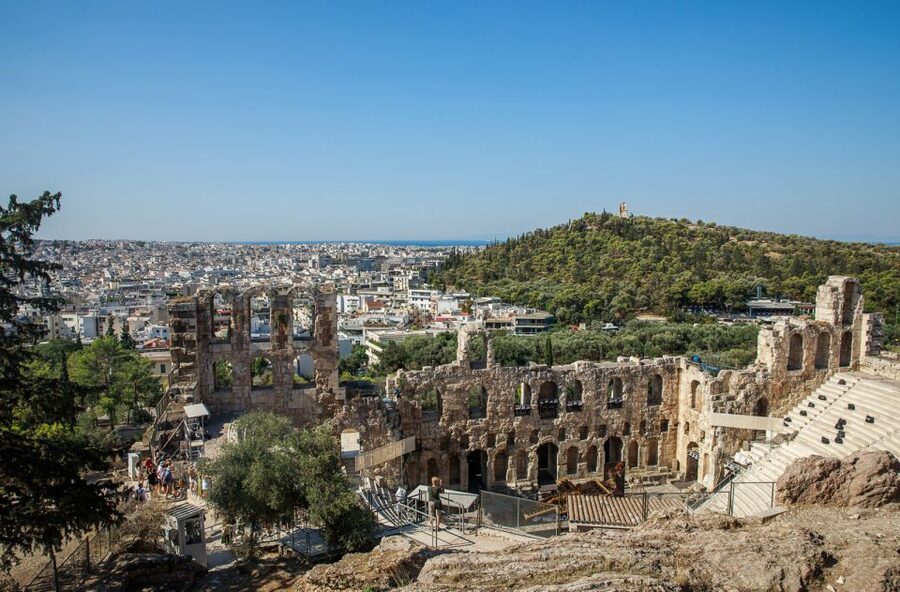
The first stop is the Sanctuary of Dionysus, followed by the Dionysus Theater, built in the fifth century BC. This is a fine opening because the theater introduces the religious and cultural life of ancient Athens before you reach the better-known temples above.
Your guide can explain why performances belonged in a sanctuary dedicated to Dionysus, the god associated with theater. The stone seating and open setting make the site easier to picture than a bare list of dates in a guidebook.
The south-slope route also helps spread out the opening section of the visit. It does not guarantee an empty entrance, and all visitors still pass through security, but it avoids beginning at the busiest upper approach. Security waits can range from none to 10 or 30 minutes, with longer delays possible during peak periods.
The climb begins here. You will walk uphill toward the Acropolis, and the ground can be uneven. I would wear firm shoes with good grip rather than thin sandals. The tour runs rain or shine, so a light rain layer may matter as much as sun protection depending on the forecast.
Reaching the Acropolis monuments
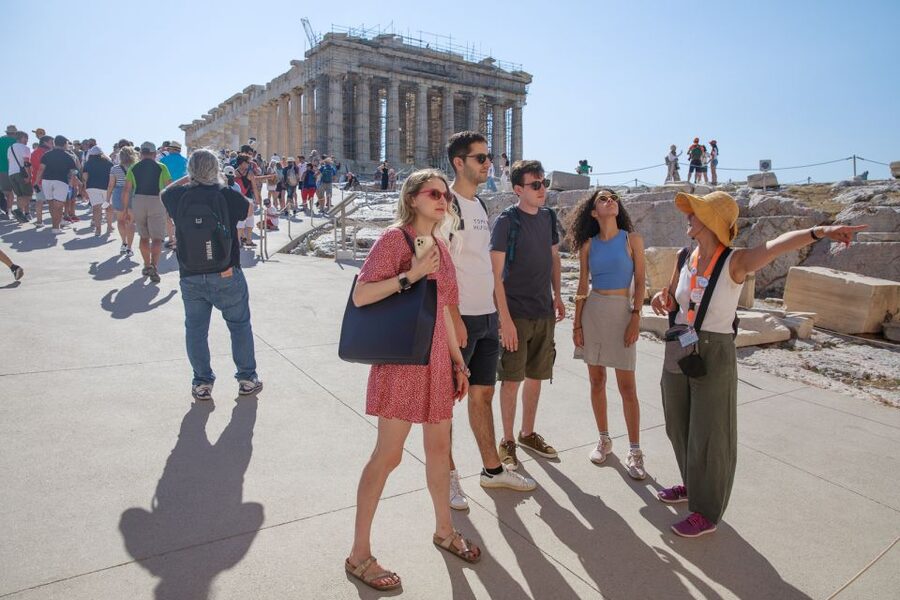
As you climb, Athens opens below you. The guide points out the city and surrounding hills, including the Observatory, Philopappos Hill, Mars Hill, and Pnyx Hill. These views are not just photo stops. They help you see how the Acropolis fits into the wider ancient city.
At the summit, the guide explains the main monuments:
- The Parthenon, the grand temple most closely linked with Athens
- The Erechtheion, known for its unusual design and the Caryatid figures
- The Propylaia, the monumental entrance to the sacred hill
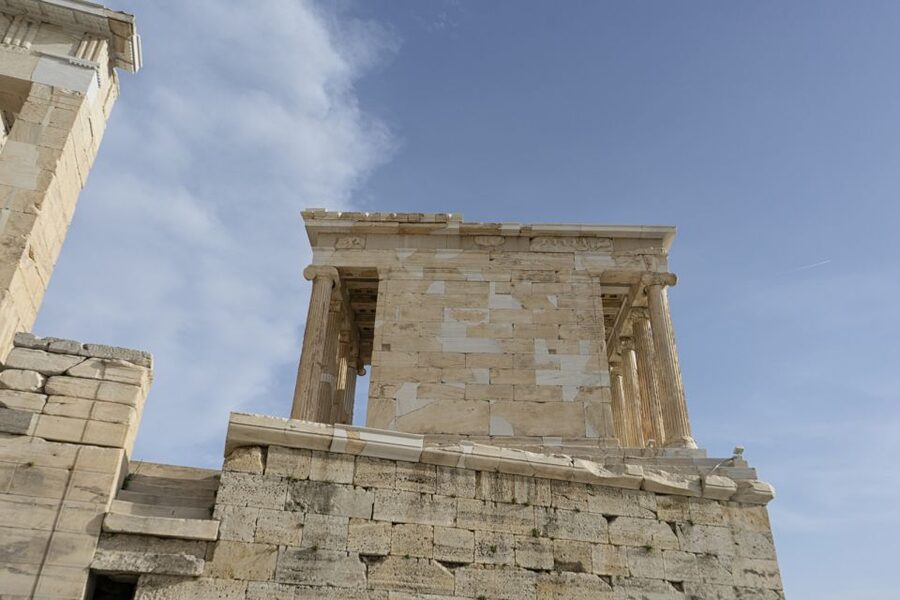
- The Temple of Athena Nike, a smaller temple with a strong position near the gateway
- The Agrippa Monument, a reminder that later periods added their own marks to the site
The point of having a licensed guide here is not simply to name the buildings. A good guide gives you a way to read the ruins: which structure served as an entrance, which carried religious meaning, and how later additions changed the hill.
The listed guides have different strengths. Vasaliki has been praised for being friendly, keeping a comfortable pace, and pausing in shaded places. Sissy is an archaeologist, a useful background when your questions move beyond the basic story. Tina has been described as bringing the broken stones back to life through clear explanation. You cannot choose a particular guide from the information provided, but these examples suggest the experience relies heavily on the person leading your group.
The Acropolis is exposed, and shade is limited. The guide may stop where shade is available, but you should still carry water and protect yourself from the sun. There is no time for a relaxed meal during the tour, so eat beforehand or plan to buy something quickly at the canteen during the break.
More Plaka and old town walks:
- Culinary Backstreets of Plaka – Athens Food Tour
★ 5.0 · 182 reviews - Acropolis monuments, Parthenon and Plaka, Monastiraki walking tour
★ 5.0 · 182 reviews - Traditional Greek Show in Plaka with Dinner
★ 3.6 · 178 reviews - VIP Private Guided Tour of Athens Acropolis & Plaka in a Sidecar
★ 5.0 · 108 reviews
Free time for photos at the Acropolis
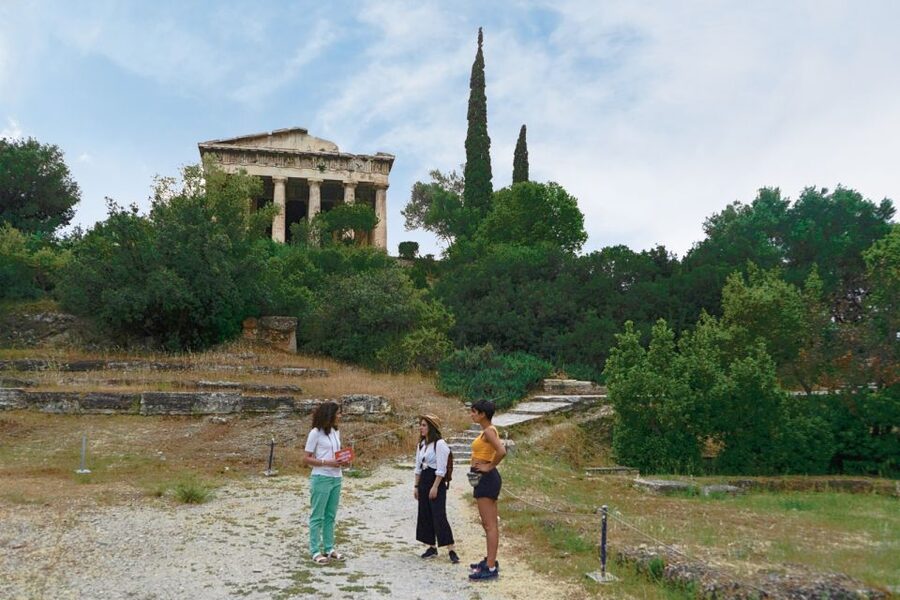
After the guided explanation, you receive free time to explore and take pictures at the Acropolis. This is a useful touch. A fully guided walk can leave you focused on keeping up, while a little independent time lets you look again at the details that caught your eye.
Keep your expectations practical. Free time does not mean the site becomes private or quiet. You will still deal with crowds, security procedures, and the fixed timing of the Agora portion. Use the pause for photographs, a closer look at the monuments, and a drink rather than wandering far from the agreed meeting plan.
The break before the Agora is short. The schedule specifically does not include a leisurely lunch. If you need a full meal, have it before the tour or arrange it later. A snack and beverage are the realistic choices during the gap.
Walking down to the Ancient Agora
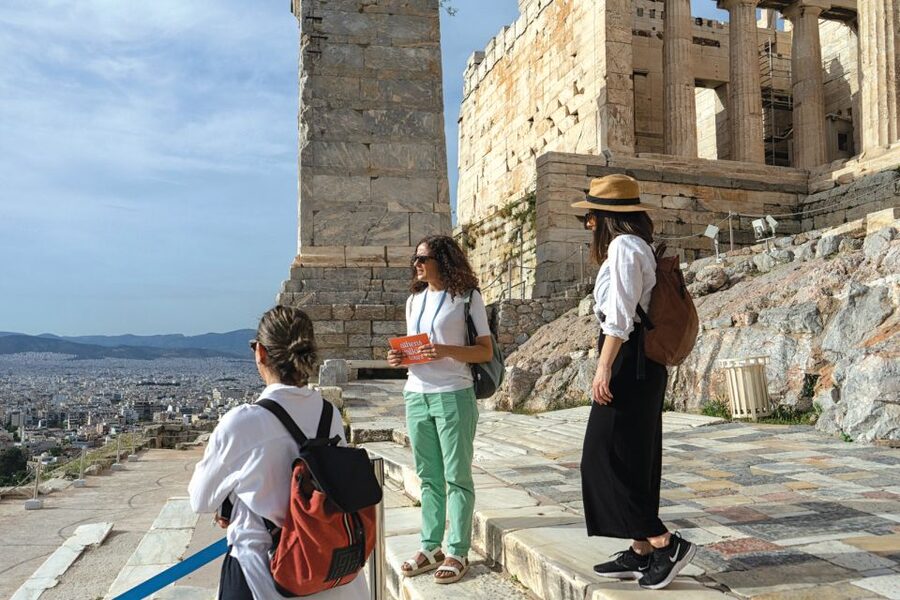
The group then walks down to the Ancient Agora, the commercial, political, and financial center of ancient Athens. This transition is one of the tour’s strongest features. You move from the hilltop sanctuaries into the place where public business and ordinary transactions took place.
The Agora can be harder to understand without help because many remains are low walls, foundations, and scattered columns. Your guide gives each section a purpose and connects the surviving stones with the people who used the space.
The site is associated with Socrates, Plato, and other philosophers who walked and taught here. That does not mean every stone marks a known conversation, but the Agora was the setting for the public life that shaped Athenian thought. With a guide, the connection between philosophy, politics, trade, and civic duties becomes clearer.
The Ancient Agora begins at approximately 1 p.m. If you buy your own ticket, make sure the entry time matches this schedule. The official booking system is hhticket.gr, and the same care is needed for the Acropolis ticket at the earlier time.
Hephaestus Temple and the Agora’s smaller monuments
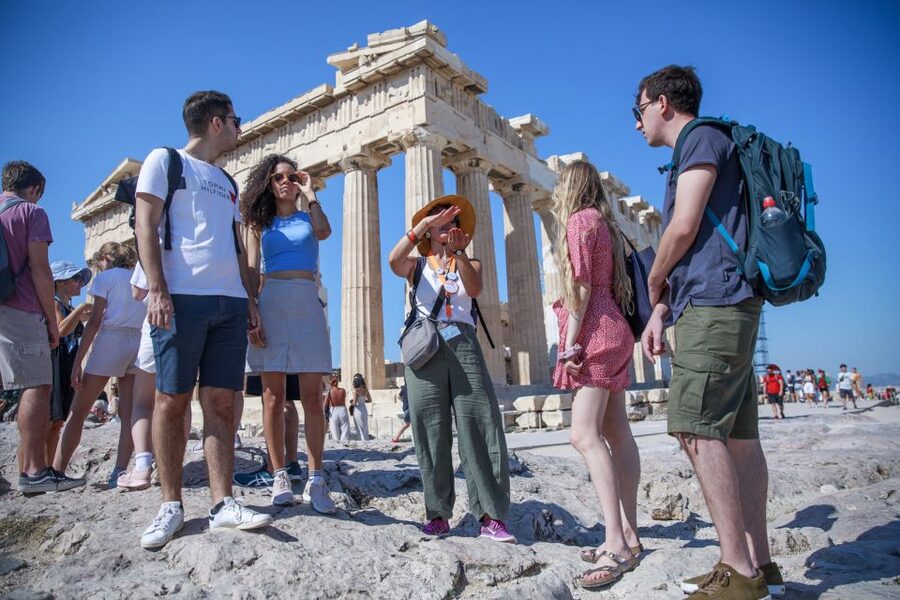
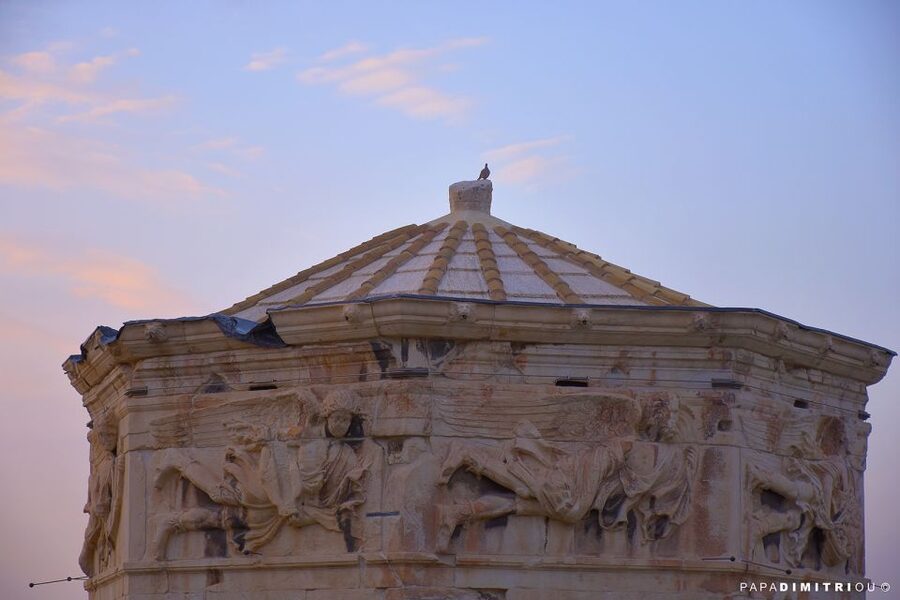
The Temple of Hephaestus is the visual star of the Agora. It is described as the best-preserved Greek temple from the fifth century BC, and its condition makes it easier to understand the form of a classical temple than the more damaged buildings on the Acropolis.
The tour also includes the Church of the Twelve Apostles, the Temple of Apollo Patroos, the Stoa of Zeus, and the Altar of Zeus. These are not all equally complete, but together they show that the Agora was not one single building. It was a working district with religious, political, and commercial functions.
I appreciate this part of the route because it slows the pace after the headline monuments. At the Acropolis, your eye goes straight to the Parthenon. In the Agora, the guide has to point out why a smaller foundation or partial colonnade matters. That extra explanation turns a walk among ruins into a readable place.
The ground remains uneven, and the tour is not suitable for wheelchair users or people with mobility impairments. An older participant with some knee trouble found the pace manageable, but that should not be treated as a guarantee. Your comfort will depend on your own strength, balance, and tolerance for inclines and steps.
The Attalos Museum and everyday ancient Athens
The final major stop is the Attalos Museum. Housed in the reconstructed Stoa of Attalos, it gives you objects that make the Agora less abstract.
Particularly useful are the ancient identification items, along with original measures and weights used by market inspectors. These objects show the practical side of Athenian life. The Agora was not only a place for grand speeches and philosophy. It was also where goods were measured, prices were handled, and market rules were enforced.
This museum is a good reason to choose the combined tour rather than visiting only the Acropolis. The hilltop monuments can dominate your first impression of Athens, but the Agora explains how the city operated at street level. You see the public world behind the famous names.
Timing, tickets, and the real cost
The total duration is 3.5 hours, with the Acropolis beginning around 11 a.m. and the Agora portion starting around 1 p.m. Check the available departure date and time before booking, since the schedule is fixed around the archaeological sites.
There are two important ticket choices. With Ticket is the simpler option because the required admissions are included, along with the local licensed English-speaking guide, skip-the-ticket-line service, an Athens guide magazine, and an Athens map.
Without Ticket requires more work. You must purchase Acropolis admission and Ancient Agora admission through the official site, select the right date, time slot, and ticket category, and complete those purchases before booking the tour. A valid ticket is required to join, and the entry times must match the tour schedule.
Skip-the-line does not mean walking straight through every gate. Airport-style security still applies, and waits can run from zero to 10 or 30 minutes. During busy periods, the delay may exceed 30 minutes. Build that possibility into your day and avoid scheduling another timed attraction immediately afterward.
Hotel pickup and drop-off are not included. You reach the central meeting point on your own, and food and drinks are also separate. The tour offers free cancellation up to 24 hours before departure, and reserve-now, pay-later booking is available.
Who will get the most from this tour
I would choose this tour if you want the major ancient sites explained by a person rather than an audio guide. The strongest fit is a first-time Athens visitor, a history fan, or anyone who wants the Acropolis and Agora placed in the same story.
It also suits families and mixed-age groups when everyone can manage the walking. The guides have been praised for answering questions, keeping a steady pace, and finding shade when possible. That personal pacing can be more useful than a fixed recording, especially when a child or older adult needs an extra moment.
You may prefer a different plan if you want a slow lunch, a private schedule, or extended time at each site. The tour moves on to the Agora at a set hour, and the short break is for a snack, not a sit-down meal.
If you use a wheelchair, have major mobility limits, or dislike uphill walking and uneven ancient ground, do not book this activity. The restrictions are clear, and the Acropolis in particular demands physical effort.
Should you book the Acropolis and Agora tour?
Book it if you want a well-organized history lesson with real site access and a route that makes sense. The combination of Dionysus Theater, Acropolis monuments, Ancient Agora, and Attalos Museum gives you more than a quick Parthenon visit.
Choose the With Ticket option if you want fewer opportunities for a costly timing mistake. Choose Without Ticket only if you are comfortable managing the official ticket system and can secure both entry times before booking.
At $66, the tour offers solid value for a licensed English guide across two major archaeological sites, especially when admission is included. Just arrive early, bring identification and water, leave large bags behind, and treat the 3.5 hours as an active walk rather than a relaxed city stroll.
FAQ
How long is the Acropolis, Plaka, and Ancient Agora tour?
The tour lasts 3.5 hours.
What language is the tour conducted in?
The live tour is conducted in English.
What time does the Acropolis portion begin?
The Acropolis portion begins at approximately 11 a.m.
What time does the Ancient Agora portion begin?
The Ancient Agora portion begins at approximately 1 p.m.
Where is the meeting point?
Meet at 3 Dionyssiou Areopagitou Street, near the orange Athens Walking Tours sign at the start of the pedestrian walkway leading to the Acropolis from Hadrian’s Arch and Syngrou Avenue.
How early should I arrive?
Arrive 20 minutes before the scheduled departure time.
Are admission tickets included?
Admission depends on the option selected. The With Ticket option includes the required entries. With Without Ticket, you must buy the official Acropolis and Ancient Agora tickets yourself.
Does skip-the-ticket-line access remove all waiting?
No. Security screening is still required, and waits can range from none to 10 or 30 minutes. During busy periods, waits may be longer than 30 minutes.
Can I bring a stroller or large bag?
No. Baby strollers, luggage, and large bags are not allowed.
Is the tour suitable for wheelchair users?
No. The tour is not suitable for wheelchair users or people with mobility impairments because it includes inclines, steps, and uneven ground.
More ancient city sites in Athens
- Athens Half Day Tour, Acropolis, Parthenon, Temple of Olympian Zeus & Hephaistus
★ 5.0 · 609 reviews - Athens: Agora and Hephaistos Temple Entrance Ticket
★ 4.0 · 449 reviews - Athens: Ancient Agora E-Ticket and Audio Tour
★ 3.9 · 413 reviews - Athens: Temple of Olympian Zeus Ticket and Audio Tour
★ 3.4 · 188 reviews
Freshly added Athens trips
- Athens and Ancient Corinth Private from Athens★ 5.0 · 3 reviews
- From Athens: Mycenae and Epidaurus Private Tour★ 4.8 · 3 reviews
- Full day Meteora private tour★ 5.0 · 3 reviews
- Double Shore Dive (certified divers)★ 4.5 · 3 reviews
- Athens Hills: Mythology Treasure Hunt★ 5.0 · 3 reviews
- Sunset & swimming at Cape Sounio, Poseidon temple★ 5.0 · 3 reviews
- Philosophy Experience at Plato’s Academy Park – basic version★ 5.0 · 3 reviews
- Private Acropolis Tour – Ticket Included★ 5.0 · 3 reviews
Acropolis Tours, compared.

Acropolis & up to 5 Archaeological Sites Combo Pass
Read our review →

Acropolis, Parthenon & Acropolis Museum Guided Tour
Read our review →
Acropolis, Parthenon & Acropolis Museum Guided Tour
Read our review →


Acropolis monuments & Parthenon Walking Tour with Optional Acropolis Museum
Read our review →Browse the lists this tour appears in