
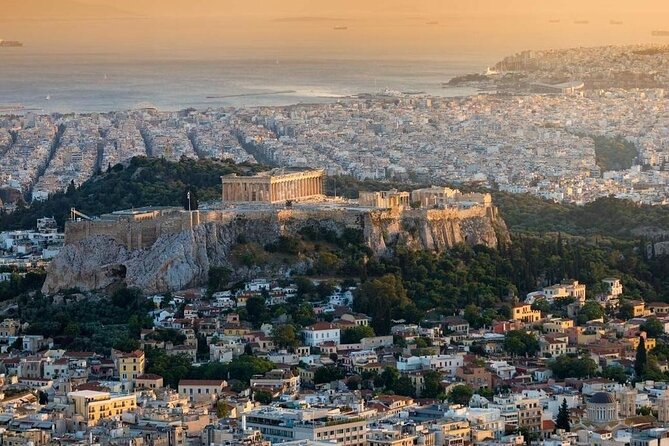
Reviewed · ACROPOLIS TOURS
Visit of the Acropolis with an official guide in Spanish
The best part of this Acropolis visit is the Spanish-language storytelling. In about two hours, an official guide ties the stones to mythology, war, religion, politics, theater, and everyday life. The Parthenon becomes more than a famous photograph, and the Caryatids become part of a story about Athena, Poseidon, and the first king of Athens.
I like the small maximum of 27 people, which should make it easier to hear through the wireless audio system. I also like the guide team’s clear passion. Efi receives especially warm praise for asking questions, pointing out the best photo spots, and keeping children involved. Ari, Simon, and Maria are also named as engaging Spanish-speaking guides.
The main thing to consider is that the $44.03 price does not include Acropolis admission. You must arrange the entry ticket separately, and the entire visit is on foot over uneven historic ground. Plan for heat, steps, and a moderate level of fitness.
In This Review
- Key points to know before you book
- Why a Spanish guide changes the Acropolis
- Starting at the Acropolis entrance
- The Parthenon and its optical refinements
- The Propylaea and the Temple of Athena Nike
- The Erechtheion and its famous Caryatids
- Ancient performance at the Herod Atticus Odeon
- Medicine at the Temple of Asclepius
- The Theatre of Dionysus and the birth of drama
- What the two-hour format gives you
- Price, admission, and practical value
- Who should choose this Acropolis visit
- Should you book it?
- FAQ
- Is admission to the Acropolis included?
- How long does the tour last?
- What language is the tour in?
- What time does the tour begin?
- Where is the meeting point?
- Where does the tour end?
- Which monuments are included in the guided visit?
- Is transportation included?
- How large can the group be?
- What level of fitness is needed?
- Is a wireless audio system provided?
- Can I cancel for a refund?
Key points to know before you book
- Spanish-only guiding: The tour is designed for Spanish-speaking visitors, with an official guide explaining the site in Spanish.
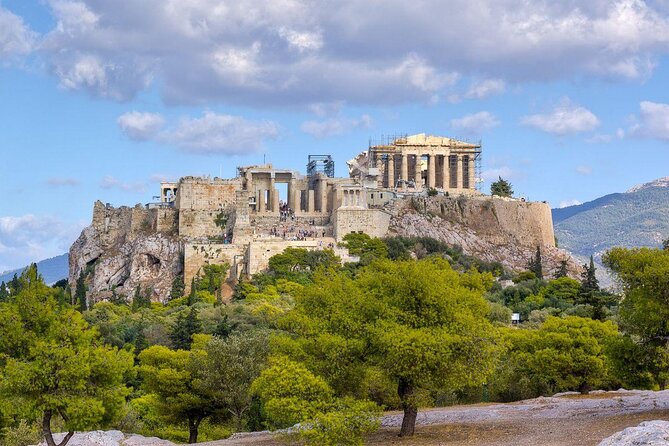
- Seven major monuments: You see the Parthenon, Propylaea, Erechtheion, Odeon of Herod Atticus, Temple of Asclepius, and Theatre of Dionysus, along with the wider Acropolis.
- Admission costs extra: The listed price covers the guiding service, not the ticket needed to enter the Acropolis.
- About two hours on foot: The route packs in a great deal, so expect a focused visit rather than a slow, free-form wander.
- Wireless audio included: The audio system should help you follow the guide when the group spreads out.
- Meet near Dionysiou Areopagitou: The 8:30 am meeting point is at the Greek National Tourism Organisation Information Point, at Dionysiou Areopagitou 18.
Why a Spanish guide changes the Acropolis
The Acropolis is easy to admire and surprisingly easy to misunderstand. You see broken columns, marble walls, and a hilltop temple, but without context, the site can feel like a collection of beautiful ruins.
This tour gives you a framework. The guide begins with the historical, mythological, and cultural meaning of the Acropolis, then connects individual buildings to the changing life of Athens. You hear how sacred spaces were used, how monuments were altered, and how the hill changed during Byzantine and Ottoman rule.
That broad approach is the real value here. The Parthenon is not treated as an isolated temple. You learn about its original purpose, its optical refinements, its decoration, and its later use as a church and mosque. You also hear about damage, looting, and the restoration work still taking place.
The Spanish-only format is important. If Spanish is your strongest language, you can follow complicated architectural and historical ideas without constantly translating in your head. The guide can also explain mythology with more detail and feeling than a short audio panel usually allows.
The guides named in the feedback include Efi, Ari, Simon, and Maria. Efi receives the most repeated praise for her energy, warmth, and ability to keep people connected to the subject. One particularly useful detail is her habit of indicating good places for photographs, allowing you to listen first and take pictures at the right moment.
More Acropolis and Parthenon visits:
- Athens: Acropolis & up to 5 Archaeological Sites Combo Pass
★ 4.4 · 12,619 reviews - Athens: Acropolis Ticket with Optional Audio or Live Guide
★ 4.2 · 11,055 reviews - Athens: Acropolis, Parthenon & Acropolis Museum Guided Tour
★ 4.8 · 9,316 reviews
Starting at the Acropolis entrance
The meeting point is the Greek National Tourism Organisation Information Point at Dionysiou Areopagitou 18. The tour starts at 8:30 am, a sensible hour for a site that can become difficult in the heat later in the day.
You should arrive ready to walk. Transfers are not included, and the visit takes place entirely on foot. The route includes historic paving, slopes, stairs, and exposed areas, so comfortable shoes are more useful than stylish ones.
Your guide sets the scene before moving through the monuments. This opening context matters because the Acropolis was not simply a fortress or a temple complex. It was a religious center and a symbol of Athenian power, with buildings designed to honor the gods and display the city’s achievements.
The group can include up to 27 people. That is not a private experience, but it is a manageable maximum for a major attraction. The wireless audio system is included, which should help you hear the guide while looking at the monuments rather than standing shoulder to shoulder around the speaker.
The Parthenon and its optical refinements
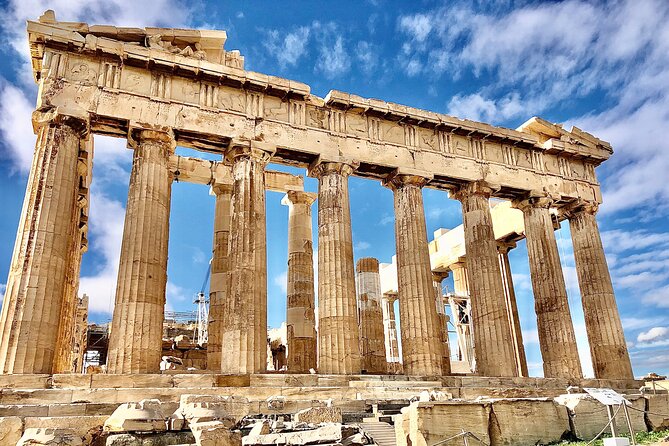
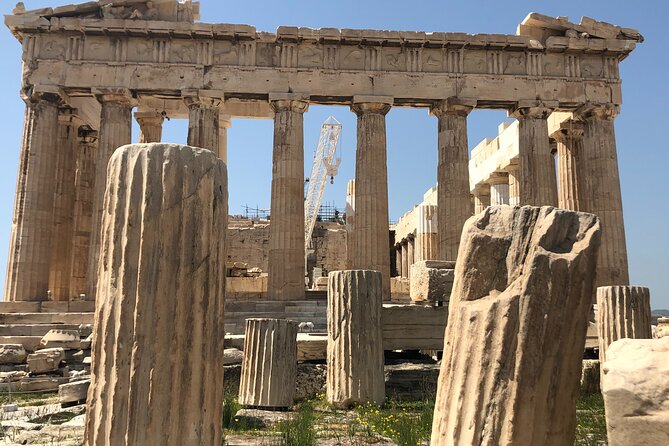
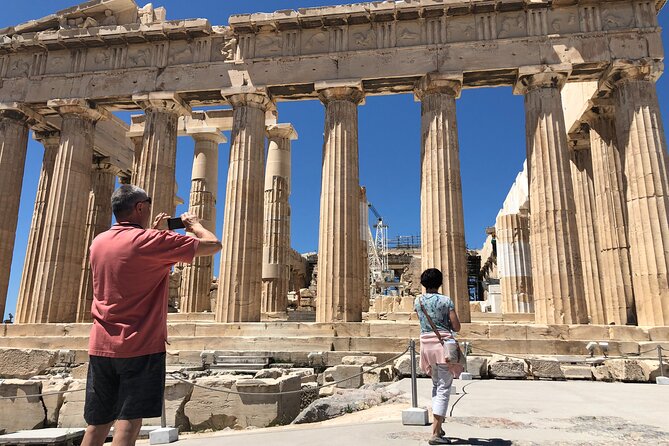
The Parthenon receives the longest attention, about 20 minutes within the published schedule. That makes sense. This is the building most people come to see, but its importance goes well beyond its fame.
The guide explains its construction around 2,500 years ago and introduces the optical refinements that give the building its famous sense of balance. Ancient Greek builders did not rely on perfectly straight visual lines in the simple modern sense. The design used subtle adjustments to create a harmonious appearance when seen from the ground.
You also learn about the building’s changing identity. The Parthenon later became a church during the Byzantine period and a mosque during Ottoman rule. Its decoration was damaged and removed over time, and restoration remains an active part of the site.
I find this section most useful for anyone who has already seen photographs of the Parthenon but wants to understand why it matters. The guide’s job is not only to point out columns. It is to help you read the building as architecture, political statement, sacred space, and survivor.
The limitation is time. Twenty minutes is enough for a strong explanation, but not for every detail of sculpture, restoration, and ancient worship. If you want a specialist study of the Parthenon, you may want more time afterward to explore independently.
The Propylaea and the Temple of Athena Nike
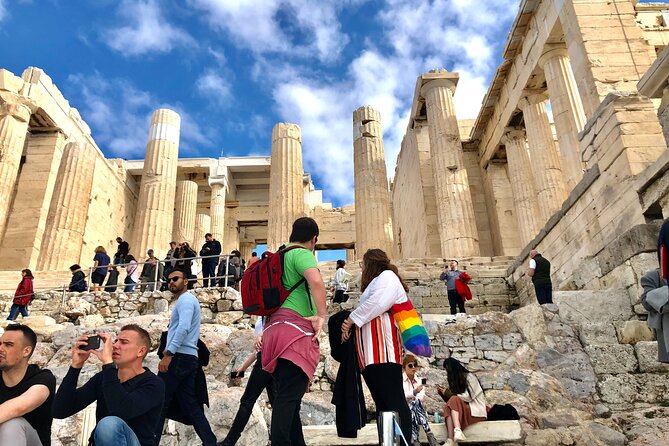
The Propylaea is the monumental gateway to the Acropolis. It was built almost entirely of marble and designed to impress people arriving at the sacred hill.
The guide explains why its position mattered. The approach narrows through the gateway, creating a natural funnel that could also have strategic value in wartime. The structure uses different types of columns, and this is a good place to hear how practical concerns and visual design worked together.
The Propylaea often receives less attention than the Parthenon, but I like having it included. It changes the way you understand the visit. You are not simply walking toward a temple. You are passing through a carefully planned entrance that marked the move from ordinary city life into a sacred and prestigious space.
The supplied route also refers to the Temple of Athena Nike, described as an architectural jewel above the monumental entrance. It was dedicated to Athena Victorious and linked to Athenian victories over the Persians. The building served as a lasting reminder of the city’s most celebrated era.
This stop is brief, but its message is clear: religion and politics were closely linked on the Acropolis. Victory, civic pride, divine protection, and public memory were built into the stone.
A few more Athens days worth a look
- Athens: Acropolis and Parthenon Guided Walking Tour
★ 4.6 · 5,882 reviews - Athens: Cape Sounio & Poseidon Temple Trip with Audio Guide
★ 4.4 · 4,521 reviews - Athens: Mythology of Delphi, Museum and Arachova Guided Tour
★ 4.6 · 4,008 reviews - Athens: Acropolis, Parthenon & Acropolis Museum Guided Tour
★ 4.8 · 3,579 reviews
The Erechtheion and its famous Caryatids
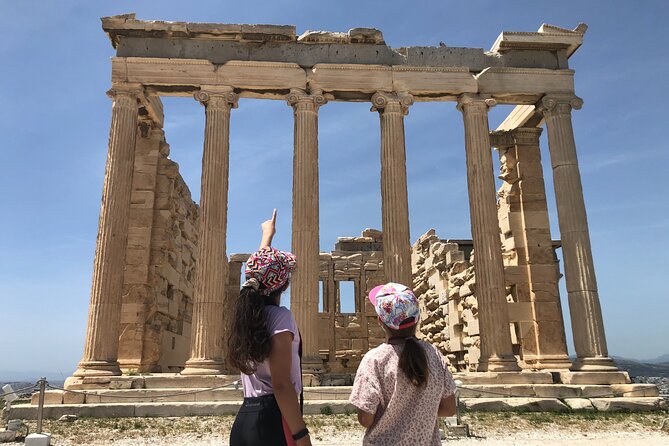
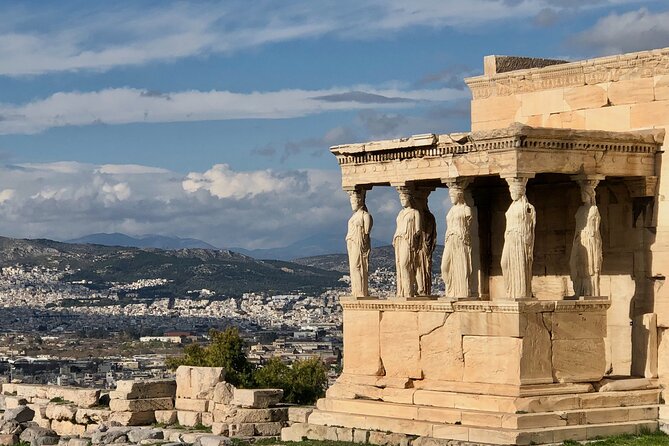
The Erechtheion is the most photogenic stop for many people, thanks to its Caryatids, the female-shaped columns supporting one of its porches. You get time to hear the stories behind them and to look closely at how sculpture and architecture work together.
The building was dedicated to several divine and heroic figures, including Athena, Poseidon, and Erechtheus, the mythological first king of Athens. That mixture tells you something important about ancient Greek religion. A single sacred building could hold several connected traditions rather than serving one simple purpose.
The sacred olive tree is another key subject. The guide explains why it mattered to the Athenians and how it connects to the contest between Athena and Poseidon for the city’s protection.
The Caryatids are easy to photograph, but the explanation gives the view more weight. You begin to see the porch not as decoration alone, but as part of a building loaded with myth and civic meaning.
The tour does not promise a long stop here, only about 10 minutes. That is enough for the essential stories and photographs, though you may wish for longer if architecture is your main interest. The guide’s photo advice is useful because it helps you set aside your camera during the explanation and return to it afterward.
Ancient performance at the Herod Atticus Odeon
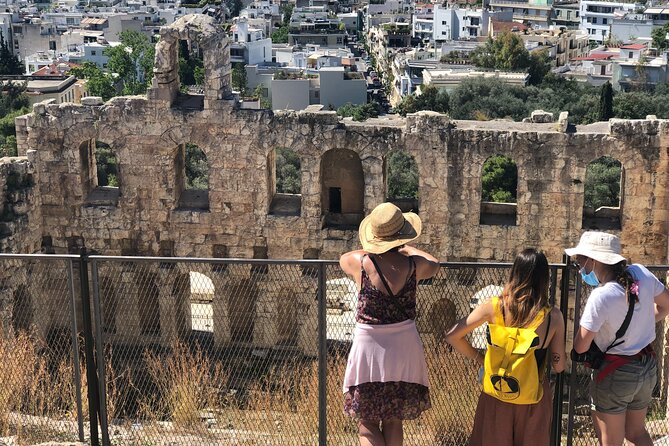
The Odeon of Herod Atticus is a Roman-era auditorium with room for about 5,000 spectators. It was built by one of the prominent Roman governors in Athens and dedicated to his wife, Regina.
Unlike many ancient buildings, this one is fully restored and still used for performances during the Athens Festival. The guide explains how it functioned and why it remains part of the city’s cultural life.
You cannot treat the Odeon as just another ruin. Its restored form helps you picture ancient and modern performance traditions sharing the same setting. The scale is also easier to grasp from the Acropolis than from a photograph.
The scheduled explanation lasts about 10 minutes. That is sufficient to understand the building’s purpose and continuing use, but the tour does not include a performance or a separate theater program. You view the auditorium as part of the Acropolis visit.
Medicine at the Temple of Asclepius
The Temple of Asclepius offers a short but welcome change of subject. This sanctuary was dedicated to Asclepius, the god of medicine.
In about five minutes, the guide explains how ancient Athenians sought treatment and what kinds of votive offerings they left as thanks. That detail brings the site down from grand state monuments to individual hopes and fears.
You are reminded that the Acropolis was not only about rulers, victory, and artistic perfection. People came here with illness, prayers, and gratitude. Even a brief stop can make the ancient world feel more personal.
Because this is the shortest part of the route, do not expect a full account of ancient medicine. You get the main idea and a useful glimpse into religious healing practices.
The Theatre of Dionysus and the birth of drama
The Theatre of Dionysus is one of the oldest theaters in the world and was built entirely of marble. Its position on the slope of the Acropolis helped provide good acoustics, while its capacity of about 17,000 spectators shows the size of public entertainment in ancient Athens.
This is the place associated with the first performances of works by Euripides, Aeschylus, Sophocles, and Aristophanes. The names alone make the stop worthwhile, but the guide’s explanation helps you picture drama as a public and civic event rather than a private evening at the theater.
The theater also puts Athenian culture in a wider frame. The city’s achievements were not only temples and military victories. Plays challenged leaders, explored moral choices, mocked social habits, and examined the relationship between people and the gods.
The published schedule allows about 10 minutes here. You will hear the key facts and see the layout, but the tour cannot recreate the experience of attending a full ancient performance. If theater is especially important to you, treat this as an introduction.
What the two-hour format gives you
Two hours is a good length for a first visit if you want structure and clear explanations. You see the major monuments without committing half a day to a single guided walk.
The pace is also the main compromise. The published stop times add up to less than two hours because the route includes movement, opening context, and time at the Acropolis as a whole. You should expect a focused walk with limited lingering at each monument.
The end point is given as Theorias 21, at the top of the Acropolis. The tour description says the visit ends there so you can use free time to photograph the monuments. This gives you a useful chance to remain on the hill after the formal guiding ends, though the exact amount of free time is not specified.
The experience suits you best if you want the essential story of the Acropolis in Spanish. It is particularly useful on a first visit, for families who need a guide to keep attention moving, and for anyone who prefers human explanation to reading every sign.
It may not suit you if you want a private guide, a slow photography session, or a highly specialized architectural study. The group can reach 27 people, and the guide has to balance different interests.
Price, admission, and practical value
At $44.03 per person, the guiding fee is reasonable for a two-hour official tour, especially with a wireless audio system and a route covering several major monuments. The price becomes less simple once you add the separate Acropolis admission ticket.
That separation is the most important booking detail. You do not receive entry to the venue with this purchase. A ticket is required, and the supplied details specify entry from 8:00 to 9:00, though the wording is unclear about the closing time. Confirm the ticket timing before you go.
The price is strongest for Spanish-speaking visitors who want the site explained in their own language. If you already have a detailed guidebook and prefer to move at your own pace, paying for a guided visit may offer less value.
The tour is free to cancel up to 24 hours before the start time for a full refund. Changes or cancellations made less than 24 hours before the start are not accepted for a refund. The cutoff uses local Athens time.
Who should choose this Acropolis visit
I would choose this tour for a first-time visit when Spanish is your preferred language and you want the major stories without planning your own route.
It is also a strong choice for families. Efi is praised for asking questions and holding children’s attention, and the route has enough variety to break up the stonework: temples, gateways, theaters, medicine, mythology, and Roman Athens.
You should have moderate physical fitness. The entire visit is on foot, and the setting includes historic surfaces and slopes. Service animals are allowed, and the meeting point is near public transportation.
The early start helps you make better use of the day, but you still need to prepare for sun and heat. The information supplied does not specify shade, water arrangements, or rest breaks, so plan independently for the conditions.
Should you book it?
Book this Acropolis tour if you want a Spanish-speaking official guide who can connect the Parthenon to mythology, architecture, religion, theater, and later periods of Athenian history. The repeated praise for Efi’s passion, clear explanations, and help with photographs suggests that the guide can make the difference between seeing ruins and understanding a city’s central story.
Before booking, confirm the separate admission ticket and be ready for a brisk, two-hour walk. If those details suit you, the $44.03 guiding fee is a sensible way to get your bearings on the Acropolis and then use the remaining free time for your own photographs.
FAQ
Is admission to the Acropolis included?
No. The tour price does not include the Acropolis entrance ticket. You must have a separate admission ticket to enter the site.
How long does the tour last?
The guided visit lasts approximately two hours.
What language is the tour in?
The tour is exclusively in Spanish.
What time does the tour begin?
The stated start time is 8:30 am.
Where is the meeting point?
You meet at the Greek National Tourism Organisation Information Point, Dionysiou Areopagitou 18, Athina 117 42, Greece.
Where does the tour end?
The stated end point is Theorias 21, Athina 105 58, Greece. The experience description says the visit ends at the top of the Acropolis, where you can use free time to take photographs.
Which monuments are included in the guided visit?
The route includes the Acropolis, Parthenon, Propylaea, Temple of Athena Nike, Erechtheion, Herod Atticus Odeon, Temple of Asclepius, and Theatre of Dionysus.
Is transportation included?
No. Transfers are not included, and the complete visit is conducted on foot.
How large can the group be?
The maximum group size is 27 people.
What level of fitness is needed?
A moderate level of physical fitness is recommended because the visit takes place on foot at the Acropolis.
Is a wireless audio system provided?
Yes. A wireless audio system is included in the tour.
Can I cancel for a refund?
Yes. You can cancel up to 24 hours before the start time for a full refund. Cancellations or changes made less than 24 hours before the start are not accepted for a refund.
Freshly added Athens trips
- Athens and Ancient Corinth Private from Athens★ 5.0 · 3 reviews
- From Athens: Mycenae and Epidaurus Private Tour★ 4.8 · 3 reviews
- Full day Meteora private tour★ 5.0 · 3 reviews
- Double Shore Dive (certified divers)★ 4.5 · 3 reviews
- Athens Hills: Mythology Treasure Hunt★ 5.0 · 3 reviews
- Sunset & swimming at Cape Sounio, Poseidon temple★ 5.0 · 3 reviews
- Philosophy Experience at Plato’s Academy Park – basic version★ 5.0 · 3 reviews
- Private Acropolis Tour – Ticket Included★ 5.0 · 3 reviews
Acropolis Tours, compared.

Acropolis & up to 5 Archaeological Sites Combo Pass
Read our review →

Acropolis, Parthenon & Acropolis Museum Guided Tour
Read our review →
Acropolis, Parthenon & Acropolis Museum Guided Tour
Read our review →


Acropolis monuments & Parthenon Walking Tour with Optional Acropolis Museum
Read our review →Browse the lists this tour appears in