

Reviewed · TOURS
Unexpected Athens Orientation Tour
Athens reveals its most surprising side away from the Acropolis. This four-hour walk links royal palaces, 19th-century civic buildings, Ottoman streets, old markets, and neighborhoods that show how ancient, modern, Eastern, and Western influences met in one city. I especially like the route through Kolonaki and Exarcheia, followed by the more traditional streets of Psiri and Monastiraki. I also like that guides such as Andreas, Antigoni, Simos, and Christina are singled out by name for clear explanations, good pacing, and personal attention.
The main drawback is that this is a city walk, not a grand monument tour. Some important sites are viewed from outside, the route covers several neighborhoods in four hours, and the notorious World War II prison is closed on Mondays and Tuesdays. Wear comfortable shoes, and check the meeting point carefully because it can change with the option you book.
In This Review
- Five things to know before you book
- Why this Athens walk feels different
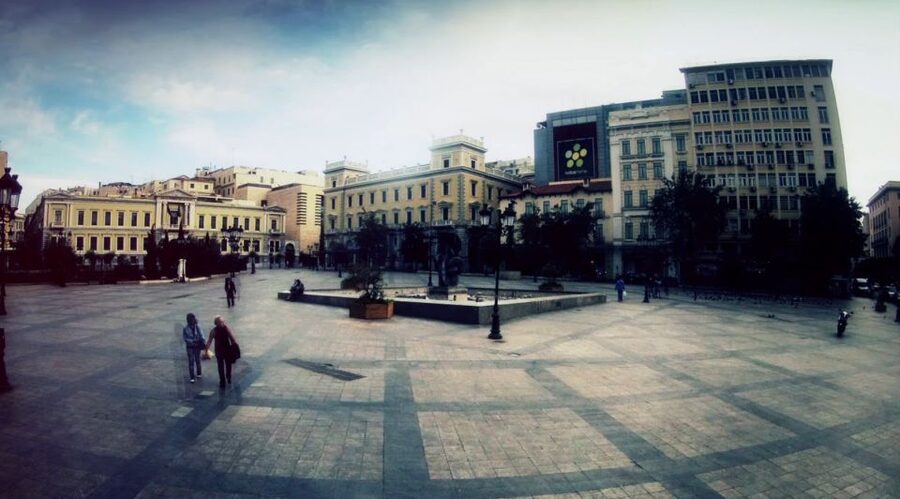
- Starting at Syntagma Square and meeting modern Athens
- Kolonaki and the city’s royal and industrial chapters
- Exarcheia and difficult chapters of the city
- Psiri and the old city’s Ottoman traces
- Monastiraki, markets, rivers, and older remains
- What the architecture adds to the story
- How the four-hour pace works
- English, French, and the value of a personal guide
- Is $62 a fair price for four hours?
- Who should book this orientation walk?
- Final recommendation: book it for the city between the monuments
- FAQ
- Where does the Unexpected Athens Orientation Tour start?
- Where does the tour finish?
- How long does the tour last?
- Which neighborhoods does the tour visit?
- What languages are available?
- Is the World War II prison open every day?
- What is included in the price?
- Can I cancel or pay later?
Five things to know before you book
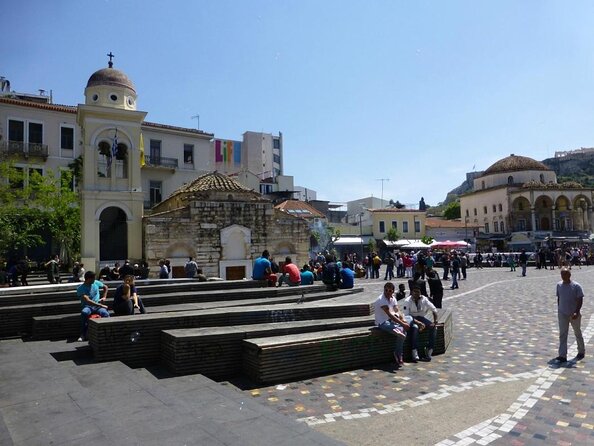
- The route shows four very different Athens neighborhoods: Kolonaki, Exarcheia, Psiri, and Monastiraki each reveal a different chapter of city life.
- You’ll see the civic face of modern Greece: Syntagma Square, Parliament, the Academy, the University, and the National Library help explain how Athens became a European capital.
- Ottoman-era traces remain in the old city: Psiri and Monastiraki preserve street patterns and traditions that sit beside newer shops, cafés, and city traffic.
- The tour includes less-expected history: ancient rivers, old tombs, 19th-century industry, royal buildings, and a World War II prison all appear in the story.
- The guide matters here: English and French tours are available, and past guides including Andreas, Antigoni, Simos, and Christina have been praised for pacing and local insight.
- The $62 price buys context rather than admission tickets: You’re paying for a private or small-group-style walking experience and a city map, not food, drinks, or entry to every place passed.
Why this Athens walk feels different
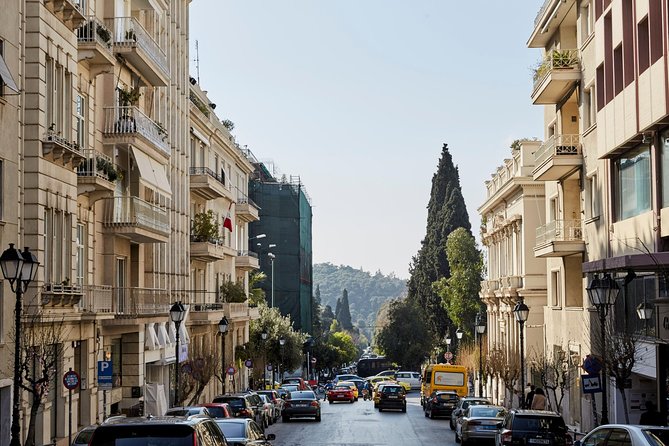
Many first visits to Athens follow the familiar line from Syntagma Square to the Acropolis and Plaka. This tour begins near that same central core, then turns toward the city’s less polished and more revealing sides.
That change of direction matters. Athens is not only an ancient capital preserved in marble. It is also a 19th-century European project, a former Ottoman city, a royal capital, a wartime city, and a modern urban center where old customs and new pressures meet.
You’ll walk rather than ride, so the city unfolds at street level. That means you can pay attention to building fronts, street plans, squares, markets, and the changing feel of each district. It also means you should expect uneven pavement, city noise, and a steady four-hour pace.
The guide provides a map showing how Athens changed over 2,500 years. That is useful because the tour’s appeal lies in connections. A building or street may seem ordinary at first, but its place in the city’s long development gives it meaning.
Other days out people book around Athens:
- Athens: Acropolis & up to 5 Archaeological Sites Combo Pass
★ 4.4 · 12,619 reviews - Athens: Acropolis Ticket with Optional Audio or Live Guide
★ 4.2 · 11,055 reviews - Athens: Acropolis, Parthenon & Acropolis Museum Guided Tour
★ 4.8 · 9,316 reviews
Starting at Syntagma Square and meeting modern Athens
The tour begins at Syntagma, or Constitution, Square, with two possible starting options listed around the square. Confirm the exact meeting point when you book.
Syntagma is the right place to begin because it represents the political center of present-day Greece. From here, the walk introduces the Parliament and the former royal setting around it, then places modern Athens within the older city that surrounds it.
The emphasis is not simply on photographing the Parliament. You’ll learn how institutions such as the Parliament, Academy, University, and National Library helped shape Athens after it became the capital of the modern Greek state.
These buildings reflect the 19th-century desire to give Athens a formal European identity. Their grand classical style looks back to ancient Greece, but their purpose was modern: education, government, research, and national administration.
I like this opening because it gives you a useful frame for the rest of the walk. Ancient Athens often receives all the attention, yet the city you see today was also built through royal planning, public institutions, and industrial change.
Kolonaki and the city’s royal and industrial chapters
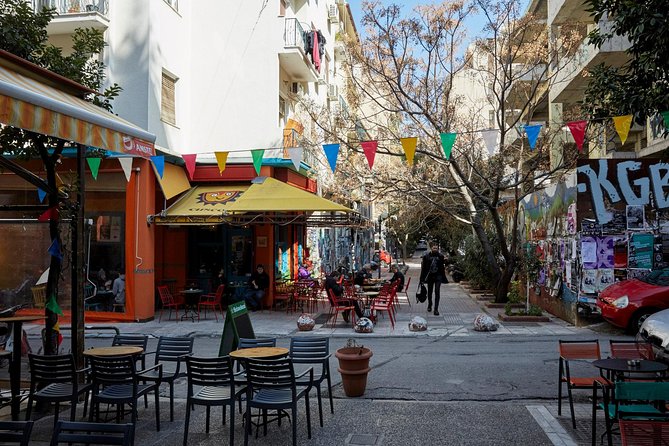
The first major neighborhood stop is Kolonaki, with about an hour of guided walking. The district helps reveal the more formal side of central Athens and the city’s 19th-century transformation.
Here, the tour focuses on landmarks connected with the industrial revolution and royal palaces. These subjects broaden your view of Athens beyond temples and archaeological remains. You’ll see how the capital developed during the period when Greece was building a modern state and linking itself to wider European ideas.
Kolonaki can feel more polished than the districts later on the route, which makes the contrast useful. The point is not that one neighborhood is better than another. It is that Athens changes character quickly, and those changes reflect class, politics, architecture, and time.
This section may appeal most to you if you enjoy architecture and urban history. It is less suitable if you want a tour focused mainly on entering major ancient sites. The experience is about reading the city around you, often from the pavement, rather than collecting admission tickets.
Exarcheia and difficult chapters of the city
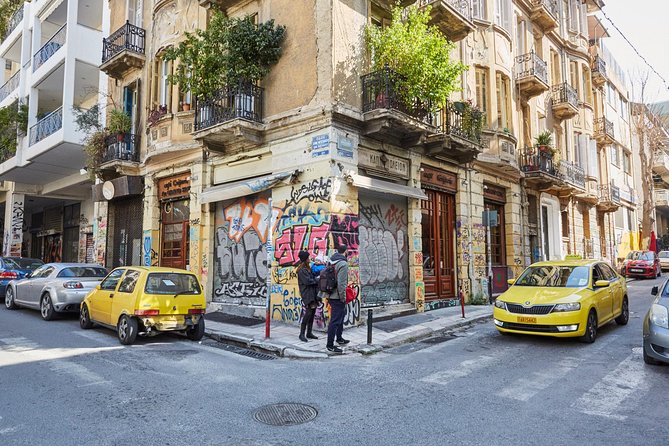
The walk then moves into Exarcheia for roughly an hour. This is one of the tour’s more important changes in tone.
Exarcheia allows the guide to discuss modern Athens and the challenges faced by its citizens. The route also includes a notorious prison connected with World War II. The prison is closed on Mondays and Tuesdays, so your experience will depend on the day you choose.
This stop gives the tour emotional weight. Athens is not presented as a postcard city frozen in the age of Pericles. Its streets also hold memories of occupation, political conflict, hardship, and ordinary people living through major upheaval.
You should not expect a theatrical or sensational presentation. The value comes from setting a difficult site within the wider story of Athens. A good guide can help you understand why a neighborhood matters without reducing it to a label.
Past guides have been praised for clear explanations and an approachable manner. Andreas, in particular, is noted for taking experienced visitors to places they had never seen before, while Simos is praised for attentive guiding and a comfortable walking pace. Those qualities matter in Exarcheia, where context is more important than a quick photograph.
Same city, a completely different century:
- Athens: Cape Sounion & Poseidon Temple Sunset Half-Day Trip
★ 4.8 · 8,241 reviews - Athens: Acropolis and Parthenon Guided Walking Tour
★ 4.6 · 5,882 reviews - All Day Cruise -3 Islands to Agistri,Moni, Aegina with lunch and drinks included
★ 5.0 · 4,958 reviews - Athens, Piraeus, and Coastline: Blue Hop-On Hop-Off Bus
★ 3.9 · 4,849 reviews
Psiri and the old city’s Ottoman traces
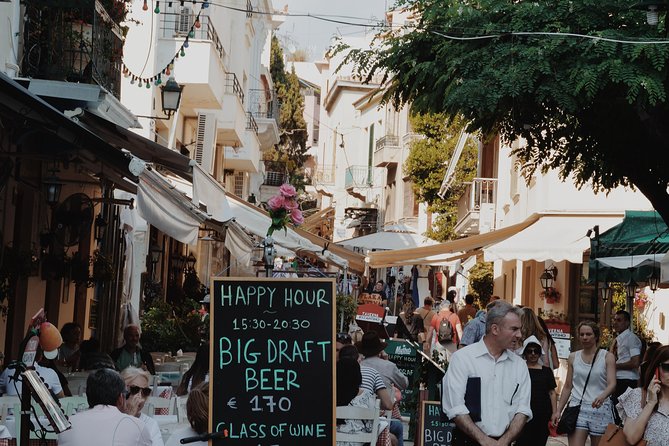
After Exarcheia, the route reaches Psiri for another hour of guided walking. This district helps explain the mixture of old Athens, Ottoman influence, and later urban life.
Psiri and nearby Monastiraki retain parts of the old city’s street pattern and character. You’ll see how traditions from the Ottoman period mixed, or failed to mix, with Western European ideas brought in during the creation of the modern Greek capital.
That tension is one of the strongest themes of the walk. Athens did not simply replace one period with another. Older customs, buildings, markets, and routes remained in use while new institutions and architectural styles appeared around them.
Psiri is also a good place to notice how the city changes from one block to the next. The tour takes you through streets where daily life matters as much as formal monuments. You might find small details in the built environment that explain more about the old city than a single grand façade.
This part should suit you if you want a sense of Athens as a lived-in city. It may feel less satisfying if you prefer a quiet, carefully preserved historic quarter, since the tour’s subject is the mixture itself.
Monastiraki, markets, rivers, and older remains

The final neighborhood is Monastiraki, with about 30 minutes of guided walking before the tour ends at Monastiraki Square.
Monastiraki is a fitting finish because several strands of Athens meet here. You’ll pass through older streets, central markets, and places where commercial activity has continued across generations. The area brings the tour back to the city’s public life after the more formal buildings of Kolonaki and the political history of Exarcheia.
The route also includes ancient rivers that still flow and tombs from an earlier era. These are the kinds of details that can be easy to miss without a guide. Athens often places modern streets directly over, beside, or around traces of much older settlement.
The short Monastiraki section is useful as a final piece, but it is also a limitation. Thirty minutes is enough for orientation and explanation, not for a slow market visit or extended independent exploration. Since the tour ends here, you can continue on your own afterward if you want more time in the area.
What the architecture adds to the story

The tour visits buildings of international architectural interest, including the Academy, University, National Library, Parliament, and royal landmarks. These are not just decorative stops.
Their styles show how the new Greek state used architecture to make a claim about national identity. Classical references pointed toward ancient Athens, while the buildings’ institutions looked toward the future: education, government, public knowledge, and civic order.
I find this approach more useful than a simple list of dates. You’ll begin to see why so many Athens buildings look backward to antiquity while serving a modern capital. The city’s appearance is part of its political story.
The experience also helps you read contrasts. A formal neoclassical building may sit within a district shaped by older local customs. A market street may run close to a major civic square. Ottoman-era patterns can remain visible beside later European planning.
That is the central lesson of the walk: Athens is not one clean historical layer. It is a city where periods overlap in plain sight.
How the four-hour pace works

The advertised duration is four hours, divided roughly into one hour each in Kolonaki, Exarcheia, and Psiri, followed by 30 minutes in Monastiraki. The remaining time covers the opening, transitions, and stops between neighborhoods.
That is a substantial walk. Comfortable shoes are essential, and you should plan for a full morning or afternoon on foot. Food and drinks are not included, so carry what you need for the duration.
The pacing appears to be one of the experience’s strongest practical features. Simos is praised for keeping an attentive, well-judged pace, and other guides are described as friendly and professional. Still, you should tell the guide early if you need a slower rhythm or a short pause.
Because the route crosses several distinct districts, the walk can feel full rather than leisurely. You’ll cover a lot of ground and hear a lot of history. If you like extended walking and want a broad introduction, that density is a benefit. If you prefer long café stops or detailed visits inside monuments, it may feel rushed.
English, French, and the value of a personal guide
Tours are offered in English or French. A private group is available, which may be worth considering if you want more room for questions or a pace suited to your own party.
The strongest guide names associated with this experience include Andreas, Antigoni, Simos, and Christina. Andreas is praised for explaining both ancient history and modern city issues, while Antigoni is noted for helping visitors understand Greek culture and the difficulties faced by people in Athens today.
Christina is remembered for taking people to places they were unlikely to find alone. One particularly practical benefit of a good guide is local advice after the walk, such as suggestions for a traditional taverna or a café serving Greek coffee. That kind of help can make the tour useful beyond its four-hour route.
The guide’s role is especially important here because many stops are about interpretation. You may pass a building or old street without immediately knowing why it matters. The map showing changes across 2,500 years gives you something concrete to follow, but the guide supplies the connections.
Is $62 a fair price for four hours?
At $62 per person, this is not the cheapest way to walk around central Athens. You are paying for four hours with a live English or French-speaking guide, a city map, and a route designed around places you may not choose on your own.
There are no food, drink, or general admission costs included. That makes the value depend on how much you want interpretation rather than entry to major sights.
For a first visit, the price can make sense if you want to understand how Athens fits together before exploring alone. The walk gives you a broad map of the central city and ends at Monastiraki, a useful area for continuing your day.
For a return visit, the value may be even clearer. Several people with previous Athens experience found new areas and new ways to understand the city. If you have already seen the Acropolis, this route offers a different kind of discovery.
A small or private group also improves the value, especially if you care about asking questions. The standard cost is harder to justify if you mainly want photographs of famous monuments or prefer to wander without a set pace.
Who should book this orientation walk?
I’d recommend it to you if you:
- Want an introduction to Athens beyond the Acropolis
- Enjoy walking through ordinary city districts
- Care about architecture, politics, and social history
- Have visited Athens before and want unfamiliar areas
- Prefer a guide who can explain changes across long periods
- Like ending near Monastiraki, where you can continue exploring independently
- Speak English or French
You may want another kind of tour if your priority is entering ancient monuments, spending time inside museums, or avoiding a long walk. This experience moves through many areas, so it favors curiosity and stamina over a slow, single-site visit.
It also suits couples and small groups particularly well. Past visitors have valued the small-group atmosphere, and a private option is available for those who want a more personal outing.
Final recommendation: book it for the city between the monuments
Book the Unexpected Athens Orientation Tour if you want to understand the city beyond its famous ancient remains. Its best feature is the range of subjects packed into one walk: royal Athens, 19th-century state building, Ottoman neighborhoods, wartime memory, markets, old tombs, and modern urban life.
I would choose it early in an Athens visit, especially if you have several days in the city. You’ll finish at Monastiraki with a clearer sense of where the old neighborhoods, civic buildings, and central markets fit together.
The strongest reason to book is the guide-led interpretation. The main reason to hesitate is the pace and the lack of included admissions. If those trade-offs suit you, $62 buys a thoughtful introduction to the Athens that many visitors pass by.
FAQ
Where does the Unexpected Athens Orientation Tour start?
The tour has two listed starting options at Syntagma, or Constitution, Square. The exact meeting point may vary depending on the option booked.
Where does the tour finish?
The walk finishes at Monastiraki Square.
How long does the tour last?
The tour lasts four hours.
Which neighborhoods does the tour visit?
The route includes Kolonaki, Exarcheia, Psiri, and Monastiraki.
What languages are available?
The tour is available with an English or French-speaking guide.
Is the World War II prison open every day?
No. The prison is closed on Mondays and Tuesdays.
What is included in the price?
The price includes the live guide and a city map showing how Athens changed through 2,500 years. Food, drinks, and gratuity are not included.
Can I cancel or pay later?
You can cancel up to 24 hours before the tour for a full refund. Reserve-now, pay-later booking is available, and a private group option can be selected.
Freshly added Athens trips
- Athens and Ancient Corinth Private from Athens★ 5.0 · 3 reviews
- From Athens: Mycenae and Epidaurus Private Tour★ 4.8 · 3 reviews
- Full day Meteora private tour★ 5.0 · 3 reviews
- Double Shore Dive (certified divers)★ 4.5 · 3 reviews
- Athens Hills: Mythology Treasure Hunt★ 5.0 · 3 reviews
- Sunset & swimming at Cape Sounio, Poseidon temple★ 5.0 · 3 reviews
- Philosophy Experience at Plato’s Academy Park – basic version★ 5.0 · 3 reviews
- Private Acropolis Tour – Ticket Included★ 5.0 · 3 reviews
Tours, compared.

Acropolis, Parthenon & Acropolis Museum Guided Tour
Read our review →


Mythology of Delphi, Museum and Arachova Guided Tour
Read our review →
Acropolis, Parthenon & Acropolis Museum Guided Tour
Read our review →