
Reviewed · WALKING TOURS
Private Tour: Ancient and Contemporary Athens Walking Tour
The clever idea here is to join Athens’ famous ruins to its living neighborhoods in one long walk. You begin near Hadrian’s Arch, climb through the Acropolis, then move from the Ancient Agora to Psiri, Monastiraki, Plaka, and Syntagma. Ancient stones and modern street life share the same route.
I like the private format, since your guide can adjust the pace and explain Athens in a way that works for your group. I also like the food stop around the central market area, where coffee, snacks, and gyros give the day a welcome local flavor. The main drawback is the price, $475.16 per person, and the fact that admission tickets, lunch, and transport outside the central pickup area cost extra. Expect a serious walking day, often 6 or 7 miles.
In This Review
- Key points to know before you book
- Why this Athens walk works so well
- Starting beneath the Acropolis at Hadrian’s Arch
- Seeing the Acropolis without rushing past it
- The Ancient Agora and the city’s civic heart
- Psiri, coffee, and Greek food near the market
- Monastiraki and the route into Plaka
- What the private guide adds
- Six hours on foot: the practical reality
- Who should book this Athens experience?
- Should you book it?
- FAQ
- How long does the Ancient and Contemporary Athens Walking Tour last?
- What sights are included in the walking route?
- Are Acropolis and archaeological entrance fees included?
- Is hotel pickup available?
- Is lunch included?
- What should I bring and wear?
Key points to know before you book
- Ancient and modern Athens in one route: The Acropolis and Ancient Agora are paired with Psiri, Monastiraki, Plaka, and central Athens.
- A truly private experience: Only your group takes part, with a guide who can shape the discussion and pace.
- Food is part of the walk: Tastings include Greek specialties, with past itineraries featuring coffee, a snack, and gyros.
- Plan for 6 to 7 miles: Comfortable, sturdy shoes, light clothing, water, and a hat matter in Athens’ heat.
- The price excludes key extras: Archaeological entrance fees, lunch, and some transportation are not included.
- Guide quality is central: Andreas, Sofia, Danae, Lina, Tania, Katerina, Maroussa, Nikos, and Josephine have each been praised for different strengths, from ancient history to local neighborhoods and street art.
Why this Athens walk works so well
Athens can feel scattered at first. The Acropolis is the obvious anchor, but the city’s appeal grows when you see how the old quarters, markets, squares, and modern streets fit around it. This tour gives you that connection without asking you to plan several separate visits.
The six-hour length is useful if you have only one full day in central Athens. You get a broad introduction, then you can return later to the places that catch your interest. One particularly good strategy is to book it near the start of your stay, so your guide can help you decide where to spend your free time afterward.
The private setup changes the day. You are not tied to a large group’s pace or a fixed level of interest. A family with teenagers can ask for stories and visual details, while history-minded adults can spend longer on archaeology, philosophy, or politics. Guides have also been praised for connecting ancient Athens with the meaning of being Athenian today, which gives the ruins more life than a list of dates.
Still, this is not a gentle orientation stroll. The route includes uphill walking, uneven archaeological ground, heat, and a lot of standing. If you want a short Acropolis visit followed by a leisurely lunch, this plan may feel demanding.
More Athens walking tours:
- Athens: Acropolis and Parthenon Guided Walking Tour
★ 4.6 · 5,882 reviews - Greek Food Walking Tour in Athens
★ 5.0 · 4,740 reviews - Acropolis: Acropolis and Parthenon Guided Walking Tour
★ 4.7 · 3,442 reviews
Starting beneath the Acropolis at Hadrian’s Arch
The official starting point is the Arch of Hadrian on Leoforos Vasilisis Amalias, close to the Acropolis and the center of Athens. If your hotel is within about a 10-minute walk, the guide can meet you there. If it is farther away, you need to arrange a practical meeting point, and transport may cost extra.
Hadrian’s Arch is a useful opening scene because it marks a shift between ancient Athens and the Roman city. From here, the route moves toward the Acropolis, giving your guide a natural chance to explain the city’s changing power, rulers, and boundaries before you reach the major monuments.
Hotel pickup is offered for central properties, but do not assume a private car is included. This is mainly a walking tour. The pickup wording means a guide can meet you at a nearby hotel, not that a vehicle will collect you from anywhere in Athens.
Seeing the Acropolis without rushing past it
The Acropolis section is allotted about an hour, with stops at the Parthenon, Erechtheion, Propylaea, the Temple of Athena Nike, and the Herod Atticus Odeon. In practice, these are not separate attractions with long pauses at each one. They form a connected uphill visit, so your guide’s explanations help you understand what you are seeing before the next view competes for your attention.
The Propylaea is the grand entrance to the sacred hill. It sets up the experience well, since you pass through a monumental gateway before reaching the central temples. The Temple of Athena Nike is smaller but easy to overlook, making a guide useful here. Its position also gives you a strong view toward the city and surrounding hills.
The Parthenon naturally receives the most attention. You will see the temple from outside, study its scale and surviving decoration, and hear why it became the symbol of Athens. Do not expect a quiet, empty photograph. The Acropolis is the city’s busiest historic sight, and your guide cannot control crowds or the time spent waiting at entry.
The Erechtheion offers a different mood. Its unusual design and famous Caryatids make it one of the most memorable stops on the hill. The Herod Atticus Odeon sits below the Acropolis slope and is a reminder that ancient Athens was also a place of performance, not only temples and civic buildings.
The supplied timing lists admission as free, but the tour details clearly state that archaeological entry fees are not included. Ask the operator to pre-purchase tickets if you want to reduce ticket-day decisions. If you qualify for reduced or free admission, bring a valid identity card or passport. Fees are non-refundable and cannot be exchanged.
You also need to pack lightly. Backpacks and large bags are not allowed at the Acropolis and should not be brought along. Wear shoes with a firm sole, and avoid clothing that becomes uncomfortable in strong sun.
The Ancient Agora and the city’s civic heart
From the Acropolis, the walk continues to the Ancient Agora for about an hour. This is one of the most valuable parts of the day because it shifts attention from monumental religion to ordinary public life. The Agora was a civic center, and its remains help explain how Athenians met, debated, traded, worshipped, and handled public business.
The Agora also gives you a more open setting after the concentrated Acropolis visit. You can look across the ruins toward the Acropolis and understand the physical relationship between the city’s civic center and sacred hill.
An hour is enough for a guided overview, but not for every corner or every archaeological detail. If you already have a strong interest in classical archaeology, you may want to return independently. For a first visit, the guide’s ability to connect the ruins to Athenian government and daily life is likely more useful than trying to memorize every structure.
A few more Athens days worth a look
- Best of Athens Half Day Private Tour
★ 5.0 · 3,714 reviews - Athens Full Day Private Tour
★ 5.0 · 2,903 reviews - Athens Airport Private Arrival Transfer with Meet & Greet
★ 4.5 · 1,495 reviews - Athens Airport to Athens Hotels Private Arrival Transfer
★ 5.0 · 947 reviews
Psiri, coffee, and Greek food near the market
The contemporary half begins in Psiri, where the tour spends about 30 minutes before continuing through central Athens. This is where the experience earns its title. Instead of treating Athens as an outdoor museum, the route shows you a neighborhood where people eat, shop, meet, and go about daily business.
The food tastings are included, while lunch is not. Specific food experiences can vary, but the day has included coffee, a small snack, Greek specialties, and gyros. That is enough to add flavor and local context, but you should not book this expecting a full meal.
The central market area is especially useful for understanding Athens through food. You might find the tastes more memorable when your guide explains how they fit into local habits and neighborhood life. Since the tour does not include lunch, budget for another meal if you are hungry after the walk.
Psiri is also a good place to ask your guide for practical recommendations. Tania, Danae, Nikos, and other guides have been praised for showing less obvious parts of central Athens and explaining the city from a local point of view. That kind of knowledge can help you find places you would not spot from a standard monument checklist.
Monastiraki and the route into Plaka
Monastiraki receives only about 10 minutes in the published route, but its position makes it an important transition. You move from Psiri and the market district toward Plaka, crossing a part of Athens where ancient remains, shops, restaurants, and major pedestrian routes sit close together.
Do not judge this stop by its short timing. Monastiraki is better understood as a crossroads than as a single monument. Your guide can point out how the modern city has grown around ancient remains and how the area connects the Acropolis with central squares and neighborhoods.
Plaka receives about an hour. This old quarter is known for neoclassical buildings, narrow streets, and historic sights below the Acropolis. It is more polished and visitor-friendly than Psiri, but that does not make it uninteresting. The contrast between the two neighborhoods is part of the point.
In Plaka, look up as you walk. The architecture matters as much as the shops at street level. A strong guide can explain how the area changed over time and how Athens developed after becoming the capital of modern Greece. Maroussa and Katerina have been praised for making neighborhood walks varied, clear, and personal, while Josephine has led a separate street-art experience for the same company.
What the private guide adds
The guide is the main reason to choose this tour instead of following a map on your phone. The ancient sites are easy to locate, but the meaning behind them is harder to organize in a single day. A good guide can keep the Acropolis from becoming a parade of names and turn the neighborhoods into more than scenery.
The guide team has included Andreas, Sofia, Danae, Lina, Tania, Katerina, Maroussa, Nikos, and Josephine. Andreas has been praised for holding the attention of both teenagers and parents during a six-hour walk. Sofia has been praised for patience and for including food and coffee in a family day. Danae has been valued for linking ancient ideas with present-day Athens.
Nikos has led walks focused on unusual and less familiar parts of the city, while Tania has been especially appreciated for her personal view of Athens’ neighborhoods. French-speaking guides are also available within the company, including Maroussa and Josephine, but you should confirm language availability when booking because this experience is advertised in English.
The private format is useful for families, couples, and small groups with mixed interests. It is also a good choice if you dislike the stop-and-go rhythm of a large tour. The tradeoff is cost. At $475.16 per person, the tour is expensive for a solo visitor or couple, especially once entrance fees and lunch are added. Group discounts are offered, and the price becomes easier to justify when several people share the guide’s attention and hotel pickup arrangement.
Six hours on foot: the practical reality
The route covers enough ground that you should expect a full physical day. Direct guidance for the walk suggests roughly 6 to 7 miles, along with stairs, uneven paving, and exposed areas on the Acropolis. Most people can take part, and service animals are allowed, but the tour is not designed around limited mobility.
Wear comfortable, sturdy shoes. Choose light clothing, carry water, and bring a hat. A small handkerchief or towel can be useful in hot weather. Large backpacks and big bags are not permitted at the Acropolis, so keep your day bag compact.
The end point is Syntagma Square, a practical finish in central Athens. It leaves you near public transportation and within reach of more restaurants, shopping streets, and hotels. Since lunch is not included, Syntagma is also a convenient place to continue your day with a meal.
The tour runs in English and is confirmed at booking. It is offered as a private activity, so only your group participates. Free cancellation is available up to 24 hours before the start time. Changes or cancellations inside that window are not accepted for a refund.
Who should book this Athens experience?
I would choose this tour if you have one main day in Athens and want more than the Acropolis. It gives you the famous monuments, the Ancient Agora, old neighborhoods, food tastes, and a guide who can explain how the ancient and modern city connect.
It suits families especially well when different ages need different kinds of stories. It also fits repeat visitors who have already seen the Acropolis and want a better feel for central Athens. The contemporary neighborhood section may be the strongest reason for returning visitors, since it can reveal parts of the city you would not find by visiting monuments alone.
I would hesitate if you are watching your budget, dislike long walks, or want a relaxed schedule. You will pay extra for archaeological tickets, lunch, and some transportation, and six hours can feel long in hot weather.
Should you book it?
Book this private walk if you value a local guide, have limited time, and want Athens explained as a real city rather than a collection of ruins. The best value comes when you share the tour with family or friends and make full use of the guide’s flexibility.
Skip it if you only want the Acropolis or prefer exploring independently. For most first-time visitors with one full day, though, the combination of Parthenon views, the Ancient Agora, Psiri food stops, Plaka streets, and a private guide makes this a strong, if costly, introduction.
FAQ
How long does the Ancient and Contemporary Athens Walking Tour last?
The tour lasts approximately six hours.
What sights are included in the walking route?
The route includes the Acropolis, Herod Atticus Odeon, Erechtheion, Propylaea, Ancient Agora, Psiri, Parthenon, Monastiraki, Plaka, and the Temple of Athena Nike.
Are Acropolis and archaeological entrance fees included?
No. Entrance fees are not included, though the operator can pre-purchase tickets. Reduced or free admission requires a valid identity card or passport.
Is hotel pickup available?
Yes, pickup is available from hotels in central Athens. If your hotel is within about a 10-minute walk of the starting point, the guide can meet you there. Other pickup arrangements may require transportation at extra cost.
Is lunch included?
No. Food tastings are included, but lunch is not. Past food stops have included coffee, a snack, Greek specialties, and gyros.
What should I bring and wear?
Wear comfortable, sturdy shoes and light clothing, and bring water and a hat. Do not bring a backpack or large bag to the Acropolis.
Freshly added Athens trips
- Athens and Ancient Corinth Private from Athens★ 5.0 · 3 reviews
- From Athens: Mycenae and Epidaurus Private Tour★ 4.8 · 3 reviews
- Full day Meteora private tour★ 5.0 · 3 reviews
- Double Shore Dive (certified divers)★ 4.5 · 3 reviews
- Athens Hills: Mythology Treasure Hunt★ 5.0 · 3 reviews
- Sunset & swimming at Cape Sounio, Poseidon temple★ 5.0 · 3 reviews
- Philosophy Experience at Plato’s Academy Park – basic version★ 5.0 · 3 reviews
- Private Acropolis Tour – Ticket Included★ 5.0 · 3 reviews
Walking Tours, compared.




Acropolis monuments & Parthenon Walking Tour with Optional Acropolis Museum
Read our review →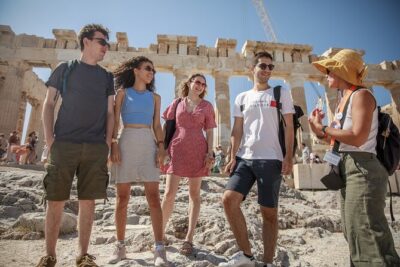

Athens Authentic Greek Food Walking Tour (Small Group)
Read our review →
Early Morning Acropolis & Old Athens Guided Walking Tour
Read our review →
Browse the lists this tour appears in