
Reviewed · TOURS
Philosophical Tour in Athens
Athens has plenty of tours about stones, dates, and famous names. This one asks a different question: How should you live? With guide Lampros, you walk from the Theater of Dionysus to the Acropolis slopes, stopping where ancient ideas about tragedy, democracy, happiness, reason, and self-knowledge took shape.
I like two things right away. First, the route connects philosophy to real places rather than treating it like a classroom lecture. Second, the private format lets Lampros adjust the conversation to your group, using short videos, speakers, and discussion to make difficult ideas easier to grasp. The main consideration is pace: this is a talking tour with a lot of ideas, not a quick photo walk.
In This Review
- Key points at a glance
- Why this Athens walk feels different
- The Theater of Dionysus and the value of tragedy
- Herod Atticus Odeon and the masks we wear
- The Prison of Socrates and Plato’s cave
- Agios Dimitrios Loumbardiaris and the birth of democracy
- Philopappos Monument and the ancient recipe for happiness
- Pnyx, Eudaimonia, and the place of public choice
- Keramikos and the Epicurean garden
- Roman Agora and Stoicism as a way of life
- Mnisikleous Stair and the social side of philosophy
- Lysikratous Square, Nietzsche, and the two sides of Athens
- Anafiotika and the Cycladic finish
- Price, private format, and practical value
- Who will get the most from this tour
- Should you book the Philosophical Tour in Athens?
- FAQ
- How long does the Philosophical Tour in Athens last?
- What time does the tour start?
- Where does the tour begin?
- Where does the tour finish?
- Is this a private tour?
- What language is the tour offered in?
- Are admission tickets included?
- Can I cancel for a full refund?
Key points at a glance
- Walk in the footsteps of Socrates and Plato: The route links major ancient sites with ideas about the good life, judgment, reason, and freedom.
- Private group of up to six: You pay for a small, focused experience rather than joining a large crowd.
- Multimedia adds variety: Short presentations and videos support the spoken explanations.
- Views become part of the lesson: Philopappos Monument and Pnyx bring discussions of happiness and democracy into clear focus.
- A thoughtful Athens introduction: The tour works especially well early in your stay, before you visit more ancient sites on your own.
- Plan for warm-weather walking: Lampros uses shady places for stops, but you still need comfortable shoes, water, and sun protection.
Why this Athens walk feels different
The heart of the experience is not simply learning who Socrates, Plato, Aristotle, Epicurus, or Nietzsche were. It is seeing how their questions grew out of public life in Athens.
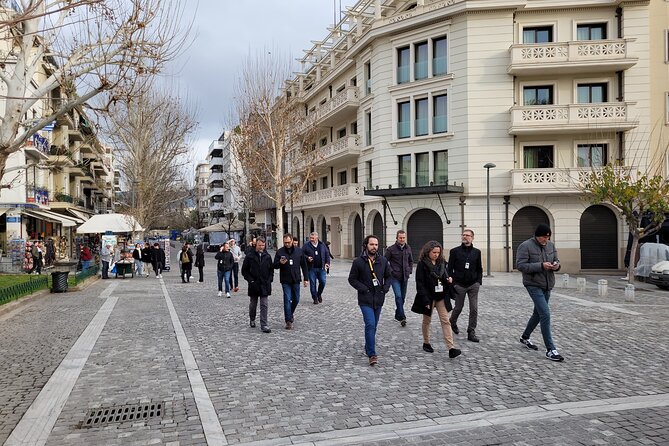
You begin near Acropoli, then move through theaters, wooded paths, monuments, archaeological areas, old lanes, and viewpoints. The setting keeps changing, which helps break up the heavier subjects. One moment you are considering why tragedy might make people less quick to judge. Soon after, you are looking across the city while discussing happiness.
Lampros also brings psychology into the conversation. His approach links ancient Greek thought with Carl Jung, Buddhism, evolutionary psychology, and even current questions about artificial intelligence and human reasoning. That mix will appeal to you if you enjoy ideas that cross subjects. It may feel too broad if you want a strictly academic course in classical philosophy.
The tour is offered in English and lasts about two and a half hours. It is private, with only your group taking part, and the advertised arrangement allows up to six people. That small size matters here. You can ask questions, admit when an idea is confusing, and steer the discussion toward your own interests.
Other days out people book around Athens:
- Athens: Acropolis & up to 5 Archaeological Sites Combo Pass
★ 4.4 · 12,619 reviews - Athens: Acropolis Ticket with Optional Audio or Live Guide
★ 4.2 · 11,055 reviews - Athens: Acropolis, Parthenon & Acropolis Museum Guided Tour
★ 4.8 · 9,316 reviews
The Theater of Dionysus and the value of tragedy
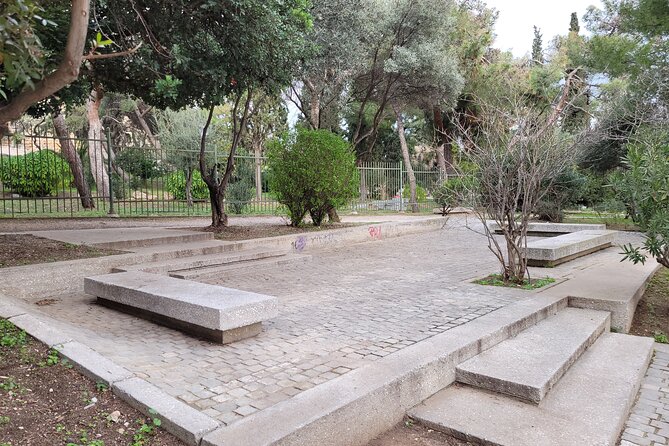
The first stop is outside the Theater of Dionysus Eleuthereus, often linked with the birth of Greek tragedy. You do not pay an admission fee for this stop, and the visit lasts about 15 minutes.
The discussion asks why Athenians felt tragedy had a public purpose. Rather than seeing a tragic play as simple entertainment, the tour presents it as a way to challenge easy judgment. Through the suffering and mistakes of characters, you are asked to look at your own reactions and limits.
Lampros connects this idea with Carl Jung and the role of tragedy in becoming a fuller person. Buddhism and evolutionary psychology also enter the conversation, giving you several ways to think about the human tendency to judge, fear, and identify with others.
This is a strong opening because the theater gives the subject a physical setting. You are not just hearing a definition of tragedy. You are standing beside a place built for a community to watch difficult human problems unfold.
Herod Atticus Odeon and the masks we wear
The short stop at the Herod Atticus Odeon lasts about 10 minutes. This famous open-air theater provides a natural setting for a discussion of personality and the roles people play in public.
The focus includes Jungian ideas such as persona, animus, and anima. You will consider the outward identity you show to others and the less visible parts of your character. The theater itself helps make the point: public performance and private self are never entirely separate.
This section is brief, so do not expect a full psychology lecture. Its value comes from the connection between place and theme. The Odeon is a memorable stop even if you are not deeply interested in Jung, and the ideas add another layer to what you are seeing.
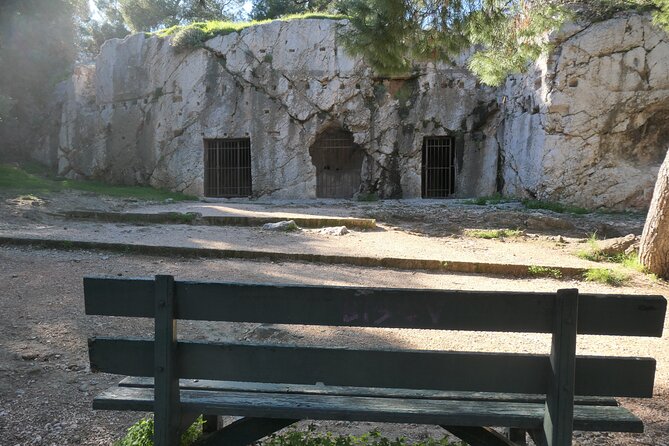
The Prison of Socrates and Plato’s cave
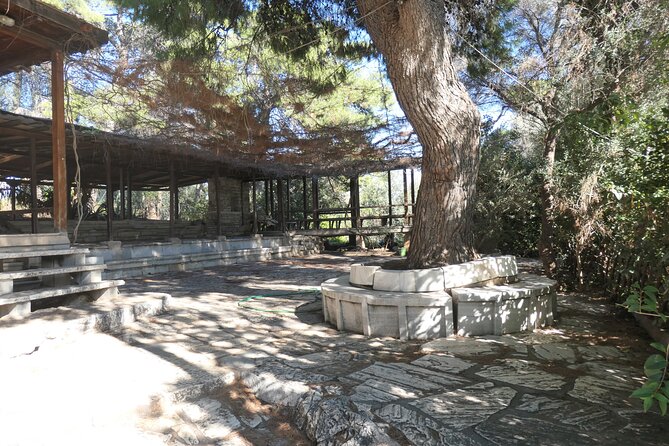
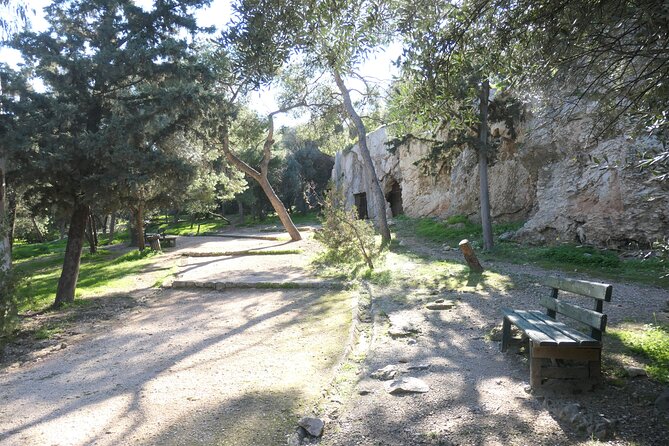
The route continues to the Prison of Socrates for about 20 minutes. The key subject here is Plato’s allegory of the cave, one of the most widely discussed images in Western philosophy.
You look at the idea of people mistaking shadows for reality, then consider what it takes to question familiar beliefs. Lampros uses the site to discuss Plato’s view of education and the difficult process of turning toward truth.
This stop suits families and mixed-age groups particularly well. A 17-year-old and adults with very different levels of background can approach the story at their own level. The private format also helps because you can stop and ask for a modern example instead of letting an unfamiliar term pass by.
Do keep expectations realistic. The prison is not presented as a large, fully restored building with many rooms to explore. The interest lies in the conversation and in the connection to Socrates, not in a long archaeological visit.
Same city, a completely different century:
- Athens: Cape Sounion & Poseidon Temple Sunset Half-Day Trip
★ 4.8 · 8,241 reviews - Athens: Acropolis and Parthenon Guided Walking Tour
★ 4.6 · 5,882 reviews - All Day Cruise -3 Islands to Agistri,Moni, Aegina with lunch and drinks included
★ 5.0 · 4,958 reviews - Athens, Piraeus, and Coastline: Blue Hop-On Hop-Off Bus
★ 3.9 · 4,849 reviews
Agios Dimitrios Loumbardiaris and the birth of democracy
At the Church of Agios Dimitrios Loumbardiaris, the tour turns toward democracy. You spend about 20 minutes discussing how Athenian citizens took part in public decision-making and why that system still shapes political thought.
The setting offers a useful pause from the better-known monuments. You are on the Acropolis hillside, away from the main stream of sightseeing, with room to listen and think. Lampros uses the location to explain democracy as a lived practice rather than a slogan.
This is one of the parts that makes the tour feel connected to Athens itself. You are not only studying ancient philosophers as isolated thinkers. You are looking at the civic world that gave their arguments urgency.
Philopappos Monument and the ancient recipe for happiness
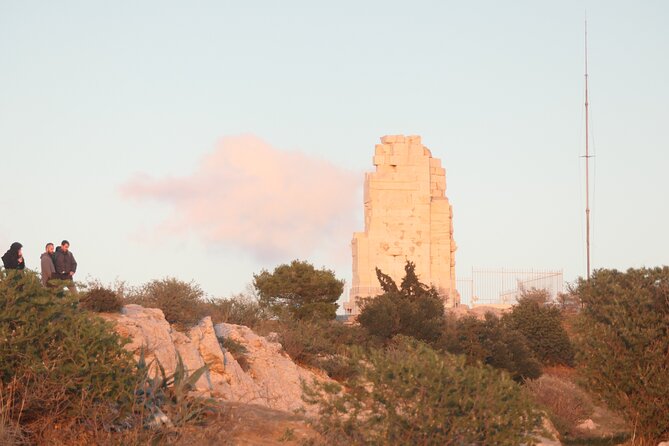
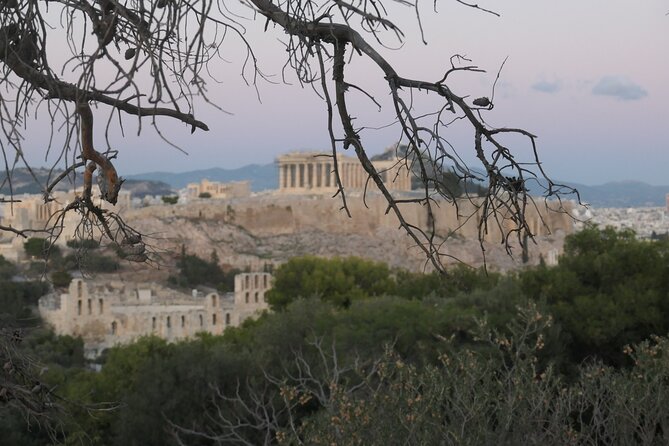
The Philopappos Monument is one of the visual high points of the route. The stop lasts about 15 minutes and offers a clear view toward the Parthenon and Acropolis.
Here, the subject is happiness according to Plato and Socrates. The discussion moves away from the modern idea that happiness means comfort, pleasure, or getting everything you want. Instead, you consider whether a good life depends on character, self-control, purpose, and the condition of the soul.
I like this stop because the view does real work. Looking across Athens while talking about happiness gives the idea space to settle. You are also likely to appreciate the break from dense city streets.
The tour describes this as one of Athens’ most energetic points. That is a subjective claim, of course, but the open view and hillside setting do give it a special feel. Bring water, especially in summer, since the route includes exposed walking as well as shaded pauses.
Pnyx, Eudaimonia, and the place of public choice
At Pnyx, you spend about 15 minutes in the assembly area associated with Athenian citizens. This is one of the most important stops for understanding how philosophy and democracy met in everyday life.
Aristotle’s idea of eudaimonia is the focus. The word is often translated as happiness or flourishing, though neither English term fully captures it. The tour presents it as a life lived well through reason, virtue, and purposeful action.
You also hear about the secret place of Socrates. The exact phrase is intriguing but not explained in the supplied details, so expect Lampros to use the setting as a prompt for discussion rather than a formal museum-style presentation.
Pnyx is also described as another superb viewpoint over Athens. That makes it a good place to pause, take photos, and let the group talk. Admission is included at this stop.
Keramikos and the Epicurean garden
The Keramikos Archaeological Site brings a different mood. It was the ancient cemetery of Athens, and the stop lasts about 15 minutes.
Here you explore Epicurus’ approach to happiness, often associated with the garden he created for philosophical discussion. The tour can help correct the common idea that Epicureanism simply means chasing luxury or constant pleasure. The focus is more carefully connected to peace of mind, friendship, modest needs, and freedom from unnecessary fear.
The cemetery makes the subject of happiness more serious. Ancient philosophy was not only about winning arguments. It also dealt with death, loss, anxiety, and the question of how to use the limited time you have.
The supplied route also refers to the birthplace of Stoicism, the birth of philosophy, the birth of theater, and the first practice of democracy. These broad references show how many major ideas are packed into the walk. They also mean Lampros covers a lot of ground in a short time, so ask questions if you want to stay with one school longer.
Roman Agora and Stoicism as a way of life
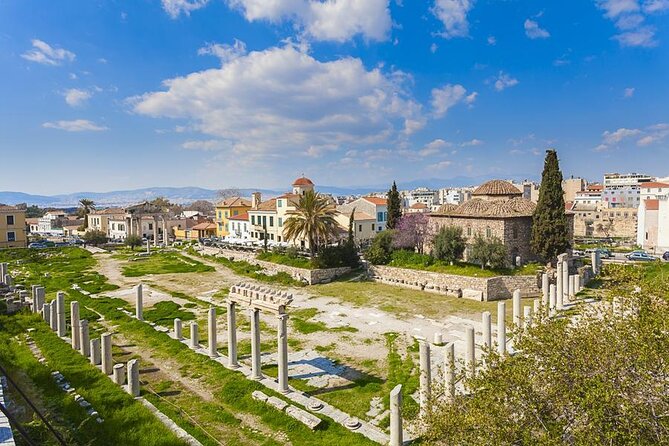
The Roman Agora is the next named stop, with about 15 minutes devoted to Stoicism. You look at philosophy not as a set of abstract theories but as a practical way to live.
The discussion can be especially useful if you are curious about self-control, responsibility, and how to respond to events outside your power. The Roman Agora also helps you see that philosophical teaching took place in public settings, where ideas could circulate among ordinary city life.
The route includes the first meteorological station in the world. This detail adds a welcome change of subject and reminds you that ancient Athens was interested in observation and practical knowledge as well as ethics.
Mnisikleous Stair and the social side of philosophy
The walk continues through the Mnisikleous stair area, described as a discussion point for philosophers and a good place for lunch. This part helps bring ancient ideas into present-day Athens.
You experience the atmosphere of a lively stairway and hear suggestions for eating nearby. Lampros has also given practical tips about rooftop bars, open-air cinema, and local food. One particularly useful recommendation concerns a place known for meatballs.
Because the tour ends back at its starting point, you can use these suggestions after the walk if time allows. If you are doing the tour near the end of your stay, as one family did, you may not have enough time to try every recommendation. I would schedule it early in your Athens visit so the advice can shape the rest of your plans.
Lysikratous Square, Nietzsche, and the two sides of Athens
At Lysikratous Square, you spend about 15 minutes considering Nietzsche’s Apollonian and Dionysian ideas. These terms describe contrasting forces: order, clarity, and restraint on one side, and instinct, emotion, and creative release on the other.
The setting gives you a way to think about Athens beyond its classical image. The city can feel measured and rational in one place, noisy and impulsive in another. The tour uses Nietzsche to explore that tension rather than presenting Athens as a frozen ancient monument.
This is another section where the guide’s personality matters. Lampros is described as warm, engaged, and able to meet different levels of interest. If your group includes both philosophy fans and complete beginners, that flexibility is important.
Anafiotika and the Cycladic finish
The final stop is Anafiotika, for about 10 minutes. This small area beneath the Acropolis has the feel of a Cycladic island, making it a charming contrast to the formal ruins and wide civic spaces earlier in the walk.
The tour describes it as Athens’ second most energetic point. Again, that is a personal interpretation, but the narrow lanes and island-like character make it an enjoyable final setting for a discussion about the self and the city.
Ending here gives the tour a lighter visual finish. You have moved from tragedy and death to happiness, democracy, Stoicism, Nietzsche, and a village-like corner of modern Athens. It is an ambitious route, and the range is part of its appeal.
Price, private format, and practical value
The listed price is $90.11 per person. The experience is also described as a private tour for a group of up to six, with one price for the group highlighted in the booking details. Because those two descriptions do not fully match, check the exact total shown for your party before paying.
For a small group, the value comes from access to the guide’s full attention. A standard city walk can give you facts, but this experience is built around questions and exchange. If six people share the cost, the private setup may compare well with separate tickets for several attractions, though the walk itself includes free admission at most named stops.
This is not the right choice if you want extended entry time inside major archaeological sites. The emphasis is on outdoor locations, interpretation, views, and discussion. It is a good fit if you want Athens to make more sense after you leave the monuments.
The tour starts at 11:00 a.m. near Acropoli, lasts about two hours and 30 minutes, and returns to the meeting point. Mobile tickets are accepted, confirmation arrives when you book, and free cancellation is available up to 24 hours before the start time. Poor weather can lead to a different date or a full refund.
Who will get the most from this tour
I would choose this for adults, older children, university students, couples, and small groups who enjoy asking why rather than only asking when. It also suits anyone who wants a gentler introduction to philosophy before reading more on their own.
You do not need a degree in the subject. The strongest parts are presented through stories, places, short multimedia clips, and conversation. At the same time, people with some background in philosophy can ask for more detail and take the discussion toward psychology, Stoicism, Epicureanism, or artificial intelligence.
The walk may be less suitable for you if your main goal is a fast tour of the Acropolis interiors, a chronological history of Athens, or a relaxed stroll with little talking. It covers many themes, and the guide expects you to think along with him.
Most people can participate, service animals are allowed, and the route is near public transportation. One especially useful detail for families is that Lampros has helped children in wheelchairs along the way. Still, the data does not give a formal route accessibility assessment, so ask for current details if that is important for your group.
Should you book the Philosophical Tour in Athens?
Book it if you want the ancient sites to raise questions, not just fill your camera. Lampros brings together Socrates, Plato, Aristotle, Epicurus, Stoicism, Jung, Nietzsche, psychology, and AI in a walk that feels personal and discussion-led.
I would book it near the start of an Athens visit, wear comfortable shoes, carry water, and leave room afterward for lunch or one of the local suggestions. Skip it if you prefer a conventional archaeological tour with long site visits and fewer abstract ideas.
The experience has a 5 out of 5 rating from 32 ratings, with 100 percent recommending it. The numbers fit the tour’s clearest strength: a private, thoughtful walk led by a guide who makes philosophy feel connected to the streets under your feet.
FAQ
How long does the Philosophical Tour in Athens last?
The tour lasts approximately two hours and 30 minutes.
What time does the tour start?
The start time is 11:00 a.m.
Where does the tour begin?
It begins at Acropoli, Athens 117 42, Greece.
Where does the tour finish?
The activity ends back at the meeting point.
Is this a private tour?
Yes. Only your group participates, with the private group format covering up to six people.
What language is the tour offered in?
The tour is offered in English.
Are admission tickets included?
Most listed stops have free admission. Admission is specifically marked as included at Pnyx. The tour focuses mainly on outdoor locations and discussion.
Can I cancel for a full refund?
Yes. You can cancel at least 24 hours before the experience start time for a full refund. Cancellations or changes made less than 24 hours before the start time are not refunded, and poor weather may result in another date or a full refund.
Freshly added Athens trips
- Athens and Ancient Corinth Private from Athens★ 5.0 · 3 reviews
- From Athens: Mycenae and Epidaurus Private Tour★ 4.8 · 3 reviews
- Full day Meteora private tour★ 5.0 · 3 reviews
- Double Shore Dive (certified divers)★ 4.5 · 3 reviews
- Athens Hills: Mythology Treasure Hunt★ 5.0 · 3 reviews
- Sunset & swimming at Cape Sounio, Poseidon temple★ 5.0 · 3 reviews
- Philosophy Experience at Plato’s Academy Park – basic version★ 5.0 · 3 reviews
- Private Acropolis Tour – Ticket Included★ 5.0 · 3 reviews
Tours, compared.

Acropolis, Parthenon & Acropolis Museum Guided Tour
Read our review →


Mythology of Delphi, Museum and Arachova Guided Tour
Read our review →
Acropolis, Parthenon & Acropolis Museum Guided Tour
Read our review →