
Reviewed · TOURS
Jewish tour and Athens sightseeing in 6 hours
Athens reveals two very different stories on this private six-hour outing: the city of Pericles and the much smaller, often overlooked story of Greek Jewish life. You move from the Acropolis and Parthenon to the Etz Hayyim and Beth Shalom synagogues, then into the Jewish Museum of Greece, where books, textiles, jewelry, documents, and religious objects give the subject a human scale.
I like the convenient hotel pickup and the smart mix of major sights with places most first-time visitors would miss. I also like the flexibility of a private car, especially when your time is short or you are arriving from a cruise. The main catch is that the driver is not a licensed guide, and synagogue access depends heavily on the time and day of your visit.
In This Review
- Key points to know before booking
- A useful blend of Jewish Athens and ancient Athens
- Etz Hayyim and Beth Shalom, two synagogues with different roots
- The Acropolis, from the Propylaea to the Parthenon
- Syntagma Square and the ceremonial center of Athens
- The Neoclassical Trilogy and the old city center
- Ninety minutes at the Jewish Museum of Greece
- Plaka, Kallimarmaro, and Mount Lycabettus
- What the private price really buys you
- Who will get the most from this tour
- Final verdict: a smart overview with two important checks
- FAQ
- How long does the Jewish tour and Athens sightseeing experience last?
- What is included in the $421.44 price?
- Are entrance fees included?
- Can a licensed guide accompany me inside the sites?
- Can I be picked up at Piraeus Port?
- What happens if the synagogues are closed?
Key points to know before booking
- Two Jewish traditions in one Athens street: Etz Hayyim is the older Romaniote synagogue, while Beth Shalom represents the city’s Sephardic community.
- The Jewish Museum deserves real time: The planned visit lasts about 90 minutes, making it more than a quick photo stop.
- The Acropolis is an exterior-guided visit unless you add a guide: Entrance tickets and licensed inside guiding are not included.
- This is a private outing for up to three people: The listed price is $421.44 per group, not per person.
- The route covers much of central Athens: You see Syntagma Square, the Parliament, the Neoclassical Trilogy, Plaka, the Panathenaic Stadium, and Mount Lycabettus.
- Synagogue hours matter: A late pickup can mean seeing the buildings from outside, even if the Jewish Museum is still open.
A useful blend of Jewish Athens and ancient Athens
This tour works because Jewish Athens alone does not fill six hours. The Jewish community’s two synagogues and museum provide the central theme, while the Acropolis, Syntagma Square, Plaka, and Lycabettus supply the classic Athens experience.
You begin with pickup at your hotel. A cruise-port meeting can also be arranged, but Piraeus pickup carries an extra charge according to the tour conditions. Airport and general port transfers are not part of the listed price, so check this carefully before booking.
The driver takes you toward the Acropolis early in the route, with the stated aim of avoiding some traffic and crowds. That is sensible in Athens, where a short road distance can take much longer than expected. Still, the route includes many short stops and several major sights, so you should think of this as a broad introduction, not a slow, museum-by-museum tour.
You will have an air-conditioned vehicle sized for your booking, an English-speaking driver, and a private itinerary. Drivers such as George, Peter Carabellas, and John have been used on different departures, but you cannot request a particular person unless the operator confirms it.
Other days out people book around Athens:
- Athens: Acropolis & up to 5 Archaeological Sites Combo Pass
★ 4.4 · 12,619 reviews - Athens: Acropolis Ticket with Optional Audio or Live Guide
★ 4.2 · 11,055 reviews - Athens: Acropolis, Parthenon & Acropolis Museum Guided Tour
★ 4.8 · 9,316 reviews
Etz Hayyim and Beth Shalom, two synagogues with different roots
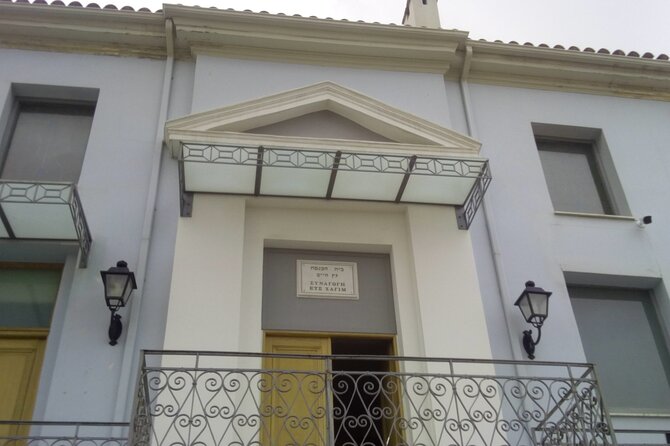
The Jewish portion begins in Thission, near central Athens, where the city’s two functioning synagogues face each other on Melidoni Street. That arrangement alone makes the stop unusually easy to understand: two communities, two traditions, and two very different buildings within a few steps of one another.
At number 8 is Etz Hayyim, the older Romaniote synagogue, built in 1904. Older community members also call it the Ioannina Synagogue, reflecting the Romaniote Jewish tradition associated with Ioannina in northwestern Greece. It is the smaller building and is used mainly during the High Holidays. Community offices occupy the ground floor, in rooms first intended for a Jewish school.
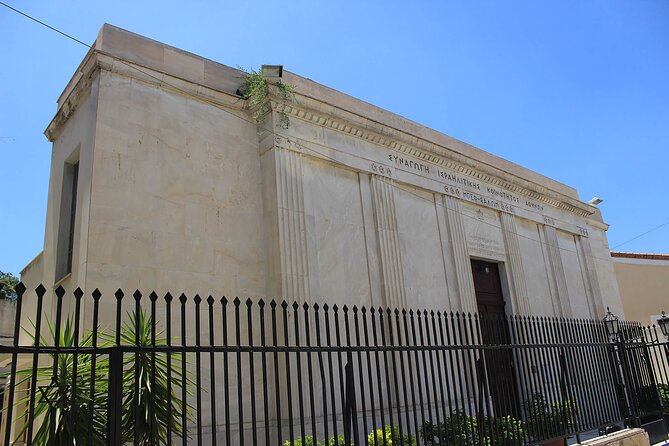
Across the street, at number 5, is Beth Shalom, also written as Beit Shalom in some tour descriptions. Built in 1935, it is the larger Sephardic synagogue and the one used regularly today. Its white Pentelic marble exterior and restrained Greek Revival design connect it to the city around it, while the interior follows a synagogue layout that is not especially Greek in style.
The scheduled time here is about 45 minutes, but access is the key issue. You may be able to enter, but you should not assume it. Synagogues are active religious institutions, not standard sightseeing buildings, and opening hours can change. One departure arranged around a later pickup found both synagogues closed, despite the driver trying to gain access.
That is why I would book this tour with a morning start whenever possible, and confirm the synagogue plan before departure. If entering the buildings is essential to you, ask whether a licensed guide or community contact can be arranged. Seeing the façades still has value, but it is not the same as hearing the story inside the sanctuary.
The Acropolis, from the Propylaea to the Parthenon
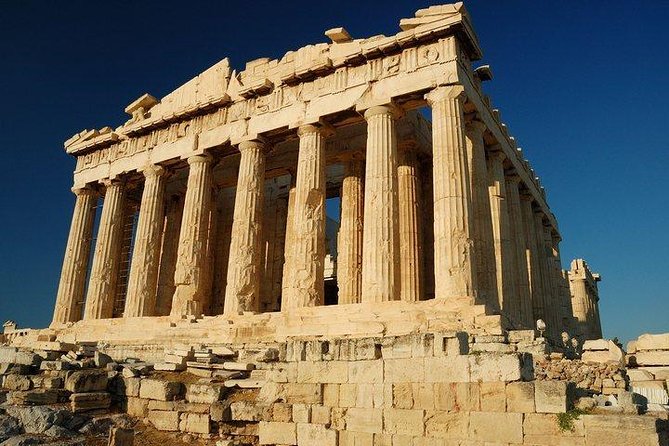
The Acropolis is the tour’s grandest ancient stop. The rocky citadel rises above Athens, with monuments built largely during the fifth century BC, when Pericles directed a major building program after Athens’ victory over Persia and the growth of democracy.
The route calls at the Propylaea, the monumental entrance to the Acropolis. This was designed by Mnesicles between 437 and 432 BC and built from Pentelic marble. Its broad, angled form frames the entrance to the sacred precinct, though the original plan was never completed.
Nearby is the Temple of Athena Nike, a small temple dedicated to Athena as bringer of victory. The supplied description repeats some of the Propylaea history here, so you should expect a short explanation rather than a separate, lengthy stop.
The Parthenon receives about an hour. That is enough for a meaningful look, especially if you have already read a little about the building, but the time includes the approach and the busy Acropolis setting. Built between 447 and 438 BC, the temple honored Athena Parthenos, the city’s patron goddess. I like that the explanation includes the earlier temples destroyed by the Persians, as well as the roles of architects Ictinus and Kallikrates and sculptor Pheidias.
You also see the Erechtheion, the elegant sanctuary on the north side of the Acropolis. Its porch of Caryatids is one of Athens’ most recognizable details. Five of the original female statues are now in the Acropolis Museum, one is in the British Museum, and the figures on the building are casts.
The practical point is important: Acropolis admission is not included, and the driver cannot escort you through the archaeological site. The driver can explain the history until you enter, but a state-licensed guide is required for inside commentary. That guide can be arranged for an added fee, subject to availability.
If you want a full ancient-site experience, pay for the licensed guide. If your goal is to see the essential monuments while keeping the day moving, the driver-led format can work. Bring water, wear sturdy shoes, and cover your shoulders and knees at religious and marble sites. A moderate level of fitness is required.
Syntagma Square and the ceremonial center of Athens
After the Acropolis area, the route shifts to modern Greek history around Syntagma Square. The Hellenic Parliament occupies the former royal palace, built after Otto became king and Athens became the capital of the modern Greek state. The building was constructed from 1836 to 1862, with marble from Penteli.
In front of Parliament is the Tomb of the Unknown Soldier, a cenotaph honoring Greek soldiers killed in war. Evzones of the Presidential Guard protect it, and the changing of the guard is the most recognizable ceremony in this part of town.
The change-of-guards stop lasts about ten minutes. It is a quick look rather than a guarantee of the full Sunday ceremony, since the schedule provided does not specify a particular changing time. If you care strongly about seeing the formal performance, ask the operator to align your pickup with the ceremony.
Syntagma means Constitution Square. The name dates to an uprising on September 3, 1843, when King Otto granted a constitution. That small fact helps explain why this square has been central to Greek public life for almost two centuries.
You may also pass the National Garden, a 160,000-square-meter green space behind Parliament. Queen Amalia ordered its design in 1839, and it contains more than 500 types of plants and trees. The route also includes the Old Parliament Building, now home to the National Historical Museum, though the itinerary does not promise an interior visit.
Same city, a completely different century:
- Athens: Cape Sounion & Poseidon Temple Sunset Half-Day Trip
★ 4.8 · 8,241 reviews - Athens: Acropolis and Parthenon Guided Walking Tour
★ 4.6 · 5,882 reviews - All Day Cruise -3 Islands to Agistri,Moni, Aegina with lunch and drinks included
★ 5.0 · 4,958 reviews - Athens, Piraeus, and Coastline: Blue Hop-On Hop-Off Bus
★ 3.9 · 4,849 reviews
The Neoclassical Trilogy and the old city center
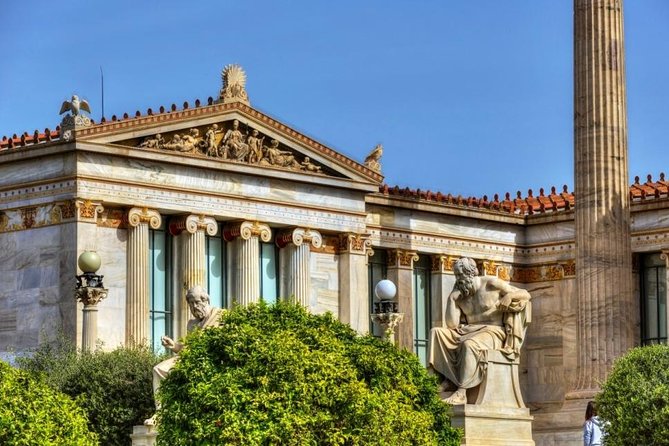
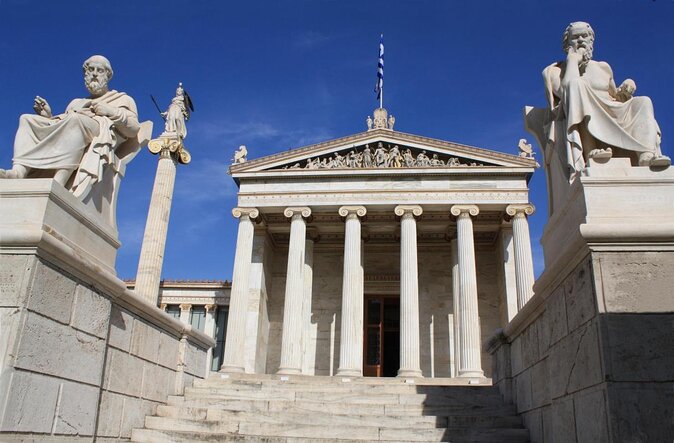
The Academy of Athens, National and Kapodistrian University of Athens, and National Library form the city’s Neoclassical Trilogy. Each stop is brief, about five minutes, so you will mainly admire the façades and hear why the buildings matter.
The Academy was founded in 1926 as an institution for sciences, humanities, and fine arts. The university opened in 1837 and was the first university in the modern Greek state, as well as the first in the Balkans and the eastern Mediterranean. The National Library, built between 1887 and 1902, holds more than one million books and magazines, along with handwritten codices dating from the ninth to the nineteenth centuries.
This section gives you a quick sense of the Athens created after independence. It is a useful counterpoint to the ancient stones above the city, though anyone fascinated by architecture may wish for more walking time.
The route may also pass the Old Parliament House, built in 1858 for the Parliament and Senate. It housed Greece’s political life for about 60 years before Parliament moved to the former palace at Syntagma Square in 1935. The National Historical Museum inside focuses on Greece from Ottoman and Latin rule through the War of Independence and the development of the modern state.
Ninety minutes at the Jewish Museum of Greece
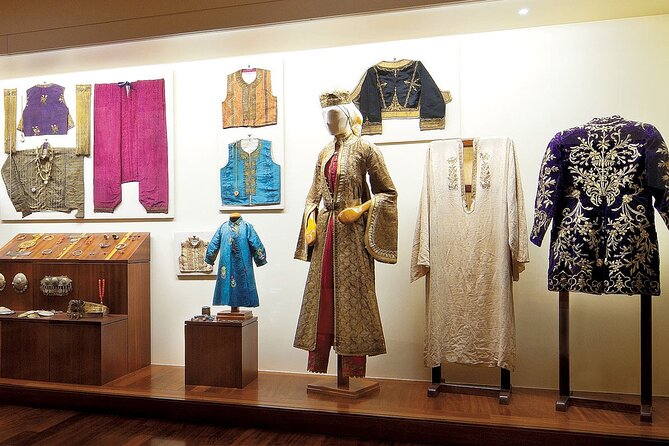
The Jewish Museum is the most important stop for anyone booking this tour primarily for Jewish history. The planned visit lasts about an hour and a half, which gives you time to look beyond headline displays.
The museum began in 1977 in a small room beside Athens’ synagogue. Its early holdings included objects saved from World War II, nineteenth- and twentieth-century documents and manuscripts, and jewelry belonging to the Jews of Thrace that had been seized in 1943 and later returned to the Greek government.
The collection grew to include material from Jewish communities across Greece. You can expect rare books and publications, textiles, jewelry, domestic objects, and religious artifacts. The collection’s Hebrew books are especially relevant to the tour’s stated focus, since they show Jewish learning and religious life in physical form rather than reducing the subject to wartime history alone.
I would give this museum priority even if time becomes tight. The Acropolis is impossible to miss in Athens, but the museum adds a story you are unlikely to assemble from a standard city tour. It also gives context to the synagogue visit, especially if the buildings are closed when you arrive.
Museum admission is extra. The museum has a stated closing time of 2:00 PM in the operator’s response to one scheduling problem, so a late morning start can put this visit at risk. Ask for the current hours and plan the Jewish Museum before the outdoor Jewish sites if your schedule is tight.
Plaka, Kallimarmaro, and Mount Lycabettus
Plaka provides the walking portion of the old city. Its narrow cobblestone streets run below the Acropolis, with small shops, cafés, tavernas, neoclassical buildings, and traces of antiquity. The nearby Anafiotika quarter has whitewashed homes and a Greek-island feel.
You should not expect a long, independent Plaka walk unless the driver and timing allow it. The overall route is packed, and Plaka is best treated as a chance to see the neighborhood and perhaps note where you want to return later.
The Panathenaic Stadium, or Kallimarmaro, is another short stop. Built entirely from Pentelic marble, it hosted the first modern Olympic Games in 1896. The marble can shift from a cooler tone in the morning to a warmer bone-gold color later in the day, a small detail worth noticing from the outside.
The final major stop is Mount Lycabettus, the highest point in central Athens at 277 meters. From the hill, you get wide views over the capital and toward the coast. The hill can be reached on foot, by funicular, or by car, and the tour uses the vehicle for this sightseeing stop.
The listed time is about 70 minutes, making Lycabettus one of the less rushed parts of the route. You can enjoy the city from above and see the chapel of Saint George. Afterward, you return to the original pickup point.
What the private price really buys you
The cost is $421.44 per group of up to three people. For three, that works out to about $140.48 per person before entrance fees. For one or two people, the per-person cost rises sharply, but you are paying for a private vehicle, hotel pickup and drop-off, and a driver focused only on your group.
That can be good value for a family or small party with six hours between plans. You avoid organizing several taxis, and the driver can adjust the order when traffic, closing times, or site access cause trouble. The private format also makes it easier to ask for more time at the Jewish Museum or a shorter stop at a familiar sight.
The value is weaker if you want expert inside commentary at every monument. Archaeological sites and the Jewish Museum charge separate admission, and a licensed state guide costs extra. Add those costs before comparing this with a conventional guided walking tour.
The vehicle size deserves attention. The booking is for up to three people, but one group of four adults found a sedan cramped with the driver. Do not treat this as a four-adult vehicle unless the operator confirms a minivan and any added charge.
Who will get the most from this tour
I would choose this for a small family, couple, or group with a clear interest in Jewish heritage and limited time in Athens. It also suits cruise passengers who want a private overview rather than a large coach excursion, provided they arrange the port transfer and allow enough time to disembark.
It is a good fit if you want both major landmarks and a subject-specific museum. Drivers George, Peter Carabellas, and John have been praised for being prompt, patient, courteous, and willing to explain Greek culture at a relaxed pace. The quality can depend on the assigned driver, but the format leaves room for questions and does not force you through a fixed group schedule.
I would hesitate if you need guaranteed synagogue entry, a fully escorted Acropolis visit, or long periods inside each monument. In that case, add a licensed guide, confirm synagogue hours, and ask for a vehicle and timetable built around your priorities.
The experience has a 4.8 rating from 10 reviews, with 90 percent of customers recommending it. That is encouraging, but the small sample means I would focus more on the practical conditions than the score.
Final verdict: a smart overview with two important checks
Book this tour if you want a private Athens sampler with a Jewish focus, especially when your time is limited. The strongest combination is the Jewish Museum, the two synagogue sites, the Acropolis, and Lycabettus, all connected by private transport.
Before paying, confirm three things: the exact pickup point, the synagogue opening plan, and whether you want a licensed guide inside the Acropolis and museum. Buy admission tickets ahead when possible, since availability may be limited.
The tour cannot replace a full Jewish-history program or a slow archaeological visit. But with the right expectations, it gives you a useful, personal introduction to Athens, from Romaniote and Sephardic worship to the Parthenon, Syntagma Square, and the city views from Lycabettus.
FAQ
How long does the Jewish tour and Athens sightseeing experience last?
The tour lasts approximately six hours and returns you to the same place where you were picked up.
What is included in the $421.44 price?
The price covers a private tour for up to three people, an air-conditioned vehicle, hotel pickup and drop-off, and an English-speaking professional driver.
Are entrance fees included?
No. Admission fees for the Acropolis, archaeological sites, and Jewish Museum of Greece are not included.
Can a licensed guide accompany me inside the sites?
The driver is not licensed to escort you inside archaeological sites or museums. A state-licensed guide can be arranged for an additional cost, subject to availability.
Can I be picked up at Piraeus Port?
Piraeus pickup can be arranged on request for an extra cost. Airport and port transfers are not included in the listed tour price.
What happens if the synagogues are closed?
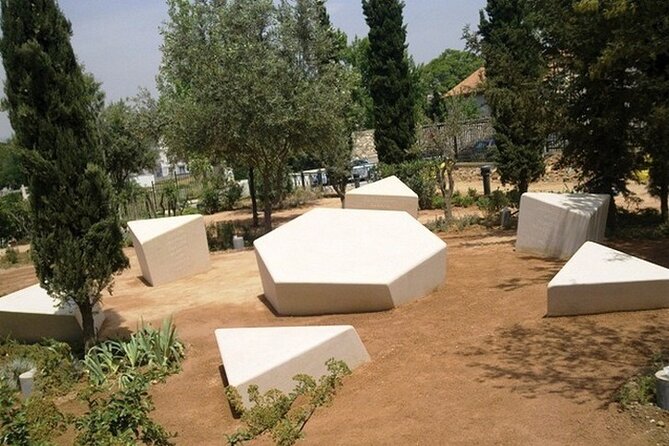
You may see Etz Hayyim and Beth Shalom from outside, along with the nearby Holocaust memorial. Confirm the synagogue hours and request an early pickup if entering the synagogues is important to you.
Freshly added Athens trips
- Athens and Ancient Corinth Private from Athens★ 5.0 · 3 reviews
- From Athens: Mycenae and Epidaurus Private Tour★ 4.8 · 3 reviews
- Full day Meteora private tour★ 5.0 · 3 reviews
- Double Shore Dive (certified divers)★ 4.5 · 3 reviews
- Athens Hills: Mythology Treasure Hunt★ 5.0 · 3 reviews
- Sunset & swimming at Cape Sounio, Poseidon temple★ 5.0 · 3 reviews
- Philosophy Experience at Plato’s Academy Park – basic version★ 5.0 · 3 reviews
- Private Acropolis Tour – Ticket Included★ 5.0 · 3 reviews
Tours, compared.

Acropolis, Parthenon & Acropolis Museum Guided Tour
Read our review →


Mythology of Delphi, Museum and Arachova Guided Tour
Read our review →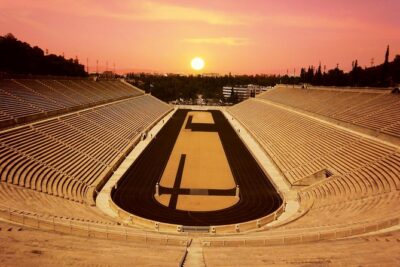
Acropolis, Parthenon & Acropolis Museum Guided Tour
Read our review →