
Reviewed · ACROPOLIS TOURS
Best of Athens & Acropolis Full Day Private Guided City Tour
The best thing about this private Athens tour is its sweep. In roughly five to seven hours, you move from the marble temples of the Acropolis to the market lanes of Monastiraki, with ancient democracy, royal myths, modern Olympics, and Greek civic life along the way. It gives you a useful first map of the city instead of trapping you in one archaeological site.
I like the private format, since your group can move at its own pace and ask for more explanation where your interest lies. I also like the mix of famous sights and ordinary Athens, especially the Ancient Agora, Syntagma Square, Plaka, and the Athenian Trilogy on Panepistimiou Street. The main consideration is time: the route covers a lot, so several stops are brief photo and orientation visits rather than full explorations.
- Acropolis highlights: See the Parthenon, Propylaea, Temple of Athena Nike, and Erechtheion with admission included.
- Ancient Athens beyond the hill: Walk through the Agora and see the Temple of Hephaistos, one of Greece’s best-preserved Doric temples.
- Modern city context: Visit Syntagma Square, the Unknown Soldier, the Academy, University, and National Library.
- Private transportation: Pickup is offered, with exact arrangements made through WhatsApp or Apple iMessage.
- Strong service record: The Greek Taxi is praised for punctual drivers, quick communication, clean cars, luggage help, and requested child seats on transfers.
- Flexible cancellation: Cancel at least 24 hours before the start for a full refund, subject to the stated weather and minimum-number conditions.
In This Review
- A broad first look at Athens, from sacred rock to market square
- Climbing the Acropolis and entering Classical Greece
- The Parthenon, Propylaea, and Athena Nike
- The Erechtheion and Athens’ founding myths
- Walking through the Ancient Agora and Temple of Hephaistos
- Syntagma, the Unknown Soldier, and ceremonial Athens
- The Athenian Trilogy on Panepistimiou Street
- The Panathenaic Stadium and the Olympieion
- Plaka and Anafiotika: Athens at walking speed
- Monastiraki and the city’s many layers
- What the $600.12 price means for your group
- Timing, pickup, and practical limits
- Who should book this Athens tour
- Should you book it?
- FAQ
- How long does the Athens private tour last?
- What language is the tour offered in?
- Is this a private activity?
- Is pickup offered?
- Is admission to the Acropolis included?
- Is admission to the Ancient Agora included?
- Is Panathenaic Stadium entry included?
- Can I cancel for a full refund?
- What should I wear for the Acropolis?
A broad first look at Athens, from sacred rock to market square
This experience works best as an overview tour with serious ancient sights at its center. You do not simply tick off the Acropolis and leave. You also see where Athenians debated, worshiped, competed, governed, studied, shopped, and gathered.
The route is private, which matters in Athens. The Acropolis has smooth marble underfoot, tight viewing areas, and plenty of visual detail that can be missed in a large group. A private guide can spend more time on the Parthenon’s optical tricks, explain the myths behind the Erechtheion, or keep the pace moving if the heat rises.
The company’s transportation service also gets high marks for punctuality and communication. Drivers named Stefanos, George, and Nikos are praised for being polite, prompt, and helpful, though the supplied information does not identify the specific guide assigned to this sightseeing tour. Communication is arranged by WhatsApp or Apple iMessage, so make sure you can use one of those services before pickup.
Climbing the Acropolis and entering Classical Greece

The tour begins at the Acropolis, reached along a pedestrian approach to the sacred rock. The climb is not huge, but the stone can be slick and polished. Wear shoes with firm grip, and take care on the marble steps and slopes.
Your guide sets the Acropolis in its wider setting: the ambitions of Pericles, religious ceremonies, the Persian Wars, and Athens at the height of its political and artistic power. I like the small clues here more than another broad speech about ancient glory. Quarry marks, carved drainage channels, and reused blocks show that this place has been repaired and altered for centuries.
Allow about an hour for the Acropolis visit, with admission included. Pause partway up the slope for a view of the Parthenon with the Saronic Gulf beyond. This is one of the better photo angles because it puts the temple in its city and sea setting, rather than treating it as an isolated monument.
The site can be sunny, exposed, and crowded. Since the listed stop includes several monuments, you should expect an efficient visit rather than a long period sitting with each building. The private setup helps, but it cannot change the size of the pathways or the rules around protected stone.
More Acropolis and Parthenon visits:
- Athens: Acropolis & up to 5 Archaeological Sites Combo Pass
★ 4.4 · 12,619 reviews - Athens: Acropolis Ticket with Optional Audio or Live Guide
★ 4.2 · 11,055 reviews - Athens: Acropolis, Parthenon & Acropolis Museum Guided Tour
★ 4.8 · 9,316 reviews
The Parthenon, Propylaea, and Athena Nike
The Parthenon receives about 15 minutes as its own scheduled stop, though the Acropolis visit gives you more time around it. The temple was dedicated to Athena Parthenos, patron of Athens, and its famous balance is not as simple as it looks.
Your guide can point out the subtle curves and tilted columns that correct the eye. Corner columns were made slightly thicker because they appear thinner against the open sky. The sculpted decoration once carried strong color, so the white marble ruins you see today do not show the full ancient effect.
Shoot along the colonnade for a sense of rhythm and scale. Do not cross barriers or touch the stone. Every block here is protected archaeology, and the best way to enjoy the place is to leave room for other people and keep your camera work tidy.
The Propylaea was the grand gateway into the sacred precinct. Its Doric columns and Pentelic marble give the entrance a formal power, but the building is not perfectly symmetrical. The uneven plan reflects the slope and the nearby shrines. Step inside, turn around, and use the columns to frame Athens below.
The small Temple of Athena Nike sits on a bastion near the gateway. It is easy to rush past, yet its position gives it real drama. The temple celebrates victory, and its Ionic details contrast with the heavier Doric forms nearby.
The famous Nike adjusting her sandal is represented by a replica at the site. The original is protected in the Acropolis Museum. This is a good example of why guiding helps: the temple is compact, and a few minutes of context make its battle scenes and winged Victories easier to understand.
The Erechtheion and Athens’ founding myths
The Erechtheion is often the Acropolis building that rewards the slowest look. Its plan is irregular because it gathered several sacred places into one complex. Athena’s olive tree, Poseidon’s salt spring, and the memory of legendary kings all belong to its story.
The south porch’s Caryatids appear to carry the roof as human figures. The figures here are faithful casts, while the originals are kept in museums. Look for the olive tree to the west, tied to the myth of Athena’s gift to the city.
A useful photo is two Caryatids with the Parthenon softened behind them. The contrast between the ornate porch and the larger temple gives your picture depth. The scheduled 15 minutes is enough for an introduction and photos, but not for a long architectural study.
Walking through the Ancient Agora and Temple of Hephaistos

The Ancient Agora is the tour’s best counterweight to the Acropolis. This was the working civic center, where law, trade, political argument, philosophy, and gossip shared the same ground. It helps you picture ancient Athens as a busy community rather than a collection of perfect temples.
Plan on about an hour here, with admission included. The Stoa of Attalos houses a museum with coins, weights, inscriptions, and other objects tied to daily life. These modest pieces make the big ideas of democracy and philosophy feel more human.
Look for boundary stones that separated sacred and civic areas, along with ruts left by ancient carts. The porticoes provide shade, a welcome break after the exposed Acropolis.
The Temple of Hephaistos, sometimes labeled the Temple of Aries in the supplied tour details, is dedicated to Hephaistos and Athena Ergane. It is described as the best-preserved Doric temple in Greece, and its condition lets you see the basic form of a Greek temple without having to reconstruct every line in your head.
The temple overlooks the old metalworking area, linking its gods to craft and labor. Look for metopes showing Heracles and Theseus. From the southeast corner, the columns make a strong photograph, while the higher position gives you a fine view back toward the Agora and the Acropolis.
The schedule allows about 15 minutes at the temple. That is enough to see it well after your Agora walk, though the larger archaeological area deserves extra time if ancient ruins are your main reason for visiting Athens.
A few more Athens days worth a look
- All Day Cruise -3 Islands to Agistri,Moni, Aegina with lunch and drinks included
★ 5.0 · 4,958 reviews - From Athens: Delphi Full Day V.R. Audio Guided Tour
★ 4.6 · 3,028 reviews - Athens Full Day Private Tour
★ 5.0 · 2,903 reviews - From Athens: Mycenae, Epidaurus & Nafplio Full Day Trip
★ 4.8 · 2,438 reviews
Syntagma, the Unknown Soldier, and ceremonial Athens

Syntagma Square shifts the tour from ancient remains to the modern capital. It is a useful place to regroup, refresh, and watch the city work around you. Archaeological finds displayed in the metro concourse hint at the layers uncovered beneath modern Athens.
Next comes the Monument to the Unknown Soldier, guarded by the Evzones. Their uniforms include the pleated fustanella and pom-pom tsarouhia, and the ceremonial drill is precise and slow. The relief of a fallen hoplite adds a quiet human note to the formal display.
The schedule gives about 15 minutes at Syntagma and another 15 minutes at the monument. If the timing fits, you may see the guard change, but the provided details do not promise a particular ceremony. Stay behind the line, do not touch the guards, and avoid blocking the path.
The Athenian Trilogy on Panepistimiou Street

The Academy of Athens, National and Kapodistrian University, and National Library form one of the city’s finest neoclassical sequences. Together they show how the modern Greek state used ancient forms to express its identity after independence.
The Academy has a temple-like façade with Athena and Apollo above, and Socrates and Plato seated in front. Look for the restrained red and blue details restored on the building. A low-angle photo from the steps makes the statuary and pediment more imposing.
The University receives only about five minutes, so treat it as a quick exterior stop. Its frescoed portico, symmetrical design, allegorical figures, and ironwork reward a short look, especially if your guide connects it to the Academy and Library.
The National Library gets another five minutes. Its twin curved staircases, Doric columns, marble balustrades, owls, and laurel motifs create a highly balanced façade. The historic building remains an important symbol of public learning, while the Library’s modern facilities now operate at the Stavros Niarchos Foundation Cultural Center.
This section is valuable because it prevents the tour from presenting Athens as only an archaeological site. The city’s modern public buildings deliberately speak to its ancient past.
The Panathenaic Stadium and the Olympieion

The Panathenaic Stadium, or Kallimarmaro, is carved entirely from white marble. It hosted the first modern Olympic Games in 1896 on the site of an ancient stadium used for the Panathenaic festival.
You can see the steep horseshoe seating, track, finish line, and plaques connected with the 1896 champions. The tour includes an exterior visit, while entry to climb higher and see the small exhibit costs extra. That distinction matters if you want time inside, so budget for the optional admission rather than assuming it is covered.
A view from the upper tiers looks down the running lanes and shows the stadium’s full shape. The scheduled stop is about 15 minutes, making it more of a focused visit than a long stadium tour.
The route also includes the Olympieion, though it is not numbered clearly in the supplied schedule. Once planned as Greece’s largest temple, it took centuries to complete and was finished under the Roman emperor Hadrian. The remaining Corinthian columns still convey its huge scale.
You may see it quickly from the vehicle, with Hadrian’s Arch possibly appearing in the same view if traffic allows. That is useful for orientation, but it is not a substitute for walking through the Olympieion grounds.
Plaka and Anafiotika: Athens at walking speed
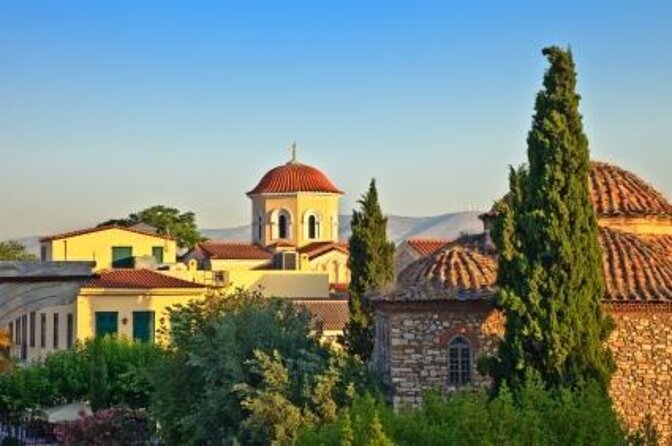
Plaka is where the tour relaxes. The neighborhood sits beneath the Acropolis, with narrow lanes, neoclassical homes, small chapels, cafés, cats, and shops. You get about an hour here, free to wander, stop for ice cream, or look for an artisan item.
The most distinctive pocket is Anafiotika, where whitewashed homes recall the Cycladic islands. Island craftsmen built this hillside quarter, and its tiny lanes feel far removed from the traffic below.
Take your time on the cobblestones and stairs. Plaka is not a place to march through while staring at a checklist. Early afternoon light can brighten the pale walls, and the best moments may be a doorway, balcony, or quiet corner rather than a major landmark.
Monastiraki and the city’s many layers
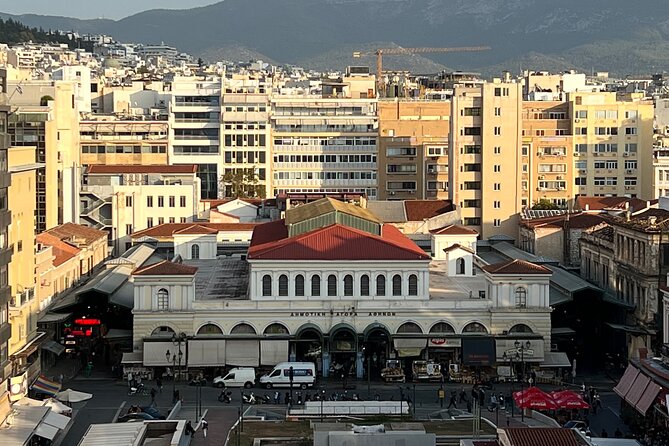
The final major stop is Monastiraki, with about an hour for the square and surrounding lanes. Here, a mosque, church, Roman Agora, flea-market stalls, food vendors, and Acropolis views occupy the same compact area.
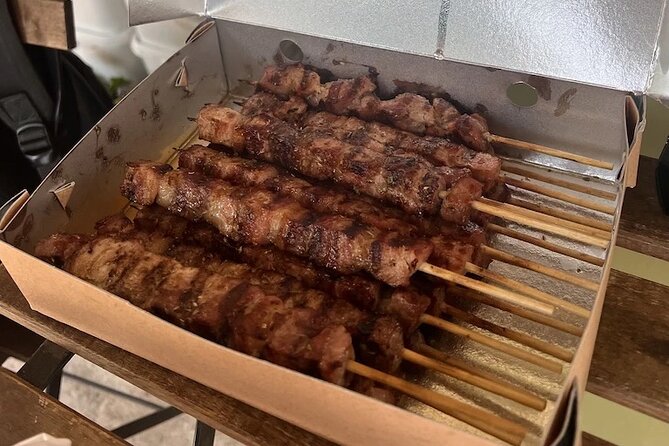
It is a good ending because Athens feels lived-in here. Leather sandals, antiques, street food, and bargaining replace the formal order of the Acropolis. Hadrian’s Library is only a short walk away, and the Parthenon can rise above the square.
Keep small valuables zipped in crowded areas. The market atmosphere is part of the appeal, but it also calls for normal city awareness. For photographs, late-day light can catch the Parthenon above the square.
What the $600.12 price means for your group
At $600.12 per person, this is an expensive Athens sightseeing day. Its value depends heavily on group size, since this is a private activity and group discounts are offered. For a couple, the cost is a major splurge. For a larger family or group, private transportation, included Acropolis and Agora admission, and a dedicated guide may make the price easier to justify.
You are paying for coverage and control, not just entry tickets. Pickup is offered, the group is not mixed with strangers, and the route joins sites that would otherwise require careful planning across central Athens. The value is strongest for first-time visitors with limited time, families who want private logistics, or people who prefer a guide to connect the monuments.
The price is harder to defend if you mainly want a slow Acropolis visit. Several stops last only five or 15 minutes, and the Panathenaic Stadium entry is extra. You may get better value by choosing a shorter private Acropolis and Agora tour if you already know Athens or plan several days in the city.
Timing, pickup, and practical limits
The advertised duration is about five to seven hours, with operating hours listed from 9:00 a.m. to 6:00 p.m. The long stop list means the schedule is likely flexible, with some sites handled as brief exterior visits or viewed along the driving route.
Confirm the exact pickup place through WhatsApp or Apple iMessage. The company’s transfer service is praised for early arrivals, clean vehicles, water, chargers, luggage assistance, and requested baby seats. Those comments concern the transportation service, not a guarantee of every vehicle or feature on this exact tour, but they give you useful points to confirm before the day.
Most people can participate, but the Acropolis requires walking on smooth marble and Plaka includes cobblestones and stairs. Good footwear is essential. The tour is offered in English, and a mobile ticket is provided.
Free cancellation is available up to 24 hours before the start time for a full refund. Changes made inside that window are not accepted, and poor weather or failure to meet the minimum number of participants may lead to a new date, another experience, or a refund.
Who should book this Athens tour
I would choose this tour if you have one full day in Athens and want the major ancient sights plus a useful look at the modern city. It is also a strong fit for families, multigenerational groups, and visitors who value door-to-door help and private questions.
I would think twice if you dislike quick stops, want extensive museum time, or are traveling alone at this price. The Acropolis and Agora are the heart of the day, while the Trilogy, Syntagma, stadium, Plaka, and Monastiraki add breadth.
Should you book it?
Book it if private transport, an English-speaking guide, included Acropolis and Agora admission, and a wide city overview are worth the premium. Ask about the guide, pickup time, vehicle, and optional Panathenaic Stadium entry before paying.
Skip it if your priority is a slow archaeological visit or the lowest possible cost. For the right group, this tour offers an efficient first encounter with Athens, from Periclean temples and ancient civic life to marble stadiums, neoclassical institutions, neighborhood lanes, and market energy.
FAQ
How long does the Athens private tour last?
The tour lasts approximately five to seven hours.
What language is the tour offered in?
The tour is offered in English.
Is this a private activity?
Yes. Only your group participates.
Is pickup offered?
Yes, pickup is offered. The exact pickup spot is coordinated through WhatsApp or Apple iMessage.
Is admission to the Acropolis included?
Yes. Admission is included for the Acropolis and its listed monuments, including the Parthenon, Propylaea, Temple of Athena Nike, and Erechtheion.
Is admission to the Ancient Agora included?
Yes, admission to the Ancient Agora of Athens is included.
Is Panathenaic Stadium entry included?
No. The tour includes a visit to the stadium, but optional paid entry for the higher seating areas and small exhibit is not included.
Can I cancel for a full refund?
Yes, if you cancel at least 24 hours before the experience start time. Cancellations made less than 24 hours in advance are not refunded.
What should I wear for the Acropolis?
Wear grippy footwear. The Acropolis has smooth marble surfaces, and Plaka includes cobblestones and stairs.
Freshly added Athens trips
- Athens and Ancient Corinth Private from Athens★ 5.0 · 3 reviews
- From Athens: Mycenae and Epidaurus Private Tour★ 4.8 · 3 reviews
- Full day Meteora private tour★ 5.0 · 3 reviews
- Double Shore Dive (certified divers)★ 4.5 · 3 reviews
- Athens Hills: Mythology Treasure Hunt★ 5.0 · 3 reviews
- Sunset & swimming at Cape Sounio, Poseidon temple★ 5.0 · 3 reviews
- Philosophy Experience at Plato’s Academy Park – basic version★ 5.0 · 3 reviews
- Private Acropolis Tour – Ticket Included★ 5.0 · 3 reviews
Acropolis Tours, compared.

Acropolis & up to 5 Archaeological Sites Combo Pass
Read our review →

Acropolis, Parthenon & Acropolis Museum Guided Tour
Read our review →
Acropolis, Parthenon & Acropolis Museum Guided Tour
Read our review →


Acropolis monuments & Parthenon Walking Tour with Optional Acropolis Museum
Read our review →Browse the lists this tour appears in