
Reviewed · ACROPOLIS TOURS
Athens:Acropolis – Historical Center Walking Tour in Spanish
The smartest feature of this Athens tour is its early entry through the Acropolis south slope, rather than the main gate. You begin near the Theater of Dionysus, then climb through the Propylaea toward the Parthenon before the day gets too hot and crowded. The Spanish-speaking guides, especially Efi and Andrea, bring structure and humor to a site that can otherwise feel like a jumble of marble and names.
I like the route for two clear reasons: it covers the Acropolis and central Athens in one well-shaped morning, and it gives you time for photos rather than turning every stop into a lecture. The walk through Plaka, ending near the Tower of the Winds and Athens Cathedral, adds street life and Orthodox culture to the ancient stones.
The main catch is the Acropolis ticket. It is not included in the $57 tour price, and you need an entry slot from 8:00 to 9:00. You also need comfortable shoes and enough mobility for uneven ground, steps, and slopes. Baby carriages and electric wheelchairs are not allowed.
In This Review
- Key points to know before booking
- Why the south entrance changes the Acropolis visit
- Theater of Dionysus, where Greek drama began
- Athena, Poseidon, and the city’s founding story
- Propylaea and the first view of the Parthenon
- The Parthenon, seen with time to look up
- Caryatids and the Acropolis views
- Plaka gives the morning a different rhythm
- The Ancient Agora from the outside
- The Tower of the Winds and Athens Cathedral
- The Spanish guides and the feel of the tour
- Is $57 a fair price?
- Who should choose this Athens walking tour?
- Should you book it?
- FAQ
- Is the Acropolis entrance ticket included?
- Can the company arrange the Acropolis ticket?
- What language is the tour conducted in?
- Where does the tour meet?
- How long does the experience last?
- What does the route include?
- Are headphones provided?
- Is the tour suitable for people with mobility impairments?
Key points to know before booking
- Enter from the south slope: Start near the Acropolis Museum and the Theater of Dionysus, with a route designed to avoid the main entrance crowds.
- Spanish guide with strong local experience: Efi has 27 years of experience, while Efi and Andrea are both praised for clear, lively explanations.
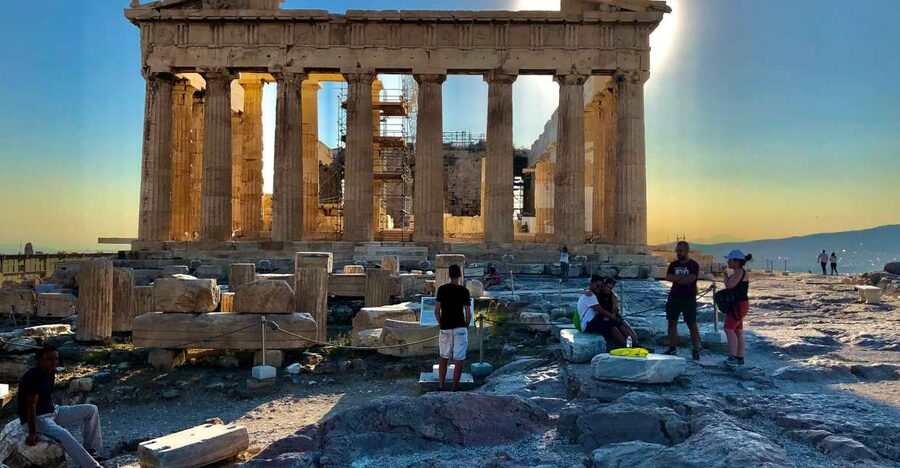
- See the Acropolis from the inside: The route includes the Parthenon, Propylaea, Temple of Athena Nike, and Caryatids.
- Look beyond the hilltop: City views include Hadrian’s Arch, the Temple of Olympian Zeus, the Odeon of Herodes Atticus, and several Athens hills.
- Continue into Plaka: The four-hour walk finishes with the Ancient Agora exterior, Tower of the Winds, and Athens Cathedral.
- Budget for admission separately: The $57 covers the licensed Spanish guide and headphones, not the Acropolis entrance ticket.
Why the south entrance changes the Acropolis visit
The Acropolis is Athens’s essential sight, but your first few minutes can shape the whole experience. This tour begins at the lower gate near the Acropolis Museum and enters from the south side. That puts you close to the Theater of Dionysus, an important stop that is easy to miss when you rush straight toward the summit.
The south slope also gives the climb a useful sense of order. Instead of arriving at the Parthenon with no idea what came before it, you move through the earlier stages of the Acropolis complex. Your guide can explain how theater, worship, civic identity, and power came together on this rocky hill.
You should still expect uphill walking. The ancient surfaces are uneven, and the Acropolis has stairs and exposed areas with little shade. Comfortable shoes are not a polite suggestion here. They are part of the ticket price you pay in comfort, even though they are not part of the official cost.
Starting early matters in Athens. The 8:00 to 9:00 entry slot places you on the site during the cooler part of the day, which helps with both heat and crowds. The tour does not promise an empty Acropolis, but the south-side entry is a sensible way to avoid the main access point.
More Acropolis and Parthenon visits:
- Athens: Acropolis & up to 5 Archaeological Sites Combo Pass
★ 4.4 · 12,619 reviews - Athens: Acropolis Ticket with Optional Audio or Live Guide
★ 4.2 · 11,055 reviews - Athens: Acropolis, Parthenon & Acropolis Museum Guided Tour
★ 4.8 · 9,316 reviews
Theater of Dionysus, where Greek drama began
The Theater of Dionysus is the first major stop. It sits on the southern slope below the Acropolis and connects the monument above with the public culture of ancient Athens.
This is where the guide can give you a useful frame for the rest of the visit. The Acropolis was not simply a collection of temples. It was tied to festivals, worship, performance, and the city’s sense of itself.
The stop is especially valuable if you are visiting Athens for the first time. You begin with a place where people gathered for drama and public events, then continue toward the sacred buildings on the hilltop. That sequence makes the Acropolis feel less like a postcard and more like a working center of ancient life.
Athena, Poseidon, and the city’s founding story
Near the top, your guide tells the famous story of Athena and Poseidon competing to become patron of the city. Athena offered the olive tree, while Poseidon struck the ground with his trident. Athena won the city’s favor, and Athens took her name.
The story is not only a charming myth for children. It helps explain why Athena mattered so much to the Athenians and why the Acropolis was the right place for her major sanctuary. A good guide uses the tale as a doorway into the city’s religious and political ideas, rather than leaving it as a disconnected legend.
Efi is particularly well suited to this kind of storytelling. Her explanations are described as clear, patient, and full of useful context, and one participant noted that she offered practical tips for the rest of a stay in Greece as well as information about the monuments.
Propylaea and the first view of the Parthenon
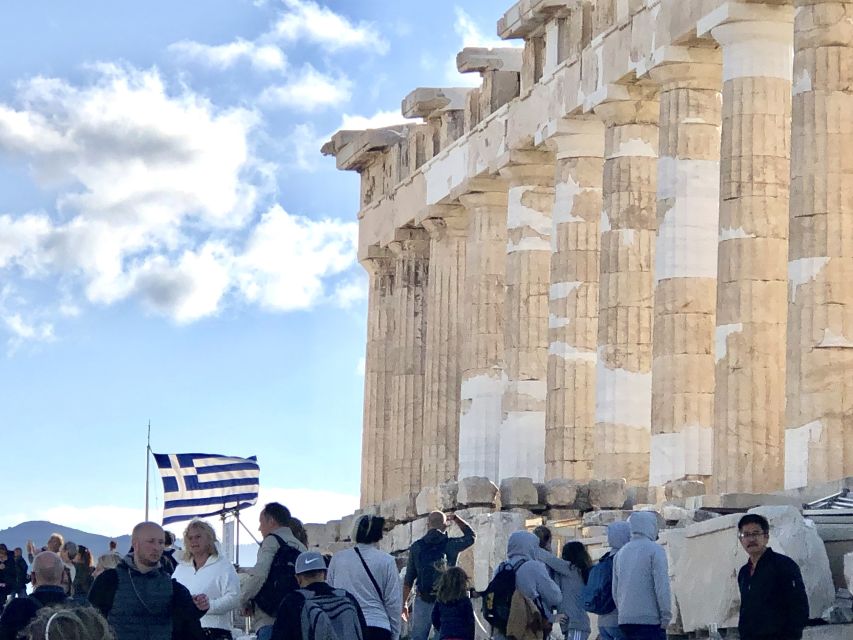
The Propylaea is the monumental gateway to the Acropolis. It was designed to control access and create a strong approach to the sacred center. You pass through this entrance before the Parthenon comes fully into view.
That pause matters. The Propylaea was not merely a doorway. Its scale helped prepare ancient worshippers for what lay ahead, and it still gives your arrival a sense of ceremony. Your guide can point out how the entrance worked as both a practical barrier and a carefully planned architectural statement.
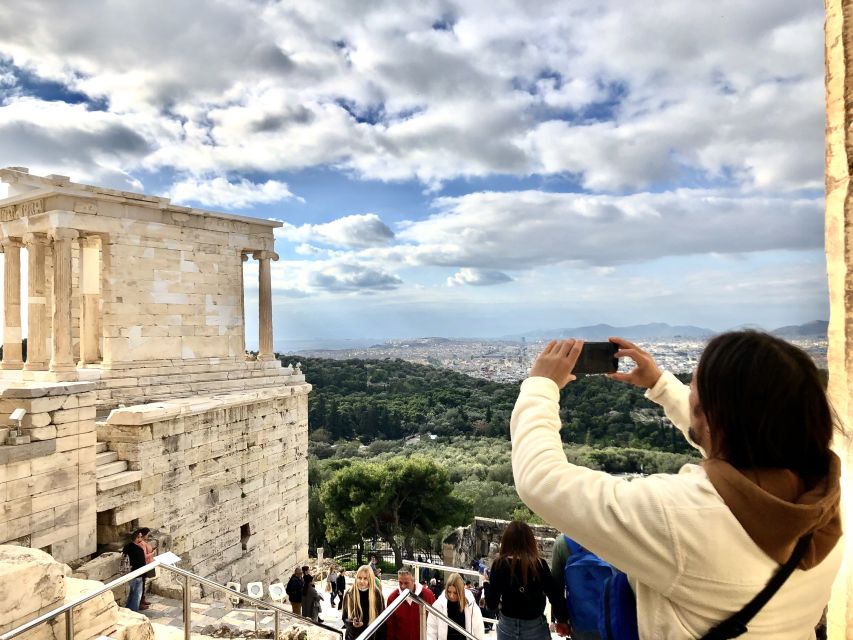
The route then brings you toward the Temple of Athena Nike. This smaller Ionic temple is easy to overlook beside the Parthenon, but its position near the entrance makes it an important part of the Acropolis story. The guide can help you notice its refined proportions and explain why this compact building deserves more than a quick photograph.
More ancient history days in Athens:
- Historical Delphi One Day Tour with Arachova Stop & Expert Guide
★ 4.5 · 1,247 reviews - Historic Athens: Small Group Electric Bike Tour
★ 4.9 · 740 reviews - The History of Athens: Greek Mythology Private Tour
★ 5.0 · 138 reviews - Athens Highlights by E-Bike: Small-Group Historic Tour
★ 5.0 · 131 reviews
The Parthenon, seen with time to look up
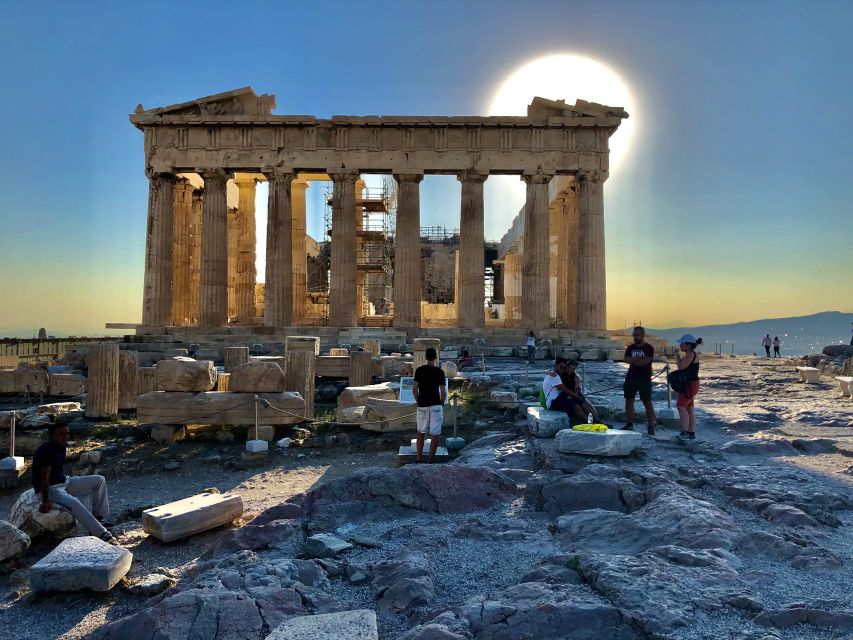
The main pause comes in front of the Parthenon. Here, the tour focuses on why the temple was built and how its design became famous for balance and harmony.
You will not enter the Parthenon itself. The value comes from seeing the building within its setting and having a guide explain the choices behind its form. The scale is impressive, but the details are what repay attention: the columns, the sculpted decoration, and the way the building was planned as a sacred monument to Athena.
Your guide also gives you a chance to stop for photos and take in the view. That balance was praised by several people who found Efi enthusiastic without feeling rushed. One person specifically appreciated having time to rest, photograph the site, and enjoy the Acropolis instead of listening without a break.
This is one point where a four-hour tour can be better than a rushed checklist. You get interpretation, but you also get quiet moments to look at the stones yourself. If you prefer to explore entirely at your own pace, a guided visit may feel structured. If you want help making sense of the architecture, the structure is a benefit.
Caryatids and the Acropolis views
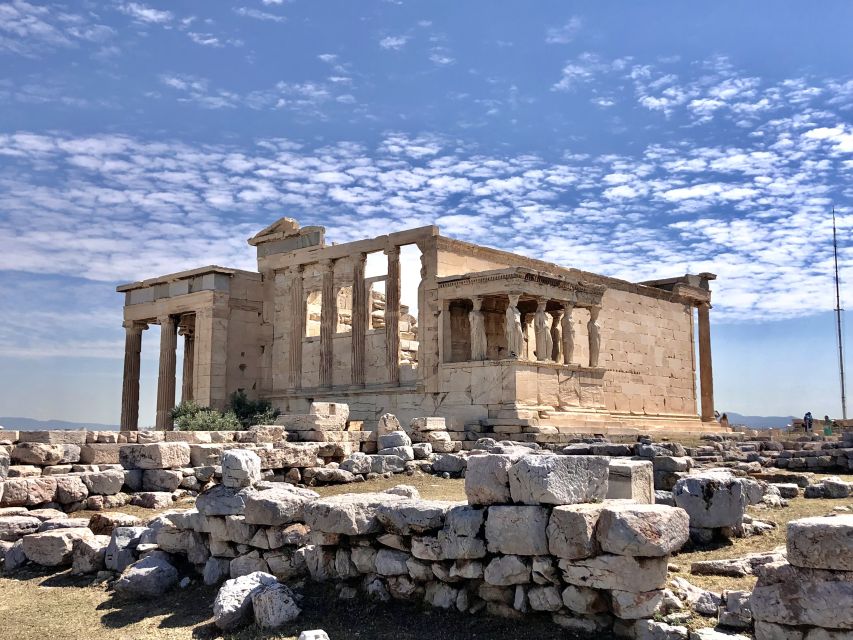
The Caryatids are among the Acropolis’s most memorable details. These sculpted female figures serve as architectural supports, replacing ordinary columns with human forms. Your guide points them out as part of the Acropolis complex and explains their place in the site’s design.
From the top, you also look across Athens toward Hadrian’s Arch and the Temple of Olympian Zeus. The Odeon of Herodes Atticus sits below, a grand ancient performance space still used for the Athens Festival today. The National Observatory and the hills of Lycabettus, Philopappos, and the Areopagus help you understand how the city spreads beyond the Acropolis.
These views are more than scenic breaks. They show why the Acropolis was such a powerful place. From the hill, you can connect ancient monuments with modern Athens and see how the city grew around its old center.
The open setting also means sun exposure. A morning slot helps, but you should carry water and protect yourself from the heat. Food and drinks are not included, so plan to handle refreshments on your own.
Plaka gives the morning a different rhythm
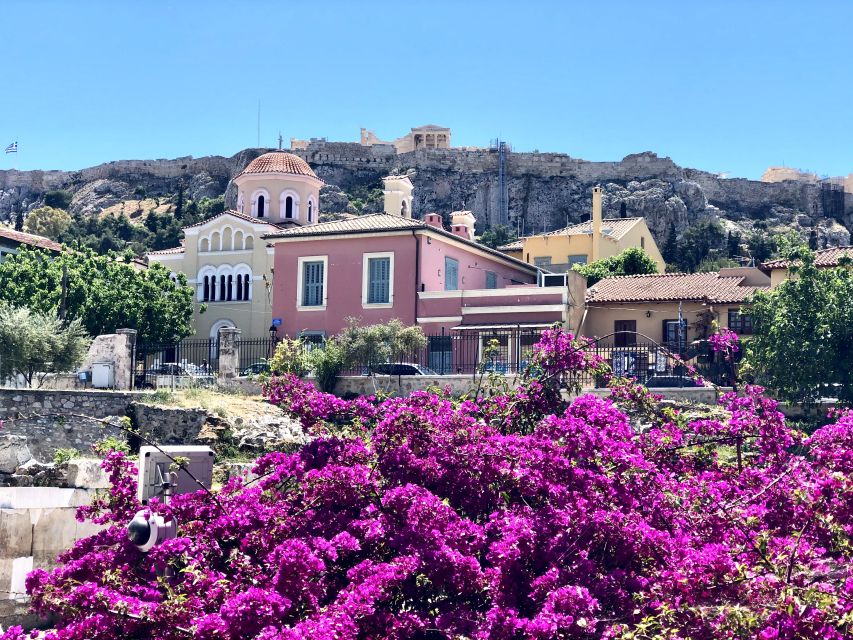
After the Acropolis, the tour moves into the Old Town and Plaka. This shift is welcome. The hilltop is monumental and exposed, while Plaka offers a closer look at Athens through streets, buildings, shops, and everyday movement.
The route is designed to show you the neighborhood’s picturesque side, but it is not simply a shopping walk. Your guide helps connect Plaka with the older parts of Athens and points out relevant corners as you move through the historic center.
You should expect continued walking after the Acropolis. The four-hour duration includes both the archaeological site and the city streets, so this is not the best choice if you want a short monument-only visit. It is a good fit if you would rather combine Athens’s major ancient sight with a first orientation to the center.
The Ancient Agora from the outside
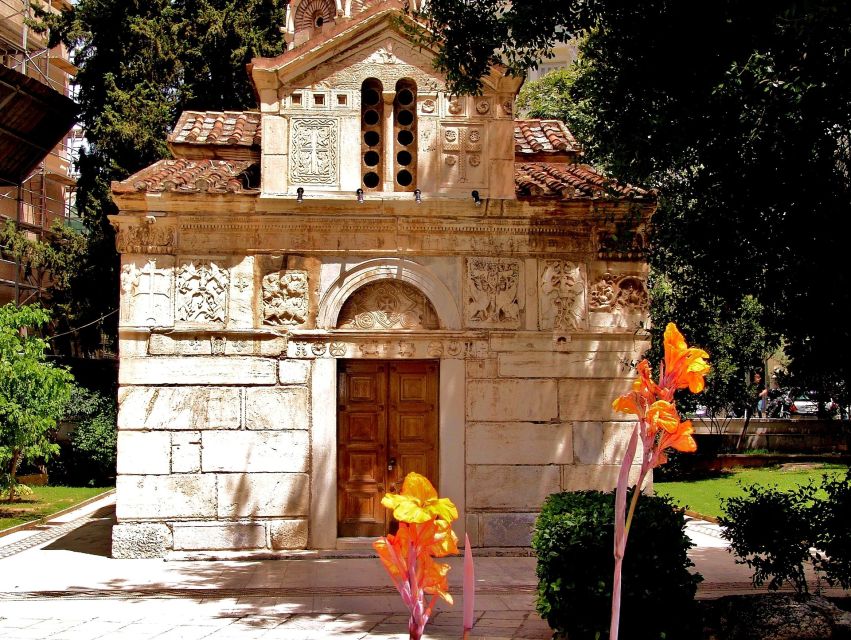
The tour passes outside the Ancient Agora. That distinction is important: the Agora entry ticket is not part of this experience, and the itinerary does not describe an interior visit.
Even from outside, the location has a powerful connection to Athens’s intellectual life. Socrates, Plato, and Aristotle are associated with this public space, where ideas, politics, trade, and civic life met. Your guide can give you the setting and explain why the Agora mattered without adding another full archaeological visit to an already busy morning.
The best-preserved temple in Athens is also associated with the Agora area. Seeing it from the route gives you another example of ancient architecture without requiring extra time inside the site.
If the Agora is high on your list, you will need a separate plan and ticket. This tour provides context and an exterior view, not a substitute for exploring the archaeological grounds.
The Tower of the Winds and Athens Cathedral

The final stops add two very different layers to the city. The Tower of the Winds is described as the oldest meteorological observatory in the world. Its purpose links architecture with timekeeping, weather, and the practical concerns of urban life.
It is the kind of smaller monument that benefits from a guide. Without explanation, you might walk past it as another ancient structure. With context, its design becomes a reminder that ancient Athens was interested in measuring and organizing the world, not only building temples.
The tour then visits the Mitropolis of Athens, the city’s cathedral. It is connected with the marriage of Queen Sofía and Juan Carlos, and it gives you a chance to learn about the Orthodox faith that is central to Greece.
This final stop broadens the tour beyond classical Athens. You move from pagan sanctuaries and ancient civic spaces to a living religious tradition. That change helps prevent the day from becoming an archaeological marathon.
The Spanish guides and the feel of the tour
The strongest part of this experience is the guiding. Efi receives repeated praise for her passion, patience, humor, and command of the subject. One person noted her 27 years of experience, while others found her explanations detailed but easy to follow.
Andrea is also praised for giving interesting information throughout the Acropolis and offering practical advice for time in Greece. The guide assigned to your departure may vary, so you should not book solely on the promise of one named person. Still, the available feedback points to a strong guiding team.
Headphones are included. That matters on a busy archaeological site, where wind, distance, and nearby groups can make a normal speaking voice hard to catch. The Spanish language is the central reason to choose this tour. If Spanish is your preferred language, you can spend more energy looking at the monuments instead of translating every sentence.
One caution comes from a person who felt the historical explanations could be shorter and more precise. That is fair. Guides who know a subject well can sometimes give too much detail. The positive side is that the tour allows pauses for photos and rest, so the experience does not appear to be nonstop talking.
The group may be small, though this is not guaranteed in the information provided. A reduced group can make it easier to ask questions and stay close to the guide. Communication before the tour is another practical strength: the local office has used WhatsApp in Spanish to send directions and answer calls promptly.
Is $57 a fair price?
The tour costs $57 per person, with a licensed Spanish guide and headphones included. The Acropolis entrance fee is extra, so you must compare the full cost with what you would pay for admission and a self-guided visit.
The value depends on what you want from the site. If you only need to enter, take photos, and read signs, the added guide fee may not suit you. If you want the Parthenon, Propylaea, Caryatids, and surrounding monuments explained in Spanish, the price pays for a clear route and four hours of interpretation.
The ticket arrangement needs careful attention. You must have an Acropolis ticket for the 8:00 to 9:00 time slot. After booking, the company may contact you if you do not have one and arrange it at the official cost, but you should not assume admission is included in the advertised price.
There is no hotel pickup, food, or drink. You meet at the lower Acropolis gate, a few meters from the Acropolis Museum, where the guide holds a sign with the office logo. The starting point is central, but you are responsible for reaching it.
Free cancellation is available up to 24 hours before the tour, and you can reserve now and pay later. Those terms help if your Athens plans are still shifting, though the ticket issue still needs sorting before the morning begins.
Who should choose this Athens walking tour?
I would choose this tour if you are visiting Athens for the first time, want the Acropolis explained in Spanish, and prefer a planned route over navigating the site alone. It also suits you if you want a first look at Plaka and the historic center on the same morning.
It is particularly useful for people who enjoy stories and context. Athena’s contest with Poseidon, the role of the Propylaea, the design of the Parthenon, the intellectual life of the Agora, and Orthodox Athens all become part of one connected walk.
I would think twice if you have limited mobility. The route includes slopes, steps, and uneven ancient surfaces, and the activity is not suitable for people with mobility impairments. Baby carriages and electric wheelchairs are not allowed.
I would also skip it if your priority is a long visit inside the Acropolis Museum or the Ancient Agora. The itinerary centers on the Acropolis and an exterior view of the Agora. A museum tour is not included, and a separate Agora ticket would be needed for an interior visit.
Should you book it?
Book this tour if you want the Acropolis to make sense, not simply appear in your camera roll. The south-slope entry, Spanish guidance, city views, Plaka walk, and final stops at the Tower of the Winds and Athens Cathedral give you a broad first morning in Athens.
Before paying, confirm that you have the required Acropolis entry for 8:00 to 9:00, and add the admission cost to your budget. Wear sturdy shoes, bring water, and allow for a steady four-hour walk.
For Spanish-speaking visitors, especially on a first visit, this is a sensible choice. The only real tradeoff is that the guide may sometimes give more history than you want, and the Acropolis ticket is separate. If those points work for you, the tour offers a useful mix of major monuments, local orientation, and clear storytelling.
FAQ
Is the Acropolis entrance ticket included?
No. The tour price does not include the Acropolis entrance ticket. You need an Acropolis ticket with an entry time between 8:00 and 9:00.
Can the company arrange the Acropolis ticket?
After booking, the company may contact you if you do not have a ticket and arrange one at the official cost. Admission is still separate from the tour price.
What language is the tour conducted in?
The tour is conducted in Spanish by a licensed live guide.
Where does the tour meet?
Meet at the lower gate of the Acropolis, a few meters from the Acropolis Museum. The guide will hold a sign with the office logo.
How long does the experience last?
The walking tour lasts four hours.
What does the route include?
It includes the Acropolis, Theater of Dionysus, Propylaea, Temple of Athena Nike, Parthenon, Caryatids, Acropolis views, Plaka, the exterior of the Ancient Agora, the Tower of the Winds, and Athens Cathedral.
Are headphones provided?
Yes. Headphones are included so you can hear the guide during the walking tour.
Is the tour suitable for people with mobility impairments?
No. The activity is not suitable for people with mobility impairments. Baby carriages and electric wheelchairs are also not allowed.
More Athens walking tours
- Athens: Acropolis and Parthenon Guided Walking Tour
★ 4.6 · 5,882 reviews - Greek Food Walking Tour in Athens
★ 5.0 · 4,740 reviews - Acropolis: Acropolis and Parthenon Guided Walking Tour
★ 4.7 · 3,442 reviews - Acropolis monuments & Parthenon Walking Tour with Optional Acropolis Museum
★ 5.0 · 2,678 reviews
Freshly added Athens trips
- Athens and Ancient Corinth Private from Athens★ 5.0 · 3 reviews
- Full day Meteora private tour★ 5.0 · 3 reviews
- Double Shore Dive (certified divers)★ 4.5 · 3 reviews
- From Athens: Mycenae and Epidaurus Private Tour★ 4.8 · 3 reviews
- Athens Hills: Mythology Treasure Hunt★ 5.0 · 3 reviews
- Sunset & swimming at Cape Sounio, Poseidon temple★ 5.0 · 3 reviews
- Philosophy Experience at Plato’s Academy Park – basic version★ 5.0 · 3 reviews
- Private Acropolis Tour – Ticket Included★ 5.0 · 3 reviews
Acropolis Tours, compared.

Acropolis & up to 5 Archaeological Sites Combo Pass
Read our review →

Acropolis, Parthenon & Acropolis Museum Guided Tour
Read our review →
Acropolis, Parthenon & Acropolis Museum Guided Tour
Read our review →


Acropolis monuments & Parthenon Walking Tour with Optional Acropolis Museum
Read our review →Browse the lists this tour appears in