
Reviewed · GUIDED
Athens: the Great Greek Philosophers Guided Tour in Spanish
Athens is more than temples and marble columns. This walking tour follows the city’s great thinkers, from the Greek Agora to the Pnyx, and turns familiar streets into places where Socrates, Plato, and Aristotle once shaped ideas that still affect how you see the world. I especially like the small philosophy games and open questions, which make this more than a standard history walk. I also like the chance to visit places such as Socrates’ Prison that can be missed on a first trip.
The main point to consider is language. This experience is listed as a Spanish-language tour, so you should be comfortable following a live discussion in Spanish before booking. It is also a walking tour on historic ground, with uneven surfaces and hills, so bring good shoes and water.
In This Review
- Key points at a glance
- Why this Athens philosophy walk feels different
- Meeting Plato before the walk begins
- The Greek Agora and the public life of ideas
- Standing at the Areopagus
- Finding Socrates’ Prison
- Walking toward the Pnyx
- The guide makes or breaks this experience
- What the $34 price gets you
- Who should book this tour
- How to prepare for the 150-minute route
- My verdict on the Athens philosophers tour
- FAQ
- How long does the tour last?
- What language is the tour in?
- How much does the tour cost?
- Where does the tour meet?
- How early should I arrive?
- Which sites are included?
- Is a guide included?
- Are food and drinks included?
- What should I wear?
- Can I cancel the booking?
Key points at a glance
- Plato’s statue is the meeting point, with arrival requested 10 minutes before the start.
- The Areopagus and Socrates’ Prison give the tour a strong sense of place, not just a classroom-style lecture.
- The Greek Agora and Pnyx help explain how public life shaped ancient philosophy and politics.
- Gregory is a particularly hands-on guide, using stories, questions, and everyday examples to make difficult ideas clear.
- The tour costs $34 and lasts 150 minutes, a fair price for a focused cultural walk in central Athens.
- Spanish is the stated tour language, and comfortable shoes plus water are essential.
Why this Athens philosophy walk feels different
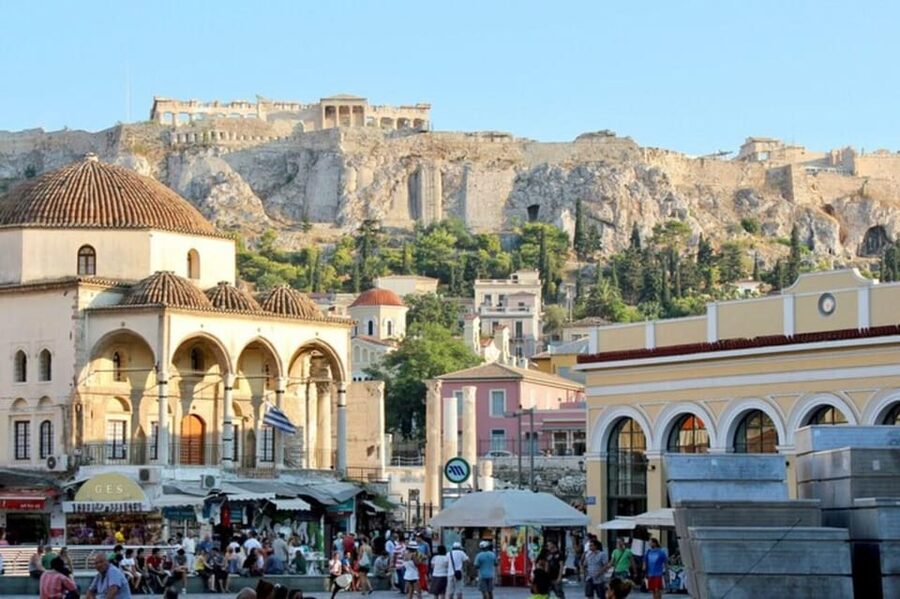
Most Athens tours put the Acropolis at the center. This one shifts your attention to the people who asked what makes a good life, a fair society, or a sound argument. You still walk through the historic center, but the subject is not only what happened here. It is how people learned to question what happened here.
That change in focus matters. A guide can point to an ancient stone and give you a date. A good philosophy guide asks what the place meant to the people who used it, who had a voice there, and what kind of society allowed ideas to spread. Gregory, who has led many of these walks, is praised for doing exactly that. He explains philosophy in plain terms, then draws you into a conversation.
You do not need a degree in philosophy. The tour suits beginners, curious families, and people who already know the basic names. Gregory has adapted his explanations to different levels of knowledge and interests, including a guest with a background in law and society. That flexibility is one of the experience’s best features.
The format is active rather than purely academic. You may be asked to consider a moral problem, compare different ways of thinking, or discuss a question with the rest of the group. These moments help keep the subject from becoming a list of names and theories.
A few more Athens days worth a look
- Athens: Acropolis Ticket with Optional Audio or Live Guide
★ 4.2 · 11,055 reviews - Athens: Acropolis, Parthenon & Acropolis Museum Guided Tour
★ 4.8 · 9,316 reviews - Athens: Acropolis and Parthenon Guided Walking Tour
★ 4.6 · 5,882 reviews
Meeting Plato before the walk begins
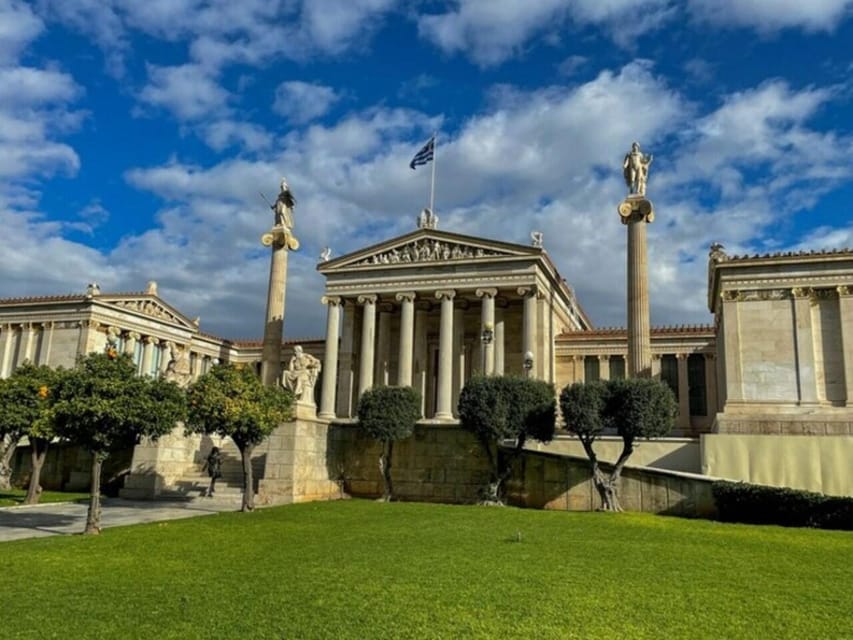
The tour starts in front of the Statue of Plato. You are asked to arrive 10 minutes before the scheduled start, which is sensible in central Athens, where a short walk can take longer than expected.
Beginning with Plato gives the outing an immediate focus. He is not treated as an isolated figure, but as part of a chain of ideas linked to Socrates and later thinkers. The guide uses this starting point to explain the birth of philosophy and the personalities who gave ancient Greek thought its lasting shape.
The statue also provides a clear landmark for meeting up. Still, you should check the exact location details when booking and allow extra time to reach the center. The available information does not specify group size or the precise route between stops, so do not assume the walk will feel like a private tour.
The Greek Agora and the public life of ideas
The Greek Agora is one of the most important parts of the route because philosophy in Athens was tied to public life. This was not simply a subject studied in silence. Ideas were tested in conversation, argument, and debate.
Your guide explains the Agora’s role in ancient society and connects it to the wider growth of philosophical thought. The value here is context. When you hear about Socrates asking questions in public, the story becomes easier to picture when you are standing in the kind of civic setting where such exchanges took place.
Expect the discussion to move between history and philosophy. You may hear about Socrates, Plato, Aristotle, Pythagoras, and different schools of thought. The route does not treat every philosopher in equal depth, but the selection gives you a useful outline of how Greek thought developed.
I would not book this tour expecting a full archaeological study of the Agora. Its focus is the meaning of the places and their connection to ideas. If you want detailed information about every building, inscription, or excavation, you will need a separate archaeological tour or museum visit.
Standing at the Areopagus
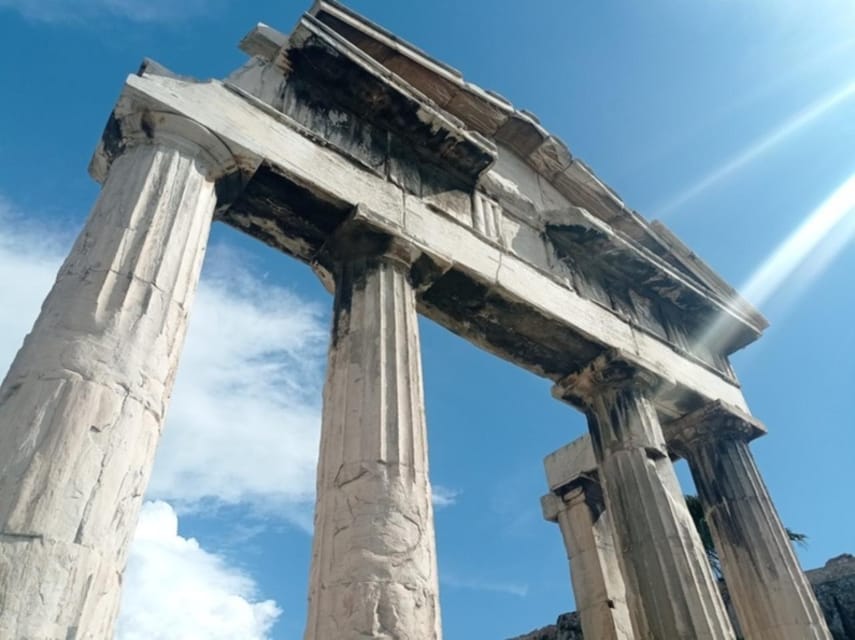
The Areopagus is one of the tour’s main stops. The rocky hill is closely tied to ancient Athens and offers a place to connect political life, justice, public speech, and philosophy.
This is also a practical point to think about before you go. Historic Athens is not a smooth modern sidewalk from start to finish. Rocks, slopes, and worn surfaces can make parts of the walk awkward, especially in hot weather. Wear shoes with a firm grip and carry water, exactly as the activity instructions advise.
The Areopagus works well in a philosophy tour because it encourages you to think about who gets to speak and how societies decide what is right. The guide does not only describe the location. He uses it to open a wider discussion about power, morality, and the systems built around those ideas.
The stop may be brief or extended depending on the group’s questions and the guide’s pacing. That flexibility is useful if you enjoy discussion, but it means the exact amount of time at each place is not fixed in the information provided.
Same city, a completely different century:
- Athens: Acropolis & up to 5 Archaeological Sites Combo Pass
★ 4.4 · 12,619 reviews - Athens: Cape Sounion & Poseidon Temple Sunset Half-Day Trip
★ 4.8 · 8,241 reviews - All Day Cruise -3 Islands to Agistri,Moni, Aegina with lunch and drinks included
★ 5.0 · 4,958 reviews - Athens, Piraeus, and Coastline: Blue Hop-On Hop-Off Bus
★ 3.9 · 4,849 reviews
Finding Socrates’ Prison
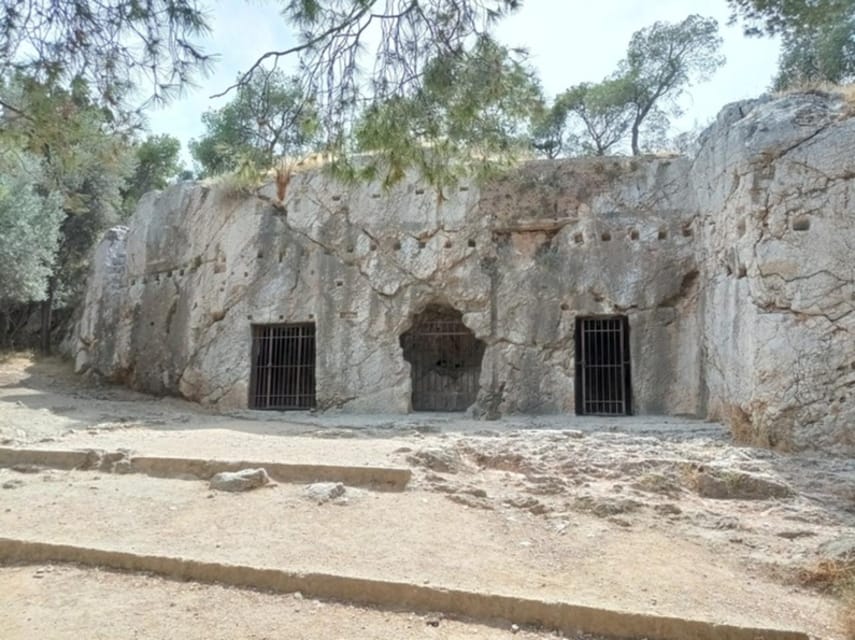
Socrates’ Prison is a memorable stop because it gives the story of the philosopher a physical setting. The experience presents Socrates not only as a thinker but as a man who paid a high price for his beliefs and method of questioning.
This is where the tour’s storytelling matters most. Ancient philosophy can sound dry when reduced to definitions. A guide who explains the choices, conflicts, and consequences behind the ideas can make the subject feel immediate.
The stop is also a reminder to keep expectations realistic. The tour takes you to a place identified with Socrates, but it is not described as a museum visit with extensive displays or a formal interior interpretation. You are going for the connection between location and story.
Gregory has been praised for bringing these episodes to life through dramatic storytelling without losing the intellectual side. He also welcomes questions, so this is a good place to ask about Socrates’ trial, his teaching style, or why his approach remained so influential.
Walking toward the Pnyx
The Pnyx adds another important layer. This hill is linked to public assembly and civic participation, making it a natural setting for discussing the relationship between philosophy, democracy, and collective decision-making.
The route uses the Pnyx to show how places in Athens carried more than one meaning. A hill could be a meeting ground, a political space, and a setting for larger questions about citizenship and responsibility.
You may find this part especially useful if you have already visited the Acropolis but want more context for how ancient Athens functioned beyond its monuments. The Pnyx helps shift your view from buildings to people, debate, and the rules of public life.
The climb also adds physical effort. The tour lasts 150 minutes, and the route covers several locations, so this is not a good choice if you want to avoid walking or hills. The pace is described as organized and adaptable, but there is no promise of a vehicle or seated transport.
The guide makes or breaks this experience
The strongest feature is the guide. Gregory is repeatedly praised for his passion, clear explanations, patience, and ability to encourage discussion. He has also helped participants with broader Athens recommendations, though the central subject remains philosophy and history.
Sunny is another guide named in the experience feedback, described as friendly and enjoyable. Since the booking information lists a live Spanish-speaking guide rather than guaranteeing a particular person, you should not assume Gregory will lead every departure. If having him specifically matters to you, ask the operator before booking.
The best guide style here is conversational. You hear a story, consider a question, and then connect the idea to a place or to modern life. Everyday examples are used to explain difficult concepts, which helps if terms such as ethics, logic, or political philosophy are new to you.
This approach also gives the group some influence over the outing. Questions are welcomed, and the guide has adjusted explanations to suit different interests. The trade-off is that a discussion-led walk may feel less tightly scripted than a sightseeing tour built around fixed facts and exact timings.
What the $34 price gets you
At $34 per person, the value is strongest if you want a focused cultural experience rather than another general walk through central Athens. The price includes an official tour guide and 150 minutes of live instruction in Spanish.
That works out to a reasonable cost for a two-and-a-half-hour experience, especially because the route links several places with one clear theme. You are paying for interpretation, not entrance tickets, food, transport, or a packaged meal.
Food and drinks are not included, and personal expenses are your responsibility. Carry water from the start. In warm weather, you may also want to plan a break before or after the walk, since the tour covers open-air sites and some uphill ground.
The value drops if you are mainly interested in architecture, excavation details, or the Acropolis interior. This is not a replacement for the major archaeological sights. It is best seen as a companion experience that gives Athens an intellectual and human frame.
Who should book this tour
I would recommend it most strongly for:
- First-time Athens visitors who want a fresh angle on the historic center.
- People curious about Socrates, Plato, Aristotle, Pythagoras, or ancient schools of thought.
- Couples and small groups who enjoy discussing big questions while walking.
- Beginners who want philosophy explained without academic jargon.
- Repeat visitors who have already seen the main monuments and want lesser-known places tied to ideas.
- Spanish-speaking travelers looking for a live tour rather than an audio guide.
It can also work for people who are not philosophy fans. Several aspects are still useful even if you arrive knowing little about the subject: the walk connects major historic areas, introduces lesser-known locations, and adds social and political context to the city.
I would hesitate if you dislike group discussion, want a purely visual sightseeing tour, or are uncomfortable walking over uneven ground. I would also avoid booking without checking the language if your Spanish is limited. The listing states Spanish as the language, and that should guide your decision.
How to prepare for the 150-minute route
Wear comfortable walking shoes. This is not a suggestion to ignore. The route includes historic hills and outdoor locations, and the Areopagus in particular can require care underfoot.
Bring water, as requested in the practical information. You may also want sun protection, though the available details do not specify how much shade the route provides. Keep your schedule reasonably open after the tour if you expect to ask many questions or want to continue the discussion.
Arrive at the Statue of Plato 10 minutes early. The meeting point is clear, but central Athens can be confusing if you are rushing. Check the starting time when you select your date because availability determines the departure time.
The tour offers free cancellation up to 24 hours before the start for a full refund. You can also reserve now and pay later, which is useful if your Athens plans are still changing.
My verdict on the Athens philosophers tour
Book this tour if you want Athens to give you something to think about, not just something to photograph. The strongest reasons are the well-chosen route, Socrates’ Prison, the Areopagus, and a guide style built around stories and questions.
At $34, it is a good buy for a two-and-a-half-hour philosophy walk with a live guide. Just remember what it is: an outdoor discussion and history tour, not a full archaeological survey. Confirm that Spanish suits you, wear sturdy shoes, and choose it because you want to connect ancient places with the ideas born there.
FAQ
How long does the tour last?
The tour lasts 150 minutes, or two and a half hours.
What language is the tour in?
The live tour guide language is Spanish.
How much does the tour cost?
The price is $34 per person.
Where does the tour meet?
The meeting point is in front of the Statue of Plato.
How early should I arrive?
You should arrive 10 minutes before the tour begins.
Which sites are included?
The highlighted sites are the Statue of Plato, the Areopagus, and Socrates’ Prison. The route also discusses the Greek Agora and the Pnyx.
Is a guide included?
Yes. An official tour guide is included.
Are food and drinks included?
No. Food and drinks are not included, so you should bring water.
What should I wear?
Wear comfortable shoes. The practical information also recommends bringing water.
Can I cancel the booking?
Yes. You can cancel up to 24 hours in advance for a full refund. You can also reserve now and pay later.
Freshly added Athens trips
- Athens and Ancient Corinth Private from Athens★ 5.0 · 3 reviews
- From Athens: Mycenae and Epidaurus Private Tour★ 4.8 · 3 reviews
- Full day Meteora private tour★ 5.0 · 3 reviews
- Double Shore Dive (certified divers)★ 4.5 · 3 reviews
- Athens Hills: Mythology Treasure Hunt★ 5.0 · 3 reviews
- Sunset & swimming at Cape Sounio, Poseidon temple★ 5.0 · 3 reviews
- Philosophy Experience at Plato’s Academy Park – basic version★ 5.0 · 3 reviews
- Private Acropolis Tour – Ticket Included★ 5.0 · 3 reviews
Guided, compared.


Acropolis, Parthenon & Acropolis Museum Guided Tour
Read our review →

Cape Sounio & Poseidon Temple Trip with Audio Guide
Read our review →
Mythology of Delphi, Museum and Arachova Guided Tour
Read our review →Acropolis, Parthenon & Acropolis Museum Guided Tour
Read our review →
