

Reviewed · WALKING TOURS
Athens Social and Political Walk
Athens is more than ancient stones and sunny café tables. This small-group political walk traces how modern Greece took shape, from independence and monarchy to dictatorship, democratic reform, economic crisis, and today’s political tensions. Guide Isaac leads the discussion with the eye of a political scientist, not just a sightseeing guide.
I like the route for two reasons: it puts major civic buildings into context, and it leaves room for real questions about current events. I also like the group limit of 15 people, which should make a serious conversation possible rather than turning the walk into a lecture heard from the back row.
The catch is simple: this is a talking-and-walking tour, not a classic Athens highlights tour. You will see important buildings from the outside, and the political subject matter may feel demanding if you want only ruins, views, and quick photo stops.
In This Review
- Key points to know before booking
- Why this Athens walk feels different
- Starting at the Prime Minister’s seat
- The President’s residence and the shape of the state
- Parliament of Greece and the politics of public space
- Old Parliament House and the long view
- Athens Polytechnic and the memory of November 17
- Isaac’s style and the value of a political scientist guide
- How much walking and time to allow
- Is $47.92 a fair price?
- Who should book this walk?
- Should you book the Athens Social and Political Walk?
- FAQ
- Where does the Athens Social and Political Walk begin?
- Where does the walk end?
- How long does the experience last?
- What language is the tour offered in?
- How many people can join the tour?
- What places are included on the route?
- How much does the tour cost?
- Can I cancel for a full refund?
Key points to know before booking

- Modern Athens takes center stage: The walk focuses on Greek government, society, history, and present-day politics rather than ancient monuments.
- Isaac leads the experience: His approach connects events from the Greek independence era to the Junta, democratic reform, and the recent economic crisis.
- The route links power and protest: You visit the Prime Minister’s seat, the President’s residence, Parliament, Old Parliament House, and Athens Polytechnic.
- A small group helps the discussion: The maximum is 15 people, a useful size for asking questions and following complex topics.
- Plan for moderate walking: The experience lasts about two and a half hours and requires a moderate level of fitness.
- The price reflects the guide’s subject focus: At $47.92 per person, you are paying for a focused conversation about Greece, not entry tickets to major attractions.
Why this Athens walk feels different

The most useful thing about this experience is its subject. Many Athens tours explain the Acropolis, temples, and ancient democracy. This one asks what happened after the glory days, and how the modern Greek state, political system, and social conflicts developed.
That shift matters. If you have ever looked at a government building in Athens and wondered what it represents, this walk gives you a framework. Isaac’s route connects places with events, institutions, and arguments. You are not simply told that a building is important. You learn why power is located there, what political memories cling to it, and how modern Greek life has been shaped by earlier decisions.
I especially like the bridge between history and the present. The discussion reaches from the Greek independence war through later political change, the military Junta, the move toward democratic reform, and the economic crisis of recent decades. It also covers culture, the economy, and polarization in Greek society.
That makes this a good first or second-day activity if you want Athens to make more sense. You may begin with only a basic idea of Greek politics and still follow the route. If you already know the country’s history, the value comes from Isaac’s synthesis and examples rather than from a basic timeline.
The tone also appears balanced. Isaac’s perspective as someone living in Greece without being Greek can help him explain the country from a slightly outside angle. That does not make the walk free of interpretation, and no political tour should. But a thoughtful guide can show you how different groups understand the same events, which is often more useful than a tidy, one-sided story.
More Athens walking tours:
- Athens: Acropolis and Parthenon Guided Walking Tour
★ 4.6 · 5,882 reviews - Greek Food Walking Tour in Athens
★ 5.0 · 4,740 reviews - Acropolis: Acropolis and Parthenon Guided Walking Tour
★ 4.7 · 3,442 reviews
Starting at the Prime Minister’s seat
The walk begins at Leoforos Vasilissis Sofias 2-4 in central Athens. The opening stop is the official seat of the Prime Minister of Greece, a fitting place to begin a route about modern political power.
This first point gives the tour a clear focus. You are not starting with a general city introduction. You are beginning at the center of executive government and then working outward through the institutions and places that define the modern state.
Expect the guide to use the setting as a springboard for questions about how Greece is governed and how political authority has changed over time. The supplied information does not promise access inside the building, so you should treat it as an exterior stop and discussion point.
That distinction is worth knowing. If you expect to enter government offices, this is not the right product. If you enjoy standing in front of a place and learning what happens there, the stop should feel purposeful rather than decorative.
The President’s residence and the shape of the state
The next important stop is the official residence of the President of the Hellenic Republic. Seeing the Prime Minister’s seat and the President’s residence within the same walk lets Isaac compare the roles of executive institutions and explain how the Greek state operates.
For a visitor, this is more useful than memorizing office titles. Political systems can seem abstract when they are explained in a classroom. They become easier to grasp when the guide ties those roles to actual places in the city.
You may find this part especially helpful if you are unsure about the division between ceremonial and political authority in Greece. The walk is built around questions, so you can ask for clarification instead of carrying a half-understood explanation to the next stop.
The setting also adds a layer of modern Athens that most sightseeing routes skip. Government buildings are not always visually dramatic, but they tell you what the city considers important. Here, the interest comes from the meaning of the institution and the stories attached to it.
Parliament of Greece and the politics of public space
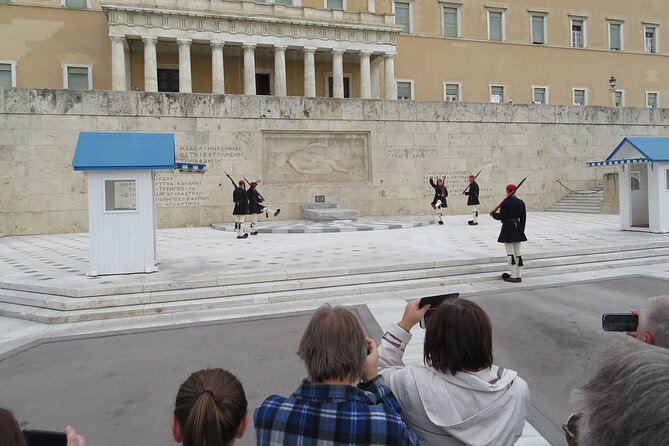
The Parliament of Greece is one of the route’s central stops. It gives the discussion a natural place to examine democratic government, political conflict, and the relationship between institutions and public life.
Parliament is also a strong location for connecting the past with the present. The walk covers the move from dictatorship toward democratic reform and the political tensions that followed. Isaac can use the building and its surroundings to explain how national debates become visible in the capital.
I would not book this walk expecting an elaborate ceremony or an inside visit. The appeal is the interpretation. You are there to ask how Greek politics reached its current point, why society remains polarized, and how older struggles still affect public discussion.
The discussion can also help put recent news into context. One especially useful feature is the use of current events and recent anecdotes alongside the broader historical story. That can make the past feel less sealed off from daily life.
For anyone who has followed Greece through the economic crisis but never understood the political background, this stop may be the turning point of the walk. It gives you a place to connect financial hardship, party conflict, public anger, and institutional change without reducing the country to a single crisis.
Same city, a completely different century:
- Athens: Acropolis & up to 5 Archaeological Sites Combo Pass
★ 4.4 · 12,619 reviews - Athens: Acropolis Ticket with Optional Audio or Live Guide
★ 4.2 · 11,055 reviews - Athens: Acropolis, Parthenon & Acropolis Museum Guided Tour
★ 4.8 · 9,316 reviews - Athens: Cape Sounion & Poseidon Temple Sunset Half-Day Trip
★ 4.8 · 8,241 reviews
Old Parliament House and the long view
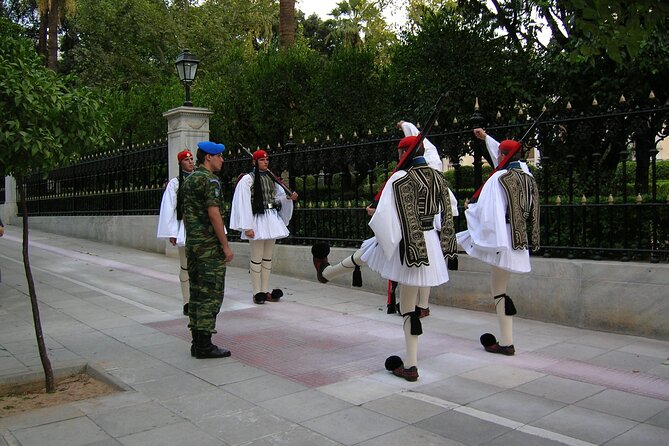
Old Parliament House adds another layer to the route. It lets Isaac step back from current politics and show how the Greek state developed through earlier periods of national life.
This is where the walk’s historical range becomes most useful. The story does not begin with recent headlines. It reaches back to independence and early modern Greece, then follows the changes that shaped later government and society.
A good city walk uses old buildings as evidence, and this one appears to do that. You are not asked to admire architecture without context. Instead, the building becomes part of a longer story about institutions, political development, and the way Greece moved through different forms of rule.
I like this stop because it can prevent a common mistake: treating modern Greece as if it appeared fully formed after independence. The country’s political structure developed through conflict, reform, and outside pressures. That history helps explain why current debates can be so charged.
The amount of detail may depend on the questions asked by the group. With up to 15 people, you should have a fair chance to steer the conversation toward subjects that matter to you, though a smaller group would allow even more back-and-forth.
Athens Polytechnic and the memory of November 17
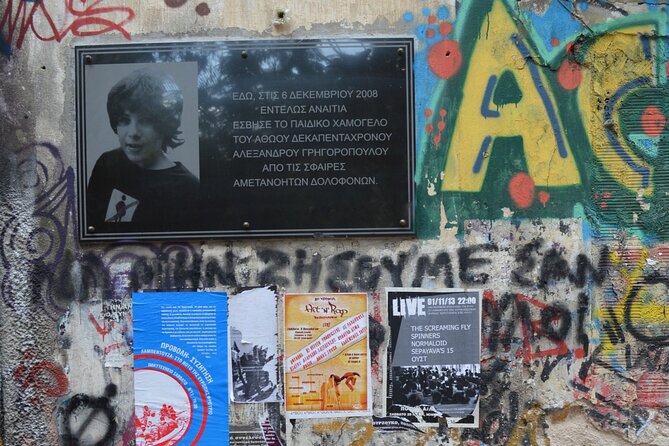
The route ends at the main entrance of the National Technical University of Athens, also called Athens Polytechnic, on Patision Avenue. The school is closely tied to the Athens Polytechnic uprising of November 17, 1973, one of the most important events in its history.
This final stop gives the walk a strong sense of purpose. The tour begins with the formal centers of government and ends at a place associated with protest, resistance, and democratic change. That movement from official power to public opposition is an effective way to frame modern Greek politics.
The uprising is not just a date to memorize. It is a way to discuss the Junta and the country’s move toward democratic reform. The site helps show how political history is also social history, shaped by students, public pressure, fear, courage, and memory.
You finish at the university’s main entrance, rather than returning to the starting point. That matters when planning the rest of your day. The ending point is on Patision Avenue in Athens, and you should allow time to orient yourself before making your next appointment.
It is also a practical ending for anyone who wants to continue exploring modern Athens on foot. Still, do not treat the Polytechnic as a quick photo stop. The point is the story connected to the place, and it deserves your attention.
Isaac’s style and the value of a political scientist guide

Isaac is the key reason this experience is more than a route between buildings. His background in political science gives the walk a clear subject, while his use of anecdotes keeps it from becoming a dry civics lesson.
The strongest parts of the approach are the links. Isaac connects the Greek independence war to later political development, the Junta to democratic reform, and recent news to longer patterns in Greek society. He also uses comparisons with other countries to make unfamiliar political ideas easier to understand.
That is valuable for you as a visitor. Greece can be hard to read from the outside. The names of political movements, the economic crisis, and the divisions within society can seem disconnected. A guide who explains cause and effect can give you a better sense of what you are seeing in newspapers, conversations, and public spaces.
You should still expect interpretation. Politics is never a neutral museum label. The best use of the walk is to listen closely, ask questions, and treat the guide’s explanation as a well-informed way into the subject, not as the only possible view.
The small-group format helps. With a maximum of 15 people, the guide can respond to questions and adjust the pace of discussion. That is important here because the value comes from conversation, not from racing through a list of stops.
How much walking and time to allow

The experience lasts about two hours and 30 minutes. The route is on foot, and you should have a moderate level of physical fitness.
That does not mean you need to be an athlete. It does mean you should be comfortable walking through central Athens for the full duration while listening and stopping along the way. Wear sensible shoes, bring water, and avoid scheduling a tight appointment immediately afterward.
The walk is offered in English and uses a mobile ticket. It is near public transportation, which makes the starting point at Leoforos Vasilissis Sofias 2-4 practical for reaching from other parts of Athens.
The tour requires good weather. If poor weather cancels the activity, you are offered another date or a full refund. It also requires a minimum number of participants, so a low booking count can lead to a rescheduled experience or refund.
Service animals are allowed. Those details are small, but they help you decide if the tour fits your day and your needs.
Is $47.92 a fair price?
At $47.92 per person, this is not the cheapest way to spend two and a half hours in Athens. You can walk past many civic buildings on your own for free.
The real question is what you want from the time. If you want entry tickets, ancient sites, or a wide survey of Athens, another tour may give you more visible sights for the money. This experience is narrower and more specialized.
I think the price can make sense if you want serious context about modern Greece. You are paying for a guide who can explain political history, current events, the economy, culture, and social division in one connected story. That kind of explanation is difficult to assemble from a quick guidebook scan.
It also has value early in your stay. A political walk can change how you read the rest of Athens. Parliament, public demonstrations, government buildings, and references to the crisis may become easier to understand after this route.
The strongest value comes if you ask questions. A silent walk would waste much of what you are paying for. Come ready to discuss what you already know, what confuses you, and what you want to understand about Greece today.
Who should book this walk?
I would recommend it to adults and older students who like history, government, current affairs, and social questions. It is particularly useful for someone who wants to go beyond the usual Athens sightseeing circuit.
It also suits visitors who have read some Greek history but want the events arranged into a clear political story. Isaac’s synthesis can help connect independence, the Junta, democratic reform, and the economic crisis.
You may also like it if you prefer a local guide’s interpretation to a large coach tour. The small group should feel more personal, and the subject naturally encourages questions.
I would not choose it as your only Athens tour if this is your first visit and you want the Acropolis, ancient Agora, or major archaeological sites explained. Those are not the focus here. This walk works best beside, not instead of, the classic ancient Athens experience.
The pace and subject may also be less suitable for young children who need constant visual variety. The route includes important places, but much of the experience comes through discussion.
Should you book the Athens Social and Political Walk?
Book it if you want to understand the Athens behind the postcards. The route gives you a clear path through the Prime Minister’s seat, the President’s residence, Parliament, Old Parliament House, and Athens Polytechnic, while Isaac ties those places to the country’s political past and present.
Skip it if you want interiors, archaeological treasures, or a light city stroll with little discussion. At $47.92, it earns its price through focus and explanation, not through the number of attractions.
For the right audience, this is a smart addition to an Athens visit. You leave with more than a set of photos. You gain a working framework for understanding Greek politics, recent history, and the public life you will see around you.
FAQ
Where does the Athens Social and Political Walk begin?
The walk begins at Leoforos Vasilissis Sofias 2-4, Athens 106 74, Greece.
Where does the walk end?
It ends at the main entrance of the National Technical University of Athens, also called Athens Polytechnic, on Patision Avenue.
How long does the experience last?
The walk lasts approximately two hours and 30 minutes.
What language is the tour offered in?
The tour is offered in English.
How many people can join the tour?
The maximum group size is 15 people.
What places are included on the route?
The route includes the official seat of the Prime Minister of Greece, the official residence of the President of the Hellenic Republic, the Parliament of Greece, Old Parliament House, and Athens Polytechnic.
How much does the tour cost?
The listed price is $47.92 per person.
Can I cancel for a full refund?
Yes. You can cancel at least 24 hours before the experience start time for a full refund. Cancellations or changes made less than 24 hours before the start time are not refunded or accepted. If bad weather or the minimum group requirement causes cancellation, you are offered another date or a full refund.
Freshly added Athens trips
- Athens and Ancient Corinth Private from Athens★ 5.0 · 3 reviews
- From Athens: Mycenae and Epidaurus Private Tour★ 4.8 · 3 reviews
- Full day Meteora private tour★ 5.0 · 3 reviews
- Double Shore Dive (certified divers)★ 4.5 · 3 reviews
- Sunset & swimming at Cape Sounio, Poseidon temple★ 5.0 · 3 reviews
- Philosophy Experience at Plato’s Academy Park – basic version★ 5.0 · 3 reviews
- Athens Hills: Mythology Treasure Hunt★ 5.0 · 3 reviews
- Private Acropolis Tour – Ticket Included★ 5.0 · 3 reviews
Walking Tours, compared.




Acropolis monuments & Parthenon Walking Tour with Optional Acropolis Museum
Read our review →

Athens Authentic Greek Food Walking Tour (Small Group)
Read our review →
Early Morning Acropolis & Old Athens Guided Walking Tour
Read our review →
Browse the lists this tour appears in