
Reviewed · WALKING TOURS
Athens Social and Political Walk
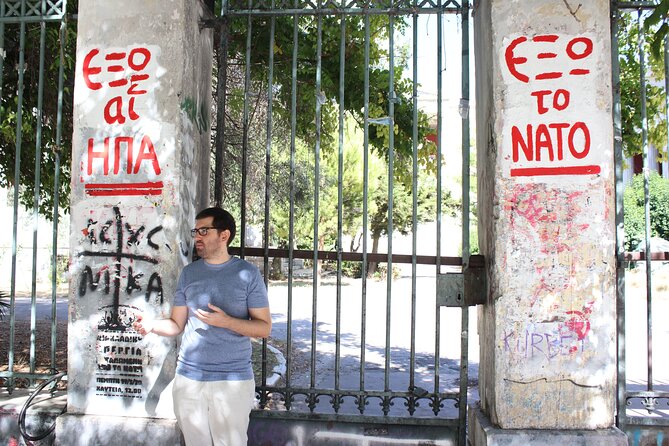
Athens can explain itself through ruins, museums, and sunny cafés. This walk asks harder questions: how did the birthplace of democracy become tied to Europe’s debt crisis, and how do modern Greeks live with that contradiction? Political scientist Isaac leads the route with history, street scenes, humor, and plain explanations of subjects such as religion, language, migration, party politics, and the economy.
I like the way the tour connects big political events to ordinary Greek life, rather than treating modern history as a list of dates. I also like the route itself, which takes you from government buildings and royal residences to the National Garden, university streets, a memorial site, and the Polytechnic. The main consideration is that this is an ideas-heavy walk. If you want ancient monuments or a relaxed sightseeing stroll, this may feel more like an outdoor seminar than a standard city tour.
In This Review
- Key points to know before you book
- Why this Athens walk feels different
- Starting near Maximos Mansion and the Presidential Palace
- The National Garden and the symbols of public life
- Parliament and the making of a modern nation
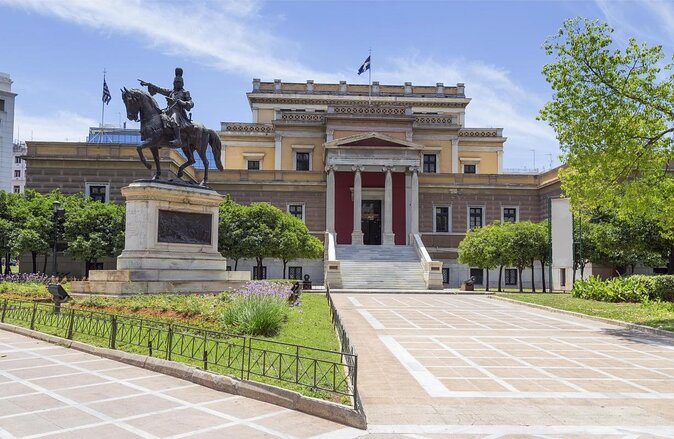
- The National Historical Museum and the road from 1821
- Korai 4 and the darker side of occupation
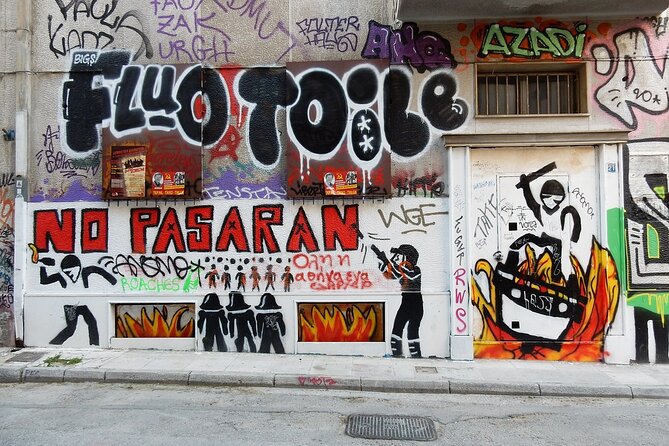
- Panepistimiou and the city as a political classroom
- The Polytechnic and the memory of student protest
- What the tour adds to the financial crisis story
- The extra slideshow and the value of the price
- Who should take this walk
- Booking advice and final verdict
- FAQ
- How long does the Athens Social and Political Walk last?
- How much does the walk cost?
- Which languages are available?
- Who leads the experience?
- What places does the route visit?
- Is the walk wheelchair accessible?
- What is included besides the walking tour?
Key points to know before you book
- Modern Greece takes center stage: The story runs from the independence war of 1821 through the monarchy, dictatorship, World War II, party politics, the debt crisis, migration, and gentrification.
- Isaac brings political science to the pavement: His explanations are clear, conversational, and often funny, with comparisons to other countries.
- The route uses civic landmarks: Maximos Mansion, the Presidential Palace, Parliament, Korai 4, Panepistimiou, and the National Polytechnic all add physical meaning to the discussion.
- The walk stays balanced: You are given background and competing viewpoints, then left to form your own opinion.
- You receive extra visual material: A slideshow with photographs and added information helps reinforce the themes after the walk.
- Plan for a focused 2.5 hours: English and Spanish are available, and the activity is listed as wheelchair accessible.
Why this Athens walk feels different
Many Athens tours begin with classical Greece and end with the Roman or Byzantine era. This one spends its energy on the country you see today. That makes it useful early in your visit, especially if you want a clearer sense of why Athens looks, works, and argues the way it does.
The central question about Greece’s political and economic troubles is deliberately blunt. The guide does not use it as a cheap punchline. Instead, it opens a path through the making of the modern Greek state and the outside pressures that shaped it.
You will hear about the independence struggle of 1821, the Byzantine and Ottoman periods, the role of the Orthodox Church, questions of Greek language and identity, and the country’s long relationship with Europe. Later subjects include World War II, the postwar years, party politics, neoliberal reforms, immigration, and gentrification.
I appreciate that the tour does not pretend one event explains everything. The financial crisis receives attention, but it is placed beside older questions about state-building, social divisions, political power, and Greece’s place in Europe. That approach gives you more useful context than a simple tale of irresponsible spending followed by outside punishment.
More Athens walking tours:
- Athens: Acropolis and Parthenon Guided Walking Tour
★ 4.6 · 5,882 reviews - Greek Food Walking Tour in Athens
★ 5.0 · 4,740 reviews - Acropolis: Acropolis and Parthenon Guided Walking Tour
★ 4.7 · 3,442 reviews
Starting near Maximos Mansion and the Presidential Palace
The walk begins with Athens as a seat of power. Maximos Mansion is the official office of Greece’s prime minister, while the Presidential Palace represents another part of the country’s political structure. These buildings are not just photo stops. They give the opening discussion a clear setting: who governs Greece, how that system developed, and how symbolic authority differs from day-to-day political power.
The Presidential Palace also connects to the country’s former monarchy and the changing shape of the modern state. I would pay close attention here if you are interested in how national institutions evolve. Greece’s political story is not a smooth march from independence to today. It includes shifts in royal power, military rule, parliamentary government, and changing public attitudes toward authority.
Because the tour is built around conversation, your questions matter. The guide is particularly useful when a broad issue needs a local example or a comparison with another country. Isaac has a political science background and draws on international reference points without turning the walk into a lecture about one narrow ideology.
The National Garden and the symbols of public life
The National Garden gives the route a change of pace. After government buildings, you move through one of central Athens’s major open spaces. The setting helps explain how formal politics and public life overlap in the capital.
This is also a good point to consider the difference between Athens as a political center and Athens as a lived-in city. Decisions made inside ministries and Parliament affect work, housing, education, migration, and family life far beyond the official quarter. The walk keeps returning to that connection.
Do not expect a long nature visit. The garden is one stop within a wider route, not the main attraction. Its value comes from the pause and the setting, especially after the more formal discussion around state buildings.
Parliament and the making of a modern nation
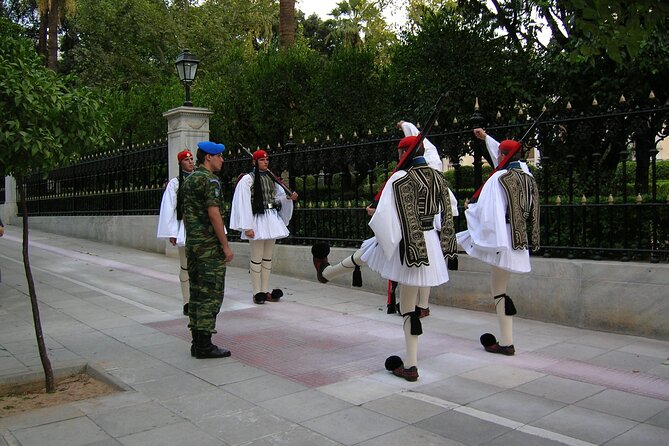
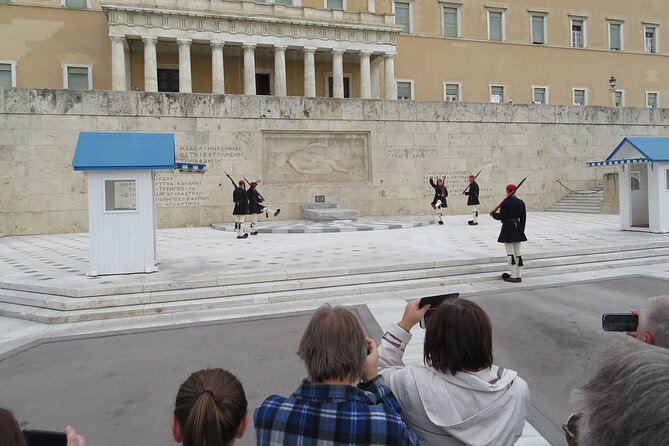
At the Hellenic Parliament, the guide can place Greece’s political institutions in their national setting. The building is closely tied to the country’s modern government, but the real subject is the system around it: parties, elections, public trust, political conflict, and the long effort to define what Greek democracy should mean after periods of instability.
This is where the tour’s title makes sense. Ancient Athens is often presented as the birthplace of democracy, yet the modern Greek state has had to work through monarchy, military dictatorship, economic hardship, and sharp divisions over Europe and reform. The walk makes clear that ancient democratic ideals do not automatically produce a stable modern political system.
You will not be asked to accept a single verdict. The advertised approach is deliberately even-handed, and that is one of the strongest reasons to choose this experience. The guide explains the forces at work and gives you room to decide how much responsibility belongs to Greek governments, European institutions, banks, social groups, or wider economic trends.
Same city, a completely different century:
- Athens: Acropolis & up to 5 Archaeological Sites Combo Pass
★ 4.4 · 12,619 reviews - Athens: Acropolis Ticket with Optional Audio or Live Guide
★ 4.2 · 11,055 reviews - Athens: Acropolis, Parthenon & Acropolis Museum Guided Tour
★ 4.8 · 9,316 reviews - Athens: Cape Sounion & Poseidon Temple Sunset Half-Day Trip
★ 4.8 · 8,241 reviews
The National Historical Museum and the road from 1821
The National Historical Museum helps anchor the discussion in the founding of the modern country. The route does not simply celebrate independence. It uses the birth of the state as a starting point for questions about identity, borders, language, religion, and the relationship between the new nation and older Greek traditions.
The walk covers the period from the independence war onward, with links to the Byzantine and Ottoman past. That broad reach matters because modern Greek politics often draws on several layers of identity at once. Religious tradition, national memory, European affiliation, and everyday language all influence how people understand the country.
You should not expect a full museum visit as part of the 2.5-hour experience. The stop works as an outdoor reference point within a moving conversation. If you want to study objects and exhibits in detail, plan separate museum time.
Korai 4 and the darker side of occupation

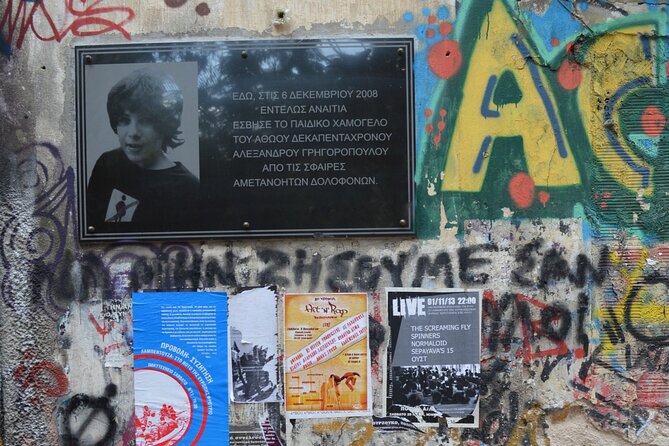
Korai 4, marked as a memorial site for 1941 to 1944, brings World War II and the occupation into the route. This is one of the more serious stops because it puts political violence and civilian suffering into the city itself.
A memorial site can do what a classroom cannot. It shows that national history is not only about leaders and institutions. It is also about imprisonment, fear, resistance, loss, and memories that can remain politically important for decades.
This stop helps explain the difficult postwar period as well. The war did not neatly settle Greece’s political disputes. Conflict and division continued, shaping later arguments about the state, the left, the right, and the role of foreign powers.
If you prefer a light walking tour, this section may feel heavy. That is not a flaw, but it is worth knowing before you book. The experience deals with real political trauma rather than keeping everything cheerful.
Panepistimiou and the city as a political classroom
Panepistimiou gives you a long urban corridor through which Athens’s public and intellectual life can be discussed. Moving along city streets keeps the experience from becoming a series of static talks. You see the capital while hearing how its institutions and social groups have changed.
This is also a useful setting for subjects such as education, language, class, and urban change. Athens is not presented as a museum piece. It is a city where older institutions, political protests, commercial change, and new housing pressures sit close together.
The guide’s style seems especially important here. Isaac is praised for making complex subjects simple, answering questions carefully, and using humor without losing the seriousness of the subject. That combination helps when the discussion turns to economics or ideology, topics that can quickly become either too technical or too partisan.
The Polytechnic and the memory of student protest
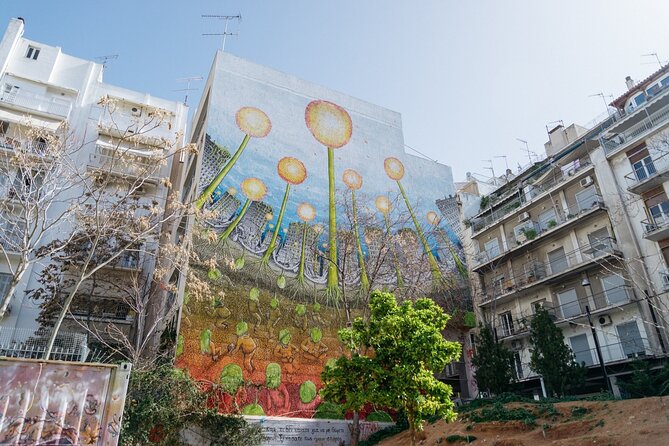
The National Technical University of Athens, commonly called the Polytechnic, is one of the route’s most important stops. It connects the walk to the student uprising and the era of military dictatorship, including the memory of the student massacre.
This is a powerful example of how a physical place can carry national memory. The Polytechnic is not simply an academic institution. It represents resistance, youth politics, state violence, and the restoration of democracy.
The stop also helps explain why political arguments in Greece can carry such strong emotional weight. Historical events are not always distant. They can remain present in family stories, public rituals, university life, and party identity.
The experience does not reduce the subject to a slogan. You get a wider explanation of the dictatorship, the opposition to it, and the political culture that followed. If modern European history interests you, this may be one of the most useful parts of the route.
What the tour adds to the financial crisis story
The 2008 financial crisis is the question that frames the experience, but it is not the only subject. That is a strength. You get a chance to examine how long-term political habits, economic choices, European rules, public services, and social expectations came together.
The crisis can be hard to understand from headlines alone. A walking discussion gives you room to ask what happened, who was affected, and why the consequences were so severe. You can also connect the crisis to later subjects such as migration, unemployment, housing, and gentrification.
The guide’s comparisons with other countries are useful here. Greece is not treated as an isolated case, and the tour avoids the easy claim that one side alone caused the trouble. I would choose this walk if you want to discuss the crisis without being pushed toward a ready-made political answer.
The extra slideshow and the value of the price
At $47 per person, the walk costs more than a basic orientation tour, but it offers a different kind of value. You are paying for a specialist guide, a focused 2.5-hour route, and a structured explanation of modern Greece rather than a quick list of sights.
The slideshow with photos and extra information adds something practical. Political history can be difficult to retain after a single walk, so the visual material gives you a way to revisit the subjects later.
The value depends on your interests. If you want archaeological sites, grand views, or a food-focused outing, spend your money elsewhere. If you want a clearer understanding of the country you are visiting, $47 is reasonable for a small-scale, discussion-led experience.
The available feedback gives the tour a five out of five rating from 31 reviews. Specific praise centers on the guide’s clarity, humor, openness to questions, and ability to explain difficult issues in simple terms. One group had seven people, suggesting that at least some departures are small enough for a real conversation, though a fixed group size is not provided.
Who should take this walk
I would recommend it to first-time visitors who want a stronger base for understanding Greece beyond the Acropolis. It is also a good choice for students, teachers, politics enthusiasts, long-stay visitors, and anyone who has lived in Greece but still finds its political life hard to follow.
The walk suits you if you enjoy asking questions. Isaac’s strongest qualities are his ability to connect Greek events with international examples and his willingness to discuss complicated issues without making the group feel lost.
It may not suit young children or anyone seeking a purely entertaining tour. The route deals with dictatorship, war, economic hardship, migration, and political conflict. Humor keeps the discussion approachable, but the subject matter remains serious.
You can request English or Spanish. The activity is listed as wheelchair accessible, which is helpful, though I would still confirm the exact route conditions and meeting details before booking if you have specific mobility needs.
Booking advice and final verdict
Book this early in your Athens stay if you want the rest of your visit to make more sense. The tour gives context that can sharpen what you notice in Parliament Square, on university streets, in neighborhoods affected by redevelopment, and in conversations about Greece’s place in Europe.
The most important question is simple: do you want to understand modern Greece, or do you mainly want to see famous sights? If it is the first, I think this is a smart use of 2.5 hours and $47. If it is the second, choose a standard Athens sightseeing walk instead.
I would book this experience for its mix of street exploration and political storytelling. Isaac has earned strong praise for being clear, funny, and open to questions, while Bianca is also named as a guide. The route will not give you every answer, but it should leave you with better questions and a more grounded view of Athens.
FAQ
How long does the Athens Social and Political Walk last?
The experience lasts 2.5 hours.
How much does the walk cost?
The price is $47 per person.
Which languages are available?
The tour is offered in English and Spanish.
Who leads the experience?
Isaac, a political scientist, leads the walk. Bianca is also named as a guide for the experience.
What places does the route visit?
The route includes Maximos Mansion, the Presidential Palace, the National Garden, the Hellenic Parliament, the National Historical Museum, Korai 4, Panepistimiou, and the National Technical University of Athens. It also includes additional stops described as special locations.
Is the walk wheelchair accessible?
Yes. The activity is listed as wheelchair accessible.
What is included besides the walking tour?
You receive a slideshow with photographs and extra information about the issues discussed during the experience.
Freshly added Athens trips
- Athens and Ancient Corinth Private from Athens★ 5.0 · 3 reviews
- From Athens: Mycenae and Epidaurus Private Tour★ 4.8 · 3 reviews
- Full day Meteora private tour★ 5.0 · 3 reviews
- Double Shore Dive (certified divers)★ 4.5 · 3 reviews
- Athens Hills: Mythology Treasure Hunt★ 5.0 · 3 reviews
- Sunset & swimming at Cape Sounio, Poseidon temple★ 5.0 · 3 reviews
- Philosophy Experience at Plato’s Academy Park – basic version★ 5.0 · 3 reviews
- Private Acropolis Tour – Ticket Included★ 5.0 · 3 reviews
Walking Tours, compared.




Acropolis monuments & Parthenon Walking Tour with Optional Acropolis Museum
Read our review →

Athens Authentic Greek Food Walking Tour (Small Group)
Read our review →
Early Morning Acropolis & Old Athens Guided Walking Tour
Read our review →
Browse the lists this tour appears in