
Reviewed · NATIONAL ARCHAEOLOGICAL MUSEUM
Athens: National Archaeological Museum Ticket w/ Opt. Audio
The National Archaeological Museum is where ancient Greece stops being a chapter in a textbook and becomes a room full of real objects: the Gold Deathmask of Agamemnon, the Antikythera mechanism, monumental statues, painted pottery, and finds from across the country. This ticket gives you a full day of admission, so you can set your own pace rather than follow a group.
I like two things here. First, the pre-booked e-ticket can save time at the admission line, especially during the busy season. Second, the museum is large enough to reward both a quick one-hour visit and a serious half-day wander. The optional English audio tour adds useful background, though its directions and app performance can be uneven.
The main consideration is the museum’s sheer size. Some visitors finish in about an hour, while others need several hours, and the galleries do not always create an obvious route. Summer heat, limited seating, and occasional closed galleries can also affect the visit.
In This Review
- Key Points Before You Go
- Why This Museum Deserves a Place in Your Athens Plans
- Getting In With the Timed E-Ticket
- The Prehistoric and Mycenaean Rooms
- Santorini, Crete, and the Aegean Story
- Sculpture, Gods, and the Classical Ideal
- The Antikythera Mechanism and Ancient Technology
- How Much Time Should You Allow?
- Is the English Audio Tour Worth Adding?
- Crowds, Comfort, and Accessibility
- The $30 Question: Good Value or Not?
- Who Should Book This Experience?
- FAQ
- Where is the National Archaeological Museum located?
- How long is the ticket valid?
- Is a guide included?
- Is the audio tour available in English?
- What identification should I bring?
- Can visitors under 25 buy the adult online ticket?
- Is the museum wheelchair accessible?
- What are the listed opening hours?
- Should You Book It?
Key Points Before You Go
- See famous ancient treasures: Look for the Mask of Agamemnon, Antikythera mechanism, Cup of Nestor, and Ring of Theseus.
- Use a timed e-ticket: Scan the ticket at the gate, but check that you are in the entry line rather than the ticket-purchase or audio-device line.
- Plan your own route: The museum covers prehistoric, Mycenaean, Classical, Hellenistic, Roman, and other periods, with plenty to see beyond the headline objects.
- Consider the English audio option: It can add historical context, but the app may use battery and some references may not work properly.
- Allow at least one hour: A quick visit is possible, but two to three hours gives you a better chance to see the major collections.
- Bring headphones and identification: You need headphones for the audio tour and a passport or ID card, with a copy accepted.
Why This Museum Deserves a Place in Your Athens Plans
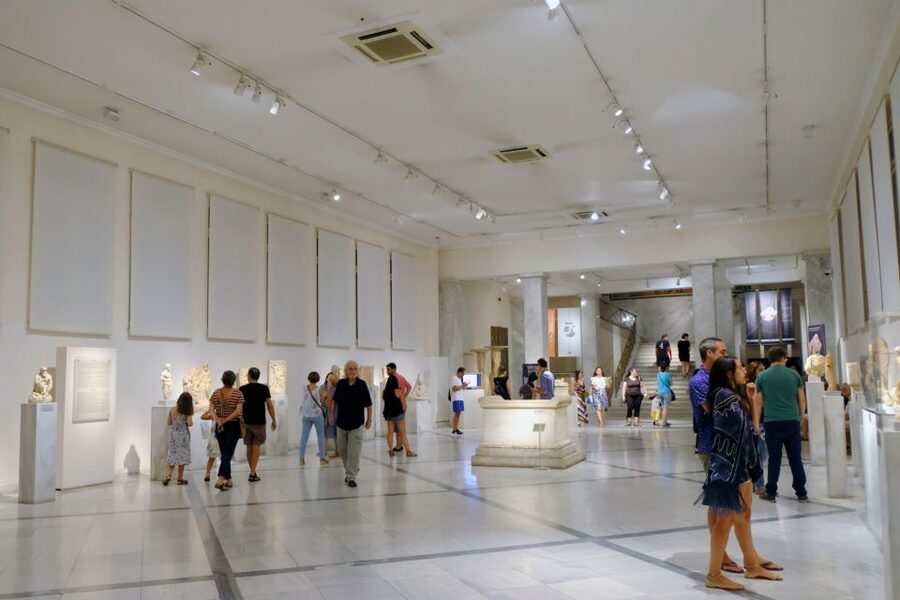
Athens has no shortage of ancient sites, but the National Archaeological Museum gives you something the ruins cannot: close views of the objects themselves. You can examine the workmanship on a vase, the expression on a marble face, or the tiny parts of a scientific instrument made more than 2,000 years ago.
The museum is the largest archaeological museum in Greece and one of the world’s major homes for ancient Greek art. Its holdings come from many parts of Greece, so you are not looking at one city’s story alone. The displays connect Mycenae, Athens, Crete, Santorini, and other regions across long stretches of time.
I especially like the way the collection lets you compare different periods. Early objects can look simple at first glance, but the galleries show how materials, religious ideas, burial customs, sculpture, and painting changed over time. You can see the movement from prehistoric artifacts to the polished naturalism of Classical sculpture without needing to visit several distant archaeological sites.
The building itself is part of the appeal. Several halls have natural light, and the galleries are arranged in sections that make it possible to focus on one era or type of object at a time. The museum can feel calm even when Athens outside is hot and crowded.
More National Archaeological Museum visits:
- Athens: National Archaeological Museum Ticket & Audio Guide
★ 4.3 · 1,330 reviews - Athens National Archaeological Museum E-Ticket with Audio Guide
★ 3.0 · 57 reviews - National Archaeological Museum Private Tour with Licensed Expert Guide
★ 5.0 · 53 reviews
Getting In With the Timed E-Ticket
Your ticket is sent to your email for the selected date and time slot. At the entrance, you scan the ticket rather than buying a standard admission ticket on site. That is the main practical benefit of booking ahead.
Do not assume every queue near the entrance serves the same purpose. There can be separate lines for people purchasing tickets, people with pre-booked tickets, and people collecting or checking in for an electronic narrator device. Look for the line marked for ticket holders before joining one.
The nearest metro station is Omonoia. The museum is in central Athens, so it can fit neatly into a day that also includes the city center and Plaka. Hotel pickup and drop-off are not included, and there is no live guide leading you through the galleries. You make your own way there and decide how long to stay.
Identification matters. Bring your passport or ID card, and a copy is accepted. The ticket is intended for travelers over 25. Reduced-price tickets are not available online, so younger visitors who qualify for free or reduced admission need to provide identification at the ticket booth. Children under five and EU citizens under 25 may receive free or reduced admission with ID, while non-EU citizens under 25 receive reduced admission from April through October with ID.
That age rule makes the $30 price less attractive for younger visitors who can qualify for a lower rate. For an adult who wants a simple pre-booked entry, the price is reasonable if you value convenience and plan to spend several hours inside.
The Prehistoric and Mycenaean Rooms
Begin with the oldest material in the museum if you want to understand the long arc of Greek civilization. The prehistoric sections contain objects from periods far earlier than Classical Athens, including finds connected with the Cyclades and Mycenaean Greece.
This is where the Mask of Agamemnon gets much of its fame. The gold death mask is associated with a royal burial at Mycenae and has become one of the most recognizable objects in Greek archaeology. The display gives you a direct connection to the elite culture of the Mycenaean age, long before the temples and statues most people picture when they think of Greece.
You will also find the Cup of Nestor and the Ring of Theseus among the objects highlighted by the visit. Their value is not only visual. They help show how burial goods, symbols of status, writing, and stories connected people to power and belief.
The rooms can feel packed with important material. That is a strength, but it also means you need to slow down if you want to read every label. If you are visiting with children or anyone who tires quickly, choose a few sections rather than trying to cover every case.
Santorini, Crete, and the Aegean Story
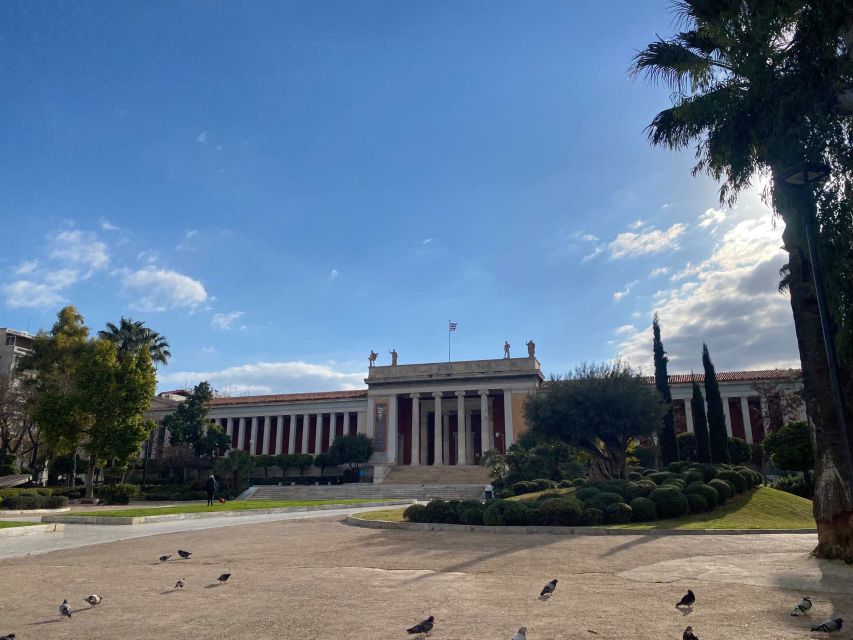
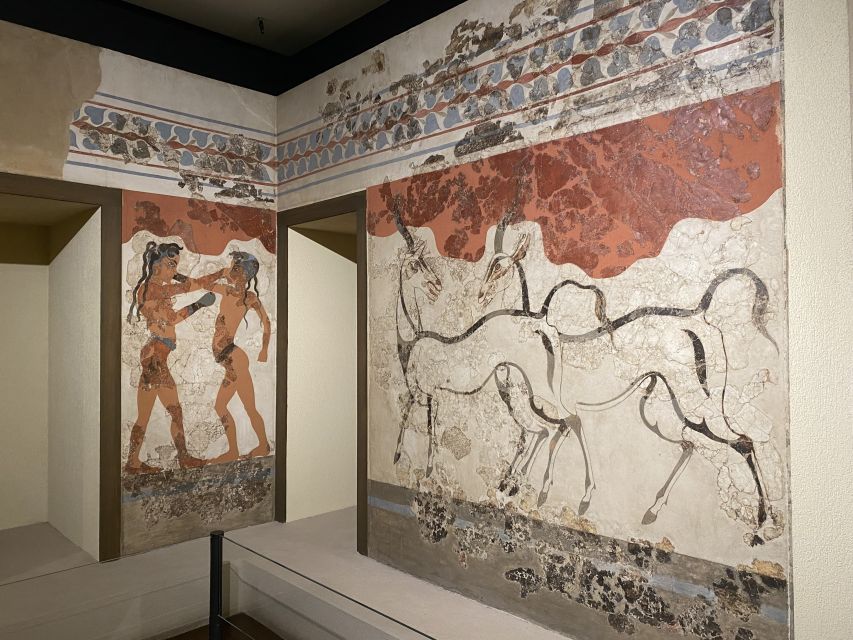
The museum’s Santorini material is a particularly good reason to visit. Objects from the island were preserved by volcanic ash, offering an unusually vivid look at Aegean life. Displays include pottery, amphorae, jugs, images, and information about the major eruption connected with the island.
The Santorini section helps you picture more than isolated artifacts. You can see artistic details, household objects, and evidence of a society interrupted by a volcanic event. The material also gives useful context for the wider Aegean world, including connections between islands and mainland Greece.
Crete and other Aegean areas add another layer to the story. The museum’s strength is its range: one gallery may focus on small objects made for daily use, while another presents large sculpture or ceremonial pieces. You do not need to know the chronology in advance, but a little patience helps the sequence make sense.
The layout is broadly organized by period and culture, yet the route is not always obvious. Some sections can leave you unsure which direction to take next. If you use the audio tour, do not expect it to function as a perfect turn-by-turn route. Use the room numbers and labels to get your bearings, then treat the audio as extra interpretation rather than a strict walking plan.
More Athens museums:
- Athens: Acropolis, Parthenon & Acropolis Museum Guided Tour
★ 4.8 · 9,316 reviews - Athens: Mythology of Delphi, Museum and Arachova Guided Tour
★ 4.6 · 4,008 reviews - Athens: Acropolis, Parthenon & Acropolis Museum Guided Tour
★ 4.8 · 3,579 reviews - Acropolis monuments & Parthenon Walking Tour with Optional Acropolis Museum
★ 5.0 · 2,678 reviews
Sculpture, Gods, and the Classical Ideal
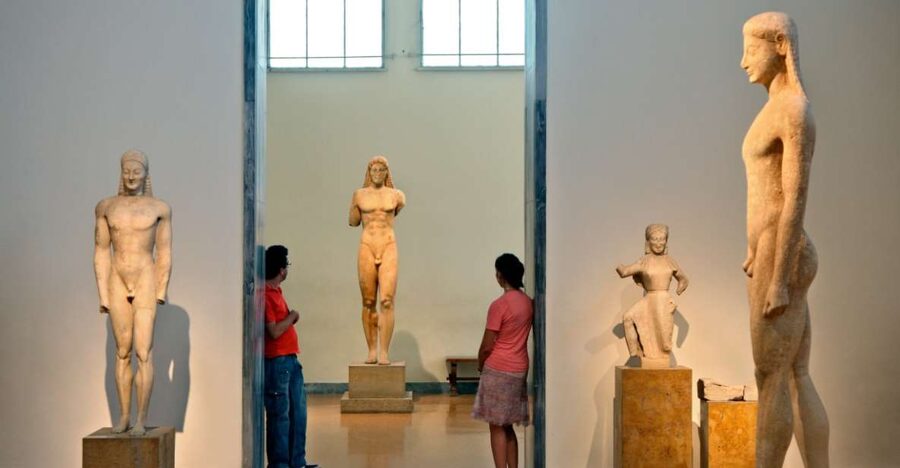
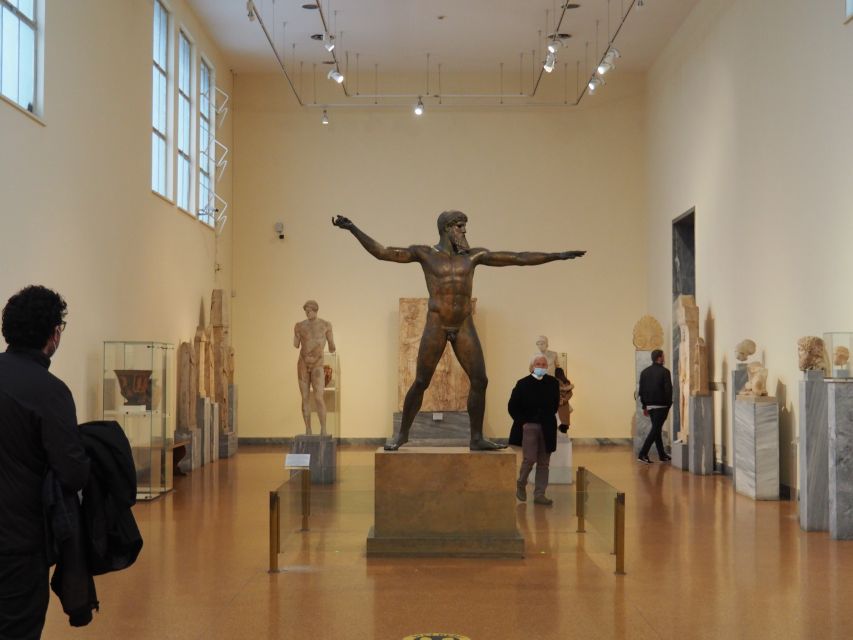
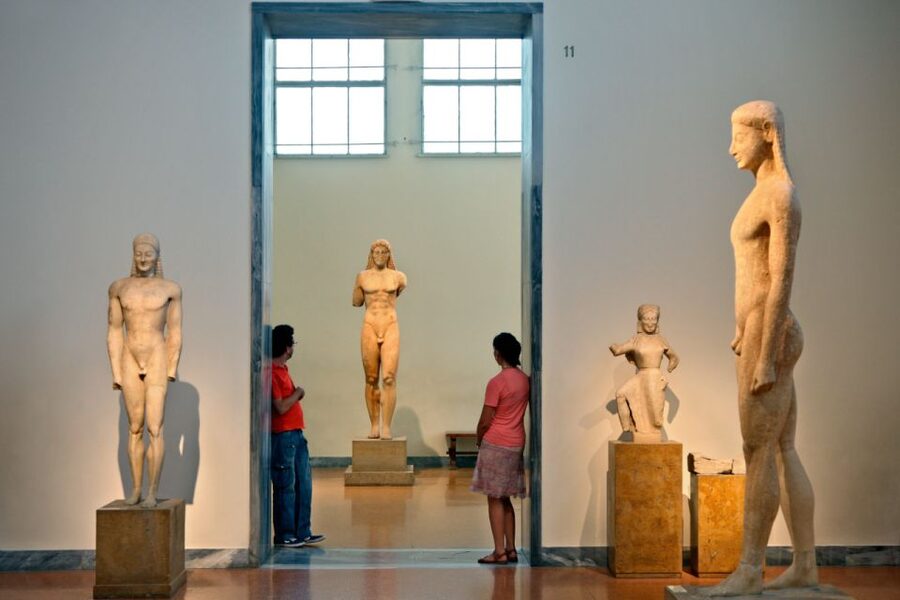
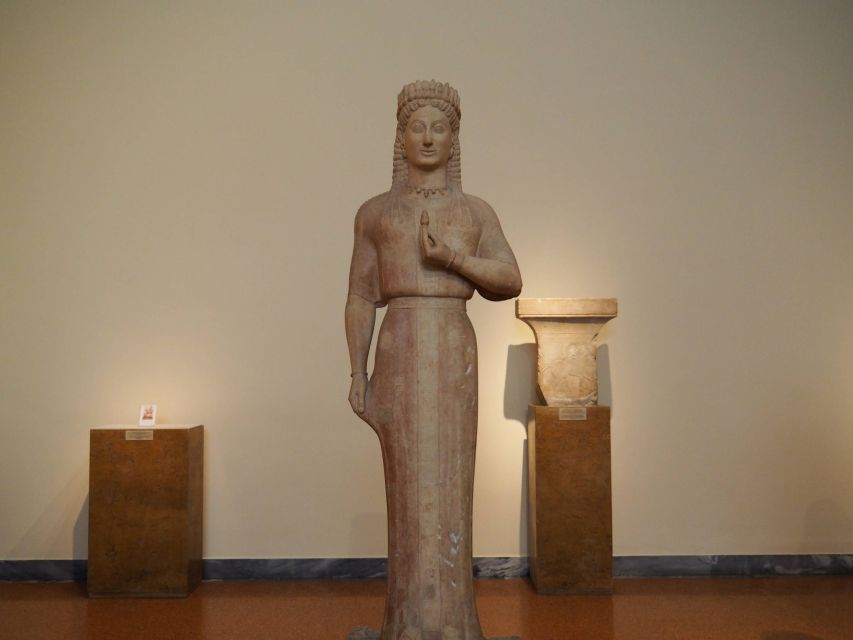
The sculpture galleries contain some of the museum’s biggest visual rewards. Look for the statues of Zeus, Aphrodite, and Poseidon, along with other figures that show how Greek artists explored the human body, movement, age, and emotion.
The statue identified as Poseidon or Zeus is especially memorable because the figure is captured in motion, with an arm extended as if preparing to throw a weapon. The uncertainty over the exact identity is part of the fun. Ancient sculpture does not always arrive with a complete label attached, and modern interpretation sometimes involves careful argument rather than certainty.
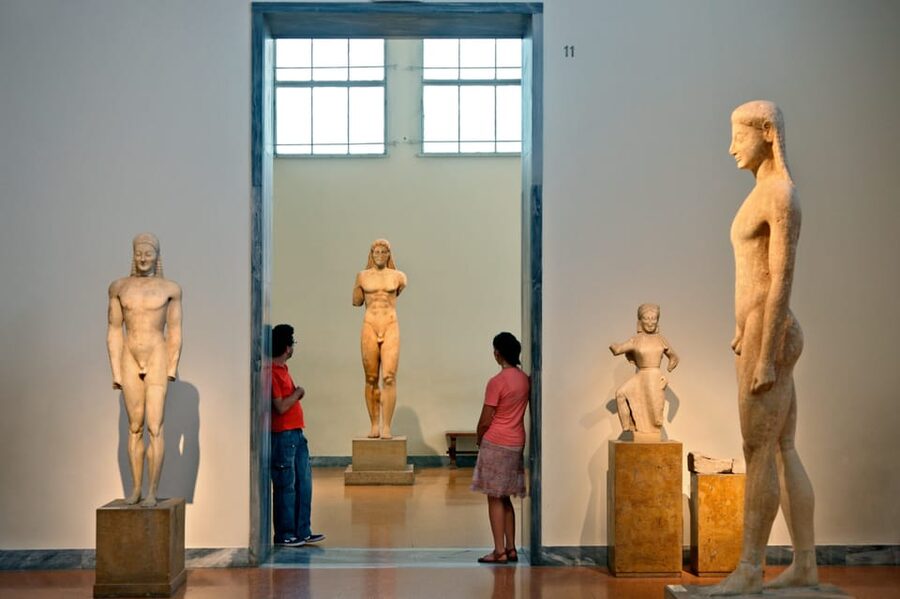
A visit here is a useful correction to the idea that Greek sculpture is only about calm, perfect bodies. You will find different poses, expressions, materials, and levels of detail. Some works feel formal and idealized. Others show a stronger interest in movement or individual character.
Allow time to look from several angles. You can see details that are easy to miss in photographs, including the treatment of hair, drapery, muscles, and facial features. The ability to stand close to the works, while respecting museum rules, is one of the advantages of seeing them in person.
Some displays may have labels placed low on the wall or in dimmer areas. If you want the full explanation, carry a phone light only if museum rules permit it, or move closer and take your time. Do not rush past a major object simply because the label is hard to read.
The Antikythera Mechanism and Ancient Technology

The Antikythera mechanism is one of the museum’s essential stops. Found in a shipwreck, this complex device is often described as an ancient astronomical calculator. Its surviving fragments show an impressive understanding of gears and cycles, and it offers a useful reminder that ancient Greek achievement was not limited to temples, pottery, and sculpture.
The object itself is not large, so it can be easy to overlook when surrounded by monumental statues. Give it a few minutes. This is one of those exhibits where a good explanation changes what you are seeing. Without context, it can appear to be a corroded metal fragment. With context, it becomes evidence of sophisticated mechanical thinking.
If this is your main reason for visiting, a self-guided audio explanation can be useful. Just check that the relevant audio track is working before you move on. The app has not always performed reliably, and several audio references may be inactive.
The museum also contains other objects connected with scientific, religious, and daily life. Together, they help balance the familiar image of Greece as a world of marble gods. You will see evidence of people measuring, trading, cooking, worshipping, burying their dead, and decorating ordinary objects.
How Much Time Should You Allow?
The official duration is one day, meaning the ticket is valid for the selected day rather than limiting you to a short guided slot. That flexibility is valuable if your plans change during the day, though you should still check the selected starting time and current opening hours.
You can see a quick selection in about an hour. That approach works if you want the Mask of Agamemnon, Antikythera mechanism, a few famous statues, and a look at the Santorini displays.
I would allow two hours for a balanced visit. That gives you time to move through the main chronological sections, stop at the major works, and read some of the labels without turning the museum into a race.
Three hours or more suits anyone with a strong interest in archaeology, art, ancient technology, or Greek mythology. The collection is large enough that even a careful visit may leave you with rooms still unexplored. Wear comfortable shoes, since you will be on your feet for much of the visit, and do not count on finding a seat whenever you need one.
The museum can be a good break from the heat, but air conditioning is not equally strong in every room. In July and August, an early visit is the safer choice. One useful strategy is to arrive near opening time, before larger sightseeing groups reach the museum. Check the hours carefully, because Tuesday opening is later than on other listed days.
From November 1 through March 31, the listed hours are Wednesday through Monday from 8:30 AM to 3:30 PM, with Tuesday hours from 1:00 PM to 8:00 PM. From April 16 through October 31, the listed hours are Wednesday through Monday from 8:00 AM to 8:00 PM, with Tuesday again from 1:00 PM to 8:00 PM. Hours can change for special occasions, so check before you set out.
Is the English Audio Tour Worth Adding?
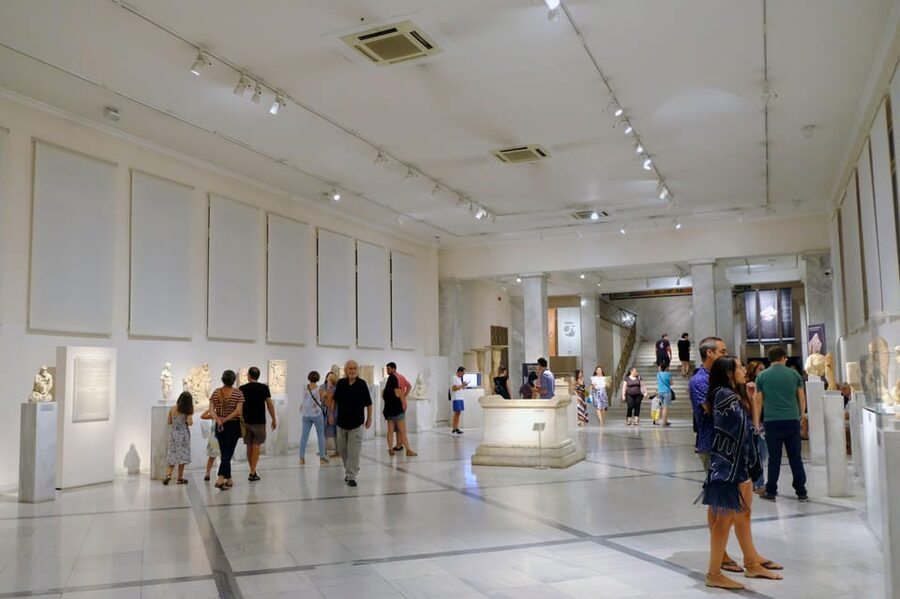
The audio option is self-guided and in English. It is created by professional guides and is meant to give you background as you move through the collection, without requiring a scheduled live tour.
I would add it if you enjoy historical explanation and do not want to read every label. It can help explain why the Antikythera mechanism matters, put Mycenaean objects into context, and make the sculpture galleries easier to interpret.
I would not depend on it as your only navigation tool. The route may send you from one side of a room to another, and some references may not activate. The app has also required repeated resets for some users. Bring headphones, and carry a portable charger because audio playback can use a lot of phone battery.
There is also a self-guided audio tour for Athens Old Town and Plaka included with all options. The National Archaeological Museum audio tour is included only when you select that option. Check your booking details so you know which version you purchased.
A live guide is not included. That keeps the visit private and flexible, but it means you need to read labels, use the audio, or do some preparation before arrival. If you want a fixed narrative and someone to answer questions, this ticket alone will not provide that.
Crowds, Comfort, and Accessibility
The museum can be active without feeling packed, particularly in the morning. Pre-booking is most useful in the busier months, when avoiding the ticket-purchase line can make your arrival faster.
Winter may be a different calculation. When visitor numbers are lower, buying ahead may not save much time, and you may still need to pass through bag checks. Even so, an e-ticket removes one small task from your arrival.
Some galleries may be closed temporarily. That is outside the control of a ticket seller and can be disappointing when you have planned around a particular section. If one major area matters most to you, check current conditions before visiting.
The museum is wheelchair accessible. Comfort is less certain for anyone who needs frequent seating, since places to rest are limited. The galleries generally offer good sightlines, but some descriptions may be low or difficult to read in dim light.
The $30 Question: Good Value or Not?
At $30 per person, this is not the cheapest way to fill an hour in Athens. The value depends on how you use it.
For a short visit focused only on a few famous objects, the price can feel high, especially in winter when lines may be short. Younger visitors who qualify for reduced admission should not buy the adult ticket without checking the age rules and bringing identification.
For an adult planning to spend two or three hours with one of the world’s major ancient Greek collections, the price is easier to justify. You are paying for access to objects that cannot be understood properly from photographs, plus the ease of arriving with admission already arranged.
The audio option can improve the value if it works well for you. Still, I would regard it as a bonus, not the reason to book. The museum itself is the main purchase.
Who Should Book This Experience?
I recommend it for first-time visitors who want a broad introduction to ancient Greek art, anyone who enjoys museums, and people looking for a calmer alternative to a full day of outdoor archaeological sites. It also works well when rain or heat disrupts another Athens plan.
Families can enjoy the large statues and visually striking gold objects, but younger children may not have the patience for the museum’s size. Choose a short highlights route rather than promising to see everything.
History and archaeology fans should allow at least half a day. Casual sightseers can still get plenty from an hour if they identify their must-see objects in advance.
If you prefer a lively guide, group conversation, or a tightly ordered story, select a guided tour instead. If you value freedom, dislike waiting to buy tickets, and want to spend as much or as little time as you choose, this ticket is a practical fit.
FAQ
Where is the National Archaeological Museum located?
The nearest metro station is Omonoia. Hotel pickup and drop-off are not included, so you make your own way to the museum.
How long is the ticket valid?
The ticket is valid for one day, on the selected date and time slot. Check availability for the starting times offered when you book.
Is a guide included?
No live guide is included. The visit is self-guided, and an English audio tour is available only if you select that option.
Is the audio tour available in English?
Yes. The optional audio guide is in English. You should bring your own headphones.
What identification should I bring?
Bring a passport or ID card. A copy is accepted.
Can visitors under 25 buy the adult online ticket?
The ticket is for travelers over age 25. Reduced-price tickets are not available online. Children under five and EU citizens under 25 may receive free or reduced admission with ID at the ticket booth. Non-EU citizens under 25 receive reduced-price admission from April through October with ID.
Is the museum wheelchair accessible?
Yes, the activity is listed as wheelchair accessible.
What are the listed opening hours?
From November 1 to March 31, the museum is open Wednesday through Monday from 8:30 AM to 3:30 PM, and Tuesday from 1:00 PM to 8:00 PM. From April 16 to October 31, it is open Wednesday through Monday from 8:00 AM to 8:00 PM, and Tuesday from 1:00 PM to 8:00 PM. Special occasions can change these hours, so check before visiting.
Should You Book It?
Book this ticket if you want an easy, flexible visit to a major Athens museum and plan to spend more than a quick hour inside. The Mask of Agamemnon, Antikythera mechanism, Santorini material, and monumental sculpture give you plenty of reasons to come.
The strongest case is convenience, not a flawless audio app. Arrive early in summer, choose the correct ticket line, bring headphones and identification, and plan your own highlights route. At $30, it is best value for adults who will give the collection at least two hours.
More Audio Tours in Athens
- Athens: Acropolis Museum Ticket with optional Audio Guide
★ 4.4 · 2,652 reviews - Athens: Acropolis Ticket & Optional Self-Guided Audio Tours
★ 4.1 · 2,542 reviews - Parthenon & Acropolis Museum with Audio or Live Tour Option
★ 4.1 · 2,446 reviews - Athens: Peloponnese Highlights Day Trip and V.R. Audio Guide
★ 4.5 · 1,425 reviews
More Self-Guided Tours in Athens
- Athens: Acropolis Ticket with Optional Audio or Live Guide
★ 4.2 · 11,055 reviews - Athens: Cape Sounio & Poseidon Temple Trip with Audio Guide
★ 4.4 · 4,521 reviews - Athens: Acropolis Ticket with Audio Guide
★ 4.0 · 3,575 reviews - From Athens: Delphi Full Day V.R. Audio Guided Tour
★ 4.6 · 3,028 reviews
Freshly added Athens trips
- Athens and Ancient Corinth Private from Athens★ 5.0 · 3 reviews
- Double Shore Dive (certified divers)★ 4.5 · 3 reviews
- From Athens: Mycenae and Epidaurus Private Tour★ 4.8 · 3 reviews
- Full day Meteora private tour★ 5.0 · 3 reviews
- Athens Hills: Mythology Treasure Hunt★ 5.0 · 3 reviews
- Sunset & swimming at Cape Sounio, Poseidon temple★ 5.0 · 3 reviews
- Philosophy Experience at Plato’s Academy Park – basic version★ 5.0 · 3 reviews
- Private Acropolis Tour – Ticket Included★ 5.0 · 3 reviews
National Archaeological Museum, compared.

National Archaeological Museum Ticket & Audio Guide
Read our review →
Athens National Archaeological Museum E-Ticket with Audio Guide
Read our review →
National Archaeological Museum Private Tour with Licensed Expert Guide
Read our review →
Acropolis Museum & National Archaeological Museum Ticket
Read our review →

Private Athens National Archaeological Museum Tour
Read our review →
Skip The Line National Archaeological Museum Private Guided Tour In Athens
Read our review →Browse the lists this tour appears in