
Reviewed · TOURS
Athens Mythological Tour: Boudoir of the Gods
The gods feel close on this two-hour walk through central Athens. At the Academy, Zeus and Athena look down from the stonework. In Syntagma, statues connect the modern capital with old stories. In Plaka, lanes and ruins earn the neighborhood its nickname, the neighborhood of the Gods.
I like the way the tour uses storytelling instead of a long list of dates, and I like its route through several central districts rather than one isolated monument. Guides such as Penelope and Christina bring a personal touch, answering questions and adjusting the pace when needed. The main drawback is that the tour covers a lot in two hours, so beginners may find the family trees and rivalries hard to follow. No archaeological-site admission is included.
In This Review
- Key points at a glance
- Why this Athens mythology walk works
- Meeting near Panepistimiou and the Academy
- Amazons and old stories at the Numismatic Museum
- Gods in modern Syntagma
- Mitropoleos Street, where old and new meet
- Plaka, the neighborhood of the Gods
- Penelope, Christina, and the guide’s role
- What you should know before paying $48.01
- How the route fits into an Athens day
- Should you book the Boudoir of the Gods tour?
- FAQ
- How long does the Athens Mythological Tour last?
- Where does the tour begin?
- Where does the tour end?
- Is admission to archaeological sites included?
- What language is the tour offered in?
- How many people can join the tour?
Key points at a glance
- Greek gods in everyday Athens: Link mythology to the Academy, Syntagma, old churches, ruins, and city streets.
- A walk through Plaka: Finish in the old neighborhood known as the neighborhood of the Gods.
- The Amazons get their turn: Hear stories about their fighting skills at the Numismatic Museum.
- Small-group feel: The maximum is 15 people, and some departures may be much smaller.
- Guides who adapt: Penelope, Christina, and other guides have adjusted explanations, answered questions, and slowed the pace when guests needed it.
- A low-cost introduction: At $48.01 per person, the tour offers two hours of guided context without charging for entry to archaeological sites.
Why this Athens mythology walk works
Athens can be hard to read at street level. You see a neoclassical building, a weathered ruin, a small church, or a statue, but the old story behind it may not be clear. This tour gives those sights a common thread: the gods, heroes, rivalries, and family dramas of Greek mythology.
That approach suits you if you want more than a standard sightseeing walk. You are not simply moving from one famous photo stop to another. The guide explains who the figures are, how they relate to one another, and why their stories still appear in Athens today.
The tour also gives you a useful first look at central Athens. It begins near Panepistimiou and the Panepistimio metro station, then moves through the Academy, the Numismatic Museum area, Syntagma, Mitropoleos Street, and Plaka. It finishes at Monastiraki, a handy place to continue exploring on your own.
The price is $48.01 per person. I consider that fair if you value an expert guide and enjoy Greek mythology. You are paying for interpretation and company, not for entry to a major ancient site. If your main goal is to go inside archaeological monuments, put that money toward a separate ticket or tour.
Other days out people book around Athens:
- Athens: Acropolis & up to 5 Archaeological Sites Combo Pass
★ 4.4 · 12,619 reviews - Athens: Acropolis Ticket with Optional Audio or Live Guide
★ 4.2 · 11,055 reviews - Athens: Acropolis, Parthenon & Acropolis Museum Guided Tour
★ 4.8 · 9,316 reviews
Meeting near Panepistimiou and the Academy
The meeting point is at Korai 4, Athina 105 64, in front of Starbucks, next to Panepistimiou Street and the Panepistimio metro station. That is a practical starting point if you are using public transport, but give yourself time to find the exact spot in the busy center.
The first stop is listed as Panepistimiou and takes about 10 minutes. Treat this as the welcome and orientation period. Your guide sets the theme, introduces the route, and begins connecting modern Athens with the stories you will hear later.
The Academy follows, with about 20 minutes at one of the city’s most striking neoclassical buildings. Its facade is decorated with statues of Greek gods and philosophers, making it a fine place to begin a mythology walk. You get a visual lesson before the storytelling becomes more detailed.
The Academy is especially useful for first-time visitors because it shows how ancient Greek ideas were reused in later Athens. The gods are not confined to an archaeological park. They appear in civic architecture, public art, and the way the city presents its intellectual past.
You will be looking at the exterior and public surroundings as part of a walking route. The tour does not include admission to archaeological sites, so do not expect a museum-style visit or extended indoor access at each stop.
Amazons and old stories at the Numismatic Museum
The Numismatic Museum of Athens is the next major stop, with about 20 minutes devoted to the building and its myths, legends, and secrets. The focus here includes the Amazons and their fighting skills, giving the tour a welcome change from stories centered only on the Olympian gods.
Greek mythology is full of powerful women, but casual sightseeing can leave them in the background. The Amazon stories add another angle, with questions about warfare, strength, independence, and the way ancient storytellers imagined societies outside the usual Greek order.
The museum building also helps show how Athens layers different periods in one district. You move from a neoclassical landmark to a site tied to mythological storytelling, then continue toward the modern center. That variety keeps the walk from feeling like a single lecture beside one statue.
If Greek mythology is new to you, this may be the point where names start to pile up. One guide recommendation is worth taking seriously: read a short introduction to the main gods before you arrive. Knowing the basic roles of Zeus, Hera, Athena, Poseidon, Ares, and Aphrodite will make the longer stories easier to follow.
Gods in modern Syntagma
The tour spends about 20 minutes in the Syntagma district, Athens’ main central square. The point is not simply to see the square. Your guide directs you toward statues of gods and explains the stories attached to them.
This is one of the tour’s strongest ideas. Syntagma is a modern civic space, yet mythology remains part of the visual language around it. You begin to see how ancient figures are used to express power, wisdom, war, beauty, or civic identity.
The square can be exposed to the sun, so the practical advice matters here. Wear a hat, use sun cream, and carry water, especially in summer. Penelope has been careful to move groups out of direct sun when possible, a small detail that can make a big difference during a warm afternoon.
The guide’s role matters most in a place like Syntagma. Without explanation, a statue is just a statue. With the right story, it becomes part of the larger family drama of Greek mythology. The storytelling also gives you a way to remember what you see after the tour ends.
Same city, a completely different century:
- Athens: Cape Sounion & Poseidon Temple Sunset Half-Day Trip
★ 4.8 · 8,241 reviews - Athens: Acropolis and Parthenon Guided Walking Tour
★ 4.6 · 5,882 reviews - All Day Cruise -3 Islands to Agistri,Moni, Aegina with lunch and drinks included
★ 5.0 · 4,958 reviews - Athens, Piraeus, and Coastline: Blue Hop-On Hop-Off Bus
★ 3.9 · 4,849 reviews
Mitropoleos Street, where old and new meet
The walk continues along Mitropoleos Street for about 20 minutes. Here, the theme shifts from formal civic buildings to a more mixed city scene, where present-day Athens meets ruins, churches, and traces of older sacred places.
This section is less about one famous monument and more about learning how to look. You may notice ancient fragments beside later buildings, churches in the middle of busy streets, and small reminders of earlier worship tucked into the urban fabric. The guide helps connect these details to the larger story of Athens.
It is also a useful transition before Plaka. The route does not rush straight from one major landmark to another. Instead, it lets you see the city changing block by block. That is valuable if you want a sense of Athens beyond the postcard views.
The walking is steady, and the route includes several districts. If your ankle, knees, or general fitness make walking difficult, say so early. One guide adjusted a tour for a guest with a twisted ankle, and another gave people time to rest when needed. Still, this is a walking activity, not a seated talk.
Plaka, the neighborhood of the Gods
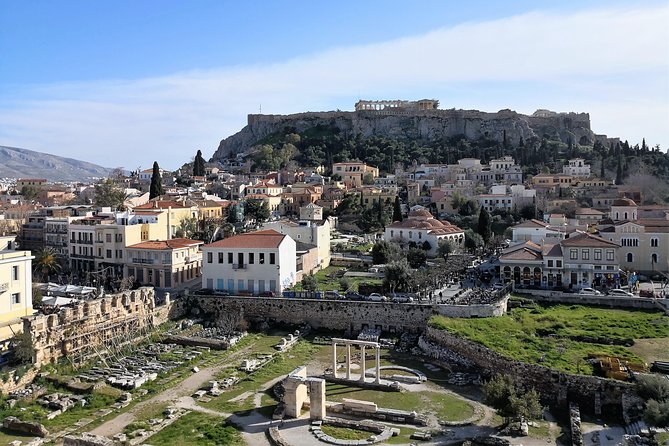
The final 30-minute stop is Plaka, one of Athens’ oldest and most picturesque neighborhoods. Its nickname, the neighborhood of the Gods, fits the tour’s theme perfectly.
Plaka gives the mythology a more intimate setting. Instead of grand civic buildings, you get narrow streets, old structures, churches, ruins, and the feeling of a district shaped by many layers of Athens. Your guide continues the stories while pointing out how the old and newer parts of the city sit together.
This is the longest stop, and it is a good choice for the end of the walk. By this stage, you have heard the basic cast of characters and can better understand the connections between gods, heroes, and rival families. The route ends at Monastiraki, so you can continue with food, shopping, or more sightseeing after the guide says goodbye.
Do not expect Plaka to be empty or untouched. It is a popular part of central Athens. The value here is not solitude. It is seeing a well-known neighborhood with a mythology-focused guide who gives the streets more meaning.
Penelope, Christina, and the guide’s role
The strongest part of this experience is the guide. Penelope is repeatedly praised for turning a tangled set of myths into a story you can follow. She has also been described as patient, engaging, and good at answering questions.
That matters because Greek mythology is not a tidy subject. Gods change alliances, family relationships overlap, and the same figure may appear in several kinds of stories. A good guide gives you a clear route through the confusion without flattening everything into a simple list.
Christina has also led this experience. She explains the origins of the gods and their family tree, and she has adjusted the afternoon when a guest could not walk comfortably. Another guide conducted the tour for a lone participant and still gave a full explanation of the sites and myths.
Group size is capped at 15 people, which should keep the walk more personal than a large coach excursion. In some cases, the scheduled group has been very small or even reduced to one or two people. You should not count on a private tour, but the limited capacity gives the guide a better chance to hear questions and adapt the pace.
The guide may also connect a mythological figure to your interests or profession. That kind of personal link is not a promised feature, but it shows why a live storyteller can offer more than an audio guide.
What you should know before paying $48.01
The tour lasts about two hours and includes the services of an expert mythology storyteller. The stops themselves are listed with free admission, but access to archaeological sites is not included. Read that point carefully. This is primarily an outdoor walking and interpretation experience.
At $48.01, the value depends on what you want from Athens. I would call it a good buy for:
- Your first day in Athens, when you want a readable introduction to the city
- Anyone fascinated by Greek gods, heroes, Amazons, and family stories
- You who prefer a small walking group to a large bus tour
- Families and mixed-age groups who benefit from stories rather than formal lectures
- Visitors who want to see Plaka, Syntagma, and the Academy in one short outing
I would think twice if you dislike walking, already know Greek mythology in great detail, or want long visits inside museums and ancient monuments. The tour gives you an overview, not a full archaeological tour.
The tour is offered in English, and a mobile ticket is provided. Confirmation comes at booking. Wear comfortable clothes and walking shoes, and bring water. Summer sun can be intense, so a hat and sun cream are sensible, not optional extras.
You may also want to read a basic family tree before going. You do not need to become a mythology scholar. Just learn the main Olympians and their rough relationships. That small effort will help you follow the more complicated stories without losing the thread.
How the route fits into an Athens day
This experience works well early in a stay because it gives later sightseeing more context. After hearing the gods’ stories, you may notice mythological references in statues, buildings, and public spaces that would otherwise pass without comment.
The ending at Monastiraki is useful for planning. You can treat the walk as a morning introduction, then continue nearby, or schedule it before an evening meal in central Athens. The tour does not include hotel pickup or drop-off, so plan your own way to Korai 4 and from Monastiraki.
The route is also practical for people staying near central Athens, since it begins beside a metro station and finishes in a well-known central district. You still need to arrive at the precise meeting point, in front of Starbucks, rather than simply heading to the general area.
Free cancellation is available if you cancel at least 24 hours before the local start time. Changes or cancellations made inside that window are not accepted for a refund.
Should you book the Boudoir of the Gods tour?
Book it if you want mythology explained while you walk through real Athens, not just recited from a page. Penelope and Christina bring the subject to life, and the route gives you a useful mix of neoclassical buildings, public squares, old streets, churches, ruins, and Plaka.
The best preparation is simple: wear good shoes, carry water, and read the basic Greek-god family tree first. If you want museum interiors or archaeological-site access, choose a different tour or add those visits separately.
At $48.01 for two hours, this is a focused introduction rather than an all-day sightseeing bargain. For mythology fans, curious first-time visitors, and anyone who enjoys a good story with their city walk, it is a sensible choice.
FAQ
How long does the Athens Mythological Tour last?
The tour lasts approximately two hours. The route includes six stops, with time divided among Panepistimiou, the Academy, the Numismatic Museum, Syntagma, Mitropoleos Street, and Plaka.
Where does the tour begin?
The meeting point is Korai 4, Athina 105 64, Greece, in front of Starbucks. It is next to Panepistou Street and the Panepistimio metro station.
Where does the tour end?
The tour ends in Monastiraki, Athens.
Is admission to archaeological sites included?
No. Access to archaeological sites is not included in the tour price. The listed stops have no admission ticket included.
What language is the tour offered in?
The tour is offered in English and includes mythology storytelling by an expert guide.
How many people can join the tour?
The tour has a maximum of 15 participants. Service animals are allowed, and most people can participate, subject to the walking demands of the route.
Freshly added Athens trips
- Athens and Ancient Corinth Private from Athens★ 5.0 · 3 reviews
- From Athens: Mycenae and Epidaurus Private Tour★ 4.8 · 3 reviews
- Full day Meteora private tour★ 5.0 · 3 reviews
- Double Shore Dive (certified divers)★ 4.5 · 3 reviews
- Athens Hills: Mythology Treasure Hunt★ 5.0 · 3 reviews
- Sunset & swimming at Cape Sounio, Poseidon temple★ 5.0 · 3 reviews
- Philosophy Experience at Plato’s Academy Park – basic version★ 5.0 · 3 reviews
- Private Acropolis Tour – Ticket Included★ 5.0 · 3 reviews
Tours, compared.

Acropolis, Parthenon & Acropolis Museum Guided Tour
Read our review →


Mythology of Delphi, Museum and Arachova Guided Tour
Read our review →
Acropolis, Parthenon & Acropolis Museum Guided Tour
Read our review →