
Reviewed · WALKING TOURS
Athens Highlights: Myths & Philosophers Private Walking Tour
Athens becomes much more interesting when you stop treating its ruins as photo backdrops and start asking the questions that shaped Western thought. This private walk links Socrates, Plato, Aristotle, and Epicurus to real streets, squares, gardens, and hills across central Athens, while Greek mythology supplies the gods, heroes, and odd family stories.
I like the way the tour turns philosophy into a conversation rather than a classroom lesson. I also like the coffee break in Thissio, where you can pause with a local guide and connect ancient ideas to modern life. The main consideration is the pace: four hours on foot, with several long stretches between stops, is not a good fit for anyone with limited mobility.
In This Review
- Key points at a glance
- A walking tour with ideas at its center
- The Academy of Athens and the first philosophical questions
- The Numismatic Museum and the route toward Parliament
- Parliament, the National Garden, and Epicurus’ Garden
- Ermou Street and the small church of Kapnikarea
- Monastiraki, Thissio, and a Greek coffee pause
- The Ancient Agora and the Poikile Stoa
- Plaka, Anafiotika, and the Tower of Winds
- Areopagus Hill and the final Acropolis view
- What the four-hour format means
- Is $100 per person a fair price?
- Who should book this Athens walk?
- Should you book the Myths & Philosophers walk?
- FAQ
- Where does the tour start?
- Where does the tour finish?
- How long does the tour last?
- Is the tour private?
- What language is available?
- Is Greek coffee included?
- Are entrance fees included?
Key points at a glance
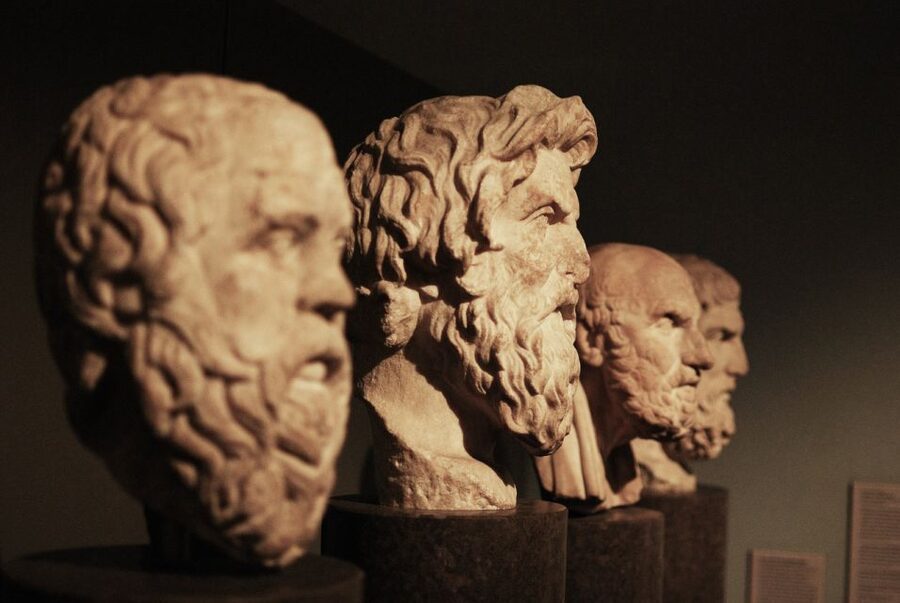
- Socrates and Plato beside the Academy of Athens: Begin with philosophy in the city’s grand 19th-century heart.
- Epicurus in the National Garden: Learn how the Garden became a school built around friendship, calm, and a good life.
- Aristotle and Hermes on Ermou Street: Connect an ancient school of thought with Athens’ busiest shopping route.
- Greek coffee in Thissio: Take a proper pause before discussing the Pre-Socratic thinkers.
- Stoicism at the Ancient Agora: See how a painted porch gave its name to one of antiquity’s best-known philosophies.
- Myths above Plaka: Finish at Areopagus Hill with Acropolis views, the Tower of Winds, and stories of the Olympian gods.
A walking tour with ideas at its center
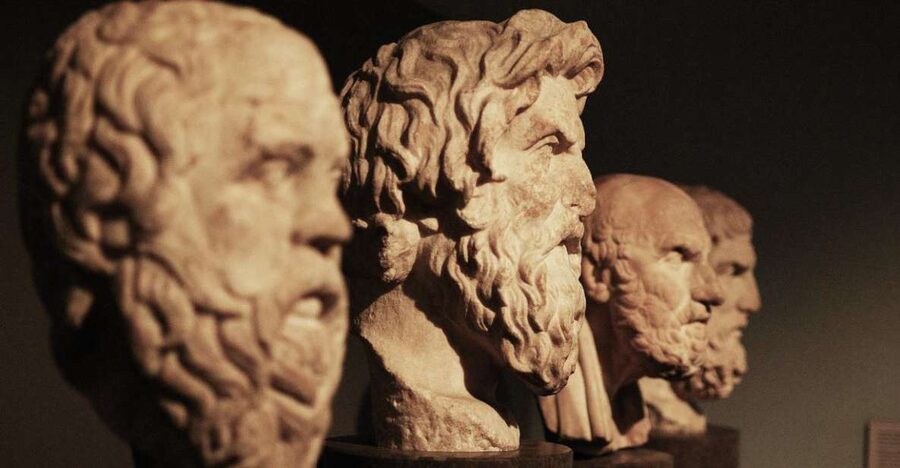
This is not a standard Athens highlights tour with a few famous names sprinkled on top. Its subject is the way people in ancient Athens tried to understand the world, human behavior, politics, happiness, nature, and the gods.
You meet outside Panepistimio Metro Station, with the exact meeting point depending on the option booked. From there, the route crosses central Athens on foot and ends at Areopagus Hill, below the Acropolis. The setting changes often enough to keep the walk moving: grand neoclassical buildings, a formal garden, a shopping street, Byzantine architecture, the Ancient Agora, Plaka lanes, and a rocky viewpoint.
The private format matters. Guides such as Bianca, John, and Effie can adjust the conversation to your interests instead of giving the same speech to a large group. John has worked with visitors preparing philosophy lessons, while another guest with a background in philosophy and rhetoric found the tour a useful way to revisit familiar ideas from a new angle.
You do not need to have studied philosophy. The guide can explain the basic ideas, answer questions, and relate them to daily life. If you already know the subject, you can ask for more depth. That flexibility is one of the strongest reasons to choose a private tour rather than a fixed group walk.
More Athens walking tours:
- Athens: Acropolis and Parthenon Guided Walking Tour
★ 4.6 · 5,882 reviews - Greek Food Walking Tour in Athens
★ 5.0 · 4,740 reviews - Acropolis: Acropolis and Parthenon Guided Walking Tour
★ 4.7 · 3,442 reviews
The Academy of Athens and the first philosophical questions
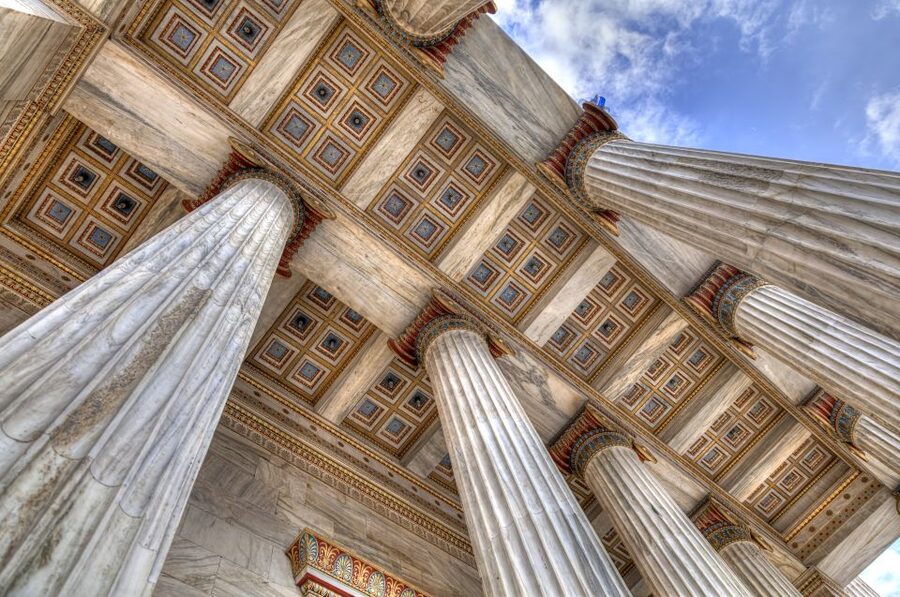
The first major stop is the Academy of Athens, part of the famous Athenian Trilogy designed by Theofilus Hansen. The buildings are 19th-century creations, not ancient ruins, but their grand columns and sculptures provide a fitting place to begin a discussion about classical thought.
Here you talk about Socrates and Plato. The setting helps separate the two men, who are often bundled together in quick introductions to Greek philosophy. Socrates left no written works, and much of what we know about him comes through later writers, especially Plato. Plato then developed his own ideas through dialogues that often use Socrates as the central speaker.
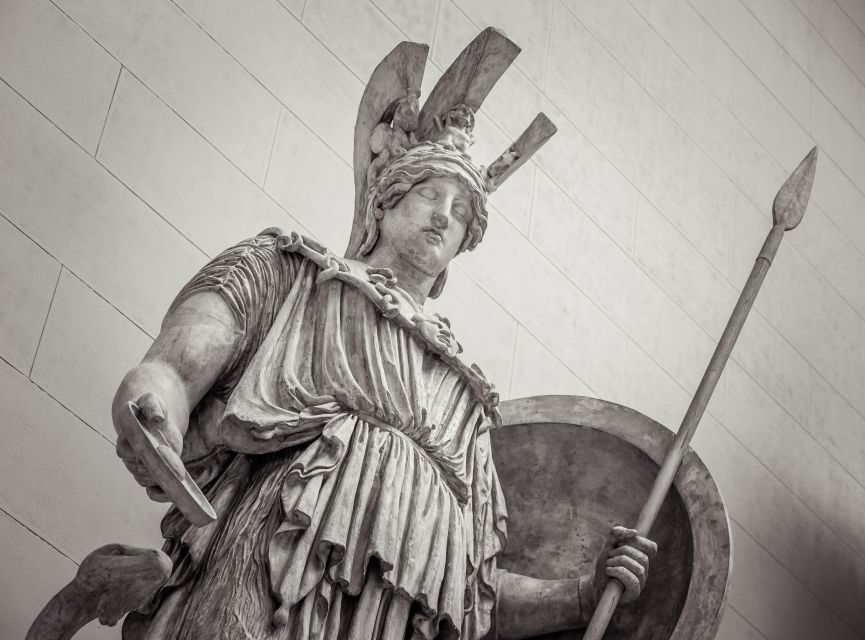
The guide also brings in Apollo and Athena. Apollo is linked with order, prophecy, music, and reason, while Athena represents wisdom, strategy, and the city of Athens. The point is not simply to memorize a list of divine powers. You get to consider how myth and philosophical inquiry offered different ways to explain human life and the natural world.
The statues and formal architecture make this a visually strong opening, though this is mainly an outdoor stop. Do not expect a museum visit or a long interior tour of the Academy buildings. The value comes from the conversation and the link between modern Athens and its ancient intellectual identity.
The Numismatic Museum and the route toward Parliament
The route continues toward the Numismatic Museum. The supplied plan lists this as a stop, though the main discussion moves more broadly through Athens’ political and cultural center rather than focusing on an entrance visit.
That distinction matters. Entrance fees are not included, and the tour does not promise admission to every point of interest. You should think of this experience as an outdoor walking conversation, not a ticketed museum circuit.
The walk through this part of the city helps place philosophy within public life. Ancient thinkers were not working in isolation from politics, law, religion, and ordinary city business. Their questions grew out of life in a crowded city where public debate mattered.
Because the walk is private, you can use this stretch to ask practical questions about the people and ideas introduced earlier. A guide may spend more time on Plato, move toward mythology, or discuss how philosophical schools differed, depending on what holds your attention.
Parliament, the National Garden, and Epicurus’ Garden
At the Greek Parliament and National Garden, the focus shifts to Epicurus. His school was known as the Garden, a name that suits this part of the route and gives the idea a physical setting.
Epicurean philosophy is often reduced to luxury or excess. The conversation here offers a chance to correct that common misunderstanding. Epicurus placed value on friendship, moderation, freedom from needless fear, and a calm life. His Garden was not simply a place for private pleasure. It was a philosophical community built around living well.
The National Garden provides one of the tour’s more restful sections. After the formal city streets, the greenery gives you room to slow down and talk. It is also a useful moment to consider the difference between a philosophy written in books and a philosophy practiced in a community.
The tour does not present Epicurus as a dusty name from a school syllabus. The guide can connect his ideas to questions you still face: how much do you need, what causes anxiety, and what makes friendship valuable? This practical approach is why the experience suits people who want more than dates and definitions.
A few more Athens days worth a look
- Best of Athens Half Day Private Tour
★ 5.0 · 3,714 reviews - Athens Full Day Private Tour
★ 5.0 · 2,903 reviews - Athens Airport Private Arrival Transfer with Meet & Greet
★ 4.5 · 1,495 reviews - Athens Airport to Athens Hotels Private Arrival Transfer
★ 5.0 · 947 reviews
Ermou Street and the small church of Kapnikarea
Next comes Ermou Street, Athens’ main commercial route. It is named after Hermes, the messenger god and patron of merchants, so the street offers a neat meeting point between mythology and modern city life.
The contrast is useful. You may be walking past shops and ordinary city traffic while discussing a god associated with trade, travel, messages, and movement. Mythology here is not sealed away in a temple. It is attached to a street name you can see and use.
Along Ermou Street, you also stop to admire Kapnikarea, an 11th-century Byzantine church. Its small scale and old stonework provide a sharp change from the grand neoclassical buildings at the beginning of the tour.
The discussion then turns to Aristotle and the Lyceum. Aristotle is often presented as the systematic thinker who classified subjects and examined the natural world, politics, ethics, and logic. His school, the Lyceum, gives the guide a chance to explain how philosophical schools functioned as places of teaching, debate, and shared inquiry.
You will not visit the Lyceum on this route, and no entrance tickets are included. Instead, you hear about it while moving through the present-day city. That approach works best if you enjoy connections between places and ideas. It is less satisfying if you want long archaeological visits at every site.
Monastiraki, Thissio, and a Greek coffee pause
The route continues through Monastiraki toward Thissio. These neighborhoods are among the most recognizable parts of central Athens, but the tour uses them for more than street scenery.
In Thissio, you stop for one Greek coffee or another traditional refreshment per person. This is included in the price, and it creates a welcome break after several hours of walking. Some descriptions of the experience also refer to a terrace setting with a view, but the clearest promise is a café stop in the Thissio area.
The pause is especially valuable because the subject now turns to the Pre-Socratic philosophers. These early thinkers asked what the universe was made of and whether natural events could be explained without relying only on myth.
You might hear about the shift from divine stories toward observation, argument, and attempts to identify a basic substance or principle behind nature. The guide can explain why this change matters without turning the stop into a lecture.
I would treat the refreshment as a thoughtful inclusion rather than a meal. One coffee will not replace lunch, and personal purchases are not covered. Still, sitting down with the guide gives you time to ask questions and let the earlier ideas settle.
The Ancient Agora and the Poikile Stoa
Near the Ancient Agora, the tour introduces Stoicism and the Poikile Stoa, or Painted Porch. This is where the name Stoicism comes from.
The Agora was a central place for public, commercial, civic, and intellectual life in ancient Athens. You do not simply hear that Stoicism began here. You can consider why a public porch, rather than a private retreat, became associated with a school that later focused so strongly on self-control, reason, duty, and responding well to events beyond your control.
The route does not include entrance fees to the Ancient Agora. You should not expect a full archaeological-site visit as part of the four-hour walk. The guide discusses the setting from the route and uses it to explain the school’s origins.
This section is a good fit for anyone interested in applying ancient ideas to present problems. Stoicism can sound simple when reduced to endure everything. A conversation with a private guide allows more room for questions about what the philosophy actually asks of you, and where popular modern versions may oversimplify it.
Plaka, Anafiotika, and the Tower of Winds
From the Agora, you head toward Plaka and Anafiotika, at the foot of the Acropolis. The streets become more intimate, and the route feels less formal than the opening stretch near the Academy.
Here the focus returns to mythology, including the Cynic philosophers. The Cynics challenged social conventions and questioned the value of wealth, status, and artificial manners. Their ideas work well in Plaka, where layers of city life sit close together and the walk shifts between ancient references and modern Athens.
You also stop near the Tower of Winds. This ancient structure is associated with Aiolos, keeper of the winds. It offers a natural way to discuss how the Greeks personified forces of nature and gave them stories, personalities, and divine roles.
The Tower of Winds is also a reminder that ancient people observed the physical world carefully. The myths are memorable, but the structure itself reflects an interest in wind direction, weather, and time. The guide can show how myth and practical observation existed side by side.
Anafiotika adds atmosphere, but uneven surfaces and steps can make this part harder for anyone with mobility limits. Comfortable shoes, sunscreen, and sunglasses are sensible choices throughout the tour, especially in warmer months.
Areopagus Hill and the final Acropolis view
The walk ends on Areopagus Hill, also called the Hill of Ares. From the rock, you get a strong view toward the Acropolis and a natural final setting for more stories about the Olympian gods.
This ending gives the tour a clear change of scale. You have spent the morning discussing individual thinkers, schools, and questions about how to live. At the top, the conversation widens again to the gods, their rivalries, powers, and relationships.
The hill is rocky and can be uneven. Take care with your footing, and do not expect a quiet private overlook at every moment. Its appeal is the view and the sense of place, not comfort or polished facilities.
Since Areopagus is also the drop-off point, the tour finishes with you already positioned near the Acropolis and Plaka. That makes it practical to continue exploring on your own, though any further sightseeing or entry requires separate arrangements.
What the four-hour format means
Four hours is enough time to build a connected story, but this is still a walking tour with a lot of ground to cover. The route includes Panepistimio, the Academy of Athens, the Numismatic Museum area, Parliament, the National Garden, Ermou Street, Monastiraki, Plaka, and Areopagus.
The listed route describes roughly 30-minute walks between several stops. You should expect steady movement, outdoor exposure, and some uneven ground. The tour is explicitly not suitable for people with mobility impairments.
The private group format helps with pacing. You can ask for a pause, spend longer on a favorite philosopher, or keep the route moving if you prefer less discussion at one stop. English is the tour language, and the guide is live rather than audio-recorded.
Guide quality is central here. Bianca is described as warm, clear, and particularly good at connecting philosophy with ordinary life. John has a strong command of Greek history and philosophy and has adapted the walk for people with academic interests. Effie has also led the experience. The exact guide depends on availability and booking.
Is $100 per person a fair price?
At $100 per person, this is not a budget sightseeing walk. The price makes more sense if you value a private guide, a flexible discussion, and a tour built around a subject rather than a basic checklist of monuments.
You are paying for four hours of guiding, not for entry to archaeological sites or museums. Entrance fees, souvenirs, and other personal expenses are extra. One Greek coffee or traditional refreshment is included, along with taxes and fees.
For a couple, family, or small private group that wants direct conversation, the price can be reasonable. It is less compelling if you mainly want to see the Acropolis interior, visit museums, or cover Athens quickly without stopping to discuss ideas.
The strongest value comes when you take part. Ask questions, explain what interests you, and tell the guide if you want more mythology, philosophy, history, or links to modern life. The private setup gives you room to shape the experience.
Who should book this Athens walk?
I would recommend it to first-time visitors who want a thoughtful introduction to Athens, especially if you plan to spend several days in the city. It can give later visits to the Acropolis, Agora, and city neighborhoods more meaning.
It is also a strong choice for students, teachers, philosophy majors, and anyone who enjoys asking big questions while walking through real places. The tour works for beginners too, since you do not need prior study to follow the main ideas.
I would skip it if you want a fast, vehicle-based overview, extensive indoor sightseeing, or a tour with no hills and little walking. Families with older children may enjoy the mythological sections, but the philosophical discussion will depend on the child’s interest and attention span.
The activity offers free cancellation up to 24 hours before the start, and you can reserve now and pay later. That flexibility helps if your Athens schedule is still changing, but check the meeting point carefully because it may vary with the option booked.
Should you book the Myths & Philosophers walk?
Book it if you want Athens to feel like a place where people still argue about happiness, justice, nature, and the gods, not just a city filled with ancient stones. The route gives you famous sights, but its real purpose is to connect them.
I especially recommend it if you prefer conversation to a rehearsed speech. Bianca, John, and Effie bring different strengths, and the private format lets the guide adjust the discussion to your background. Just wear solid walking shoes, bring sun protection, and arrive ready to cover central Athens on foot.
Skip it if your priority is included admission to museums and ruins. Choose it if your priority is a personal, idea-driven introduction to the city, with a coffee pause and an excellent final view of the Acropolis.
FAQ
Where does the tour start?
The meeting point is outside Panepistimio Metro Station, also called University. The exact meeting point may vary depending on the option booked.
Where does the tour finish?
The walk ends at Areopagus Hill, also called Areios Pagos or the Hill of Ares.
How long does the tour last?
The tour lasts four hours.
Is the tour private?
Yes. It is offered for a private group.
What language is available?
The live tour guide provides the experience in English.
Is Greek coffee included?
Yes. One Greek coffee or another traditional refreshment per person is included.
Are entrance fees included?
No. Entrance fees to points of interest are not included, and personal expenses such as souvenirs are also separate.
Freshly added Athens trips
- Athens and Ancient Corinth Private from Athens★ 5.0 · 3 reviews
- From Athens: Mycenae and Epidaurus Private Tour★ 4.8 · 3 reviews
- Full day Meteora private tour★ 5.0 · 3 reviews
- Double Shore Dive (certified divers)★ 4.5 · 3 reviews
- Sunset & swimming at Cape Sounio, Poseidon temple★ 5.0 · 3 reviews
- Philosophy Experience at Plato’s Academy Park – basic version★ 5.0 · 3 reviews
- Athens Hills: Mythology Treasure Hunt★ 5.0 · 3 reviews
- Private Acropolis Tour – Ticket Included★ 5.0 · 3 reviews
Walking Tours, compared.




Acropolis monuments & Parthenon Walking Tour with Optional Acropolis Museum
Read our review →

Athens Authentic Greek Food Walking Tour (Small Group)
Read our review →
Early Morning Acropolis & Old Athens Guided Walking Tour
Read our review →
Browse the lists this tour appears in