
Reviewed · ACROPOLIS TOURS
Athens: Acropolis & Plaka Neighborhood Private Walking Tour
The best part of this private Athens walk is the way it links the Acropolis monuments with the lived-in streets below. You move from the Theater of Dionysus and Parthenon to Plaka’s small lanes, artisan shops, cafés, and old houses, so ancient Athens does not feel cut off from the modern city. I especially like the licensed archaeologist guide and the choice between a focused 90-minute visit and a longer Acropolis-and-Plaka outing.
I also like the thoughtful pacing. Guides such as Eva, Valia, Christina, Lisa, and Delfina have been praised for clear explanations, useful Athens advice, and an ability to adjust stories for both serious history fans and children. The main drawback is practical: Acropolis admission is extra, and the uneven ground and steps make this a poor fit for anyone with limited mobility.
In This Review
- Key points to know before booking
- Why the Acropolis works better with a private guide
- Theater of Dionysus: where drama began
- The old defensive walls and the climb uphill
- Propylaea and the Temple of Athena Nike
- The Parthenon: more than the famous photo
- Erechtheion and the contest between Athena and Poseidon
- Odeon of Herodes Atticus and the way back down
- Plaka: ancient layers beneath a neighborhood walk
- The food option: useful for families and first-time visitors
- How much value do you get for $163 per person?
- Timing, languages, and comfort
- Who will get the most from this walk?
- Should you book this Athens walking tour?
- FAQ
- Where does the tour meet?
- How long does the tour last?
- Is the tour private?
- Is an archaeological guide included?
- Which languages are available?
- Is the Acropolis entrance ticket included?
- Can I choose an Acropolis-only tour?
- What does the Plaka portion include?
- What food is included with the food option?
- Is the tour suitable for people with mobility impairments?
Key points to know before booking
- Licensed archaeological guides explain the Acropolis through history and myth, from Athena and Poseidon to ancient theater and Athenian power.
- The private format lets your group set the pace, with explanations adjusted for adults, children, or seasoned history buffs.
- The 90-minute Acropolis-only option is efficient, while the longer version adds roughly 1.5 hours in Plaka.
- The walk includes major monuments, including the Theater of Dionysus, Propylaea, Temple of Athena Nike, Parthenon, Erechtheion, and Odeon of Herodes Atticus.
- A food option adds Greek coffee or mountain tea, souvlaki, savory pies, and sweets, which can make the longer tour more appealing to families.
- You must arrange Acropolis admission separately, though skip-the-line tickets can be purchased on request after booking.
Why the Acropolis works better with a private guide
At first glance, the Acropolis seems easy to understand: climb the hill, look at the Parthenon, take photos, and leave. In practice, the site is packed with layers, rivalries, religious stories, construction tricks, and political messages. A good guide gives you a route through all that without turning the visit into a lecture.
This experience begins near Makrigianni 7, close to the Acropolis Museum. Your guide meets you there with a sign bearing your name. That is a useful arrangement in a busy part of Athens, especially if you are still getting your bearings.
The tour is private, so you are not tied to the pace of a large group. If your children have had enough after a short explanation, you can keep moving. If you want to linger over the architecture or ask about mythology, you have room to do that.
The guides also appear to put thought into comfort. One detailed account praised Eva for keeping the group moving, seeking shade, and choosing the shadier side of the street when possible. That matters in Athens, where summer heat can make a long stop in direct sun feel much longer than it sounds.
More Acropolis and Parthenon visits:
- Athens: Acropolis & up to 5 Archaeological Sites Combo Pass
★ 4.4 · 12,619 reviews - Athens: Acropolis Ticket with Optional Audio or Live Guide
★ 4.2 · 11,055 reviews - Athens: Acropolis, Parthenon & Acropolis Museum Guided Tour
★ 4.8 · 9,316 reviews
Theater of Dionysus: where drama began
The first major stop is the Theater of Dionysus, generally described as the world’s oldest theater. The tour allows about 15 minutes here, enough to explain its role without using up your best viewing time before the main climb.
This is where the guide can make the ancient world feel surprisingly immediate. Greek plays were not merely private entertainment. They were staged before large audiences, tied to religious festivals, and woven into public life. You can consider how famous dramas were first performed in a theater built into the southern slope of the Acropolis.
I like this opening because it gives you a human scale before the grand monuments take over. The Parthenon is enormous and formal. The theater reminds you that ancient Athens was also a city of performers, audiences, arguments, jokes, and public emotion.
The old defensive walls and the climb uphill
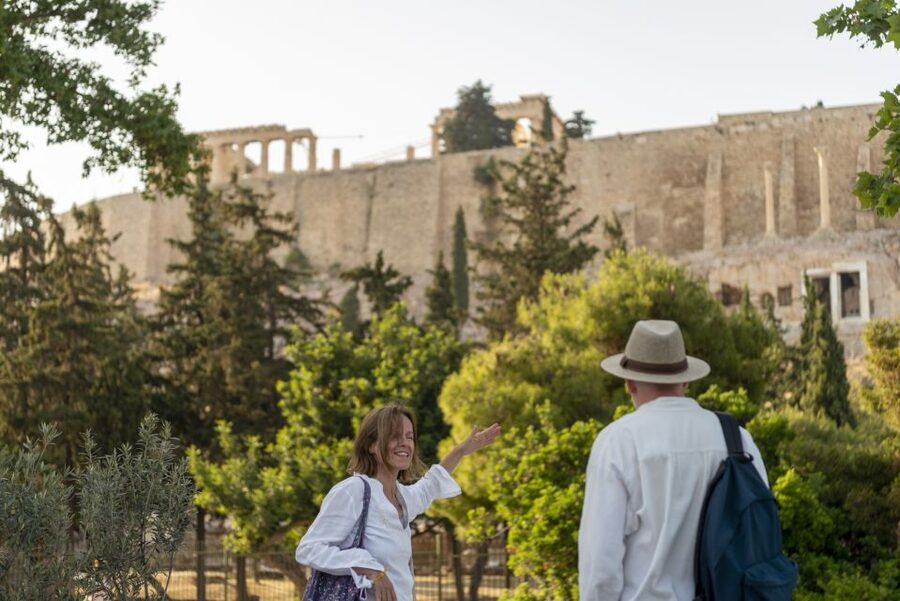
As you continue upward, the guide points out defensive walls with a thickness of about five meters. These walls predate the classical Greek period by roughly a thousand years, connecting the celebrated Athens of Pericles with much earlier societies that occupied the hill.
That is an important correction to the usual Acropolis snapshot. The hill was not created in the fifth century BCE for the Parthenon alone. It was a fortified and sacred place long before the classical monuments appeared.
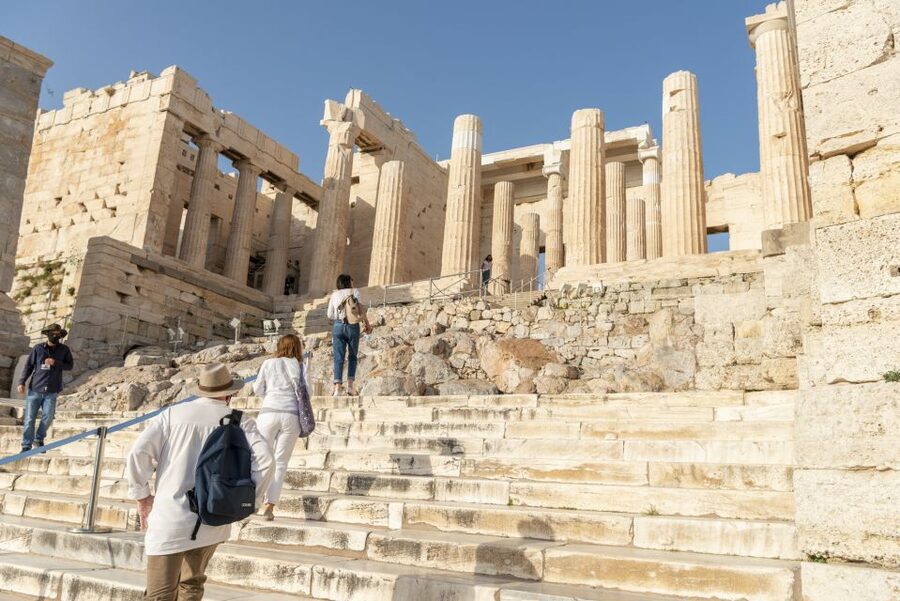
The climb includes steps and uneven surfaces. You should wear practical shoes and expect the route to require steady footing. The activity is specifically not suited to people with mobility impairments, and there is no reason to minimize that limitation. This is an archaeological site on a rocky hill, not a smooth city sidewalk.
Propylaea and the Temple of Athena Nike
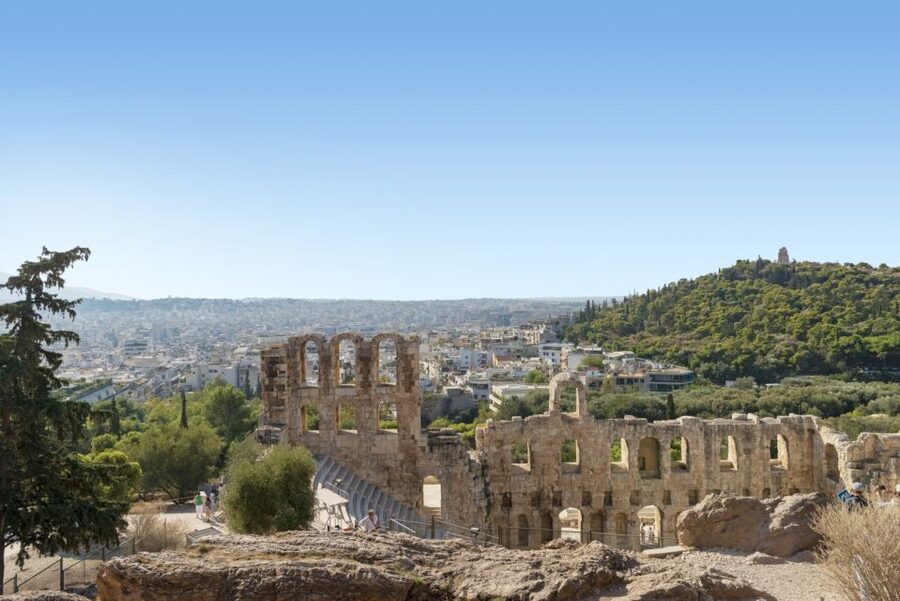
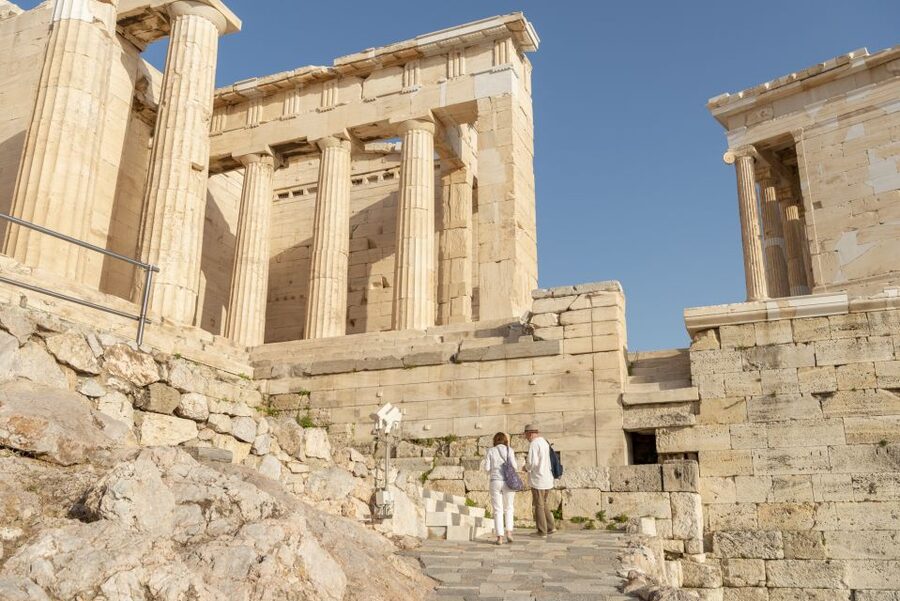
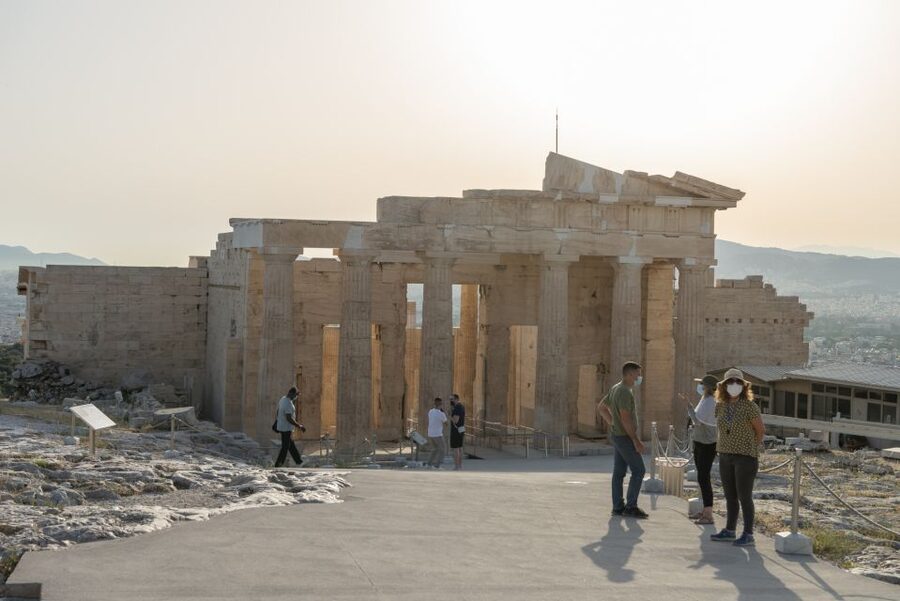
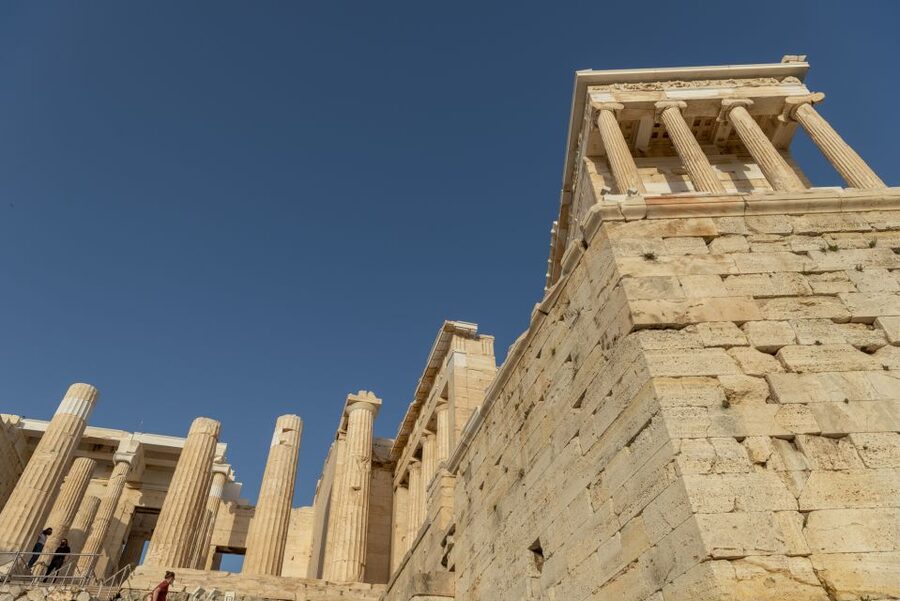
The Propylaea is the monumental entrance to the Acropolis. It was designed to make arrival feel important, and the guide uses the site to explain how the hill announced Athenian power to people approaching the city.
One of the tour’s more memorable images concerns the huge statue of Athena that once stood near the entrance. The bronze spear tip was said to catch the sun and could be seen from far away, including by sailors near Cape Sounion, roughly 70 kilometers distant. It is an effective way to picture how the Acropolis functioned as a landmark as well as a religious center.
The Temple of Athena Nike receives its own explanation. This smaller temple is easy to overlook when the Parthenon dominates the skyline, but its position beside the entrance gave it a strong visual role. The guide can help you see why a compact temple dedicated to victory mattered to a city involved in war, trade, and political competition.
The scheduled explanation here is short, about 15 minutes for each of these points. That is enough for a clear introduction, though you should not expect a long architectural seminar at every monument.
More Plaka and old town walks:
- Culinary Backstreets of Plaka – Athens Food Tour
★ 5.0 · 182 reviews - Acropolis monuments, Parthenon and Plaka, Monastiraki walking tour
★ 5.0 · 182 reviews - Traditional Greek Show in Plaka with Dinner
★ 3.6 · 178 reviews - VIP Private Guided Tour of Athens Acropolis & Plaka in a Sidecar
★ 5.0 · 108 reviews
The Parthenon: more than the famous photo
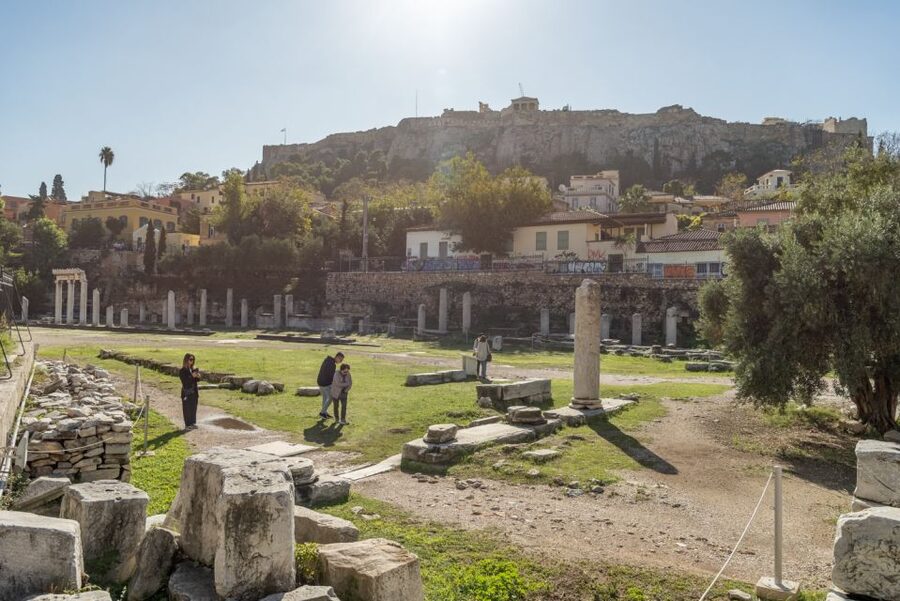
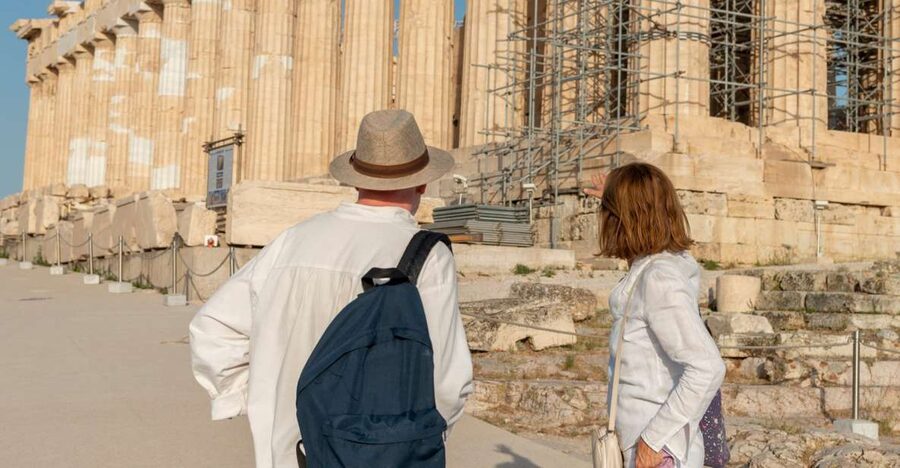
The Parthenon gets the attention it deserves, with about 15 minutes set aside for a guided explanation. You will hear about its art, architecture, religious purpose, and place in Athenian culture.
I appreciate that the tour presents the Parthenon as part of a wider story rather than treating it as an isolated photo stop. The building was dedicated to Athena, the city’s patron goddess, and its design expressed confidence, wealth, and control. Your guide can also explain why the building’s apparent straight lines are not as simple as they look.
The tour description promises the kind of explanation that works for different ages and interests. A history specialist can ask detailed questions, while a child can follow the story of Athena, the gods, and the city’s contest for protection. That flexibility is one of the strongest reasons to choose a private tour over a fixed group script.
You will also have broad views over Athens from the hill. The guide helps connect the physical view with the long span of cultural and political change below. For the Acropolis-only option, the tour ends at the Acropolis, giving you extra time for photographs and the views after the formal guiding is finished.
Erechtheion and the contest between Athena and Poseidon
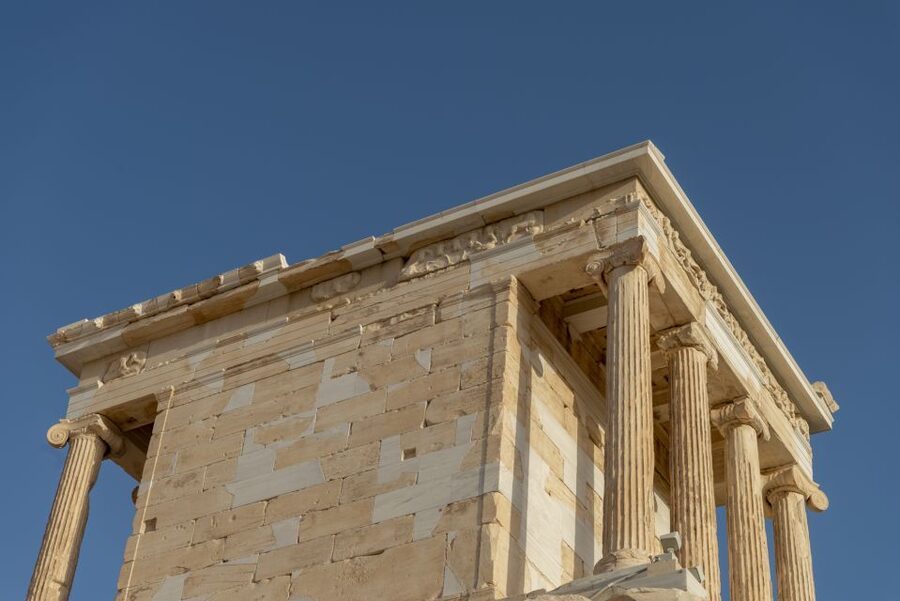
The Erechtheion brings mythology to the front. Its unusual design and sacred associations make it a useful contrast to the orderly appearance of the Parthenon.
The central story is the contest between Athena and Poseidon for the protection of Athens. Athena offered the olive tree, while Poseidon struck the ground with his trident and produced a spring or saltwater source, depending on the version being told. The guide uses this myth to explain the city’s identity and its relationship with its gods.
This is also the point where a licensed archaeological guide can add context that a quick audio guide may not. You are not just hearing a story. You are learning why myths were attached to specific places and how architecture gave those stories a physical setting.
The Erechtheion is often a favorite stop for visitors who have already seen countless images of the Parthenon. Its irregular form and layered sacred traditions give the Acropolis a more complicated personality.
Odeon of Herodes Atticus and the way back down
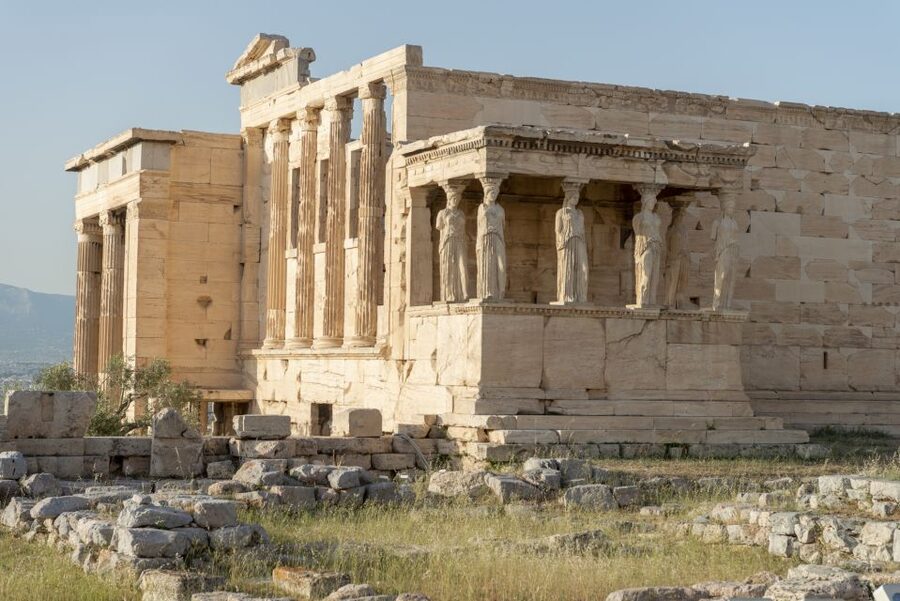
The route eventually descends through olive trees toward the Odeon of Herodes Atticus. This ancient theater is still used for performances during the summer, which gives the site an unusual link between antiquity and present-day Athens.
The point is not simply that an old theater survives. It is that the Acropolis remains part of the city’s cultural life. You can look at the structure as an ancient monument and also as a working performance venue.
The descent is a useful change of pace after the exposed upper hill. It also prepares you for the second half of the longer tour, where the focus shifts from major monuments to streets, shops, food, and daily life.
Plaka: ancient layers beneath a neighborhood walk
The Plaka option adds about 1.5 hours. This is not just extra walking after the Acropolis. It changes the feel of the experience.
Plaka has been continuously inhabited since ancient times, and the route passes monuments connected with Greek, Roman, and Byzantine periods. The guide points out the area’s long sequence of settlement while leading you through smaller streets and attractive houses.
I like this part because it gives you a chance to see Athens at street level. The Acropolis can feel grand and distant from ordinary life. Plaka brings you among local eateries, cafés, markets, souvenir stalls, artisan jewelry, and other products.
The guide also takes you toward less obvious corners rather than sticking only to the busiest paths. That can be especially useful if this is your first day in Athens and you want a quick sense of where to return later. You are free to remain in Plaka at the end, or the guide can return you to the meeting point and help with onward directions.
Keep your expectations sensible. This is not a dedicated shopping tour, and not every shop will be a small local workshop. The area includes authentic products and artisan goods, but also basic souvenirs. The value comes from having someone explain the neighborhood and point out its quieter sections.
The food option: useful for families and first-time visitors
You can add tastings in Plaka, including Greek coffee or mountain tea, souvlaki, traditional savory pies, and sweet or cake-style delicacies.
This option makes sense if you want your introduction to Athens to include more than monuments. It can also help families, since a snack break gives children a reason to stay engaged during the longer walk.
The food stops are described as traditional classics rather than a full meal. If you have a serious food itinerary planned, treat this as a pleasant introduction, not a replacement for a restaurant evening.
The food option also gives the guide more opportunities to explain local habits and ingredients. Coffee, pies, grilled meat, and sweets are small subjects, but they often make a place easier to remember than another list of dates and rulers.
How much value do you get for $163 per person?
At $163 per person, this is not a budget way to see the Acropolis. The price needs to be judged against what you value.
You are paying for a private group, a licensed archaeological guide, and the ability to adjust the pace. That can be good value for a family, a couple who wants focused attention, or anyone who prefers questions and conversation over a standard group route.
The price is harder to justify if you only want a quick look at the Parthenon and are comfortable reading signs or using an independent guide. In that case, the 90-minute Acropolis-only format may still work, but you should compare the cost with other guided options before booking.
Remember that Acropolis admission is not included. You need to have tickets before the tour, unless you ask the provider to arrange skip-the-line tickets after booking. Since ticket arrangements can affect your start time and entry, settle this point early rather than leaving it for the morning of the visit.
The flexible cancellation policy and reserve-now, pay-later option reduce financial risk. You can cancel up to 24 hours in advance for a full refund, according to the stated terms.
Timing, languages, and comfort
The total duration ranges from 1.5 to 3 hours. The shorter choice focuses on the Acropolis. The longer option combines the archaeological site with Plaka and may include food tastings.
Starting times depend on availability, and limited availability can lead to a changed start time. Check the confirmed time carefully, especially if you have museum visits, a ferry, or a restaurant booking later that day.
Guiding is available in English, German, Italian, and Greek. Several guides have been praised for speaking clearly and for explaining history through stories, legends, and modern connections. Lisa, Christina, Eva, Valia, and Delfina are among the guide names associated with especially strong experiences, though your assigned guide may be different.
Plan for sun, steps, and rough surfaces. The effort is manageable for people who can walk comfortably, but the site is not suitable for limited mobility. Guides may seek shade when possible, yet you should still prepare for exposed areas.
Who will get the most from this walk?
I would choose this tour for:
- Families who want ancient stories explained in an accessible way.
- Couples who prefer a private pace and the option to stop for food.
- First-time visitors who want both the Acropolis and a useful introduction to Plaka.
- History fans who want an accredited archaeological guide rather than a general city walk.
- People with only a few hours who want a compact, well-organized overview.
I would look elsewhere if you need a fully accessible route, want a very low-cost visit, or prefer to explore the Acropolis alone at length. The site’s steps and uneven surfaces are a real concern, not a minor footnote.
Should you book this Athens walking tour?
Book it if you want the Acropolis to make sense, not just look impressive. The private format, licensed archaeological guidance, and choice of Plaka and food options give you control over the experience.
The strongest version for most people is the longer Acropolis-and-Plaka walk, particularly on a first visit. You get the major monuments, the myths behind them, a living neighborhood, and practical suggestions for the rest of your time in Athens.
Choose the 90-minute option if your schedule is tight or you want to stay on the Acropolis for photographs afterward. Just budget separately for admission, confirm ticket arrangements, and wear shoes suited to stone steps. For a focused first look at Athens, this is a useful and personable choice.
FAQ
Where does the tour meet?
The meeting point is Makrigianni 7, Athens 117 42, close to the Acropolis Museum. Your guide will hold a sign with your name.
How long does the tour last?
You can choose a 90-minute Acropolis-only tour or a longer option lasting up to three hours that adds the Plaka neighborhood and, if selected, food tastings.
Is the tour private?
Yes. The tour is exclusive to your group.
Is an archaeological guide included?
Yes. The tour includes a state-accredited licensed archaeological guide.
Which languages are available?
Guiding is available in English, German, Italian, and Greek.
Is the Acropolis entrance ticket included?
No. You must have an admission ticket before the tour. Skip-the-line tickets may be purchased on request after booking.
Can I choose an Acropolis-only tour?
Yes. The focused option lasts about 90 minutes and ends at the Acropolis, allowing you more time for photographs and views.
What does the Plaka portion include?
The guide leads you through historic streets, monuments, local shops, markets, cafés, eateries, and less visited corners of Plaka. The Plaka portion lasts about 1.5 hours.
What food is included with the food option?
The food option can include Greek coffee or mountain tea, souvlaki, traditional savory pies, and sweet or cake-style delicacies.
Is the tour suitable for people with mobility impairments?
No. The Acropolis has steps and uneven surfaces, and the activity is not suitable for people with mobility impairments.
More Athens walking tours
- Athens: Acropolis and Parthenon Guided Walking Tour
★ 4.6 · 5,882 reviews - Greek Food Walking Tour in Athens
★ 5.0 · 4,740 reviews - Acropolis: Acropolis and Parthenon Guided Walking Tour
★ 4.7 · 3,442 reviews - Acropolis monuments & Parthenon Walking Tour with Optional Acropolis Museum
★ 5.0 · 2,678 reviews
Freshly added Athens trips
- Athens and Ancient Corinth Private from Athens★ 5.0 · 3 reviews
- From Athens: Mycenae and Epidaurus Private Tour★ 4.8 · 3 reviews
- Full day Meteora private tour★ 5.0 · 3 reviews
- Double Shore Dive (certified divers)★ 4.5 · 3 reviews
- Athens Hills: Mythology Treasure Hunt★ 5.0 · 3 reviews
- Sunset & swimming at Cape Sounio, Poseidon temple★ 5.0 · 3 reviews
- Philosophy Experience at Plato’s Academy Park – basic version★ 5.0 · 3 reviews
- Private Acropolis Tour – Ticket Included★ 5.0 · 3 reviews
Acropolis Tours, compared.

Acropolis & up to 5 Archaeological Sites Combo Pass
Read our review →

Acropolis, Parthenon & Acropolis Museum Guided Tour
Read our review →
Acropolis, Parthenon & Acropolis Museum Guided Tour
Read our review →


Acropolis monuments & Parthenon Walking Tour with Optional Acropolis Museum
Read our review →Browse the lists this tour appears in