
Reviewed · ACROPOLIS TOURS
Athens: Acropolis and Parthenon Guided Walking Tour
The best part of this Acropolis walking tour is the steady climb through layers of ancient Athens. You begin at the Theater of Dionysus and finish among the Parthenon and Erechtheion, so the monuments arrive in a natural order rather than as disconnected photo stops. I like the included entry ticket and the direct route through the Acropolis, especially when the hill is crowded.
I also like the guides’ practical approach. Guides such as Simon, Iris, Alexia, and Kostas have been praised for explaining architecture, mythology, and Greek customs in a clear, entertaining way. The main drawback is the hill itself: this is a walking tour over uneven ground, in full sun, and it is not suitable for wheelchair users, people with mobility impairments, children under six, or anyone with heart problems.
In This Review
- Key points to know before you book
- Why this Acropolis route works well
- Starting at the Theater of Dionysus
- The healing shrine and the Roman theater
- Passing through the Propylaea
- A close look at the Temple of Athena Nike
- The Parthenon, Athens’ great symbol
- The unusual Erechtheion and its Caryatids
- The value of a live guide here
- Is $35.57 a fair price?
- Who should book this two-hour walk?
- Final verdict: book it for context, not solitude
- FAQ
- Where does the Acropolis tour start?
- How long does the tour last?
- What entrance tickets are included?
- Is the tour offered in languages other than English?
- Can I use the Acropolis elevator during the tour?
- What should I bring, and what is not allowed?
Key points to know before you book
- South Slopes access: The route begins near the South Slopes entrance, which can be easier than approaching from the North Slope.
- A full Acropolis story: The walk includes the Theater of Dionysus, Asklepieion, Odeon of Herodes Atticus, Temple of Athena Nike, Propylaea, Erechtheion, and Parthenon.
- Strong guide element: The best part is the live explanation, with architecture, mythology, and ancient drama tied to what you see.
- Two hours on foot: The time is enough for the main monuments, but not for a leisurely museum visit or long independent exploration.
- Morning is wise in summer: August heat can make the exposed upper hill tiring, so an early starting time is the sensible choice.
- Price and flexibility: At $35.57 per person, the tour includes Acropolis admission, skip-the-line access, and an English-speaking guide, with free cancellation up to 24 hours ahead.
Why this Acropolis route works well
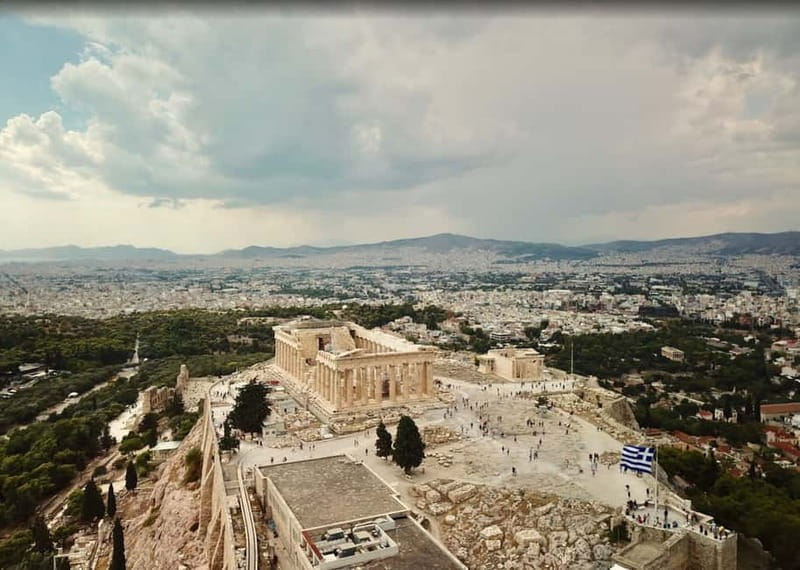
The Acropolis is not a single building. It is a rocky hill filled with monuments from different periods, each with its own purpose and story. Without context, you can admire the columns, take a few photographs, and still miss why one structure was a theater, another a gateway, and another a shrine.
This tour gives you that framework while you walk. The route takes about two hours, with roughly an hour and a half centered on the Acropolis itself. You meet at the Athenian Tours office at Mitsaion 2, postal code 11742, then return to that same meeting point when the activity ends.
The included ticket matters. You do not have to stop at the ticket office before joining the group, and the skip-the-line arrangement saves effort at one of Athens’ most visited sights. It does not mean the hill will feel empty. The Acropolis can still be crowded, and other groups may affect the quality of any disposable earphones used when the group has more than five people.
More Acropolis and Parthenon visits:
- Athens: Acropolis & up to 5 Archaeological Sites Combo Pass
★ 4.4 · 12,619 reviews - Athens: Acropolis Ticket with Optional Audio or Live Guide
★ 4.2 · 11,055 reviews - Athens: Acropolis, Parthenon & Acropolis Museum Guided Tour
★ 4.8 · 9,316 reviews
Starting at the Theater of Dionysus
The Theater of Dionysus is an excellent opening stop because it reminds you that ancient Athens was not only a city of temples. This was a place for public drama, where comedies and tragedies were performed for large audiences.
Your guide uses the theater to explain the role of performance in Athenian life. That makes the later monuments easier to understand, since the Acropolis was part of a wider civic and religious center, not an isolated hilltop ruin.
The theater is reached on foot, and the route begins building upward from here. You should wear shoes with a firm sole. Comfortable footwear is not just a general suggestion on this tour, since you will deal with a climb, stone surfaces, and uneven sections.
The healing shrine and the Roman theater
The remains of the Asklepieion of Athens come next. This was a healing temple dedicated to Asclepius and Hygeia, giving you a glimpse of the practical side of ancient religion. People did not visit sacred places only for grand ceremonies. They also sought help with illness and recovery.
The Odeon of Herodes Atticus adds another layer. This Roman-era theater was built in memory of the wife of Herodes Atticus and remains one of the most striking structures on the lower slopes. Its presence helps show how the Acropolis continued to matter long after the height of classical Athens.
These lower-slope stops are useful because they break up the climb. They also give your guide room to explain the site before you reach the most famous buildings. If you arrive expecting two straight hours focused only on the Parthenon, you may find the early stops less exciting. I think they make the visit more complete.
Passing through the Propylaea
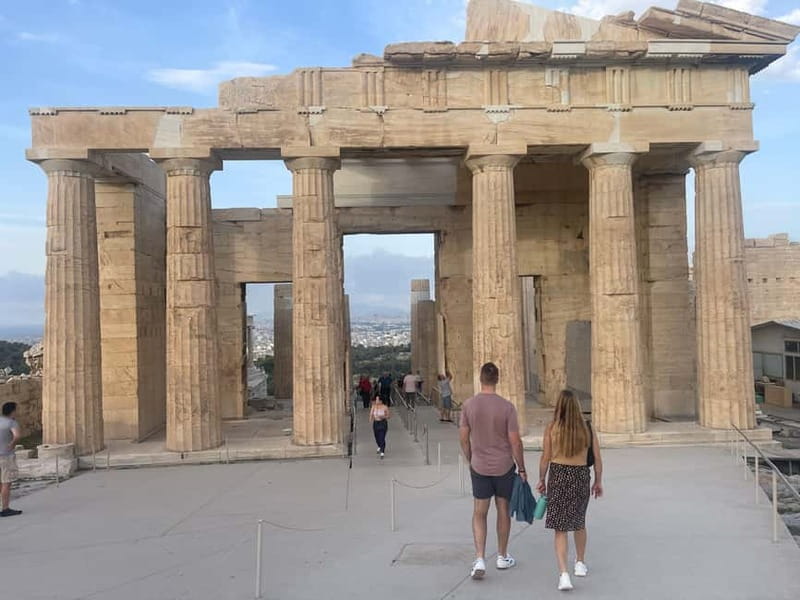
The Propylaea is the monumental gateway to the Acropolis. Walking through it gives the tour a clear sense of arrival, with the lower slopes behind you and the main plateau ahead.
This is one of the moments when a guide earns the tour price. The gateway is impressive, but its importance can be hard to read from the stones alone. Your guide can point out how the approach was designed to shape the visitor’s movement and sense of ceremony.
The climb is not described as extreme, but the tour is not designed for people who need step-free access. The group cannot use the Acropolis elevator, and large bags, luggage, baby strollers, and pets are not allowed. Bring only what you need: water, sunscreen, a hat, and your identification document.
More Athens walking tours:
- Athens: Acropolis and Parthenon Guided Walking Tour
★ 4.6 · 5,882 reviews - Greek Food Walking Tour in Athens
★ 5.0 · 4,740 reviews - Acropolis: Acropolis and Parthenon Guided Walking Tour
★ 4.7 · 3,442 reviews - Acropolis monuments & Parthenon Walking Tour with Optional Acropolis Museum
★ 5.0 · 2,678 reviews
A close look at the Temple of Athena Nike
Near the Propylaea, you will see the Temple of Athena Nike. It is a smaller monument than the Parthenon, but its position and purpose make it an important stop.
The temple was dedicated to Athena Nike, the aspect of Athena associated with victory. Here, the guide can help you separate the different forms of Athena worship and explain why a compact temple near the entrance mattered to the city.
This is also a good place to appreciate how much of the Acropolis experience is about placement. Athens’ builders used the hill, approaches, and views to create a powerful sequence. You are not simply checking off buildings. You are moving through a carefully arranged sacred precinct.
The Parthenon, Athens’ great symbol
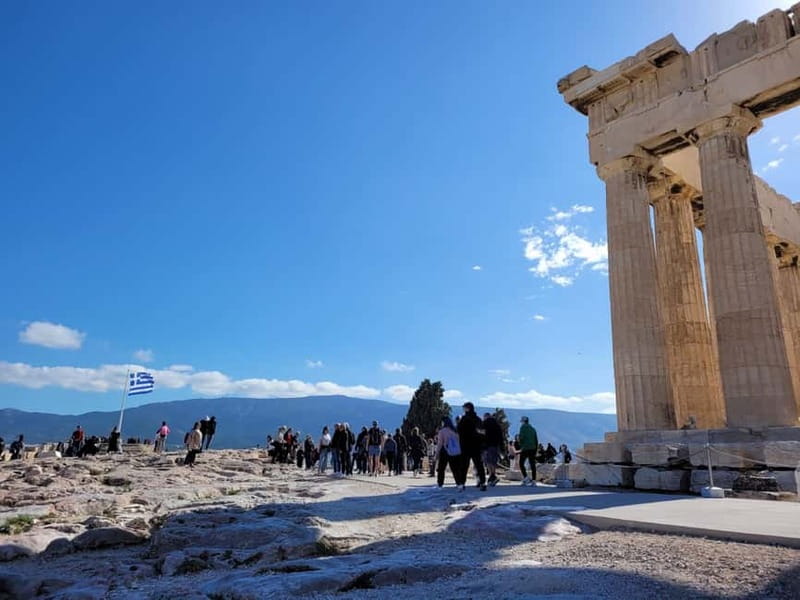
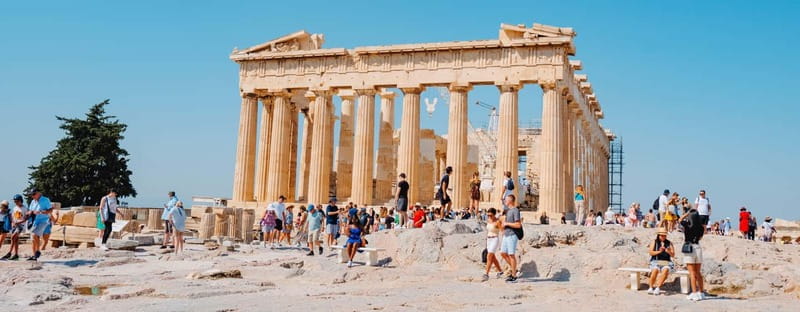
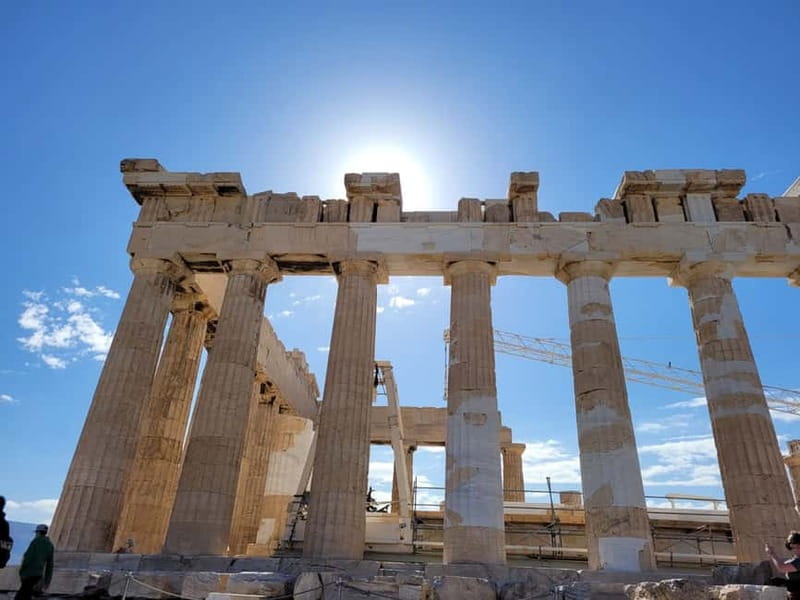
The Parthenon is the tour’s main event, and it deserves time even when the crowd is thick. Dedicated to Athena, the city’s patron goddess, it represents the high point of fifth-century BCE Doric architecture.
A guide gives you more than the familiar fact that the building is old and famous. The useful discussion is about what the Parthenon was built to express: civic pride, religious devotion, artistic control, and the power of classical Athens. The structure also becomes easier to read once you have seen the approach through the Propylaea and the neighboring shrines.
You should expect the Parthenon to be viewed from the outside. The tour focuses on the monuments and the stories attached to them, not on entering the temple interior. Give yourself a little time after the guide finishes to enjoy the views and take photographs, but remember that the activity returns to the original meeting point.
Summer timing matters here. Several people who had early morning starts found the heat easier to manage, while an August visit later in the day can be demanding. The upper hill has limited shade, so sunscreen, a hat, and water are basic equipment rather than optional extras.
The unusual Erechtheion and its Caryatids
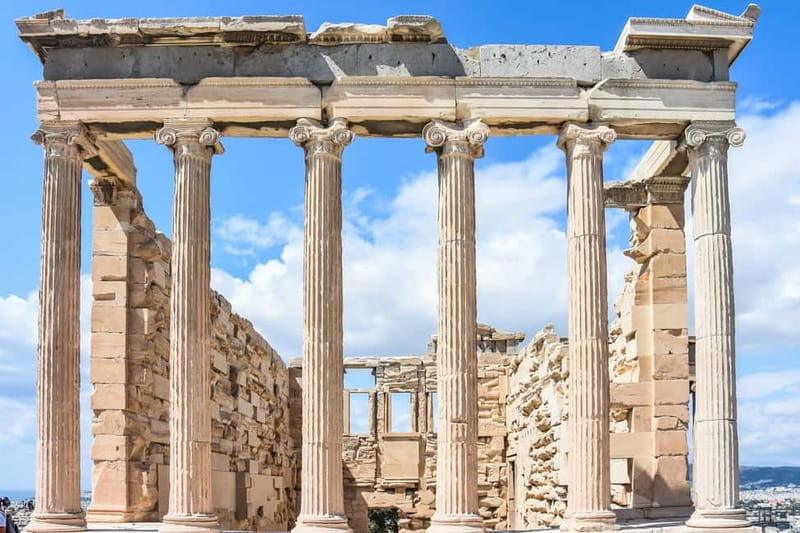
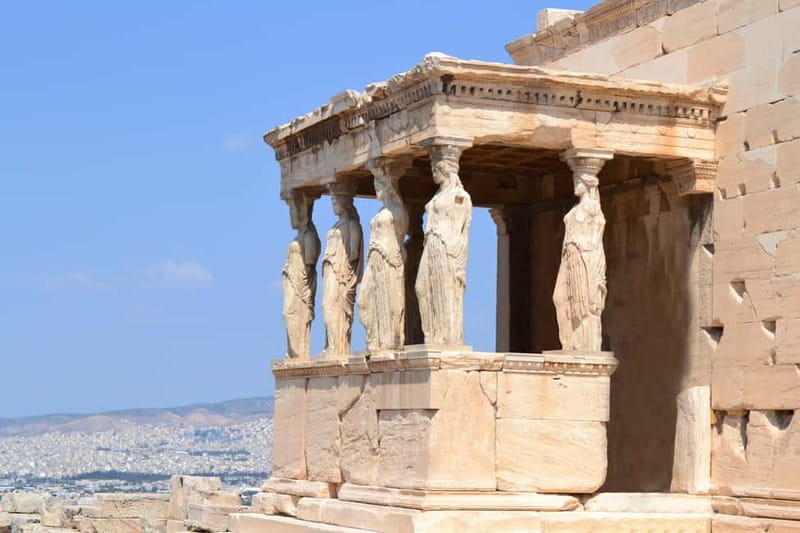
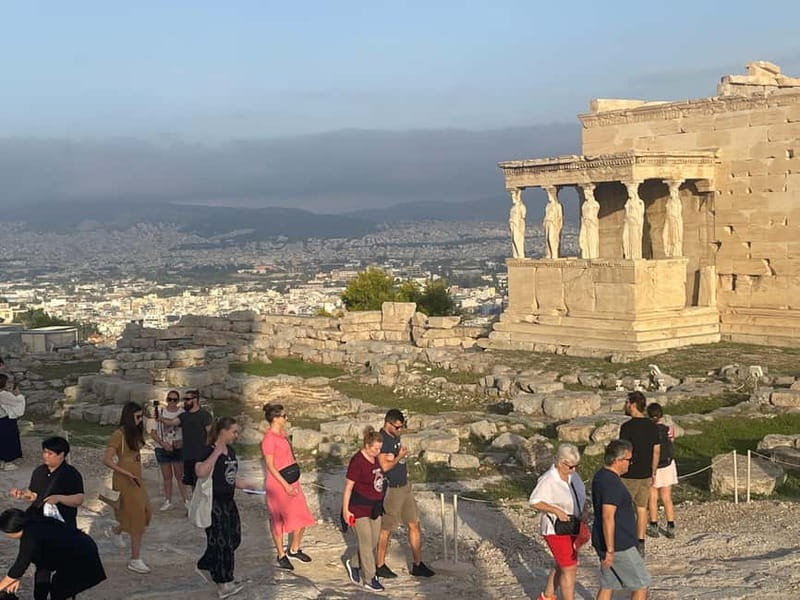
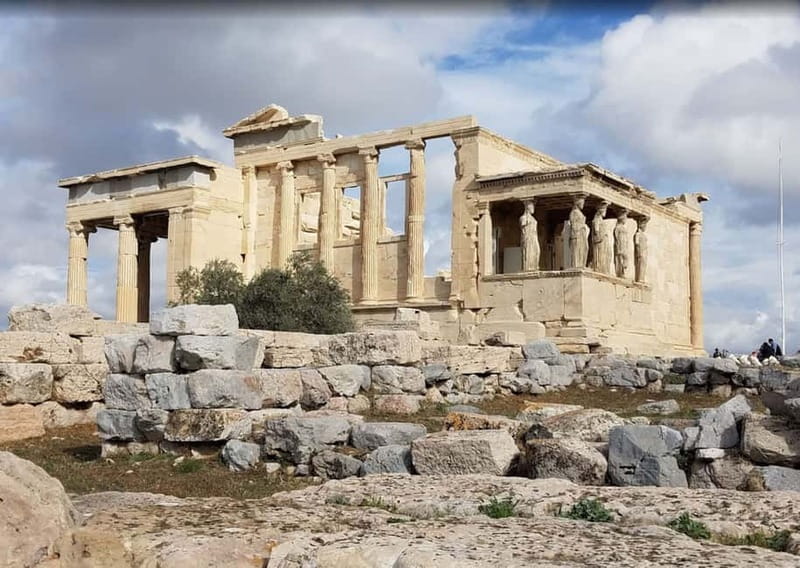
The Erechtheion is perhaps the most architecturally distinctive stop. Unlike the balanced, formal Parthenon, it has an asymmetrical design shaped by the uneven ground and the different sacred traditions connected with the site.
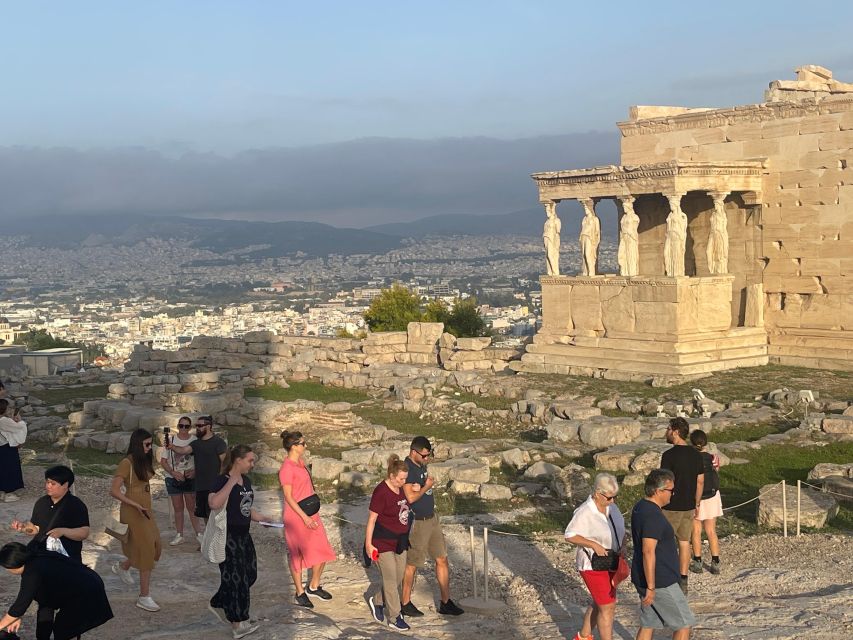
Its most famous feature is the porch supported by six sculpted female figures, known as Caryatids. They give the building a lighter, more human appearance than the massive Doric columns nearby. Your guide can help you see the Erechtheion as more than a pretty photograph by explaining why its unusual plan mattered.
This is also a good place to ask questions. The guides praised in the supplied material were especially effective at connecting architecture, mythology, language, and modern Greek customs. A guide with an archaeology or art history background, such as Christos, can add extra depth, while a lively guide such as Kostas can keep the information moving without making the walk feel like a lecture.
Guide assignments change, so you should not book on the assumption that you will receive a particular person. Still, the named guides associated with this activity include Simon, Iris, Alexia, Angel, Chris, Christos, and Kostas.
The value of a live guide here
I would choose a guided walk for a first visit because the Acropolis is easy to admire and surprisingly easy to misunderstand. You may recognize the Parthenon, but you might not know why the Theater of Dionysus comes first, how the Roman theater fits into the story, or why the Erechtheion looks so different.
The guide also helps with the practical side of a crowded site. Several guides have been especially attentive about finding patches of shade, keeping the group together, suggesting good photo angles, and moving people through busy areas. That is not glamorous, but it can make a hot, crowded visit far less tiring.
The audio equipment has a limitation. Disposable earphones are supplied for groups larger than five, but sound can suffer when nearby groups are using similar equipment. Stay reasonably close to the guide and do not expect perfect audio in every crowded corner.
The tour is offered in English only. If you want a quiet visit with no group pace, this is not the right format. If you want someone to organize the route and explain what you are seeing, the live guide is the main reason to book.
Is $35.57 a fair price?
At $35.57 per person, the cost is reasonable for a short guided visit because it includes the Acropolis entrance ticket, skip-the-line access, and an English-speaking guide. You are paying not only for admission but also for a planned route through several monuments and for someone to interpret them as you go.
The value is strongest for a first-time visitor with limited time in Athens. In two hours, you cover the major Acropolis sights without having to research the site in advance or work out the best order yourself.
The value is weaker if you already know the Acropolis well or want to linger at each location. The tour moves at a group pace, and two hours leaves limited time for quiet contemplation, detailed photography, or a separate visit to the Acropolis Museum.
Food, drinks, hotel pickup, and drop-off are not included. You need to reach the meeting office on your own and return there after the tour. The activity also does not include use of the Acropolis elevator on group tours.
There is a reserve-now, pay-later option, and cancellation is free up to 24 hours before the start time. The exact start times depend on availability, so check morning options first if you are visiting during hot weather.
Who should book this two-hour walk?
I would recommend it to a first-time Athens visitor who wants the main monuments explained in a compact format. It suits couples, friends, and families with older children who can manage the uphill walk and stay with a group.
It is also a good choice if you want the historical setting before visiting the Acropolis Museum. The tour itself does not promise a full museum visit, so treat the museum as a separate plan rather than assuming it is included.
I would not choose it for a wheelchair user, someone with serious mobility limits, or anyone who needs the elevator. It is also unsuitable for children under six and for people with heart problems, according to the activity restrictions.
Bring a passport or ID card, comfortable shoes, a sun hat, sunscreen, and water. Leave luggage, large bags, strollers, and pets behind. Photography is allowed, but recording the guide on video is not.
Final verdict: book it for context, not solitude
Book this tour if you want an efficient first look at the Acropolis with the major buildings placed in their historical setting. The strongest features are the South Slopes approach, the included entrance ticket, the clear two-hour route, and guides who bring energy to architecture, mythology, and ancient drama.
Choose a morning slot when possible, especially in August. Skip it if you want to explore at your own speed, need elevator access, or have already studied the Acropolis and prefer to spend several hours alone with the stones.
For most first visits, the $35.57 price is fair. You get the essential hilltop monuments, a useful explanation of what you are seeing, and help navigating one of Athens’ busiest sights without wasting your limited vacation time.
FAQ
Where does the Acropolis tour start?
Meet your English-speaking guide at the Athenian Tours office at Mitsaion 2, 11742. The activity ends back at the same meeting point.
How long does the tour last?
The tour lasts two hours. The Acropolis portion is listed as about one and a half hours, with the walk covering the main monuments and nearby sites.
What entrance tickets are included?
The tour includes entrance tickets to the Acropolis and skip-the-line access. A guide can supply only adult, full-price tickets at the meeting point for the specified ticket option, and those tickets must be paid for in cash.
Is the tour offered in languages other than English?
No. The live guide service for this activity is offered in English.
Can I use the Acropolis elevator during the tour?
No. The elevator cannot be used on group tours.
What should I bring, and what is not allowed?
Bring your passport or ID card, comfortable shoes, a sun hat, sunscreen, and water. Pets, baby strollers, luggage, and large bags are not allowed.
Freshly added Athens trips
- Athens and Ancient Corinth Private from Athens★ 5.0 · 3 reviews
- From Athens: Mycenae and Epidaurus Private Tour★ 4.8 · 3 reviews
- Full day Meteora private tour★ 5.0 · 3 reviews
- Double Shore Dive (certified divers)★ 4.5 · 3 reviews
- Athens Hills: Mythology Treasure Hunt★ 5.0 · 3 reviews
- Sunset & swimming at Cape Sounio, Poseidon temple★ 5.0 · 3 reviews
- Philosophy Experience at Plato’s Academy Park – basic version★ 5.0 · 3 reviews
- Private Acropolis Tour – Ticket Included★ 5.0 · 3 reviews
Acropolis Tours, compared.

Acropolis & up to 5 Archaeological Sites Combo Pass
Read our review →

Acropolis, Parthenon & Acropolis Museum Guided Tour
Read our review →
Acropolis, Parthenon & Acropolis Museum Guided Tour
Read our review →


Acropolis monuments & Parthenon Walking Tour with Optional Acropolis Museum
Read our review →Browse the lists this tour appears in