
Reviewed · DELPHI TOURS
7-Day Grand Tour: Olympia, Delphi, Meteora, Thessaloniki
The big appeal here is simple: in one week, you cover the major ancient sites scattered across mainland Greece, from Mycenae and Olympia in the Peloponnese to Delphi, Meteora, and the Macedonian homeland of Alexander the Great. This is a road tour for history fans who want the hard work of routing, driving, and hotel booking taken off their plate.
I like the range. You get famous classical ruins, a working mountain town with waterfalls, royal tombs, early Christian monuments, and a pair of dramatic Meteora monasteries. I also like that breakfast, dinner, six hotel nights, a guide, and an air-conditioned vehicle are included, which makes the $1,479.60 price easier to judge.
The tradeoff is pace. Several days are packed with sites and long road sections, and the tour may involve a change of bus and operator along the way. You should book this for breadth, not for lazy mornings or long stretches of free time.
In This Review
- The tour in five useful points
- Why this route works for history fans
- Day 1: Mycenae, Epidaurus, and the Corinth Canal
- Day 2: Olympia and the birthplace of the Games
- Day 3: Delphi, Apollo, and the bronze Charioteer
- Day 4: Meteora and the change north
- Day 5: A brief look at Thessaloniki
- Day 6: Waterfalls, royal tombs, and Paul’s Macedonian route
- Day 7: Dion, Pella, and the long return to Athens
- Hotels, food, transport, and group size
- Is $1,479.60 good value?
- Who should book this Greek grand tour?
- Should you book it?
- FAQ
- Where does the tour start?
- Is hotel pickup available?
- Where does the tour end?
- What meals are included?
- Is the tour conducted in English?
- How many people can join the group?
- What kind of physical fitness is needed?
- Is there a dress code?
- Is there an extra hotel fee?
The tour in five useful points
- Classical Greece in seven days: Mycenae, Epidaurus, Olympia, Delphi, and Thermopylae all fit into one route.
- Northern Greece is included: You go beyond the usual Athens circuit to Meteora, Thessaloniki, Vergina, Pella, Dion, and Veroia.
- Six dinners and six breakfasts: This saves planning time, though lunch remains your responsibility.
- Guides can make or break the experience: Effie, an archaeologist, received especially warm praise, while guide quality and communication can vary.
- Expect a moderate physical level: Ancient sites mean uneven ground, stairs, walking, and outdoor exposure.
- The group can reach 40 people: That keeps the price below a private tour, but it can make transitions less nimble.
Why this route works for history fans
Greece is easy to underestimate on a map. Athens, Olympia, Delphi, Meteora, and Thessaloniki are not close neighbors, and getting between them by public transport takes time and planning. This tour links them by coach, adds hotels and meals, and gives you a guide to explain what you are looking at.
The route also has a useful historical shape. The first days focus on Mycenaean and classical Greece. Delphi brings mythology and religion into the picture. Meteora adds medieval monasteries and mountain scenery. The final days turn north toward Macedonia, Philip II, Alexander the Great, Roman sites, and the modern Greek memory of Leonidas at Thermopylae.
That broad sweep is the strongest reason to choose this trip. You will not study each place at museum-tour length, but you will see how different chapters of Greek history fit together.
The tour is offered in English and starts from the Amalia Hotel Athens at 8:30 a.m. Pickup from selected city-center hotels begins about an hour earlier. The end point is back at the same meeting point in Athens, so plan your next hotel or flight with that return in mind.
More Delphi day trips:
- Athens: Mythology of Delphi, Museum and Arachova Guided Tour
★ 4.6 · 4,008 reviews - From Athens: Delphi Full Day V.R. Audio Guided Tour
★ 4.6 · 3,028 reviews - From Athens: Small-Group Delphi, Museum & Arachova Day Trip
★ 4.8 · 2,476 reviews
Day 1: Mycenae, Epidaurus, and the Corinth Canal
The opening day moves quickly from Athens into the Peloponnese. Your first stop is the Corinth Canal, where a short 20-minute pause gives you a look at the cut linking the Gulf of Corinth with the Saronic Gulf. It is a brief photo stop, not a full visit, but it helps explain the route into the peninsula.
Mycenae gets the serious time, about 90 minutes. The Lion Gate is the famous entrance, built into massive Cyclopean walls that later Greeks believed could only have been made by giants. Inside are the remains associated with the palace complex and the Tomb of Agamemnon, a monumental beehive-shaped tomb tied by legend to the king of Homer’s Trojan War.
I like Mycenae because the site feels older and more severe than the marble temples you see later. Bring sensible shoes. The ground is uneven, and the exposed hill can feel demanding in warm weather.
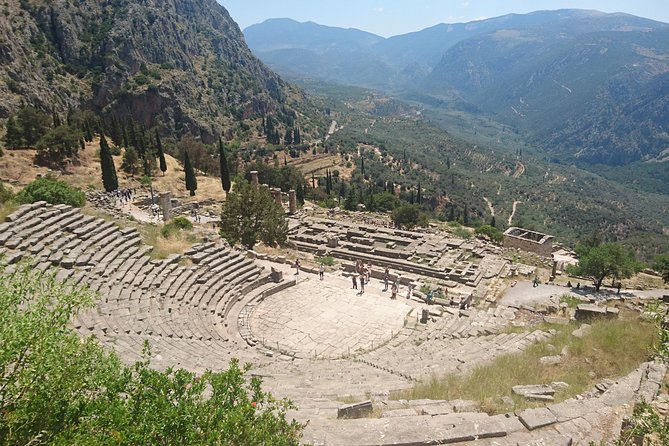
The Ancient Theatre of Epidaurus follows, with about an hour on site. Its careful design gives the theater its celebrated acoustics, and a guide will usually demonstrate how sound carries across the seating bowl. The theater is still the star attraction, so do not expect a full day among the surrounding sanctuary buildings.
The first day sets the pattern: memorable sites, limited wandering time, and a coach ride connecting them. If you want to read every sign or sit quietly at each ruin, you may find the schedule tight.
Day 2: Olympia and the birthplace of the Games
Olympia receives two hours divided between the archaeological site and museum. That is enough to see the main remains without feeling completely rushed, though the visit still favors orientation over close study.
At the archaeological site, you will see the stadium of the ancient Olympic Games and the remains of the sanctuary dedicated to Zeus. The stadium is more powerful as a space than as a surviving building. Walk through the entrance tunnel and picture athletes arriving for contests watched by large crowds in the ancient world.
The museum helps fill in what the ruins cannot show. Sculptures and architectural pieces give you a clearer idea of the sanctuary’s design, and the Hermes statue and Nike sculpture are among the kind of works that make the museum more than a backup for a rainy day.
Olympia can feel hot because much of the visit is outdoors. Water, a hat, and shoes with a firm sole will help. Lunch is not included, so the group will need time and a meeting plan after sightseeing.
This is one of the tour’s best-balanced days. Olympia has a clear theme, the site and museum support one another, and the amount of time is enough for a first visit.
Day 3: Delphi, Apollo, and the bronze Charioteer
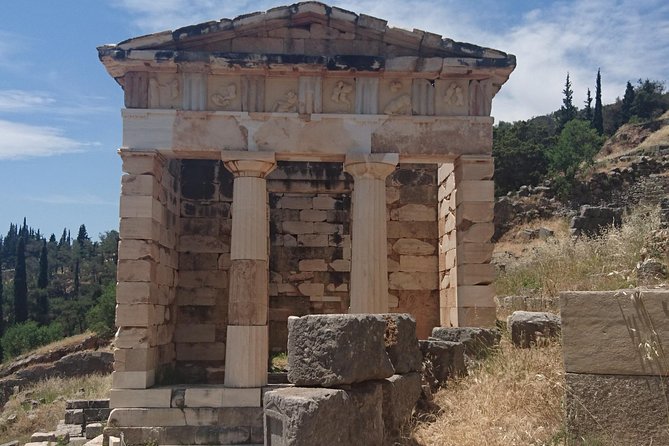
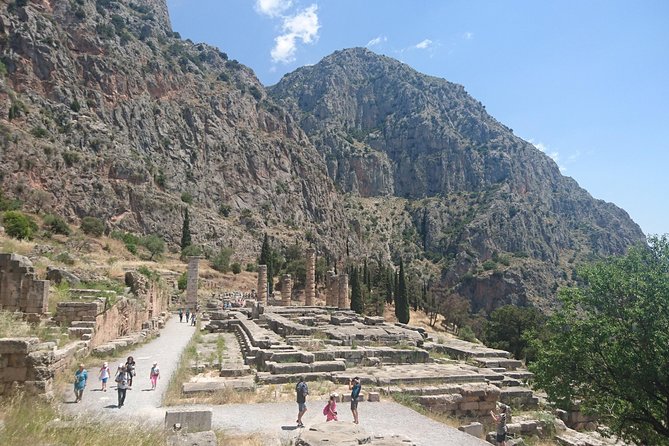
Delphi is one of the emotional high points of the trip. The route begins at the Tholos of Athena Pronaia, a graceful circular structure in a separate area below the main sanctuary. You get about 30 minutes here, enough to see the surviving columns and understand why the building is so often photographed.
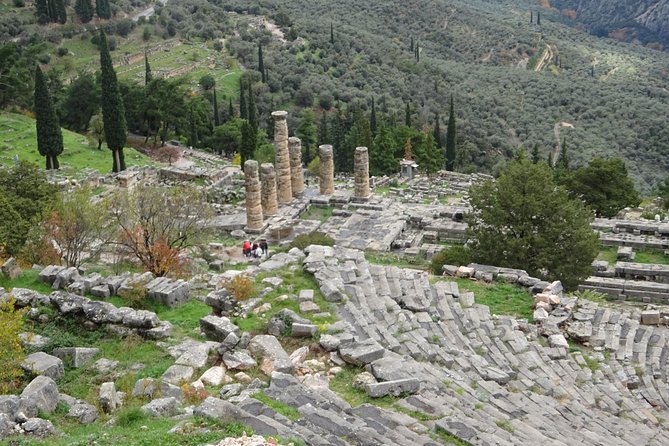
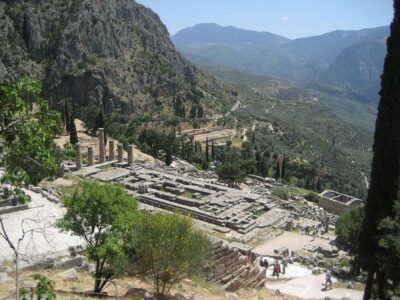
The main Delphi site receives around 90 minutes. The Temple of Apollo was the center of the sanctuary, where the oracle of Delphi delivered advice that influenced rulers, wars, and colonies. Much of the temple is gone, but the setting and the remaining columns make the site easy to picture.
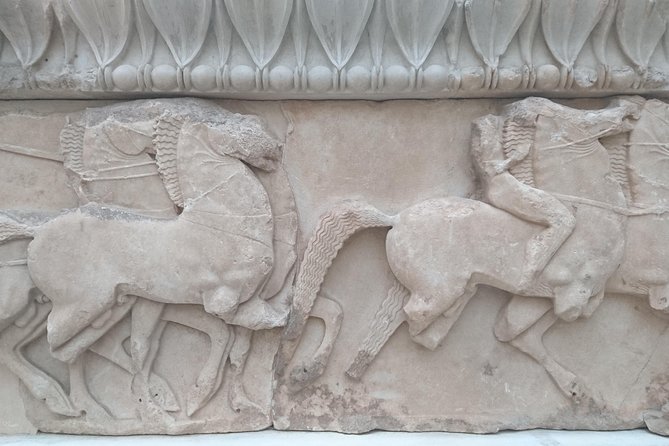
The archaeological museum adds another hour. Look for the bronze Charioteer of Delphi, one of the finest surviving Greek bronzes. The museum also gives you the sculptural details and offerings that can be hard to appreciate when you are standing among scattered foundations outdoors.
Guide quality matters a great deal at Delphi. A strong guide can explain the oracle, the sacred processions, and the rivalry among Greek city-states without turning the visit into a list of dates. George was singled out for his professional and considerate approach, while Effie, who is an archaeologist, was praised for making the ancient sites especially clear and interesting.
Free time in Delphi itself is limited in value for some people. The town is small, and the main appeal is the sanctuary and museum, so I would rather have focused site time than a long unstructured pause here.
More Meteora trips from Athens:
- Athens: Meteora Monasteries Day Trip with Caves and Lunch
★ 4.7 · 2,964 reviews - Athens: Meteora Monasteries Day Tour with Lunch
★ 4.8 · 2,196 reviews - Athens: Meteora Tour with Local Guide and Greek Lunch
★ 4.8 · 1,561 reviews - Athens: Meteora Monasteries, Caves & Coastal Stopovers with Lunch
★ 4.5 · 1,432 reviews
Day 4: Meteora and the change north
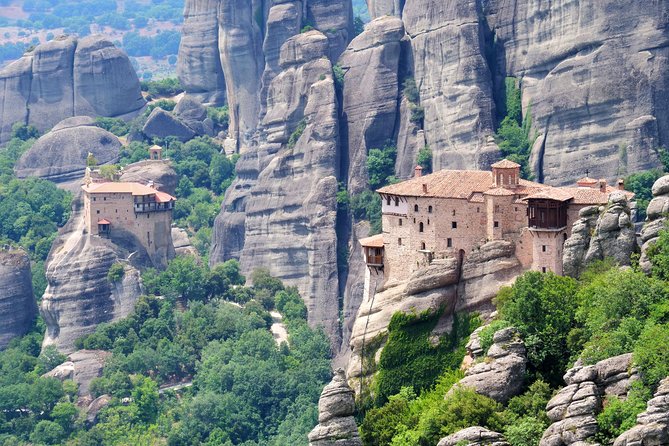
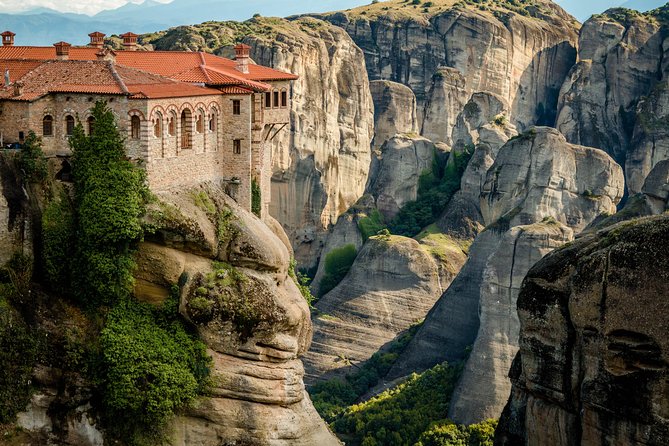
Meteora brings a sharp change of mood. Instead of open sanctuary grounds and low ruins, you see monasteries perched on tall rock formations. The tour visits two monasteries and allows about two and a half hours in the area before the bus change for Thessaloniki.
This is a major highlight, but be ready for physical effort. Monastery visits require appropriate clothing, and the stated dress code means knees and shoulders must be covered for both men and women. You may be refused entry if you arrive in shorts or a sleeveless top.
The day also contains one of the tour’s practical weak spots: the transfer between buses or operators. The change may happen around lunch, and conflicting departure instructions can create needless pressure. Keep your luggage clearly marked, listen for the final departure time, and confirm the lunch break directly with the guide.
Meteora is too important to skip, and a road tour makes it far easier than arranging the visit independently with luggage and onward transport. Still, the 2.5-hour stop covers two monasteries, so you should not expect a slow afternoon exploring the town or sitting beneath the cliffs.
Day 5: A brief look at Thessaloniki
Thessaloniki is the tour’s northern base, but the scheduled sightseeing here is surprisingly light. The listed stop is the Rotunda, an imposing building first constructed as a temple and later changed into a church, with early Christian mosaics inside.
The stop is listed as only one minute, which clearly means a very brief orientation rather than a proper guided visit. You will need to make your own use of free time in Thessaloniki if you want to see more of Greece’s second city.
That is a missed opportunity for anyone interested in urban history. Thessaloniki has Roman, Byzantine, Jewish, Ottoman, and modern layers, but this itinerary does not give the city a full walking tour. Use the hotel location and spare time carefully, and ask your guide what can realistically be reached before the next departure.
Accommodation in Thessaloniki has been a strong point, with one stay described as five-star quality. The comfort matters here because the earlier days are long and the northern section continues at speed.
Day 6: Waterfalls, royal tombs, and Paul’s Macedonian route
Day six is packed with four stops. Edessa comes first, with an hour to see its famous waterfalls. This is a welcome change from ruins and museums. The stop is short but gives you a natural landmark and a chance to stretch your legs.
Vergina is the day’s main prize. The Museum of the Royal Tombs of Aigai protects the burial complex of the Macedonian royal family, including the tomb associated with Philip II. The museum is built around the tombs, so the experience is more atmospheric than looking at royal objects in a standard gallery.
You then visit Naoussa and the site known as Aristotle’s School. The stop lasts about an hour and connects the region to Aristotle, whose teaching shaped the young Alexander. The details of what you see here are more limited than at Vergina, so treat it as a short historical stop rather than a full museum visit.
In Veroia, the route includes St. Paul’s Berma, the old Jewish neighborhood, and the market area. This gives the day a more lived-in quality. You are not only looking at ancient stones, you are also seeing a town with religious and community history still visible in its streets.
The drawback is uneven importance. Vergina is a major site, while the other stops are shorter and less substantial. A guide who explains the connections well can make the day feel coherent. A weaker guide may leave you wondering why some stops were included.
Day 7: Dion, Pella, and the long return to Athens
The final day begins at Dion Archaeological Park, a sacred Macedonian town linked to the worship of the Olympian gods. You have about an hour to see the remains, which may include sanctuaries, mosaics, and traces of the ancient settlement.
Pella, the capital of ancient Macedonia and the home region of Alexander the Great, follows with an hour in its archaeological museum. The museum is important for its mosaics and for giving shape to a city that is now largely visible through foundations and excavated remains.
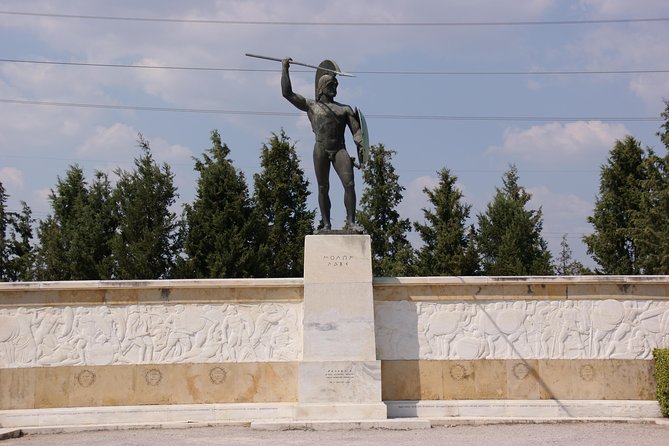
Thermopylae comes late in the day as a ten-minute stop at the monument to Leonidas. The pause is brief, but the name carries enormous weight. This is the place tied to the famous Spartan stand against the Persian army, and the monument works best as a final symbolic stop rather than a full archaeological visit.
Much of this day is spent riding back toward Athens. That is the cost of covering northern Greece and still ending at the original meeting point. If your departure from Athens is soon after the tour, leave plenty of margin. Delays are always possible on a long return route, and the listed schedule does not promise an exact arrival time.
Hotels, food, transport, and group size
Six nights of accommodation, six breakfasts, and six dinners are included. This is a real part of the value, especially in places where you may not have time to research restaurants after arriving tired from the road.
The hotels have generally been described as good, comfortable, or better, with especially strong accommodation in Thessaloniki. Standards may vary between Amalia properties. Some rooms have been criticized for stained carpets, limited nearby shopping, and missing basics such as bottled water, so buy supplies when the coach stops at a supermarket or town.
Breakfasts are usually generous, and dinners are plentiful. The meals can become repetitive, and choice may be narrower than you expect from the price. Lunch is not included, and roadside or group restaurants can cost around 25 to 30 euros for a simple meal with a main dish, tzatziki, and beer.
The air-conditioned vehicle is important because the route covers a lot of ground. The maximum group size is 40, which is manageable but not intimate. You will spend less than on a private tour, yet you must accept fixed departure times and occasional waiting for the full group.
A mid-tour change of company or guide is possible. This can be confusing, particularly if the two operators give different lunch or departure instructions. The tour is sold through Chat Tours, but arrangements may involve another local operator. Ask early in the trip how the handover will work.
Is $1,479.60 good value?
The price is high for seven days, but it covers more than sightseeing. You are paying for six hotel nights, transport across much of mainland Greece, an English-speaking professional guide, six breakfasts, six dinners, and admission to several major archaeological sites and museums.
You would need to compare the cost of intercity transport, hotels, entrance tickets, and meals before deciding that the price is excessive. The value improves if you want expert explanations and do not want to drive unfamiliar roads or manage several one-night stays.
The price is less attractive if you prefer choosing your own restaurants, staying longer at fewer places, or spending several days in Thessaloniki. It also does not include lunch or the environmental hotel fee of 10 euros per room per night from April 1 2025, paid directly to the hotel.
Who should book this Greek grand tour?
I would choose this trip if you have one week, care strongly about ancient Greece, and want to see both the classic southern sites and the less commonly included Macedonian region. It suits people comfortable with early starts, long coach rides, outdoor walking, and a set group schedule.
It is also a good fit for first-time visitors who want a guided introduction rather than a beach holiday. An archaeologist such as Effie can add real depth, and the route gives you useful context from Mycenaean kings to Alexander’s Macedonia.
I would hesitate if your priority is slow travel. Delphi free time is limited, Thessaloniki receives little scheduled sightseeing, and the final day is dominated by the return to Athens. People who dislike bus changes or uncertain handovers should also think twice.
Should you book it?
Book it if your goal is to collect the major historical sights of mainland Greece in one organized sweep. The strongest parts are Olympia, Delphi, Meteora, Vergina, and Pella, supported by good hotels and included dinners that reduce daily planning.
Skip it if you want deep visits, flexible meals, or a calm schedule. Before paying, confirm the pickup hotel, the possible operator change, the environmental fee, dress rules, and the return timing to Athens. With those limits understood, this is a practical and unusually wide-ranging introduction to Greece.
FAQ
Where does the tour start?
It starts at the Amalia Hotel Athens, Leof. Vasilisis Amalias 10, Athens. The scheduled departure time is 8:30 a.m.
Is hotel pickup available?
Pickup is offered from selected city-center hotels and begins about one hour before departure. Pickup from ports and private apartments is not available.
Where does the tour end?
The activity ends back at the original meeting point in Athens.
What meals are included?
Six breakfasts and six dinners are included. Lunch is not included.
Is the tour conducted in English?
Yes. The tour is offered in English only.
How many people can join the group?
The maximum group size is 40 people.
What kind of physical fitness is needed?
A moderate level of physical fitness is required. You should expect walking at archaeological sites and possible stairs or uneven ground at places such as Mycenae and Meteora.
Is there a dress code?
Yes. Places of worship and selected museums require covered knees and shoulders for men and women. Shorts and sleeveless tops are not allowed, and entry may be refused if you do not follow the rules.
Is there an extra hotel fee?
Yes. An environmental fee of 10 euros per room per night applies from April 1 2025 and is paid directly to the hotel.
More 7-Day Experiences in Athens
- 7-Day Northern Greece Tour – Meteora, Kastoria & Thessaloniki
★ 5.0 · 14 reviews - Best of Greece: 7-Day Tour to Real Greece of the Peloponnese, Delphi and Meteora
★ 5.0 · 12 reviews - 7 days Journey to Vikos-Aoos National Park from Athens
★ 5.0 · 8 reviews - BEST 7-Day CLASSICAL GREECE: Corinth Olympia Delphi Meteora more!
★ 5.0 · 3 reviews
More Ancient Olympia trips
- 4-Day Classical Greece Tour: Epidaurus, Mycenae, Olympia, Delphi, Meteora
★ 4.5 · 732 reviews - 3-Day Classical Greece Tour: Epidaurus, Mycenae, Nafplion, Olympia, Delphi
★ 4.5 · 342 reviews - 4-Day Tour of Mycenae, Epidaurus, Olympia, Delphi & Meteora
★ 4.8 · 168 reviews - 4-Day Greece Highlights Tour: Epidaurus, Mycenae, Olympia, Delphi and Meteora
★ 5.0 · 79 reviews
Freshly added Athens trips
- Athens and Ancient Corinth Private from Athens★ 5.0 · 3 reviews
- From Athens: Mycenae and Epidaurus Private Tour★ 4.8 · 3 reviews
- Full day Meteora private tour★ 5.0 · 3 reviews
- Double Shore Dive (certified divers)★ 4.5 · 3 reviews
- Athens Hills: Mythology Treasure Hunt★ 5.0 · 3 reviews
- Sunset & swimming at Cape Sounio, Poseidon temple★ 5.0 · 3 reviews
- Philosophy Experience at Plato’s Academy Park – basic version★ 5.0 · 3 reviews
- Private Acropolis Tour – Ticket Included★ 5.0 · 3 reviews
Delphi Tours, compared.

Mythology of Delphi, Museum and Arachova Guided Tour
Read our review →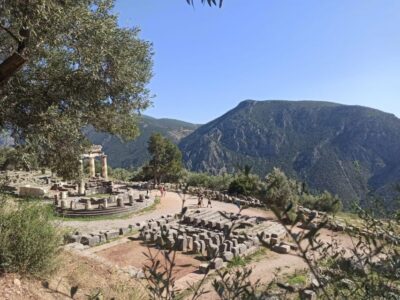
Small-Group Delphi, Museum & Arachova Day Trip
Read our review →
Delphi English Day Trip from Athens with Official Guide
Read our review →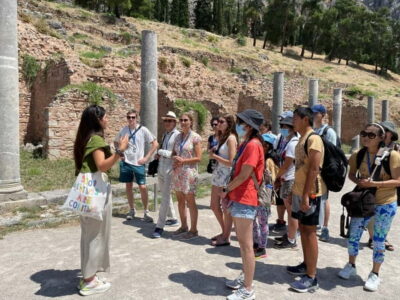
Delphi Guided Trip with Optional Lunch and Entry
Read our review →
Historical Delphi One Day Tour with Arachova Stop & Expert Guide
Read our review →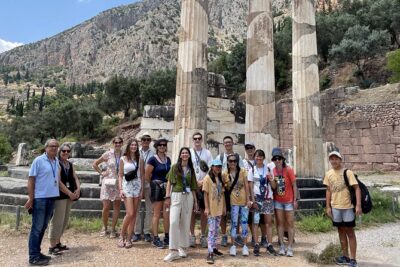
Premium Delphi Day Trip with an Expert Guide, Museum & Lunch
Read our review →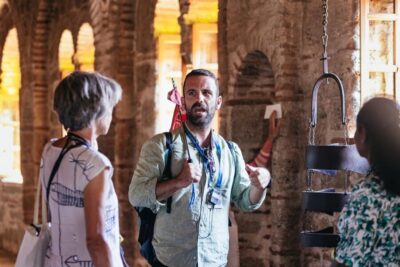
Browse the lists this tour appears in