

Reviewed · TOURS
Sparta Tour
The most striking part of this day is the change of eras. In one long outing, you move from the modern Corinth Canal to ancient Sparta, then on to the medieval Byzantine ruins of Mystras. It is a big day, but it gives you a far wider look at the Peloponnese than a quick Sparta visit could.
I like the private door-to-door service, especially for a route that would be awkward by public transport. I also like the mix of famous places and smaller stops, including the olive oil museum and lunch in Pikoulianika with views toward Sparta.
The main catch is the length. Ten to eleven hours in a vehicle, with roughly five hours of driving between Athens and the southern Peloponnese, will feel tiring. Entrance fees and drinks are extra, and the driver does not accompany you inside the archaeological sites.
In This Review
- Key points to know before booking
- A long road to the world of Leonidas
- The Corinth Canal makes a sharp first stop
- Sparta: famous name, modest ancient remains
- The Archaeological Museum of Sparta fills in the gaps
- Olive oil from ancient craft to modern kitchen
- Mystras brings the Middle Ages into view
- Lunch above Sparta in Pikoulianika
- Timing, comfort, and the private format
- What you pay for, and what you still need to budget
- Who should book this Sparta day trip?
- Should you book it?
- FAQ
- How long is the Sparta tour from Athens?
- What is the price of the tour?
- Is the tour private?
- Does the tour offer hotel pickup?
- Is airport pickup included?
- Is transportation included?
- Is an English-speaking guide included?
- Are entrance fees included?
- Is lunch included?
- Can I cancel for a full refund?
Key points to know before booking
- A full Peloponnese day: The route covers the Corinth Canal, Sparta, Mystras, and several museums in one outing.
- Private transport for up to three people: The quoted price is $802.86 per group, not per person.
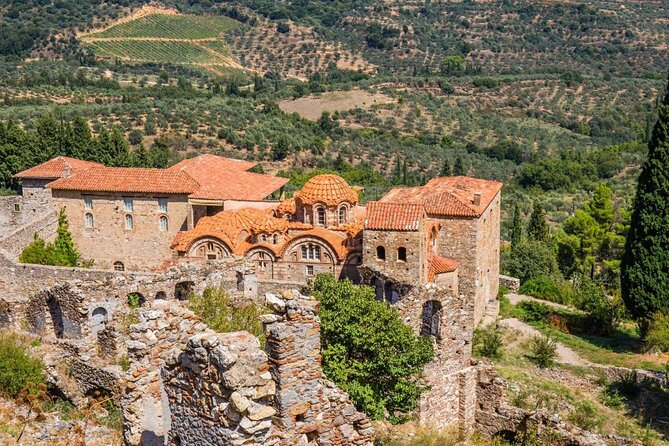
- Mystras is the star stop: Allow about 90 minutes for its steep medieval ruins and Byzantine churches.
- The driver stays outside the sites: You receive transport and guidance during the day, but not an escorted museum or ruin tour.
- Useful comfort extras: Hotel, residence, and port pickup in Athens and Piraeus, air-conditioning, Wi-Fi, and bottled mineral water are included.
- Lunch is a choice, not a standard inclusion: Pikoulianika lunch is available, but meals are not included unless you select the lunch option.
A long road to the world of Leonidas
Sparta sits about 2.5 hours from Athens by road, making this a serious day trip rather than a quick side outing. The private format helps because you can leave from your hotel, private rental, or port pickup point instead of finding your way to a bus station.
You travel in a new luxury vehicle with air-conditioning, Wi-Fi, and bottled water. Wi-Fi is a small but useful detail on a long drive, particularly if you need to stay in touch without using roaming data.
The price is $802.86 for a group of up to three people. For one person, that is expensive. Split between three people, it becomes a more reasonable rate for a private vehicle, a professional English-speaking driver, and a full day on the road. Airport pickup and return cost extra, so confirm the pickup point before paying.
The driver is there throughout the day and can explain the places you pass and help keep the schedule moving. He cannot escort you inside the sites, so you should be comfortable reading signs and exploring independently. That arrangement suits independent visitors, but anyone wanting a detailed guided walk through Mystras or Sparta’s museum should ask about adding a licensed guide.
Other days out people book around Athens:
- Athens: Acropolis & up to 5 Archaeological Sites Combo Pass
★ 4.4 · 12,619 reviews - Athens: Acropolis Ticket with Optional Audio or Live Guide
★ 4.2 · 11,055 reviews - Athens: Acropolis, Parthenon & Acropolis Museum Guided Tour
★ 4.8 · 9,316 reviews
The Corinth Canal makes a sharp first stop
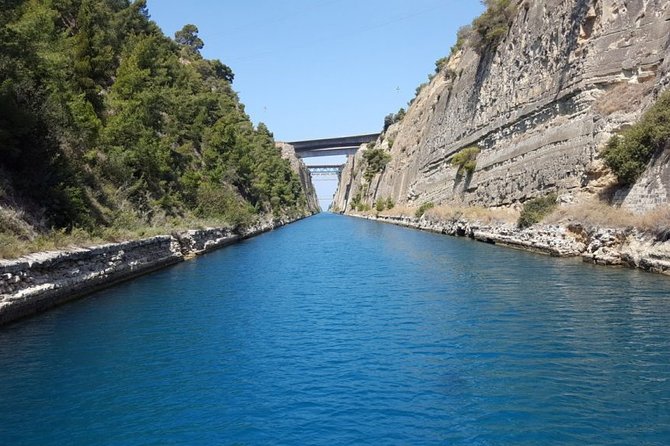
The Corinth Canal is usually the first sightseeing break. You get about 20 minutes here, which is enough to look across the narrow waterway, take photographs, and understand why this cut through the Isthmus matters.
The canal links the Gulf of Corinth with the Saronic Gulf and separates the Peloponnese from mainland Greece. It was cut at sea level and has no locks. At 6.4 kilometers long and only 21.4 meters wide at its base, it is too narrow for most modern ships and now functions mainly as a visitor stop.
This is a brief pause, not a full canal tour. The value comes from breaking up the drive and seeing a major piece of Greek engineering in person. If you expect boats, a long walk, or a museum visit, the 20-minute schedule may feel short.
Sparta: famous name, modest ancient remains
Sparta’s name carries unusual weight. In the ancient world, the city-state was known as Lacedaemon, while Sparta referred to the main settlement along the Eurotas River in Laconia. By about 650 BC, it had become the leading military land power in Greece.
Sparta later led the Greek military effort during the Greco-Persian Wars and defeated Athens in the Peloponnesian War, fought from 431 to 404 BC. Yet modern visitors should adjust their expectations. This is not an ancient city with huge intact temples at every turn.
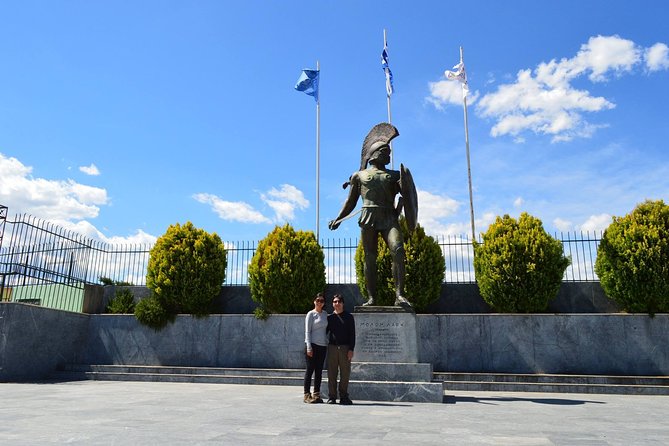
The scheduled city visit lasts about 30 minutes, followed by another 30 minutes in the Archaeological Museum of Sparta. The most direct link to the famous Spartan story is the Leonidas Tomb, which is included among the city sights. The stop works best when you come ready to picture the ancient city from its scattered remains and museum pieces rather than expecting a perfectly preserved military capital.
The short time in Sparta also means you will need to keep moving. If your main goal is a slow archaeological study of Sparta, this tour gives you an introduction, not an exhaustive visit.
The Archaeological Museum of Sparta fills in the gaps
The Archaeological Museum of Sparta contains finds from the ancient acropolis, also called Lakedaemonia, along with objects from across Laconia. Its collection ranges from the Neolithic Age to the late Roman period.
The museum occupies seven rooms covering about 500 square meters, though only a small part of the full collection is displayed. That compact size makes the 30-minute visit manageable, but it also limits how long you can spend with individual objects.
I like this stop because it gives context to a city where the surviving ruins may not match the fame of the name. You can use the museum to connect everyday objects, sculpture, and archaeological remains with the larger story of Sparta.
Your driver does not go inside as an escort, and the entrance fee is extra. Build that cost into your budget and allow enough time to enter, look around, and return to the vehicle on schedule.
Same city, a completely different century:
- Athens: Cape Sounion & Poseidon Temple Sunset Half-Day Trip
★ 4.8 · 8,241 reviews - Athens: Acropolis and Parthenon Guided Walking Tour
★ 4.6 · 5,882 reviews - All Day Cruise -3 Islands to Agistri,Moni, Aegina with lunch and drinks included
★ 5.0 · 4,958 reviews - Athens, Piraeus, and Coastline: Blue Hop-On Hop-Off Bus
★ 3.9 · 4,849 reviews
Olive oil from ancient craft to modern kitchen
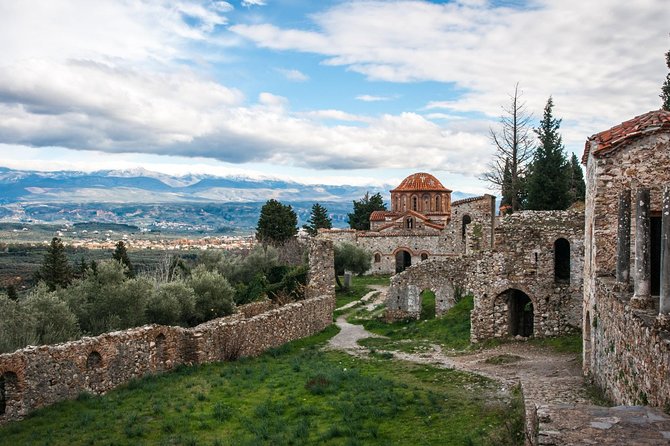
The Museum of the Olive and Greek Olive Oil adds a different note to the day. Instead of focusing on rulers, battles, and ruins, it explains how one plant shaped food, fuel, ritual, perfume, and trade across the Mediterranean.
You will see reconstructions of olive presses in the courtyard, ranging from prehistoric examples to Byzantine designs. Small working models show how pressing methods changed over time. That hands-on mechanical detail can make the subject easier to understand than a room of static objects.
The visit lasts about 30 minutes. That is enough for a clear introduction, though not a leisurely museum study. The entrance fee is not included. For many people, this is one of the tour’s most useful smaller stops because olive oil is part of everyday Greek life, not just an ancient artifact.
Mystras brings the Middle Ages into view
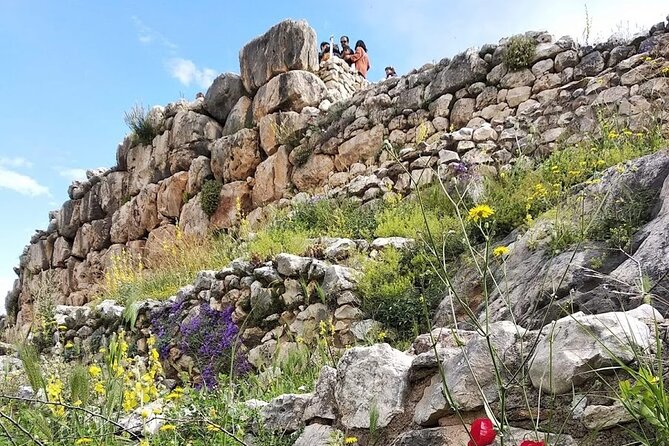
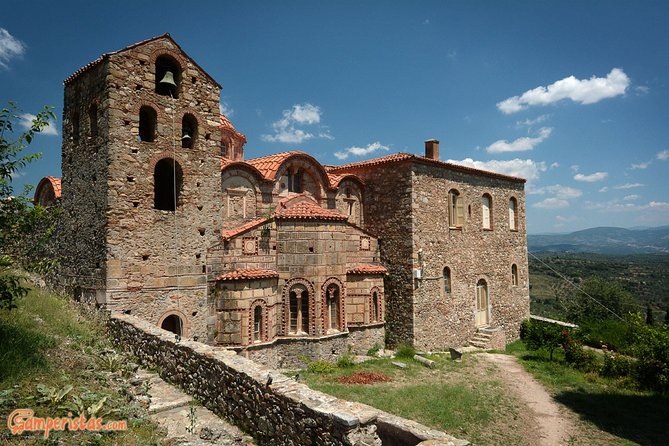
Mystras is the major sightseeing stop, with about 90 minutes at the archaeological site. The medieval city was built around a fortress erected in 1249 by William of Villehardouin, prince of Achaia. The Byzantines later reconquered it, and the Turks and Venetians also occupied it before the city was abandoned in 1832.
The ruins rise in an amphitheater-like arrangement around the fortress. That means you should expect slopes, uneven ground, and a visit that demands more effort than a flat museum. The payoff is the setting and the surviving churches, walls, monasteries, and stone buildings.
Mystras became a center of Byzantine power. Its cathedral, the Metropolis or Church of Hagios Demetrios, was built after 1264. The city also had monasteries such as Brontochion and Christos Zoodotes. Under the Byzantine Despots, churches and other buildings were added, giving the site its unusual mix of religious art, fortifications, and abandoned homes.
The 90-minute schedule is useful for a strong first look, but it is not generous if you want to explore every corner. Wear practical shoes and pace yourself on the slopes. The entrance fee is extra, and the driver cannot guide you through the site.
For me, Mystras is the reason to choose this tour over a trip focused only on Sparta. Sparta connects you to classical Greece and Leonidas. Mystras shows a later Greece that is Byzantine, Christian, fortified, and dramatically different.
Lunch above Sparta in Pikoulianika
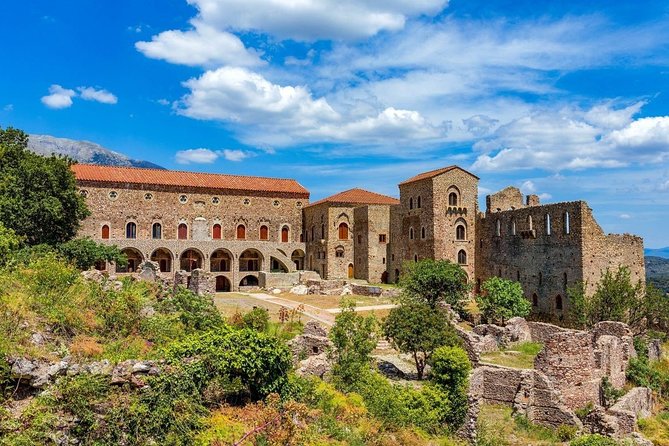
After Mystras, the route includes lunch in Pikoulianika, a mountain village with broad views toward Sparta. The chosen stop is a traditional tavern, and the meal gives you a chance to sit down after the uneven paths at Mystras.
Lunch is not included unless you choose the lunch option. Drinks are also extra. That makes the meal flexible, but you should check the exact option and cost before the day begins.
The village stop helps the itinerary feel less like a race between ruins. You get local food in a small mountain setting rather than eating beside a major highway. Still, the lunch hour is fixed at about 60 minutes, so it is best treated as a pleasant break, not a long, slow meal.
Timing, comfort, and the private format
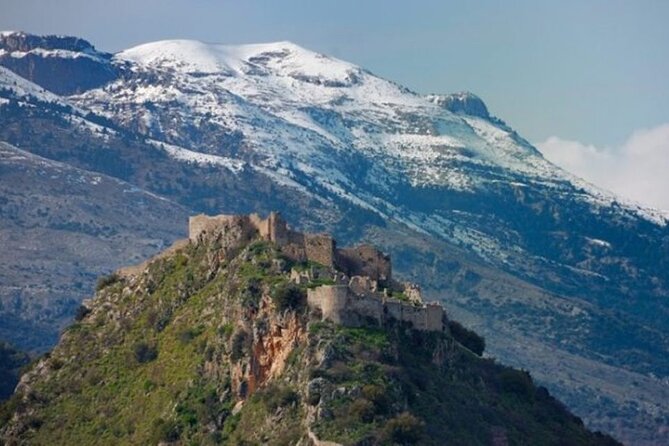
This is a private tour for your group alone, with a maximum of three people. That is the strongest practical reason to consider it. You are not sharing the vehicle with a large crowd, and the pickup can be arranged at a hotel, private residence, or port in Athens and Piraeus.
The format is especially useful for families or small groups that want a full day without handling the route themselves. One past customer praised the driver for keeping the family engaged and for remembering a request for a local sweet, even though it had only been mentioned once. That detail points to the kind of attentive service you should hope for, though no specific driver name is provided.
The day is still road-heavy. The vehicle has air-conditioning, Wi-Fi, and water, but no comfort feature can remove the distance. If you prefer slow mornings, long museum visits, or several nights in the Peloponnese, spend the night in the region instead of trying to cover it from Athens.
The tour has a five-star rating from three reviews, so the feedback is encouraging but based on a small sample. I would put more weight on the clearly stated structure: private transport, a professional English-speaking driver, and door-to-door service.
What you pay for, and what you still need to budget
At $802.86 per group of up to three, the price works best when shared. Two people pay more per person than a full group of three, but they also receive a private vehicle and a route that would be difficult to reproduce comfortably in one day.
Included services are:
- Hotel, residence, and port pickup and return in Athens and Piraeus
- A new luxury vehicle
- Air-conditioning
- Wi-Fi
- Bottled mineral water
- A professional English-speaking driver
- Private use of the tour for your group
Not included are entrance fees, meals unless you select the lunch option, drinks, and airport pickup or return. Keep extra money available for Sparta’s museum, the olive oil museum, and Mystras. The tour description does not give the separate admission prices, so check current fees when booking.
Free cancellation is available if you cancel at least 24 hours before the start time. Cancellations or changes inside that window are not refunded or accepted.
Who should book this Sparta day trip?
I would recommend it to a small group that wants to see several major sites in the Peloponnese without renting a car. It is also a good fit if you value hotel pickup, a private vehicle, and a driver who can adjust the conversation and pace to your group.
Families may appreciate the private setting and the mix of stops. The olive museum gives younger visitors something different from ruins, while the Corinth Canal provides a quick visual break. The day can still be tiring for children because of the long drive and the walking at Mystras.
History-focused visitors should book it if they want a broad introduction to classical Sparta and Byzantine Mystras in one day. If your priority is detailed site interpretation, ask about a licensed guide, since the included driver does not enter the sites with you.
Should you book it?
Book this tour if you want maximum coverage in one day and your group can share the cost. The Corinth Canal, Sparta, the olive oil museum, Mystras, and Pikoulianika give you a varied picture of the Peloponnese, while private transport removes much of the day’s practical trouble.
Skip it if you dislike long drives, need extensive time at each archaeological site, or want entrance fees and meals bundled into one price. For most small groups based in Athens, though, this is a worthwhile way to reach Sparta and Mystras without taking on the road yourself.
FAQ
How long is the Sparta tour from Athens?
The tour lasts approximately 10 to 11 hours.
What is the price of the tour?
The price is $802.86 per group of up to three people.
Is the tour private?
Yes. Only your group participates in the private tour.
Does the tour offer hotel pickup?
Yes. Free pickup and return are offered from hotels, private residences, and ports in Athens and Piraeus.
Is airport pickup included?
Airport pickup and return are available at an extra cost.
Is transportation included?
Yes. Transportation is provided in a new luxury vehicle with air-conditioning, Wi-Fi, and bottled mineral water.
Is an English-speaking guide included?
A professional English-speaking tour driver is included. The driver does not escort you inside the archaeological sites or museums.
Are entrance fees included?
No. Entrance fees for the Archaeological Museum of Sparta, the Museum of the Olive and Greek Olive Oil, and Mystras are paid separately.
Is lunch included?
Meals are not included unless you select the lunch option. Drinks are also not included.
Can I cancel for a full refund?
Yes, if you cancel at least 24 hours before the experience start time. Cancellations or changes made less than 24 hours in advance are not refunded or accepted.
Freshly added Athens trips
- Full day Mycenae – Nafplio – Epidavros private tour★ 5.0 · 3 reviews
- Private Half Day to Ancient Corinth★ 5.0 · 3 reviews
- From Athens: 2-Day Meteora Trip with Tansportation & Hotel★ 5.0 · 3 reviews
- Athens Half Day Small Group Shopping Tour★ 5.0 · 3 reviews
- Athens & Corinth: Guided Christian Tour in Paul’s Footsteps★ 4.0 · 3 reviews
- Nemea wine roads, The most famous wine tour in Greece★ 4.5 · 3 reviews
- Athens: Greek Wine & Olive Oil Tasting at Brettos Plaka★ 4.5 · 3 reviews
- Santorini Dinner Class with Margarita in Athens★ 5.0 · 3 reviews
Tours, compared.

Acropolis, Parthenon & Acropolis Museum Guided Tour
Read our review →


Mythology of Delphi, Museum and Arachova Guided Tour
Read our review →
Acropolis, Parthenon & Acropolis Museum Guided Tour
Read our review →