
Reviewed · MYCENAE & EPIDAURUS TOURS
Blue Lake, Sanctuary of Hera, Mycenae, Ancient Corinth, Canal
The best part of this day is the mix: Mycenae’s huge Bronze Age walls, the Corinth Canal, Roman ruins, mountain views, and a swim beside the Sanctuary of Hera. You cover a lot of ground without changing buses or worrying about Greek roads.
I like the private car and the flexible schedule. Yannis and Panos have been praised for clear explanations, kind service, and good lunch advice. I also like the small touches, including water, WiFi, handmade Greek biscuits, and a book for children. The tradeoff is simple: nine hours is a long day, and some stops are brief unless you adjust the plan.
In This Review
- Key points to know before booking
- Why this private Athens day trip works
- The Corinth Canal and Ancient Diolkos
- Mycenae, where myth meets stone
- Walking through the Lion Gate and royal tombs
- Acrocorinth, a fortress above Ancient Corinth
- Three hours among the ruins of Ancient Corinth
- Ending at Heraion and Blue Lake
- Is $337.15 per person good value?
- What the day feels like in practice
- Who should book this experience?
- Should you book the Corinth, Mycenae, and Blue Lake tour?
- FAQ
- How long does the tour last?
- Is hotel pickup in Athens included?
- Are entrance fees included?
- Is a licensed guide included?
- Can I swim at Blue Lake?
- Is food included in the price?
Key points to know before booking
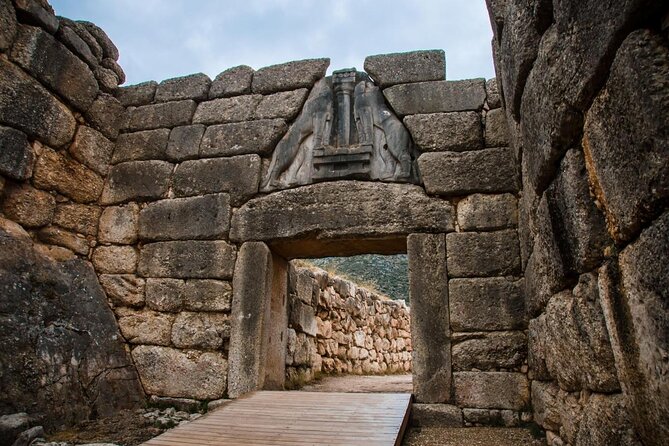
- Mycenae gives you the strongest ancient-world setting, with the Lion Gate, royal tombs, Cyclopean walls, palace remains, and a small museum.
- The private vehicle makes this route practical, especially since the sites are spread across the Peloponnese and public transport would be awkward.
- The Corinth Canal is a quick but worthwhile opening stop, with views of the modern cut and Ancient Diolkos, the old track used to move boats overland.
- Ancient Corinth deserves the most time, including the Temple of Apollo, Agora, Bema, museum, theatre, and Lechaion Road.
- Blue Lake and the Sanctuary of Hera provide a welcome change of pace, with time to swim and enjoy the shore in warm weather.
- Entrance fees, meals, and a licensed guide are extra, so the $337.15 price per person works best for people who value privacy and convenience.
Why this private Athens day trip works
Athens is packed with temples, museums, traffic, and hard stone under the sun. This excursion gives you a full day beyond the capital, heading west into the Peloponnese. You get major archaeological sites without arranging a rental car, studying road maps, or returning to the same hotel each night.
The tour lasts about nine hours and includes pickup and return at your Athens hotel. Your driver meets you in the lobby, or at the entrance of an Airbnb apartment. Airport and port pickup can also be arranged for an added cost.
This is a private experience for your own group, not a shared coach outing. That matters here because the route contains several short stops and several larger sites. You can spend more time at Mycenae, shorten the castle visit, or change the order of the day when practical.
Your driver provides transport and background as you travel, but does not accompany you inside each archaeological site or museum. If you want formal guiding among the ruins, you can request a licensed guide at an additional cost. For many people, that arrangement is a plus: you receive context on the road, then explore at your own pace.
More Ancient Corinth and canal stops:
- From Athens: Ancient Corinth Day Trip with Canal & VR Guide
★ 4.6 · 1,073 reviews - Private Biblical Tour Ancient Corinth & Isthmus Canal from Athens
★ 5.0 · 762 reviews - Athens: Ancient Corinth & Nafplio Full Day Trip with Swim
★ 4.8 · 523 reviews
The Corinth Canal and Ancient Diolkos
The Corinth Canal is the first big visual stop. The narrow waterway cuts through the Isthmus of Corinth, separating the mainland from the Peloponnese and creating a direct route between the Gulf of Corinth and the Saronic Gulf.
You get about 45 minutes here, enough for photos, a look over the canal, and a short explanation of its role in Mediterranean trade. The canal is a 19th-century engineering project, but the idea of crossing the isthmus is far older.
Nearby, Ancient Diolkos helps put the site into perspective. This paved trackway allowed boats or cargo to be moved overland across the isthmus in ancient Greece. It is an unusual reminder that ancient transport was not limited to roads and ships. People found ways to shift vessels across land when the sea route was longer or less practical.
The canal stop is not a full morning visit. You will not spend hours exploring a large archaeological complex. Think of it as a strong introduction to the region, with a striking view and an unusual piece of engineering history.
Mycenae, where myth meets stone
Mycenae is the heart of the day. The site was the most important center of the Late Bronze Age in the area, and Greek legend links it with Agamemnon, the king who led the Greeks in the Trojan War.
The setting is powerful because the ruins sit on high ground with broad views across the surrounding countryside. The walls are built from enormous limestone blocks. Ancient writers later explained their size by saying only the Cyclopes could have moved them, which is how the term Cyclopean walls entered the vocabulary of archaeology.
Allow about an hour and a half for the main Mycenae visit. The route includes the royal burial circles, the citadel, the palace remains, and the famous Lion Gate. Some portions of the itinerary list separate times for these features, but in practice they form one connected archaeological visit with nearby add-on stops.
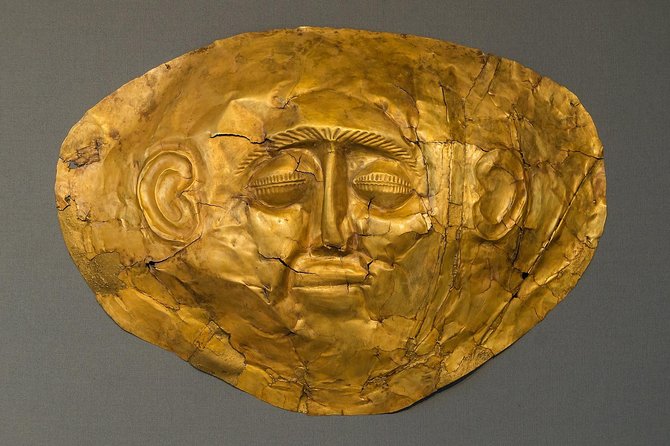
The Grave Circles A and B were royal cemeteries outside and near the citadel. Their contents included gold burial objects, weapons, jewelry, masks, and other items that helped reveal the power of Mycenae’s ruling class. The objects themselves are seen in the museum, while the grave circles let you see where these elite burials took place.
The palace area included domestic rooms, a throne room suite, a grand staircase, official rooms, and a forecourt. Much of the structure is now exposed stone, so a little imagination helps. Your driver can explain the basic layout during the journey, but remember that a driver is not the same as a licensed site guide.
Walking through the Lion Gate and royal tombs
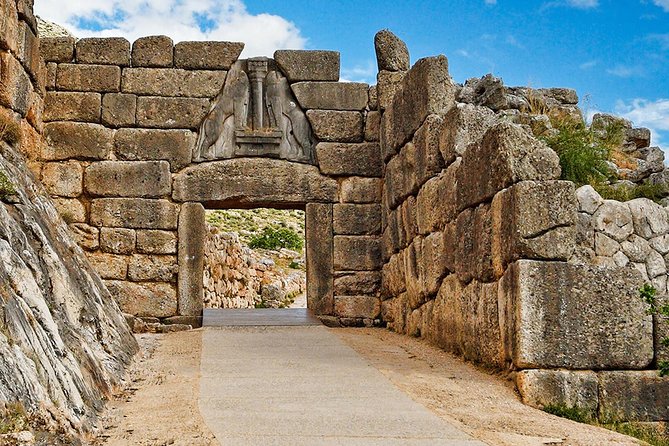
The Lion Gate is Mycenae’s best-known entrance. Built in the 13th century BC, it formed the main gateway into the Bronze Age citadel. The massive lintel and triangular relief above it make this one of the most memorable surviving entrances from the ancient world.
You have about 15 minutes assigned to the Lion Gate, but the flexible format may allow more time if the rest of your visit moves quickly. It is worth pausing here rather than treating it as a quick photo stop. Look at the scale of the stones and the way the entrance controlled movement into the fortified center.
The Treasury of Atreus is another highlight. This large tholos tomb, built around 1250 BC, has a beehive-shaped interior made from carefully laid stone. The name is traditional, and the tomb is associated with the family of Agamemnon, but the structure belongs to the Bronze Age archaeological record rather than a confirmed episode from Homer.
The nearby Tomb of Clytemnestra is another Mycenaean tholos tomb, also dated to around 1250 BC. These tombs are valuable because they show the ceremony and construction skill used for elite burials, even when the names attached to them come from later legend.
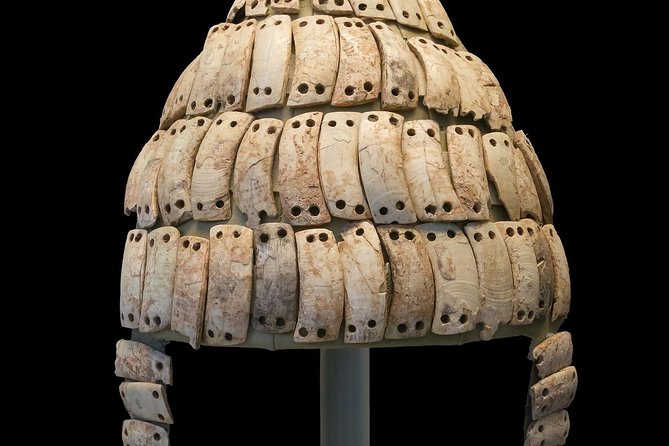
The Mycenae Archaeological Museum fills in what the bare ruins cannot show. You will find gold grave goods, burial masks, jewelry, weapons, religious figures, and fresco fragments. The museum is not huge, with roughly 30 minutes set aside, but it gives you the objects needed to understand why Mycenae was called rich in gold.
Entrance fees for the archaeological sites and museum are not included. This is an important budget detail, especially since the day includes several paid locations.
More Mycenae and Epidaurus days:
- From Athens: Mycenae, Epidaurus & Nafplio Full Day Trip
★ 4.8 · 2,438 reviews - From Athens: Mycenae, Epidaurus & Nafplio Full-Day Tour
★ 4.5 · 1,580 reviews - 4-Day Classical Greece Tour: Epidaurus, Mycenae, Olympia, Delphi, Meteora
★ 4.5 · 732 reviews - Mycenae and Nafplion Day Trip from Athens with Official guide
★ 4.5 · 501 reviews
Acrocorinth, a fortress above Ancient Corinth
After Mycenae, the route turns toward Corinth and climbs to Acrocorinth, the acropolis of ancient Corinth. This is a monolithic rock above the ancient city, fortified with three lines of walls and towers.
You have about an hour here. The site includes gates, the keep, remains linked with the Temple of Aphrodite, and a Frankish tower at the southwest edge. Churches, mosques, houses, fountains, and cisterns also survive within the fortress area, reflecting the many periods that used this strong defensive position.
Acrocorinth is visually impressive, but it is not a flat, easy stroll through neatly arranged ruins. You should expect slopes, stone surfaces, and a site spread over high ground. Wear shoes with a firm grip and do not assume you will see every corner in the allotted hour.
The views toward the Corinthian Gulf and the southwest coast of the Peloponnese are a major reason to include this stop. Geraneia Mountain also provides a scenic viewpoint over the gulf, with about 15 minutes set aside for photographs and orientation.
The Upper Peirene Fountain, located within the fortress walls, is tied to the myth of Sisyphus and the river god Asopus. You have about 15 minutes for this feature. It is a small stop, but it adds a human detail to a site otherwise dominated by walls and military stonework.
Three hours among the ruins of Ancient Corinth
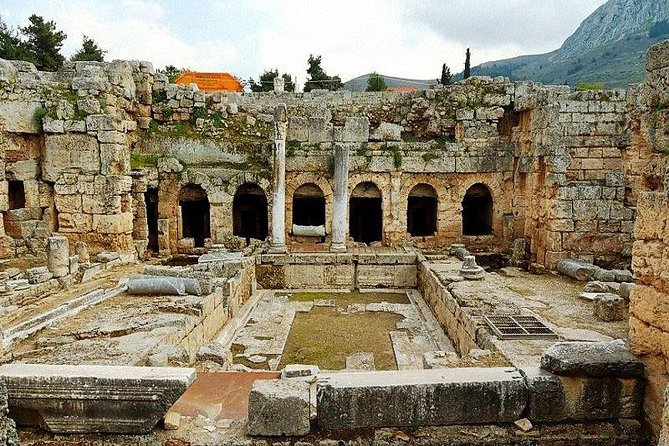
Ancient Corinth gets the longest visit, about three hours, and that is sensible. The site combines Greek, Roman, Ottoman, and early Christian remains, so it feels different from Mycenae.
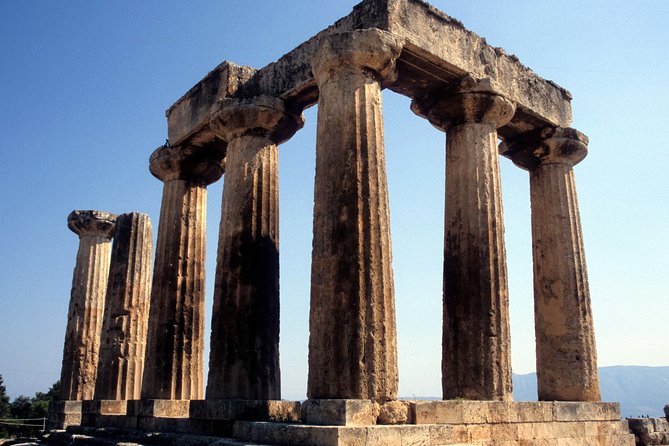
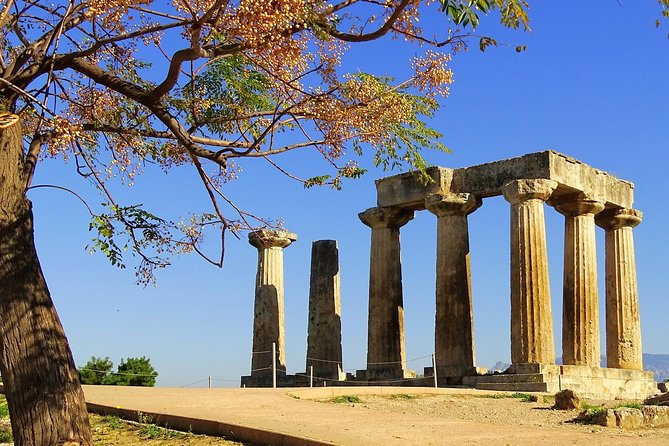
The Temple of Apollo is the main ancient landmark. Built around 560 BC, it was one of the earliest Doric temples in the Peloponnese and on the Greek mainland. Its monolithic columns are especially notable, since columns made from single stones were unusual in the ancient world.
The Agora was a large rectangular public center, about 160 meters long and 70 meters wide. Shops, small temples, an altar, and the Bema occupied this area. The Bema is the platform associated with the Apostle Paul’s address to the Corinthians in AD 52, giving the ruins a strong connection to early Christian history.
You can also see Roman buildings, the theatre, the Odeon, the Asklepieion, and the Lechaion Road leading toward the ancient port. The site rewards slow walking more than a rushed checklist. Three hours gives you enough time to see the principal remains, visit the museum, and stop for lunch.
The Ancient Corinth Archaeological Museum holds objects from the local site and nearby settlements. After seeing the ruins, the exhibits help explain daily life, worship, trade, and public building in the city.
A village-style lunch on a terrace overlooking the archaeological site and Temple of Apollo is offered as part of the day’s plan, but food and drinks are not included in the tour price. Your driver can recommend a suitable place, and a scenic meal makes good use of the midday pause.
There are also village shops where you can browse for handmade souvenirs. Keep this portion flexible. If you want a thorough look at the museum and ruins, shopping may need to be brief.
Ending at Heraion and Blue Lake
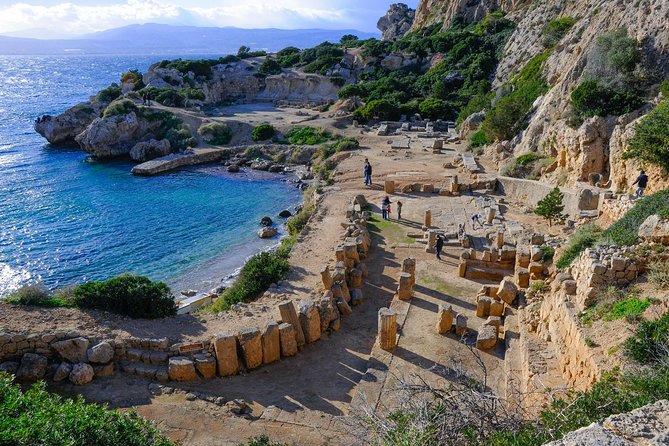
The final major stop is the Sanctuary of Hera at Perachora, often called Heraion, beside Blue Lake. After a full day of stone, tombs, walls, and museums, this is a welcome change.
The sanctuary is linked with the worship of Hera and sits near the water, with the Malagavi Lighthouse nearby. The setting combines archaeology and the coast in a way that feels less formal than a major city site.
You have about an hour here, including time for a refreshing swim and a bath in the Greek sun. Blue Lake is most appealing in warm weather, so bring swimwear, a towel, and a change of clothes if you plan to enter the water. The tour information does not promise beach facilities, so pack the basics yourself.
The timing can also work beautifully near sunset. A sunset visit to the Temple of Hera has been arranged on past outings when the schedule allowed. In winter, a different stop may make more sense, since swimming is not the point and daylight is shorter. This is one of the clearest benefits of a private vehicle: you are not locked into a single fixed stop if conditions suggest another choice.
Is $337.15 per person good value?
At $337.15 per person, this is not a budget sightseeing bus. The price makes more sense when you consider what it covers: a fully private tour, hotel pickup and return, a private luxury vehicle, an English-speaking driver, bottled water, refreshing wipes, WiFi, handmade Greek biscuits, and the ability to adjust the schedule.
You are paying for convenience as much as transport. Mycenae, Ancient Corinth, Acrocorinth, Heraion, and Blue Lake are spread across a large area. Driving yourself would add car rental costs, fuel, parking concerns, and the responsibility of navigating an unfamiliar route after a long day of sightseeing.
The value is weaker if you mainly want a formal archaeological lesson at every site. A licensed guide is not included, and admission fees are extra. You may want to add the guide if Mycenae and Ancient Corinth are central reasons for your visit.
The strongest match is a family, couple, or small group that values privacy and wants to see several major places in one day. It is also useful for anyone who prefers not to drive but dislikes a rigid group schedule.
What the day feels like in practice
The day is busy. You visit two major archaeological areas, a fortress, a museum, the canal, a mountain viewpoint, and a coastal sanctuary. Some stops are only 15 or 30 minutes, so you should decide in advance which places matter most.
The vehicle helps make the long route comfortable. Water is supplied, and the driver can adjust the order or length of stops when possible. Yannis has been especially praised for his warm manner, clear background information, attention to small details, and help with families. Panos is also noted for being responsive and for offering good advice about where to eat.
The driver may provide a book for children to use during the day. That small touch can help younger members of your group connect the ruins with the stories surrounding them.
You should also understand the difference between transport with commentary and a traditional guided tour. Your driver can explain the route and historical setting, but you explore the sites independently unless you add a licensed guide. Some people prefer exactly that freedom. Others will want more detailed interpretation once they are among the ruins.
Who should book this experience?
Book this day trip if you want a private, efficient route from Athens and enjoy variety. It suits people who want ancient sites but also appreciate a swim, a local meal, mountain views, and a comfortable ride.
It is particularly good for families, since the schedule can be adjusted and the vehicle keeps the group together. It also works for couples who want a relaxed alternative to a large coach tour.
Think twice if you dislike early starts, long drives, or short visits. The route is ambitious, and you cannot explore every archaeological corner at leisure. If your main goal is to study Mycenae in detail, choose a shorter private visit focused on that site.
Free cancellation is available up to 24 hours before the start time. Pickup and return are included from Athens hotels and Airbnb apartments, while airport pickup costs extra.
Should you book the Corinth, Mycenae, and Blue Lake tour?
I would book this if you have one free day in Athens and want a broad look at the nearby Peloponnese without handling the driving. The combination of Mycenae’s Bronze Age ruins, Ancient Corinth’s Greek and Roman remains, and the coastal finish at Heraion gives the day real variety.
Before booking, decide if you want to add a licensed guide and set aside money for entrance fees and lunch. Ask for the schedule to favor your priorities, especially if you are visiting in winter or want more time at Mycenae.
For a private group that values comfort, flexibility, and a full day away from Athens, the price can be justified. For a solo visitor or a history enthusiast who wants slow, expert-led exploration, the pace and extra costs may make another format a better choice.
FAQ
How long does the tour last?
The experience lasts approximately nine hours, including the drive from Athens, sightseeing, and the return to your hotel.
Is hotel pickup in Athens included?
Yes. Your private driver picks you up from your Athens hotel and returns you there. For an Airbnb apartment, the driver contacts you upon arrival and meets you at the building entrance.
Are entrance fees included?
No. Entrance fees to the archaeological sites and museums are not included. Skip-the-line ticket service is available on request.
Is a licensed guide included?
No. The tour includes a professional English-speaking driver with background in Greek history. A licensed guide who accompanies you inside the sites and museum can be arranged for an additional cost.
Can I swim at Blue Lake?
Yes. The Heraion stop includes time for a refreshing swim at Blue Lake. This option is most suitable in warm weather, and you should bring your own swimwear, towel, and change of clothes.
Is food included in the price?
No. Food and drinks are not included. The route includes the option of an authentic village-style lunch on a terrace overlooking Ancient Corinth and the Temple of Apollo.
Freshly added Athens trips
- Athens and Ancient Corinth Private from Athens★ 5.0 · 3 reviews
- From Athens: Mycenae and Epidaurus Private Tour★ 4.8 · 3 reviews
- Full day Meteora private tour★ 5.0 · 3 reviews
- Double Shore Dive (certified divers)★ 4.5 · 3 reviews
- Athens Hills: Mythology Treasure Hunt★ 5.0 · 3 reviews
- Sunset & swimming at Cape Sounio, Poseidon temple★ 5.0 · 3 reviews
- Philosophy Experience at Plato’s Academy Park – basic version★ 5.0 · 3 reviews
- Private Acropolis Tour – Ticket Included★ 5.0 · 3 reviews
Mycenae & Epidaurus Tours, compared.
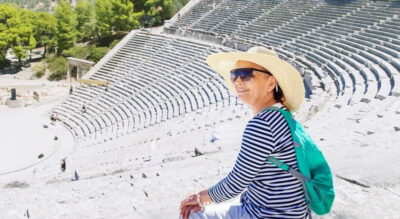
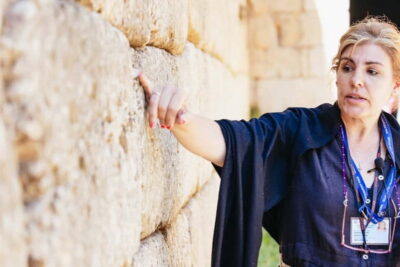
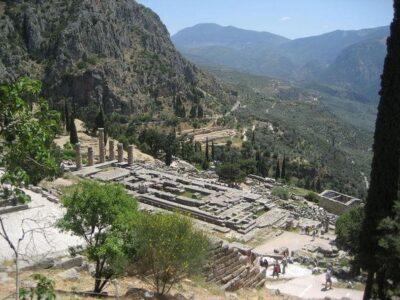
4-Day Classical Greece Tour: Epidaurus, Mycenae, Olympia, Delphi, Meteora
Read our review →
Ancient Corinth & Nafplio Full Day Trip with Swim
Read our review →
Mycenae and Nafplion Day Trip from Athens with Official guide
Read our review →
3-Day Classical Greece Tour: Epidaurus, Mycenae, Nafplion, Olympia, Delphi
Read our review →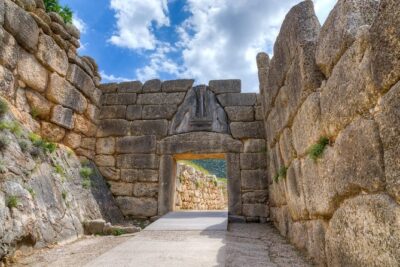
Mycenae, Epidaurus, Nafplio Full Day Private Tour from Athens
Read our review →Browse the lists this tour appears in