
Reviewed · MYCENAE & EPIDAURUS TOURS
Mycenae, Epidaurus, Nafplio Full Day Private Tour from Athens
Mycenae, Epidaurus, and Nafplio pack a remarkable slice of the Peloponnese into one long day. You move from a Bronze Age citadel linked to Agamemnon, to a sanctuary devoted to healing, then finish in Greece’s elegant former capital beside a harbor full of small boats.
I like the private car and flexible pace, especially when you want time for photographs or need to adjust the day around your group. I also like the range of the stops: the Corinth Canal gives you a quick engineering spectacle, Mycenae brings Homeric legend down to stone, and Nafplio adds food, coffee, and town life.
The tradeoff is distance. You spend many hours on the road, and the driver is not a licensed guide who enters the archaeological sites with you. If you want detailed interpretation beside every monument, request a licensed guide in advance.
In This Review
- Key points
- Why this private Athens day trip works
- The Corinth Canal: a sharp opening view
- Mycenae and the world of Agamemnon
- The Lion Gate
- Tombs, walls, and the museum
- The Treasury of Atreus
- Epidaurus and the ancient art of healing
- The Theatre of Epidaurus
- The Archaeological Museum of Epidaurus
- Nafplio: the reward at the end of the road
- Bourtzi and the harbor
- Acronauplia
- Palamidi Castle
- What your driver adds to the day
- Price, group size, and overall value
- Who should book this day out
- Should you book the Mycenae, Epidaurus, and Nafplio tour?
- FAQ
- How long does the tour from Athens last?
- What places are included in the route?
- Is lunch included?
- Are entrance fees included?
- Will the driver guide me inside the archaeological sites?
- Where can the tour pick me up?
Key points
- Four very different experiences in one day: The Corinth Canal, Mycenae, Epidaurus, and Nafplio each offer a distinct reason to stop.
- A genuinely private outing: Only your group participates, with pickup from a hotel, apartment, airport, or port.
- Drivers who add useful context: Spiros, George, Notis, Petros, Michael, and others have been praised for history, local life, and practical suggestions.
- Lunch is included: You can choose a Greek traditional food option, with Nafplio providing the setting for a relaxed midday meal.
- Allow for entrance fees: Mycenae and Epidaurus together cost €40 per person, separate from the tour price.
- Wear practical shoes: Ancient paths and stones can be slippery, especially after rain.
Why this private Athens day trip works
The route covers a lot of ground, but it is not just a checklist of ruins. You get a fast introduction to the Corinth Canal, a major Bronze Age center, one of Greece’s finest ancient theatres, and a handsome seaside town with Venetian and Ottoman traces.
A private vehicle changes the feel of the day. You are not tied to a large group or forced to move when the guide raises a flag. Your driver can give you an overview in the car, point out olive and orange groves along the way, and wait while you explore each site independently.
That flexibility matters because the stops require different kinds of attention. Mycenae rewards slow looking and some walking. Epidaurus calls for a quiet moment in the theatre. Nafplio is less about monuments and more about choosing a table, wandering by the water, and enjoying a change of pace.
The outing lasts about eight to nine hours. That makes it a full day, not a casual half-day escape. You should begin with enough energy for several archaeological sites and accept that the return to Athens may feel long after a busy afternoon.
More Mycenae and Epidaurus days:
- From Athens: Mycenae, Epidaurus & Nafplio Full Day Trip
★ 4.8 · 2,438 reviews - From Athens: Mycenae, Epidaurus & Nafplio Full-Day Tour
★ 4.5 · 1,580 reviews - 4-Day Classical Greece Tour: Epidaurus, Mycenae, Olympia, Delphi, Meteora
★ 4.5 · 732 reviews
The Corinth Canal: a sharp opening view
The Corinth Canal is usually the first major stop after leaving Athens. The visit is brief, around 15 minutes, but it gives you a strong visual start: steep limestone walls drop toward a narrow strip of water, while boats pass far below.
The canal runs about 6.4 kilometers through the Isthmus of Corinth. At its base, it is only about 21.4 meters wide, which is too narrow for many modern ships. It was cut at sea level and has no locks.
You will not spend hours here, and that is fine. The best use of the stop is to take in the scale from above, photograph the canal, and let your driver explain how the waterway separates the Peloponnese from mainland Greece. It is a quick stop, but a worthwhile one because it gives you a sense of the geography before the ancient sites begin.
Mycenae and the world of Agamemnon
Mycenae is the emotional center of the day. The fortified citadel was one of the main centers of Greek civilization during the second millennium BC, and its name gives us the term Mycenaean for the period from roughly 1600 to 1100 BC.
The site is tied to King Agamemnon, the legendary commander of the Greek forces in the Trojan War. The stone remains do not prove the stories told by Homer, but they make the old tales feel less distant. Here, myth has a physical setting: massive walls, royal entrances, burial places, and a citadel high above the surrounding countryside.
The visible remains mostly date from about 1350 to 1200 BC. At its height around 1350 BC, Mycenae may have supported a population of about 30,000 across the citadel and lower town. That helps you read the site as more than a lonely ruin. It was a powerful center with a military role and a wide sphere of influence across southern Greece, Crete, the Cyclades, and parts of southwest Anatolia.
The Lion Gate
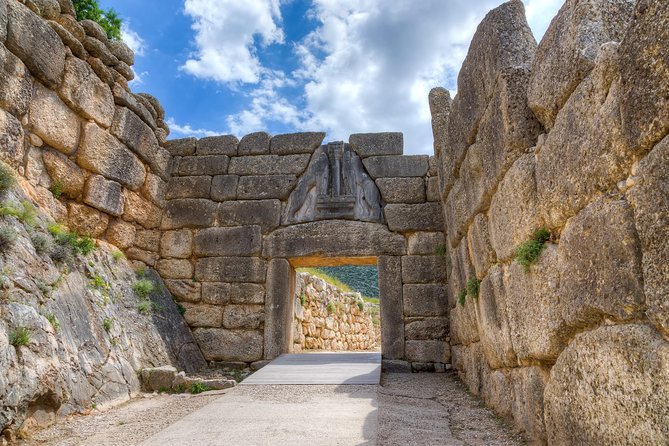
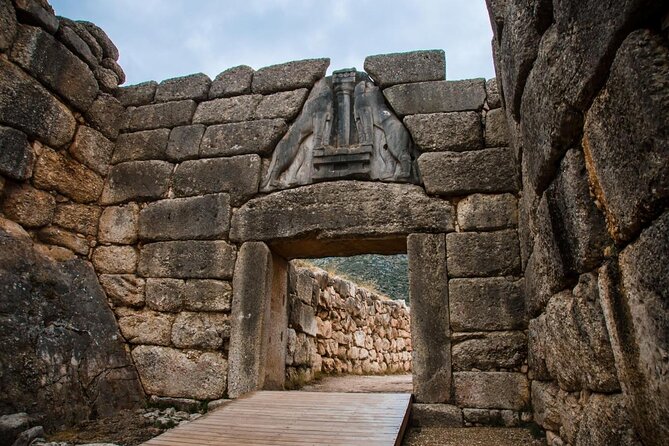
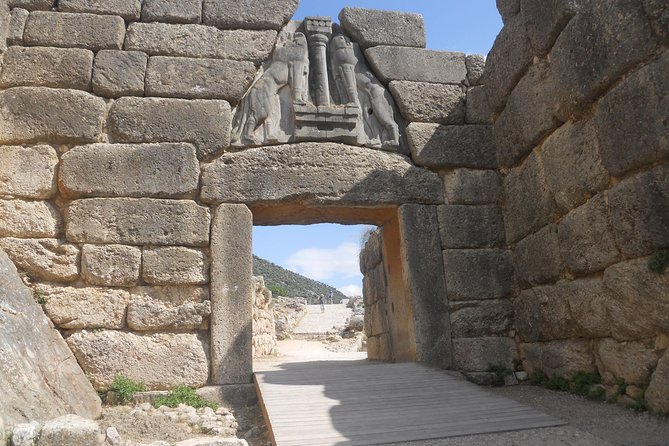
The Lion Gate is the image most people remember from Mycenae. Built around 1250 BC, it formed the main entrance to the citadel and carries a relief of two lions or lionesses above the doorway.
The relief is set into a triangular space above the lintel, a design feature used in Mycenaean building. It is especially important because it is the only monumental piece of Mycenaean sculpture that survives above ground and the largest sculpture from the prehistoric Aegean.
Stand back before walking through. The gate makes more sense when you see the scale of the surrounding Cyclopean walls, which ancient people later believed could only have been built by Cyclopes. The stones are so large that the nickname feels understandable, even if the builders were highly skilled Bronze Age engineers rather than one-eyed giants.
The visit involves uneven ground and stone paths. You might find some areas slippery after rain, so sturdy walking shoes are a sensible choice. The private format lets you spend extra time at the gate if it captures your attention, though the total day still requires a degree of discipline.
A few more Athens days worth a look
- All Day Cruise -3 Islands to Agistri,Moni, Aegina with lunch and drinks included
★ 5.0 · 4,958 reviews - From Athens: Delphi Full Day V.R. Audio Guided Tour
★ 4.6 · 3,028 reviews - Athens Full Day Private Tour
★ 5.0 · 2,903 reviews - Athens Greece Full Day private tour
★ 5.0 · 785 reviews
Tombs, walls, and the museum
The archaeological site includes the acropolis, funerary areas, and remains of habitation outside the main fortifications. You can see the Tomb of Clytemnestra, Cyclopean walls, and the arrangement of the citadel that once controlled the area.
The Archaeological Museum of Mycenae sits near the entrance, only a short walk from the Lion Gate. Its displays help give shape to what can otherwise be a hard site to read. Pottery, objects, architectural pieces, and burial finds provide the smaller details that the huge stones cannot.
Entrance to Mycenae, its museum, and the Treasury of Atreus is not included in the tour price. The listed combined fee is €20 per person. Confirm the current fee when booking, since archaeological admission prices can change.
The Treasury of Atreus
The Treasury of Atreus is a tholos tomb, shaped like a large beehive. It was built around 1250 BC on Panagitsa Hill and is also known as the Tomb of Agamemnon, although the identification with Agamemnon is not proven.
The interior is the reason to make the short additional stop. Concentric stone courses rise into a domed chamber, creating a powerful sense of order and scale. The lintel above the entrance weighs about 120 tons, with dimensions of approximately 8.3 by 5.2 by 1.2 meters.
This is not a museum-style visit with labels at every turn. You benefit from your driver’s explanation before entering, then you can take a quiet look for yourself. If you want more detail about burial customs, architecture, or the archaeological work of Heinrich Schliemann, a licensed guide would add real value.
Epidaurus and the ancient art of healing
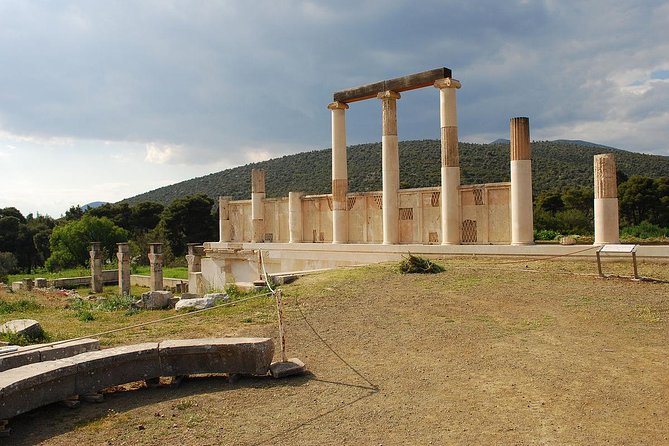
Epidaurus changes the subject from royal power to medicine. The sanctuary was dedicated to Asclepius, the ancient Greek god of healing, and it became one of the most important healing centers in Greece.
The Temple of Asclepius was built in the early fourth century BC. The sanctuary competed with major religious centers such as Olympia and Delphi, drawing people who sought cures, rituals, and divine help.
The archaeological grounds include temples, columns, inscriptions, and other remains. Some structures are fragmentary, so the site rewards a little preparation. Your driver can explain the basic setting during the journey, but only a licensed guide can provide official guided commentary inside the monuments.
The Theatre of Epidaurus
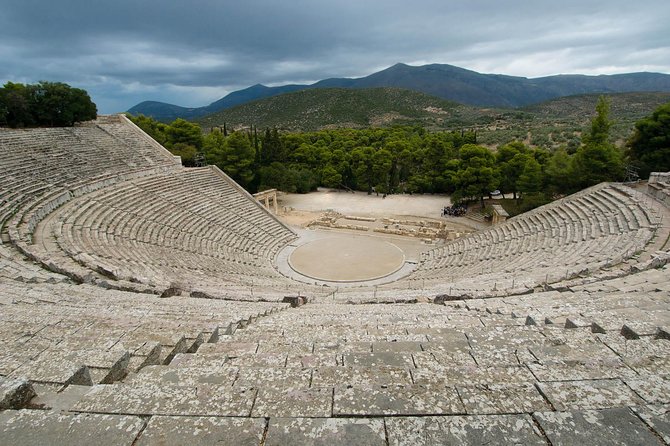
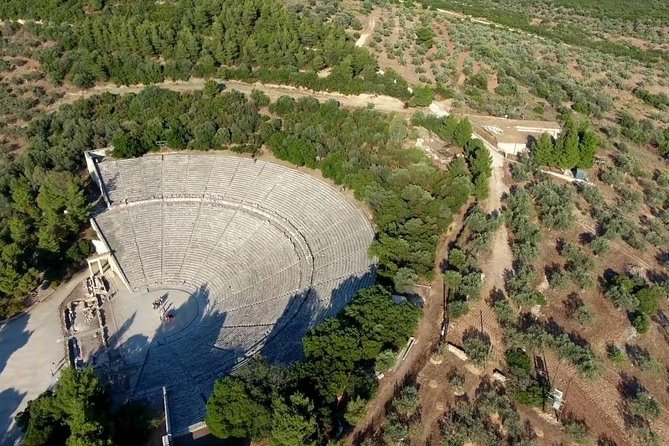
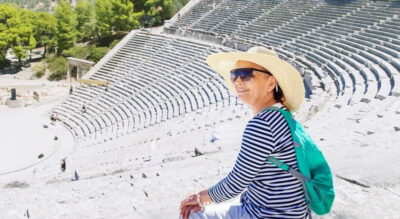
The Ancient Theatre of Epidaurus is the clear highlight. Built on the west side of Cynortion Mountain, it has the classic Hellenistic arrangement of seating, orchestra, and stage building.
Its acoustics are famous for good reason. From the upper seating, a small sound made in the orchestra can carry with surprising clarity. The theatre also retains its original form because it did not undergo major changes during the Roman period.
You should take a moment to sit quietly rather than simply snap a photograph and move on. The theatre is one of those places where the physical setting explains the reputation. Stone rows curve around the performance space, and the surrounding hills help create the sense of a carefully designed room without a roof.
The scheduled time at the theatre is about 30 minutes, alongside time for the wider sanctuary and museum. That is enough for a strong first visit, but not enough for a scholarly inspection of every building. If the theatre is your main reason for booking, tell your driver early so the pacing can reflect your priorities.
The Archaeological Museum of Epidaurus
The museum was established in the early twentieth century to show objects found at Epidaurus and nearby sites. It is especially useful for reconstructions of temples, columns, and inscriptions.
I see the museum as a compact companion to the ruins rather than a destination that requires a long independent visit. It can help you understand how the sanctuary looked and how ancient builders handled architectural details that now lie scattered across the grounds.
The entrance fee for Epidaurus and its archaeological museum is listed as €20 per person and is paid separately. Combined with the Mycenae fee, the added admission cost is €40 per person.
Nafplio: the reward at the end of the road
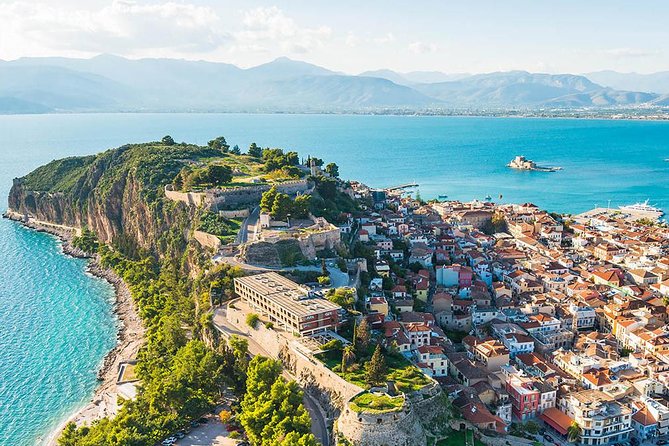
Nafplio gives the day a welcome human scale. After walls, tombs, temples, and long stretches in the car, you get free time for lunch, coffee, shopping, or a walk beside the harbor.
The town served as the capital of the First Hellenic Republic and the Kingdom of Greece from the Greek Revolution in 1821 until 1834. Its history includes periods under Frankish, Venetian, and Ottoman control, which helps explain the mixture of fortifications and architecture.
The old streets, cobbled squares, harbor, and colored buildings make Nafplio an easy place to enjoy without a strict plan. You can choose a restaurant, browse shops, or simply sit near the water. Lunch is included, and a Greek traditional food option is available. The meal is an important part of the day because it lets you slow down rather than treat Nafplio as another quick photograph stop.
The scheduled free time is about 90 minutes. That is enough for lunch and a short walk, but not enough to explore every corner or linger on the castle hill. If you want more town time, discuss the plan with your driver. The private setup gives you more room to negotiate than a fixed coach excursion.
Bourtzi and the harbor
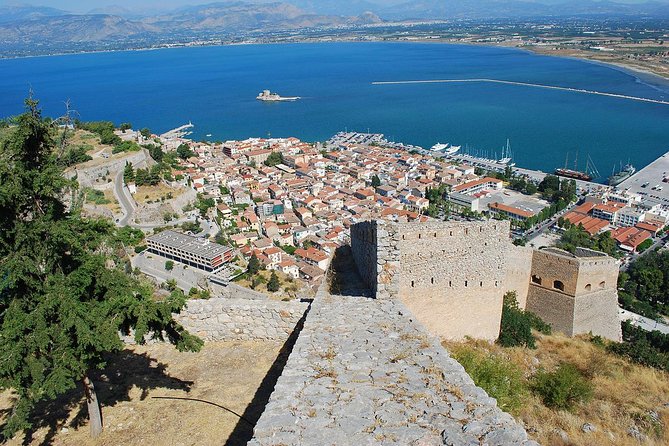
Bourtzi is the small Venetian water castle in the middle of Nafplio’s harbor. You view it from the shore and have around 10 minutes for photographs.
The stop is short, but the castle gives the harbor its most recognizable shape. Look across the water toward Bourtzi, then turn back toward the town and the hills. It is a simple pause, yet it helps you understand why Nafplio has long mattered as a port and defensive town.
Acronauplia
Acronauplia is the oldest section of Nafplio. Before the thirteenth century, it was a separate town, later absorbed into the larger fortifications under Frankish and Venetian rule.
Its position above the town provides views toward the harbor and Argolic Gulf. Part of the area was later used as a prison, and a hotel complex was eventually built there to take advantage of the outlook.
The stop is useful even if you do not spend long walking the old fortifications. It shows that Nafplio is not only a pretty harbor town. Its high ground explains the town’s military importance and gives you a different view of the streets below.
Palamidi Castle
Palamidi rises on a 216-meter hill above Nafplio. The Venetians built the fortress during their second period of control, from 1686 to 1715.
From the top, the views over the Argolic Gulf, Nafplio, and the surrounding country are the reward. The famous stairway from town is said to have 913 steps, although local counting often rounds the number to 999, and reaching every part of the fortress involves more than a thousand steps.
The tour allows about 30 minutes here, and the entrance fee is not included. The stop may be arranged as a visit to the fortress or a photo opportunity from below, depending on timing and the day’s pace. Ask your driver exactly how much walking is planned before you begin, especially after Mycenae and Epidaurus.
What your driver adds to the day
The driver is not an official archaeological guide and does not enter the sites with you. That distinction matters. You receive historical explanations in fluent English during the drive and before the stops, but you explore the monuments on your own unless you request a licensed guide.
The strongest part of the service is the personal handling of the day. Drivers named Spiros, George, Notis, Petros, Michael, Fotis, Alex, Kosta, and others have been praised for clear explanations, polite service, safe driving, and good timing. You should not assume a particular driver will be assigned, but the repeated pattern is useful: the driver can shape the day around your interests.
Specific strengths include explaining Greek myths before Mycenae, discussing local agriculture, suggesting a lunch restaurant in Nafplio, and adding a brief extra stop when time allows. One driver even used spare time for a small tour of Athens landmarks at the end.
That flexibility is especially useful for families and small groups. You can stop for a break, spend longer at the Lion Gate, or shorten a museum visit without waiting for strangers. The vehicle is air-conditioned, Wi-Fi is provided, and bottled water is included.
Price, group size, and overall value
The listed price is $229.14 per person. At first glance, that is far more than a public bus ticket, but the comparison is not quite fair. The price covers private transport from your Athens address, a full day on the road, hotel, airport, or port pickup and drop-off, Wi-Fi, bottled water, and lunch.
It also includes the convenience of reaching three major destinations that are spread across the Peloponnese without arranging separate transport. Group discounts can improve the value for families or small parties. The larger your group, the more attractive a private vehicle becomes compared with buying several seats on separate excursions.
You still need to budget €40 per person for the listed Mycenae and Epidaurus admissions. A licensed guide is an additional request and depends on availability. Include those costs when comparing this experience with a small-group tour.
I think the price makes the most sense if you value comfort, privacy, and control over the schedule. It makes less sense if you want a low-cost ride or prefer a formal guide beside you at every monument.
Who should book this day out
I would recommend it to first-time visitors who want to see more of mainland Greece than Athens allows. It is also a good fit for cruise passengers using a port pickup, families who need a private schedule, and couples who prefer a car to a large coach.
History fans will appreciate the concentration of sites, especially if Mycenae and Epidaurus are high on the wish list. Food-focused visitors will enjoy the pause in Nafplio, while photographers get strong subjects at the canal, Lion Gate, theatre, harbor, and castles.
You should think twice if long drives wear you down. One full day covering this much territory means plenty of time in the vehicle. The upside is that the road becomes part of the experience, with views of olive and orange trees and commentary about the countryside.
The tour is suitable for most participants, but the archaeological sites have uneven stone paths and steps. Good walking shoes are more important than stylish ones. Rain can make the surfaces slick, so check the forecast and dress for changing conditions.
Should you book the Mycenae, Epidaurus, and Nafplio tour?
Book it if you want a broad, comfortable introduction to the Peloponnese in one day and value a driver who can adjust the pace. The combination of Mycenae, Epidaurus, and Nafplio is unusually satisfying because it mixes ancient power, healing, performance, food, and modern Greek town life.
Before confirming, ask about the assigned driver, the exact vehicle capacity, the plan for Palamidi, and the cost of adding a licensed guide. If you are visiting in winter, the quieter sites can be a real advantage, though weather may be less predictable.
With a 4.9 rating from 270 reviews and 98 percent of customers recommending it, the service has a strong record. I would make the booking well ahead, since the experience is typically reserved about 72 days before departure.
FAQ
How long does the tour from Athens last?
The tour lasts approximately eight to nine hours. The pickup time is adjustable on request, but you should plan for a full day that includes several hours of driving between Athens and the Peloponnese sites.
What places are included in the route?
The route includes the Corinth Canal, Mycenae, the Lion Gate, the Archaeological Museum of Mycenae, the Treasury of Atreus, Epidaurus and its museum, the Ancient Theatre of Epidaurus, the Sanctuary of Asklepios, Nafplio, Bourtzi, Acronauplia, and Palamidi Castle.
Is lunch included?
Yes. Lunch is included, with a Greek traditional food option available. You also receive bottled water during the tour.
Are entrance fees included?
No. The listed fee for Mycenae, its archaeological museum, and the Treasury of Atreus is €20 per person. Epidaurus and its archaeological museum are listed at €20 per person. These fees can be paid on site.
Will the driver guide me inside the archaeological sites?
The drivers are not licensed official guides and do not accompany you inside the sites. They provide English commentary and historical information during the journey and can answer questions. A licensed guide may be requested, subject to availability.
Where can the tour pick me up?
Pickup is available from a hotel, apartment, airport, or port in Athens. At a hotel, the driver waits in the lobby. At an apartment, the driver waits at the building entrance. Airport and port pickups use a sign with your name, and flight tracking is provided for airport arrivals.
Freshly added Athens trips
- Athens and Ancient Corinth Private from Athens★ 5.0 · 3 reviews
- From Athens: Mycenae and Epidaurus Private Tour★ 4.8 · 3 reviews
- Full day Meteora private tour★ 5.0 · 3 reviews
- Double Shore Dive (certified divers)★ 4.5 · 3 reviews
- Athens Hills: Mythology Treasure Hunt★ 5.0 · 3 reviews
- Sunset & swimming at Cape Sounio, Poseidon temple★ 5.0 · 3 reviews
- Philosophy Experience at Plato’s Academy Park – basic version★ 5.0 · 3 reviews
- Private Acropolis Tour – Ticket Included★ 5.0 · 3 reviews
Mycenae & Epidaurus Tours, compared.
4-Day Classical Greece Tour: Epidaurus, Mycenae, Olympia, Delphi, Meteora
Read our review →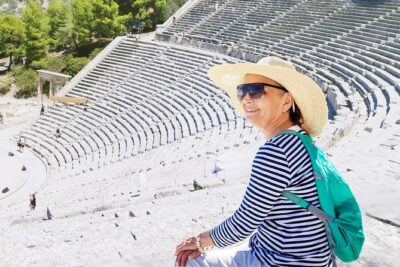
Ancient Corinth & Nafplio Full Day Trip with Swim
Read our review →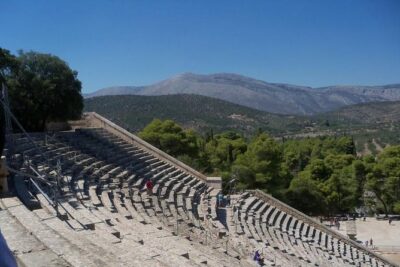
Mycenae and Nafplion Day Trip from Athens with Official guide
Read our review →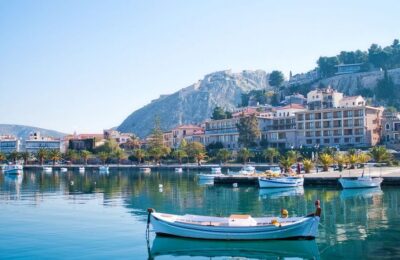
3-Day Classical Greece Tour: Epidaurus, Mycenae, Nafplion, Olympia, Delphi
Read our review →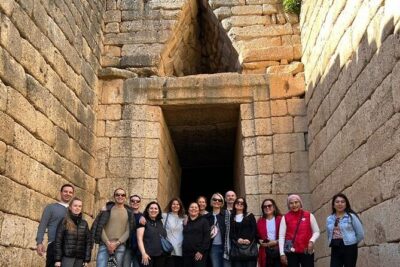
Mycenae, Epidaurus & Nafplio Full-Day V.R audio guided Tour
Read our review →Browse the lists this tour appears in