
Reviewed · APOSTLE PAUL & BIBLICAL TOURS
Biblical Tour Letters ToThe Corinthians St Paul’s Footsteps 6Hour
Paul’s story comes alive when you move from the rocky Areopagus in Athens to the Roman forum of Corinth, where he preached and faced the proconsul Gallio. This six-hour private drive into Corinthia links places from Acts and the New Testament with temples, stadiums, ports, and the famous Corinth Canal.
I like the easy hotel, apartment, or cruise-port pickup, and I like the small-group format, usually two to four people in a comfortable minivan. Drivers such as Chris, Yiannis, Panos, Alex, and Christos are praised for clear storytelling, patience, and thoughtful touches such as water, chocolate, umbrellas, and flexible time at the sites.
The main consideration is that your English-speaking driver cannot enter archaeological sites as a licensed guide. You can explore independently, or request a licensed guide for an extra €160 per booking. Entrance fees and lunch also cost extra, and the packed route may need adjustment because of traffic or parking.
In This Review
- Key Points Before You Book
- Why Paul’s Corinth Is Worth a Day Away from Athens
- Leaving Athens at Areopagus Hill
- Daphni Monastery and the Road West
- The Corinth Canal: A Modern Cut with an Ancient Dream
- Isthmia, Poseidon, and the Ancient Games
- Ancient Corinth and the Bema
- Cenchreae, the Port in Acts
- What Your Driver Can and Cannot Do
- Price, Timing, and What You Really Pay
- Who Will Enjoy This Tour Most
- Should You Book the Footsteps of Paul Tour?
- FAQ
- How long does the tour last?
- Where can pickup and drop-off take place?
- Is this a private tour?
- Is a licensed guide included?
- What entrance fees are extra?
- Is lunch included?
- Can I cancel for a full refund?
Key Points Before You Book
- Paul’s Areopagus speech: Begin in Athens at the rocky hill where Paul addressed the Athenians and spoke of the Unknown God.
- A full Corinth circuit: See the canal, Isthmia, Ancient Corinth, Cenchreae, Apollo’s Temple, and the church of Saint Paul.
- Private transport: Ride in an air-conditioned minivan with bottled water, Wi-Fi, and luggage storage, depending on space.
- Strong driver-host service: Chris, Yiannis, Panos, Alex, and Christos are known for personal attention and lively explanations.
- Extra costs matter: Ancient Corinth costs €15 per person, Isthmia costs €5, and a licensed guide is optional at €160 per booking.
- Useful for cruise schedules: Pickup and return to the port are arranged with timing in mind, including a planned return before departure.
Why Paul’s Corinth Is Worth a Day Away from Athens
Athens gives you the headline monuments, but Corinth shows you the working world in which Paul preached. This was a strategic city on the narrow isthmus joining mainland Greece to the Peloponnese. Goods, ships, soldiers, athletes, merchants, officials, and religious pilgrims all passed through this corridor.
That setting helps explain why Paul spent about eighteen months in Corinth around AD 51 to 52. He was not preaching in an isolated village. Corinth was a major commercial and political center, and its port communities gave him access to people moving across the eastern Mediterranean.
The tour also puts Paul’s letters into physical surroundings. At Ancient Corinth, you see the Roman forum and the Bema, the raised platform traditionally linked with Paul’s appearance before Gallio. At Cenchreae, you reach the port mentioned in Acts and Paul’s Letter to the Romans. At Isthmia, you connect Paul’s trade as a tentmaker with the athletic contests held near the Sanctuary of Poseidon.
I find that combination more useful than a tour focused only on Bible quotations. You get the religious connection, but you also see roads, harbors, public buildings, temples, theaters, and sports grounds. Together, they show how Paul’s message moved through a busy ancient city.
More footsteps-of-Paul trips:
- Private Biblical Tour Ancient Corinth & Isthmus Canal from Athens
★ 5.0 · 762 reviews - Private Tour of Apostle Paul’s Footsteps in Ancient Corinth
★ 5.0 · 275 reviews - Paul”s Footsteps Ancient Corinth Biblical Tour
★ 5.0 · 184 reviews
Leaving Athens at Areopagus Hill
The day begins with pickup from your Athens hotel, Airbnb apartment, or cruise ship. At a hotel, the driver waits in the lobby. At an apartment, pickup is at the building entrance. Port pickup takes place at the gate with a name sign.
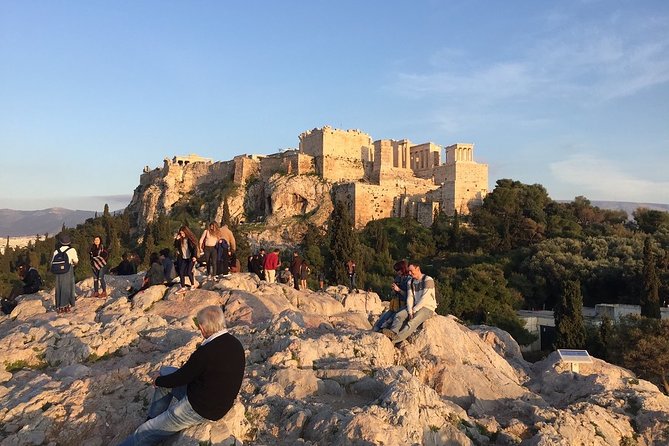
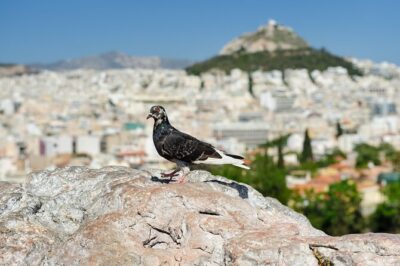
Your first stop is Areopagus Hill, also called Mars Hill, beside the Acropolis. The visit is brief, about 15 minutes, but its biblical importance is large. This is the rocky place traditionally associated with Paul’s speech to the Athenians in Acts 17.
Paul referred to an altar dedicated to an Unknown God and used that idea as a bridge to explain Christian belief. From the hill, you can look across the Acropolis area and think about the setting: a public religious center filled with temples, statues, and competing ideas.
Wear shoes with a firm grip. The rock is uneven, and even a short stop can involve climbing and standing on sloped stone. Some drivers make a point of allowing extra time here if the schedule and traffic permit, but the official visit is short.
Daphni Monastery and the Road West
The next stop is Daphni Monastery, about 20 minutes. It sits on the slopes of Mount Aigaleo, near Palataki in Aigaleo, and occupies the site of an ancient sanctuary associated with Apollo.
The monastery is enclosed by fortified walls with towers and entrance gates. Its story crosses several periods. Cistercian monks used it during the Frankish era, and it later returned to Orthodox control after the Ottoman conquest. Earthquakes caused serious damage, so restoration remains part of the site’s story.
The mosaics are the chief reason to stop. They give the tour a different religious setting from the open rock of Areopagus and the pagan temples later in the day. If you care about early Christian and Byzantine art, this is a worthwhile pause.
The route description gives about 20 minutes here, so treat Daphni as a focused visit rather than a long monastery tour. The schedule has a lot of ground to cover, and the driver’s explanation outside the monuments is an important part of the experience.
The Corinth Canal: A Modern Cut with an Ancient Dream
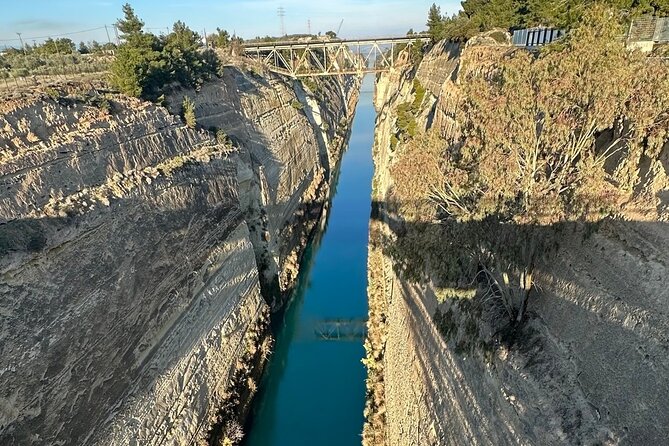
From Athens, the drive toward Corinth takes about an hour, depending on traffic. The canal stop lasts around 20 minutes and costs nothing to enter.
The Corinth Canal cuts through the Isthmus of Corinth, linking the Gulf of Corinth with the Saronic Gulf. It separates the mainland from the Peloponnese in practical geographic terms, turning the peninsula into an island-like region.
The canal was completed in the late 19th century, but the idea goes back much further. Ancient ships traveling between the Aegean and Adriatic had to sail around the Peloponnese, adding roughly 185 nautical miles to the journey. Periander, the ruler of Corinth in the early sixth century BC, is credited with considering a canal. Instead, ancient engineers built the diolkos, a stone track used to move ships on wheeled platforms.
The canal is not a biblical site in the narrow sense, but it explains Corinth’s importance. You are looking at the same geographic bottleneck that made the ancient city wealthy and strategically valuable. It also provides a welcome outdoor stop after the drive.
Same city, a completely different century:
- Athens: Acropolis & up to 5 Archaeological Sites Combo Pass
★ 4.4 · 12,619 reviews - Athens: Acropolis Ticket with Optional Audio or Live Guide
★ 4.2 · 11,055 reviews - Athens: Acropolis, Parthenon & Acropolis Museum Guided Tour
★ 4.8 · 9,316 reviews - Athens: Cape Sounion & Poseidon Temple Sunset Half-Day Trip
★ 4.8 · 8,241 reviews
Isthmia, Poseidon, and the Ancient Games
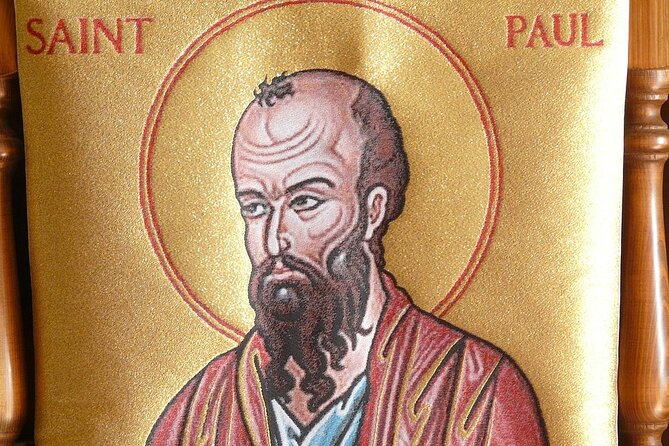
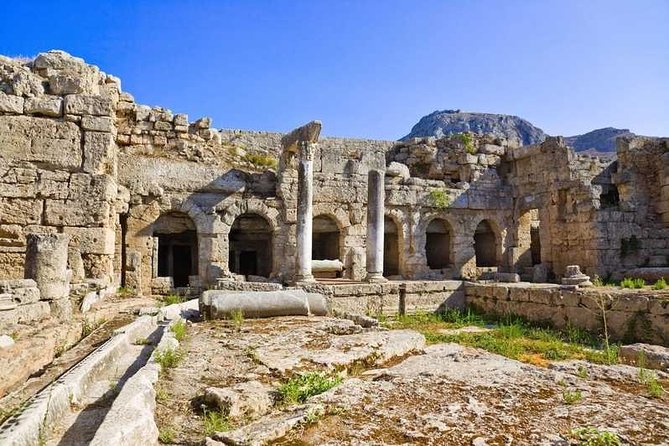
The Isthmia section is the most layered part of the day. The area was home to the Isthmian Games, one of the major athletic festivals of the ancient Greek world, ranked after the Olympic Games at Olympia.
You spend about an hour in Isthmia, with the archaeological museum and site visits divided into separate stops. The museum requires an additional €5 entrance fee per person. Its objects include an Archaic marble pediment from the Temple of Poseidon, a mid-second-century BC imperial statue in the form of Zeus, animal offerings, commercial amphorae, weapons, and finds from Mycenaean and Roman cemeteries.
One unusual display involves colored glass pieces from Alexandria. They were found underwater in the Temple of Isis at the southern harbor pier and show harbor scenes, exotic scenery, animals, plants, ships, geometric patterns, and full-length figures identified with philosophers such as Homer and Plato. These fragments give you a sense of how decorative and international the sanctuary area was.
The archaeological site includes the Temple of Poseidon, the stadium, and the Sanctuary of Palaimon. The temple was rebuilt several times after fires and later Roman damage. The stadium preserves an ancient starting mechanism called the ysplex, a rare triangular release system used to send athletes forward together.
The Sanctuary of Palaimon honors the child Melikertes, also known as Palaimon, who was linked with sailors. During the Roman period, nighttime rites and bull sacrifices took place here.
The biblical connection is more indirect than at Corinth itself, but it is still meaningful. Paul worked as a tentmaker in the Isthmian area, providing shelter and equipment for athletes and visitors to the games. That detail places him in an ordinary working setting, not just behind a pulpit. He was part of the commercial life around the contests.
Ancient Corinth and the Bema
Ancient Corinth gets about an hour, but the entrance fee is not included. The current listed fee is €15 per person. Allow for walking over uneven ground and hot, exposed surfaces in sunny weather.
The city you see today reflects several chapters. Corinth was a powerful Greek city-state, destroyed by the Romans in 146 BC, then rebuilt as a Roman city in 44 BC. It later became the provincial capital of Greece. The ancient city had a population estimated at about 90,000 in 400 BC, a remarkable figure for the era.
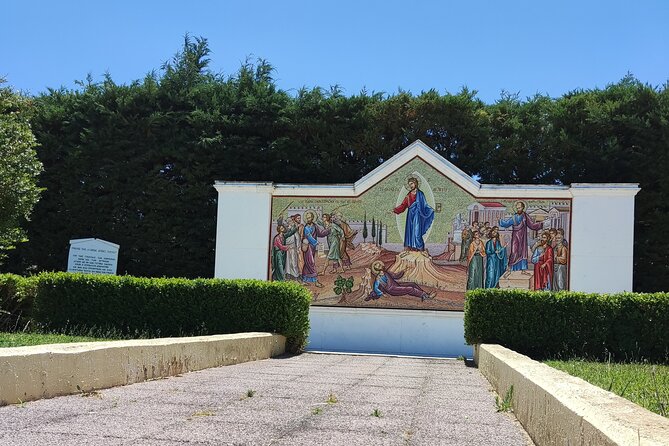
For Paul, the key place is the Roman forum and its Bema, the elevated platform from which public officials addressed the city. According to Acts 18, Paul was brought before Gallio, the Roman proconsul, accused of teaching illegally. Gallio declined to treat the matter as a criminal case, viewing it as an internal religious dispute.
The Bema is traditionally identified as the place of that hearing. A Byzantine church was later built over it, likely because of its link with Paul. Even if you approach the exact location with appropriate care, the setting makes the story easier to picture: Paul before Roman authority, in the civic heart of a large public city.
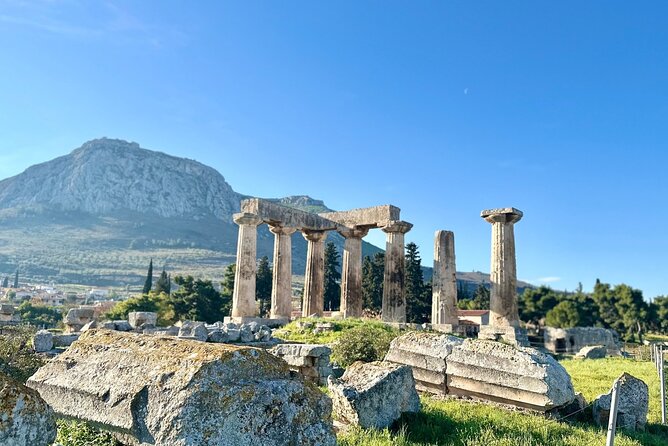
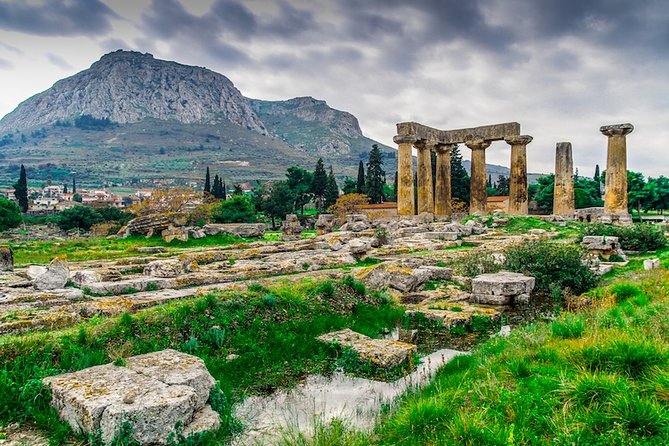
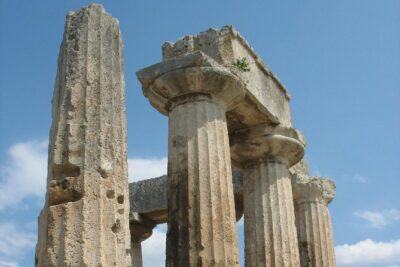
The Temple of Apollo is another major sight. Built around 550 BC, it is one of the earliest Doric temples in the Greek mainland and Peloponnese to use large monolithic columns. Its surviving columns are among the most recognizable remains at the site.
The tour also includes a short visit to the Church of Saint Paul in modern Corinth. The church recalls Paul’s stay of about a year and a half and the Christian community associated with Acts and the two letters to the Corinthians. The stop lasts around 20 minutes and has no listed admission fee.
Cenchreae, the Port in Acts
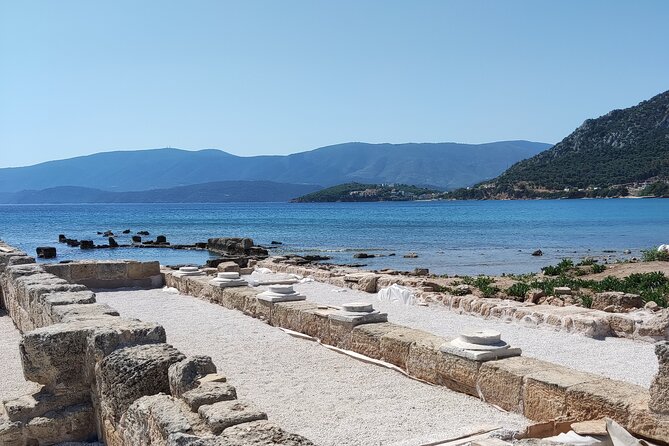
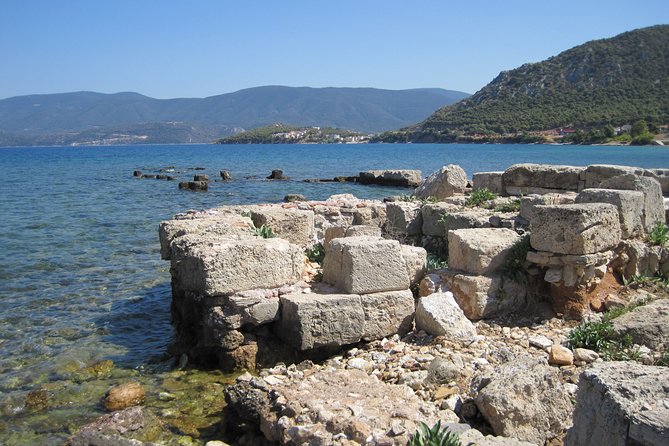
Cenchreae, now called Kechries, is the final biblical stop and lasts about 30 minutes. It was one of Corinth’s ports, located on the Saronic Gulf side of the isthmus.
Acts 18 places Paul at Cenchreae during his second missionary journey. The passage says he had his hair cut there to fulfill a vow before sailing to Syria with Priscilla and Aquila. Paul also refers to Phoebe, a woman connected with the local Christian assembly, in the Letter to the Romans.
The port stop is free and helps complete the picture of Corinth as a city with two maritime outlets. You are not simply visiting a ruin tied to a famous name. You are tracing a route through the places where Paul worked, met people, traveled, and departed by ship.
Cenchreae may be less visually dramatic than Ancient Corinth, so expectations matter. Its value is mainly biblical and geographic. I would pay close attention to the driver’s explanation here, since the physical remains alone may not tell the whole story.
What Your Driver Can and Cannot Do
This is a private or semi-private experience, with only your party participating. The stated group size is generally two to four people, while the luxury minivan can hold up to eight passengers. Confirm the exact group arrangement when booking if you are traveling with a larger party.
Your English-speaking driver provides the commentary during the drives and at the stops. The most frequently praised guides include Chris, Yiannis or Yannis, Panos, Alex, Christof or Christos, Andreas, and John. Their styles vary, but the strongest pattern is personal service: clear pickup messages, punctual arrivals, answers to questions, flexibility, and stories that connect the ancient sites with Paul’s life.
Drivers have also helped guests stay comfortable with clean vehicles, bottled water, chocolates, umbrellas, and even a jacket during rain. Those details are small, but they matter on a long day with several outdoor stops.
Greek law prevents the driver from acting as a licensed guide inside archaeological sites. He can explain the site from outside and during the ride, then give you time to look around on your own. If you want formal guiding inside the ruins, request a licensed guide in advance. The extra cost is €160 per booking, subject to availability.
This distinction is important. If you want a traditional site tour with detailed explanations beside every monument, pay for the licensed guide. If you prefer private transportation, biblical context, and freedom to explore at your own pace, the driver-only format may suit you well.
Price, Timing, and What You Really Pay
The price is $170.50 per person for about six hours and 15 minutes. For a couple or small group, that buys private transport, pickup and return, Wi-Fi, air conditioning, bottled water, and a route that would be difficult to manage by public transport in one day.
The value improves when you split the cost with friends or family. Group discounts may be available, and the private vehicle saves you from arranging separate taxis between widely scattered sites. Cruise passengers also gain peace of mind because pickup and return are planned around the ship’s schedule.
Budget separately for €15 per person at Ancient Corinth and €5 per person at Isthmia. Lunch is not included, though a meal stop is scheduled. Airport pickup is optional and costs an additional €60 per booking.
The route is ambitious. It includes Athens, Daphni, the canal, Isthmia, Ancient Corinth, Cenchreae, and the church in modern Corinth. Traffic, parking, weather, or time spent at earlier stops can force a change. One stop may occasionally be skipped, so cruise passengers should tell the operator their firm return time before departure.
Who Will Enjoy This Tour Most
I would choose this experience if you have a strong interest in Paul, Acts, the Corinthians, or the way biblical events fit into ancient Greek and Roman society. It also suits first-time visitors who want to see beyond Athens without planning a complicated day trip.
It is particularly useful for:
- Cruise passengers with limited time in Piraeus
- Small groups that want a vehicle reserved for their party
- Visitors who want biblical sites alongside archaeology
- People who prefer commentary during a drive rather than a large organized group
- History fans interested in Greek sanctuaries, Roman cities, ports, and athletic festivals
It is less suitable if you want a slow archaeological study with long periods at each monument. The schedule moves quickly, and the driver cannot guide you inside without the extra licensed-guide service.
Free cancellation is available until 24 hours before the start time. Changes or cancellations inside that window are not refunded, and poor weather can lead to a new date or full refund. The experience requires suitable weather, so keep that rule in mind when planning around a cruise.
Should You Book the Footsteps of Paul Tour?
Book it if you want the convenience of a private vehicle and a clear biblical thread running through a wide range of sites. The best part is not one single monument. It is the sequence: Paul speaks at Areopagus, the road leads toward Corinth, the canal explains the region’s geography, Isthmia shows the world of the games, Ancient Corinth brings Acts into a civic setting, and Cenchreae connects the story to the sea.
For the best result, request a licensed guide if close site interpretation matters to you, confirm entrance costs, and leave enough time for your return to the port. If you are happy to explore ruins independently after receiving detailed explanations from your driver, the standard tour offers strong value.
I would especially recommend asking for a driver who matches your interests. Chris is praised for detailed explanations and warm attention to comfort. Yiannis is noted for patience and kindness. Panos brings strong site knowledge, while Alex is particularly good at conversation and questions. The exact driver depends on availability, but the service is built around a personal, small-group day.
FAQ
How long does the tour last?
The experience lasts approximately six hours and 15 minutes.
Where can pickup and drop-off take place?
Pickup and return are offered at an Athens hotel, Airbnb apartment, or cruise port. Airport pickup is available for an additional €60 per booking.
Is this a private tour?
Only your group participates. The usual group size is two to four people, and the luxury minivan can carry up to eight passengers.
Is a licensed guide included?
No. The English-speaking driver provides commentary but cannot guide inside archaeological sites under Greek law. A licensed guide may be arranged upon request for €160 per booking, subject to availability.
What entrance fees are extra?
Ancient Corinth costs €15 per person, and the Archaeological Site of Isthmia costs €5 per person. These fees are not included in the tour price.
Is lunch included?
No. A lunch stop is scheduled, but the cost of the meal is paid separately.
Can I cancel for a full refund?
Yes, if you cancel at least 24 hours before the local start time. Cancellations or changes made less than 24 hours before the tour are not refunded. If poor weather causes the operator to cancel, you can receive a different date or a full refund.
Freshly added Athens trips
- Athens and Ancient Corinth Private from Athens★ 5.0 · 3 reviews
- From Athens: Mycenae and Epidaurus Private Tour★ 4.8 · 3 reviews
- Full day Meteora private tour★ 5.0 · 3 reviews
- Double Shore Dive (certified divers)★ 4.5 · 3 reviews
- Athens Hills: Mythology Treasure Hunt★ 5.0 · 3 reviews
- Sunset & swimming at Cape Sounio, Poseidon temple★ 5.0 · 3 reviews
- Philosophy Experience at Plato’s Academy Park – basic version★ 5.0 · 3 reviews
- Private Acropolis Tour – Ticket Included★ 5.0 · 3 reviews
Apostle Paul & Biblical Tours, compared.
Private Biblical Tour Ancient Corinth & Isthmus Canal from Athens
Read our review →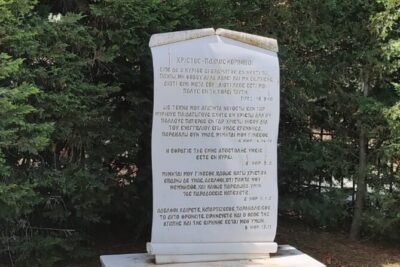
Private Tour of Apostle Paul’s Footsteps in Ancient Corinth
Read our review →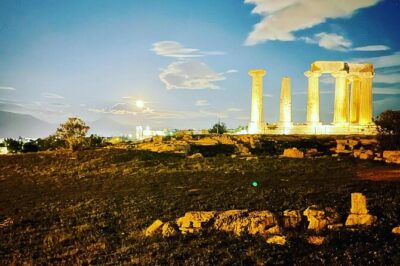
Private Luxury Biblical Tour: Apostle Paul in Athens & Corinth
Read our review →
Private Luxury Biblical Tour: Apostle Paul’s Footsteps – Corinth
Read our review →
Ancient Athens Corinth Biblical Tour Following Paul 51.A.D
Read our review →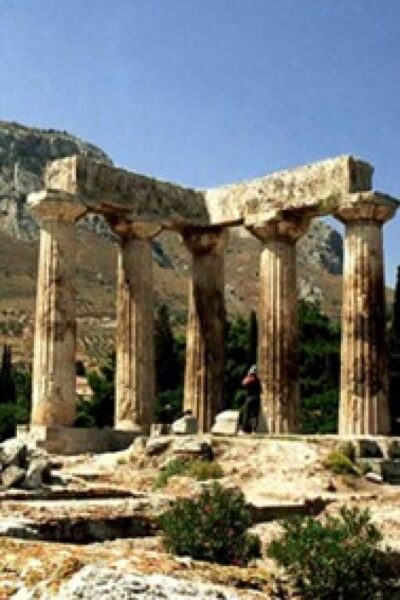
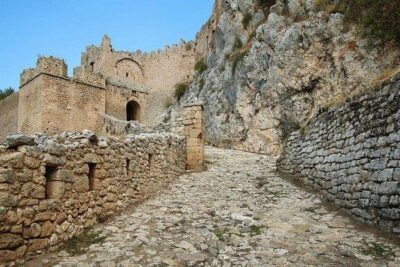
Biblical Corinth: St. Paul and His Letters to the Corinthians
Read our review →Browse the lists this tour appears in