
Reviewed · ANCIENT CORINTH TOURS
Biblical Corinth: St. Paul and His Letters to the Corinthians
The heart of this day is Ancient Corinth, where St. Paul spent about 18 months preaching, working, and building an early Christian community. You will see the Bema linked with his appearance before Gallio, the Temple of Apollo, the old port at Cenchreae, and the hilltop fortress of Acrocorinth. This is not just a ruins tour. It connects the places with the people, arguments, trade, worship, and travel that shaped Paul’s letters to the Corinthians.
I like two things right away. First, the private car gives you room to linger, change the order, or skip a stop that does not speak to you. Second, drivers such as Alex, George, Spiros, and Stephanos have proved especially good at explaining what you are seeing from the road, helping with lunch, finding a quiet coffee stop, and keeping the day at a comfortable pace. The main consideration is important: your driver cannot enter the archaeological sites as a licensed guide unless you arrange and pay for that service separately.
In This Review
- Key points at a glance
- Why this Corinth day trip feels different
- Starting at Areopagus Hill in Athens
- Seeing the Corinth Canal from above
- Following the ancient Diolkos
- Isthmia and the world of the Isthmian Games
- The Archaeological Museum of Isthmia
- Ancient Corinth, the Bema, and the Temple of Apollo
- Cenchreae, Paul’s eastern port
- Churches honoring Paul in Corinth
- Lunch at a traditional Greek taverna
- Climbing Acrocorinth
- What the private driver setup really means
- Is $218.43 per person good value?
- Who should book this experience?
- Should you book St. Paul’s Corinth tour?
- FAQ
- How long does the tour last?
- Is hotel or cruise-port pickup available?
- Is this a private tour?
- Is a licensed tour guide included?
- What entrance fees must I pay?
- Is lunch included?
Key points at a glance
- Paul’s Athens sermon begins the story: Pause at Areopagus Hill, where Paul addressed the Athenian council about the Unknown God.
- The Corinth Canal gives you a dramatic first view: Look down from above at ships moving through the narrow, steep-sided cut.
- Private travel means a flexible day: Your pickup time and pace can be adjusted for your group.
- Ancient Corinth brings the New Testament to life: See the Roman Forum, the Bema, and the Temple of Apollo.
- Isthmia adds the athletic world behind Paul’s metaphors: Visit the sanctuary, stadium, museum, and theater tied to the Isthmian Games.
- Acrocorinth is the physical challenge: The climb rewards you with wide views, but it is more strenuous than the rest of the day.
Why this Corinth day trip feels different

Many Athens excursions treat Corinth as a quick stop on the road to somewhere else. This one gives the biblical story center stage. You follow Paul’s route through Athens, across the Corinthian isthmus, into the city where he worked and preached, and out toward the port from which his mission continued by sea.
That focus works best if you have read Acts 18 or Paul’s letters to the Corinthians. Even if you have not, the places give useful context. Corinth was a major crossroads. The isthmus connected mainland Greece with the Peloponnese, while the nearby ports linked the Aegean and Ionian seas. Merchants, sailors, athletes, officials, philosophers, and pilgrims all passed through.
The experience costs about $218.43 per person and lasts roughly eight to nine hours. That is not a cheap bus outing, but the price covers private transportation, hotel or port pickup, an air-conditioned vehicle, bottled water, onboard Wi-Fi, and a flexible schedule. Lunch is included only with the Greek traditional food option.
For a couple or small family, the value comes from the private format. You are not waiting for a large group, and you can spend extra time at Acrocorinth or move faster through a museum. For a larger group, ask about group pricing before booking. You can also request a licensed guide, but that is an added cost and depends on availability.
More Ancient Corinth and canal stops:
- From Athens: Ancient Corinth Day Trip with Canal & VR Guide
★ 4.6 · 1,073 reviews - Private Biblical Tour Ancient Corinth & Isthmus Canal from Athens
★ 5.0 · 762 reviews - Athens: Ancient Corinth & Nafplio Full Day Trip with Swim
★ 4.8 · 523 reviews
Starting at Areopagus Hill in Athens
The day begins with a short visit to Areopagus Hill, also called Mars Hill. Here Paul spoke to the council of Athens, referring to an altar dedicated to an Unknown God and presenting Christianity to an audience shaped by Greek philosophy and traditional worship.
You will walk through the sacred area near the Acropolis and pause at the rocky hill. The stop is listed at about 20 minutes, so think of it as an opening reflection rather than a full Acropolis visit. Wear shoes with a good grip. The rock can be uneven, and you may find the footing more demanding than the short visit suggests.
This is a smart first stop because it frames the entire day. Paul was not preaching in an empty countryside. He was speaking in the intellectual center of the ancient Greek world, then carrying that message onward to Corinth.
If you have already visited Athens’s main ancient sites, tell the company in advance. One group went directly to the Corinth Canal because they had already covered the two downtown Athens attractions they wanted to see. The private setup makes that kind of adjustment possible.
Seeing the Corinth Canal from above
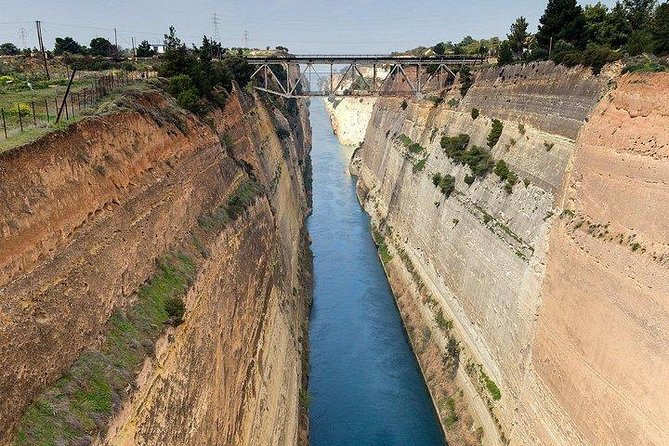
The drive from Athens takes you to the Corinth Canal, a modern engineering project cut through the Isthmus of Corinth. The canal is about 6.4 kilometers long and only about 21.4 meters wide at its base. It has no locks, and many modern ships cannot use it because of its narrow channel.
The best part is the high view. You look down at the water and the steep limestone walls while vessels pass below. Give yourself about 30 minutes here. The canal is more than a photo stop because it explains why Corinth mattered for so long. This narrow neck of land controlled movement between the mainland and the Peloponnese.
The canal itself is modern, but the problem it solved is ancient. Before the canal, ships and cargo could be hauled across the isthmus. That leads naturally to the next stop, the Diolkos.
Following the ancient Diolkos
The Diolkos was an overland route that allowed ships or their cargo to cross the isthmus before the canal existed. The remaining section is a quiet, tangible reminder of the work required to move goods between two seas.
You will spend about 20 minutes here. Do not expect a large monument or a fully rebuilt road. Its value comes from scale and imagination. You can picture sailors, merchants, animals, and laborers moving supplies across land, all within the same commercial world Paul entered centuries later.
This is one of the stops that can be easy to miss if you plan the area on your own. The driver’s local knowledge helps connect the canal with the older route rather than treating them as unrelated sights.
More footsteps-of-Paul trips:
- Biblical Tour Letters ToThe Corinthians St Paul’s Footsteps 6Hour
★ 5.0 · 1,065 reviews - Private Tour of Apostle Paul’s Footsteps in Ancient Corinth
★ 5.0 · 275 reviews - Paul”s Footsteps Ancient Corinth Biblical Tour
★ 5.0 · 184 reviews - Private Luxury Biblical Tour: Apostle Paul in Athens & Corinth
★ 5.0 · 162 reviews
Isthmia and the world of the Isthmian Games

Isthmia was a sanctuary of Poseidon and the home of the Isthmian Games, one of the major athletic festivals of ancient Greece. The games ranked just below the Olympics in importance and drew athletes and spectators from across the Greek world.
The biblical connection is meaningful, but it needs careful wording. Paul is associated with Corinth and the wider isthmus, and the tour presents him as working as a tentmaker in an area filled with athletes and visitors. Paul often used athletic images in his letters, so standing near the stadium helps you understand the daily sights behind those comparisons.
Plan on about an hour around Isthmia, followed by roughly 30 minutes in the museum. The sanctuary included the Temple of Poseidon, while the site also has an ancient stadium and the Sanctuary of Palaimon, a figure linked with sailors.
The ancient theater adds another layer. It was first used for musical contests connected with the games and later reflected the Roman and pagan culture of the area. Mosaics with sea creatures and Dionysian scenes help you picture the religious and cultural setting Paul faced.
The itinerary also presents Isthmia as a meeting point for political and military decisions. That matters because Paul’s ministry unfolded in places where power, trade, sport, and religion overlapped. This was no isolated village. It was a public crossroads where ideas moved quickly.
The Archaeological Museum of Isthmia
The museum is a compact but useful stop. Its collection includes objects from the Sanctuary of Poseidon, along with statues, offerings, and burial material. The most distinctive display is a group of glass panels from Kenchreai, the port associated with Paul’s departure for Syria.
Admission to the museum is not included. The listed entrance cost for Ancient Corinth and the Archaeological Museum of Isthmia is €15 per person, payable on site. Confirm the current fee when you book, since admission prices can change.
Allow about 30 minutes here. That is enough for a focused visit, especially if you already know the main story. Without a licensed guide inside, you will rely on the driver’s briefing before entering and on the museum signs while you walk through the displays.
This is where the tour’s main limitation becomes clear. The drivers are English-speaking and can explain history during the drive, but they do not accompany you into the archaeological areas. Some customers found the advance explanation more than enough. Others specifically wanted a guide beside them among the ruins. Decide which style suits you before you pay.
Ancient Corinth, the Bema, and the Temple of Apollo
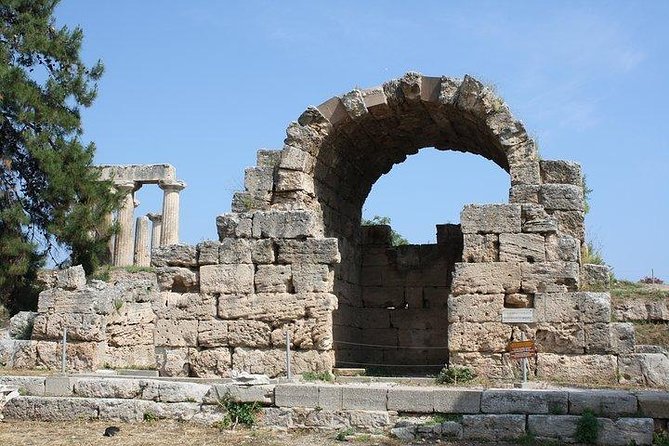
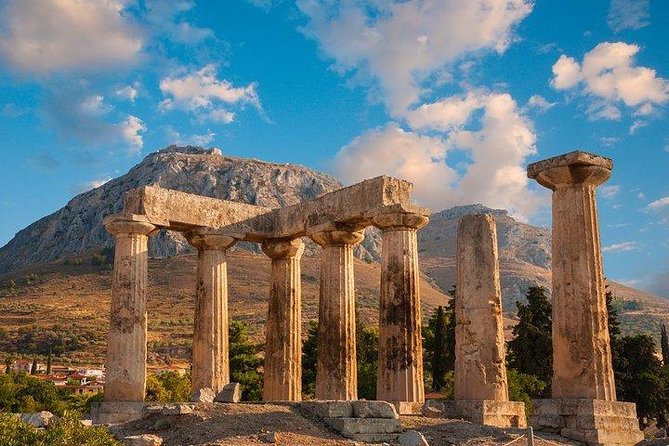
Ancient Corinth is the main event. The site is larger and more substantial than some first-time visitors expect, with the Roman Forum, streets, columns, monuments, and the Temple of Apollo spread across an open area.
Paul arrived in Corinth around AD 51 or 52 and stayed for about 18 months. Acts describes his work there, including his trade as a tentmaker and his association with Priscilla and Aquila. The Corinthian churches later received the letters that became First and Second Corinthians, texts dealing with disputes, ethics, worship, spiritual gifts, resurrection, and community life.
The Bema is the strongest biblical sight in the Roman Forum. It is the stone platform associated with Paul’s appearance before Proconsul Gallio. Gallio treated the accusation against Paul as an internal religious matter and declined to intervene. That decision gave Paul room to continue his work.
Take time to locate the Bema and imagine the civic setting around it. It was not a private chapel. It was a public platform in a Roman city, a place where law and authority were visible. The connection to Paul feels strongest here because the site links a specific episode in Acts with a physical feature you can still see.
The Temple of Apollo is another essential stop. Built around 560 BC, it is known for its early Doric design and massive monolithic columns. When Paul arrived, the temple would have been part of the city’s visual and religious identity. Its remaining columns help you picture the scale of the pagan world that Paul challenged with his message about Christ.
Ancient Corinth admission is not included, and you should budget for the stated €15 combined fee with the Isthmia museum. The site requires walking across exposed ground, so sun protection, water, and sturdy shoes matter.
Cenchreae, Paul’s eastern port
Kenchries, the modern location of ancient Cenchreae, was Corinth’s eastern port. This is where Paul is associated with cutting his hair after making a vow before sailing for Syria with Priscilla and Aquila, as described in Acts 18:18.
The stop lasts about 30 minutes and offers a calmer change from the larger ruins. You will see the seaside setting and the remains connected with the port. Paul’s movement by ship becomes easier to grasp here. Corinth was not only a place where he preached. It was a base linked to wider routes across the eastern Mediterranean.
Cenchreae also appears in Paul’s letter to the Romans through Phoebe, described as a servant or minister of the church there. That detail gives the stop added importance. It points to an early Christian community and to the significant role of a woman in its life.
Churches honoring Paul in Corinth
A stop at Apostolou Pavlou offers a modern Christian connection to the ancient story. The church honors Paul’s 18-month mission in Corinth and the community he established.
Do not expect this to replace the archaeological sites. Its value is devotional and local. You can pause, reflect, and see how Paul remains part of Corinth’s identity today. The visit takes about 20 minutes and works well after the ruins, when you have the ancient setting fresh in mind.
Lunch at a traditional Greek taverna
Lunch is scheduled for about an hour at a traditional seaside Greek taverna. If you choose the Greek traditional food option, the meal is included. If you choose another option, check exactly what is covered before booking.
The meal is more than a fuel stop on a long day. It gives you a chance to sit down, slow the pace, and try local food without having to search for a restaurant while watching the clock. Several itineraries also included a scenic lunch near Acrocorinth, and one driver helped explain the menu.
If you have dietary needs, ask the company in advance. The supplied information does not specify dietary arrangements, so do not assume substitutions are automatic.
Climbing Acrocorinth
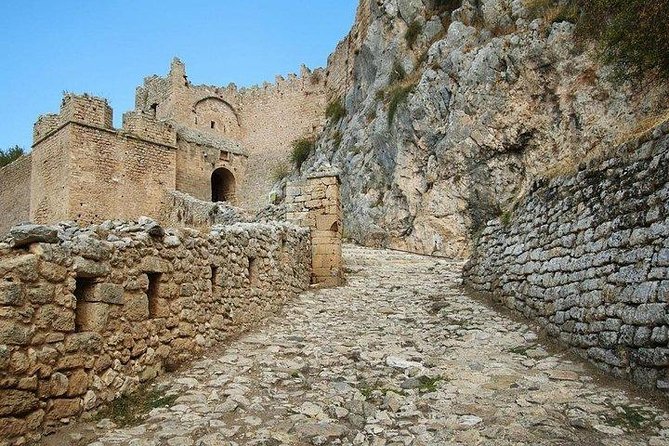
Acrocorinth is the ancient fortress high above Corinth. The one-hour visit can be the most memorable part of the day, but it is also the stop that demands the most from your legs.
The climb follows ancient paths and walls toward broad views over Corinth and the surrounding region. One visitor found the hike harder than expected but considered the view near the peak well worth the effort. That is useful advice: do not treat Acrocorinth as a quick roadside photo stop.
Wear proper walking shoes and allow yourself time. The private format helps here because you are not being pushed along by a large group. If anyone in your party does not want the full climb, ask the driver how much of the fortress can be visited comfortably.
The tour presents Acrocorinth as a place where Paul may have looked over the city while thinking about his mission. That part is reflective rather than a firmly documented episode, but the viewpoint still gives you the best sense of Corinth’s strategic position.
What the private driver setup really means
The driver is central to the experience. Alex, George, Spiros, Stephanos, Panos, Vasilis, and others are described as friendly, careful, flexible, and fluent in English. Their role is not the same as having a licensed archaeologist beside you inside every site.
You can expect commentary during the drives, help with timing, bottled water, and practical support. One driver used a speaker so everyone could hear clearly. Another helped a group recover from a mistaken ship return time and communicated tracking information to the ship so they could make the sailing.
At each archaeological site, the driver gives you background and points out what to look for, then waits while you explore independently. If detailed explanations beside the Bema, museum cases, or Temple of Apollo are essential, request the optional licensed guide. This single detail should shape your booking decision.
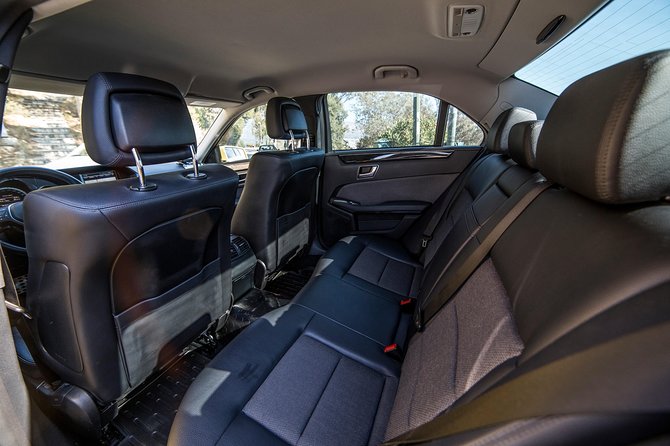
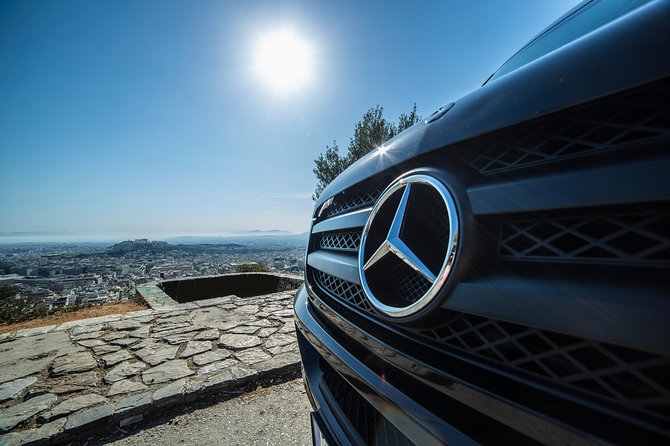
Pickup is available from a hotel, apartment entrance, or port gate, and the return point can be adjusted. The pickup time is also adjustable on request. Onboard Wi-Fi is handy for checking messages, and the air-conditioned vehicle matters after walking in the sun.
Is $218.43 per person good value?
The price is fair for a private full-day excursion, especially if you are splitting the vehicle among several people and using hotel or cruise-port pickup. You are paying for transport, flexibility, local driving, historical commentary, Wi-Fi, water, and the ability to shape the day.
You still need to add the stated €15 entrance fee per person for Ancient Corinth and the Archaeological Museum of Isthmia. A licensed guide is extra. Lunch is included only in the traditional Greek food version, so compare the options carefully.
I see the strongest value for people who want comfort and control rather than the lowest possible fare. A budget-minded visitor may prefer public transportation and independent visits, but that approach would require more planning and would make it harder to reach the smaller sites, Cenchreae, Isthmia, and Acrocorinth in one day.
Who should book this experience?
I would choose this tour if you want a biblical focus, prefer a private car, or are arriving by cruise ship and need dependable timing. It also suits families and small groups who want to stop for photos, adjust the pace, or spend longer at the fortress.
It is a strong match for readers interested in Paul’s letters, early Christianity, Greek archaeology, or the practical routes of the ancient Mediterranean. You do not need to be a specialist. The driver’s explanations during the journey help organize the day.
I would look elsewhere if you want a formal guided tour inside every site at no extra charge. The description makes the driver arrangement clear, but the distinction can still be easy to miss when you are comparing tours. Request the licensed guide before departure if that service matters to you.
Free cancellation is available up to 24 hours before the start time. Since the tour is often booked well ahead, confirm your pickup point, port timing, lunch choice, and guide request early.
Should you book St. Paul’s Corinth tour?
Book it if you want to connect the biblical story with real places, not just see a famous ruin from a coach window. The Corinth Canal, Diolkos, Isthmia, Ancient Corinth, Cenchreae, and Acrocorinth form a full day with real variety.
The best reason to choose it is the private pace and strong driver support. The main caution is the self-guided entry into the ruins unless you pay for a licensed guide. Know that before booking, and this can be a meaningful, well-organized way to follow Paul from Athens into the Corinthian world.
FAQ
How long does the tour last?
The experience lasts approximately eight to nine hours.
Is hotel or cruise-port pickup available?
Yes. Pickup and drop-off are available from hotels, apartments, and ports. At a port, the driver waits at the gate with a sign showing your name.
Is this a private tour?
Yes. Only your group participates, and the pickup time can be adjusted upon request.
Is a licensed tour guide included?
No. The professional driver provides historical commentary in fluent English but does not enter the archaeological sites as an official guide. A licensed guide may be requested, depending on availability, for an additional cost.
What entrance fees must I pay?
The stated entrance fee for Ancient Corinth and the Archaeological Museum of Isthmia is €15 per person, payable on site. The fee is not included in the tour price.
Is lunch included?
Lunch is included if you select the With Greek Traditional Food option. The tour includes about one hour for lunch at a traditional seaside Greek taverna.
Freshly added Athens trips
- Athens and Ancient Corinth Private from Athens★ 5.0 · 3 reviews
- From Athens: Mycenae and Epidaurus Private Tour★ 4.8 · 3 reviews
- Full day Meteora private tour★ 5.0 · 3 reviews
- Double Shore Dive (certified divers)★ 4.5 · 3 reviews
- Athens Hills: Mythology Treasure Hunt★ 5.0 · 3 reviews
- Sunset & swimming at Cape Sounio, Poseidon temple★ 5.0 · 3 reviews
- Philosophy Experience at Plato’s Academy Park – basic version★ 5.0 · 3 reviews
- Private Acropolis Tour – Ticket Included★ 5.0 · 3 reviews
Ancient Corinth Tours, compared.
Ancient Corinth Day Trip with Canal & VR Guide
Read our review →
Private Biblical Tour Ancient Corinth & Isthmus Canal from Athens
Read our review →
Ancient Corinth & Nafplio Full Day Trip with Swim
Read our review →
Private Tour of Apostle Paul’s Footsteps in Ancient Corinth
Read our review →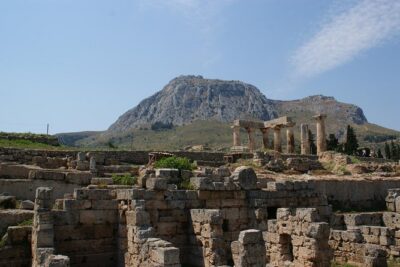
Corinth Half-Day Trip from Athens with Entrance Tickets
Read our review →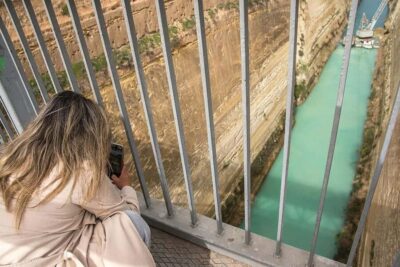
Browse the lists this tour appears in