
Reviewed · DELPHI TOURS
Argolis Olympia & Delphi Three-Day Tour
Ancient Greece comes alive on this long, ambitious loop through the Peloponnese and central Greece. In three days, you reach the Olympic sanctuary at Olympia and the oracle site at Delphi, with Mycenae, Epidaurus, Corinth, and Hosios Loukas added along the way.
I like the privacy and flexibility, since your group travels alone in an air-conditioned vehicle with WiFi and bottled water. I also like the timing, which can help you reach major ruins away from the biggest bus groups. The main catch is the pace: this is a lot of Greece in three days, and entrance fees, hotels, meals, and site guides cost extra.
- See seven major ancient sites: Corinth, Epidaurus, Mycenae, Olympia, Delphi, Hosios Loukas, and more.
- Travel in a private vehicle: The tour is designed for your group alone, with pickup offered in Athens.
- Spend two nights on the route: One night is in Olympia and one in Delphi, but hotel costs are not included.
- Visit small coastal towns: Nafplio, Tolo, Nafpaktos, Galaxidi, and Itea break up the long drives.
- Plan for extra costs: Admission fees total about 60 euros per adult, while three licensed site guides cost an additional 620 euros if available.
- Expect an active schedule: Ruins, museums, mountain roads, and several long transfers fill each day.
In This Review
- A Three-Day Route From Athens to the Great Greek Sites
- Day One: Corinth, Epidaurus, Nafplio, and Mycenae
- Ancient Corinth and the Roman Forum
- Epidaurus and the Sound of the Ancient Theater
- Nafplio and Tolo
- Mycenae, Agamemnon, and the Treasury of Atreus
- Olympia: The Birthplace of the Olympic Games
- Crossing the Gulf of Corinth Toward Delphi
- Delphi and the Slopes of Mount Parnassus
- The Charioteer and the Delphi Museum
- Arachova and Hosios Loukas
- Drivers, Guides, and the Private Touring Style
- What the Price Really Buys
- Who Should Book This Greek Archaeology Loop
- Final Verdict: A Strong Choice for Ambitious Sightseeing
- FAQ
- Where does the Argolis Olympia and Delphi tour begin?
- How long does the tour last?
- Is the tour private?
- How many people can join at the listed price?
- What is included in the tour?
- Are admission tickets included?
- Are hotels and meals included?
- Can I request licensed guides at the archaeological sites?
- What is the cancellation policy?
A Three-Day Route From Athens to the Great Greek Sites
This private tour is best understood as a road journey with major archaeological stops, not as three easy sightseeing days. The route covers a wide section of Greece, and some days involve many hours in the car.
That trade-off is the reason to choose it. Instead of limiting yourself to one region, you connect the Argolis, western Peloponnese, Gulf of Corinth, and Delphi in one carefully packed trip. You see famous monuments, but you also pass through working towns and seaside villages that give the route a more local shape.
Your driver is a professional English speaker with the required certifications. Drivers do not serve as licensed guides inside the archaeological sites, so you receive transportation and general assistance rather than formal guided tours at the ruins. Licensed local guides can be requested for an additional charge, subject to availability.
The tour costs $2,388.27 per group of up to two people. That is a serious price, but it covers private transportation rather than a seat on a large coach. For two people, the cost buys privacy, a flexible schedule, and a driver focused on your needs. You still need to budget for hotels, food, admission tickets, and any site guides.
Day One: Corinth, Epidaurus, Nafplio, and Mycenae
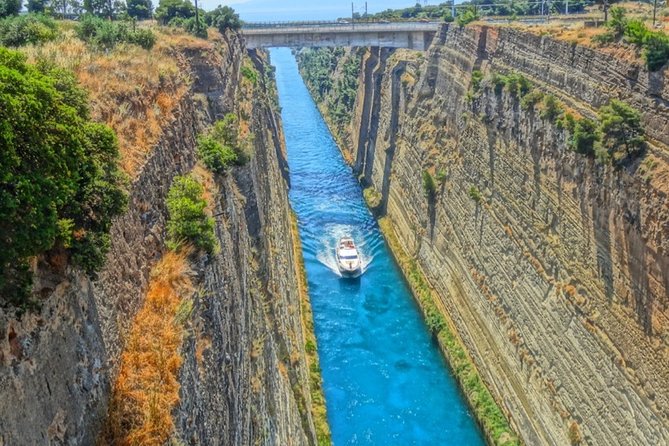
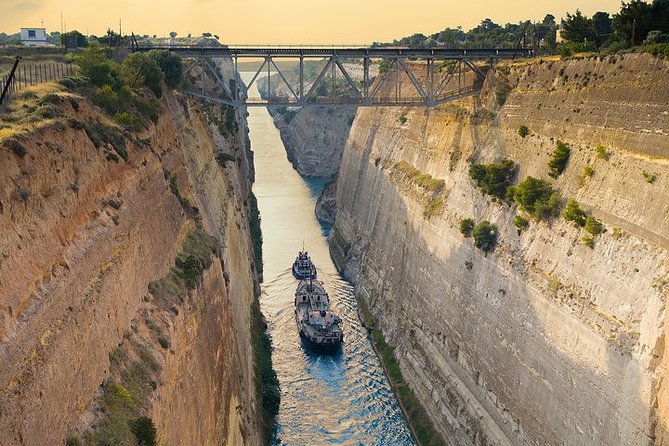
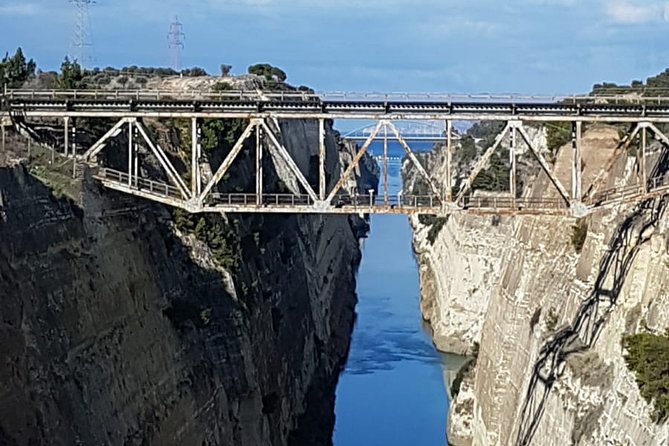
The first morning takes you west from Athens toward the Corinth Canal. The canal cuts 6.4 kilometers through the Isthmus of Corinth, separating the Peloponnese from mainland Greece. It is only about 21.4 meters wide at its base, so modern commercial value is limited, but the steep cut through the land makes a quick photo stop worthwhile.
The canal has no locks because it was dug at sea level. Ancient leaders dreamed of making this shortcut, and an attempt was made in the first century AD. Modern construction began in 1881 and was delayed by financial and geological problems before completion.
More Delphi day trips:
- Athens: Mythology of Delphi, Museum and Arachova Guided Tour
★ 4.6 · 4,008 reviews - From Athens: Delphi Full Day V.R. Audio Guided Tour
★ 4.6 · 3,028 reviews - From Athens: Small-Group Delphi, Museum & Arachova Day Trip
★ 4.8 · 2,476 reviews
Ancient Corinth and the Roman Forum
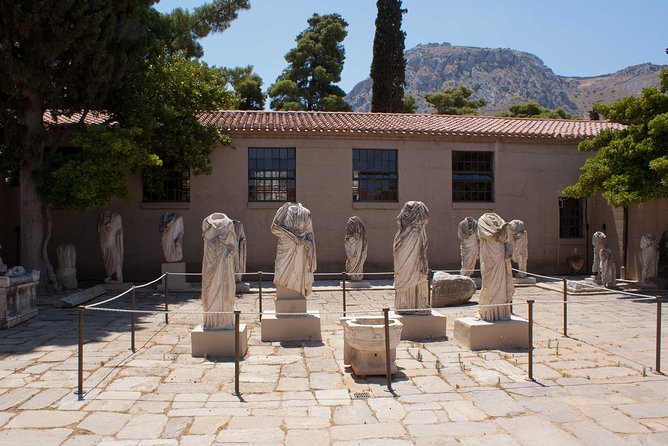
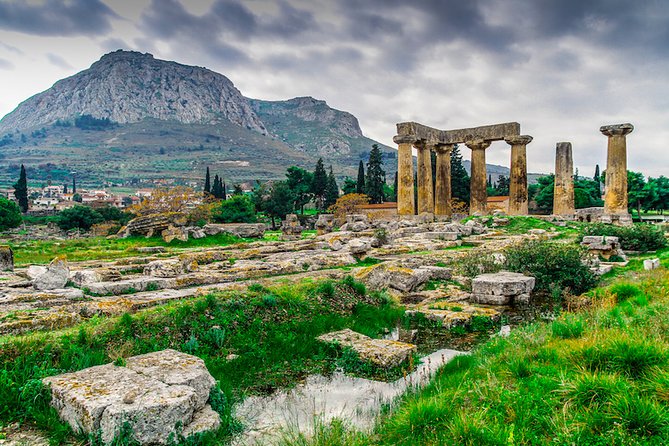
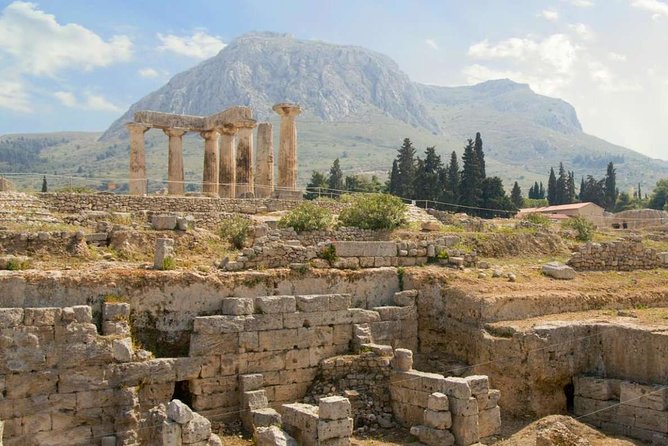
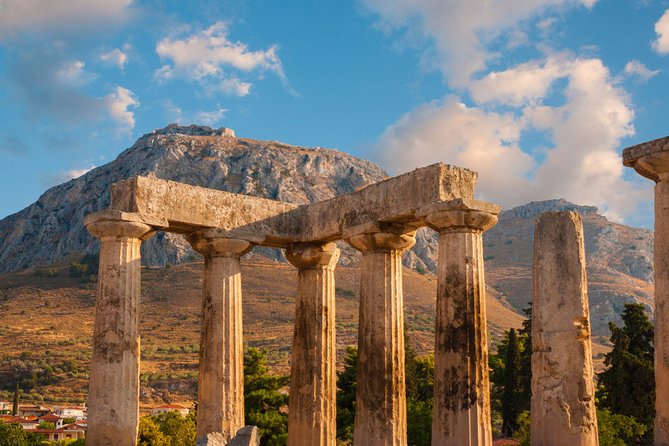
At Ancient Corinth, you have about 45 minutes at the site, followed by 30 minutes in the archaeological museum. The remains reflect several different periods, but the Temple of Apollo is the key sight. Built around 560 BC, it is one of the earliest Doric temples in mainland Greece and the Peloponnese.
You can also see the Bema, or St. Paul’s Step, a raised platform in the Roman Forum. According to tradition, Paul was brought before the Roman proconsul Gallio here after being accused of illegal teaching. The site connects the stone remains to the Christian story many people already know.
The museum adds useful detail through prehistoric, Greek, Roman, Byzantine, and Frankish objects. Its collections include sculpture, inscriptions, finds from the Sanctuary of Asklepios, and objects linked to Corinth’s Jewish community. Since entry is not included, confirm the current admission process before setting out.
Epidaurus and the Sound of the Ancient Theater
The ancient theater at Epidaurus receives about 45 minutes. That is enough to see the theater and form a sense of its design, but you may want more time if you are drawn to the Sanctuary of Asklepios and its healing traditions.
The theater is famous for its acoustics and retains its original circular orchestra. It is still used today, which helps explain why this is more than a pile of old stones. From the upper seats, the structure’s symmetry is easy to appreciate, although the short visit means you will need to keep moving.
Nafplio and Tolo
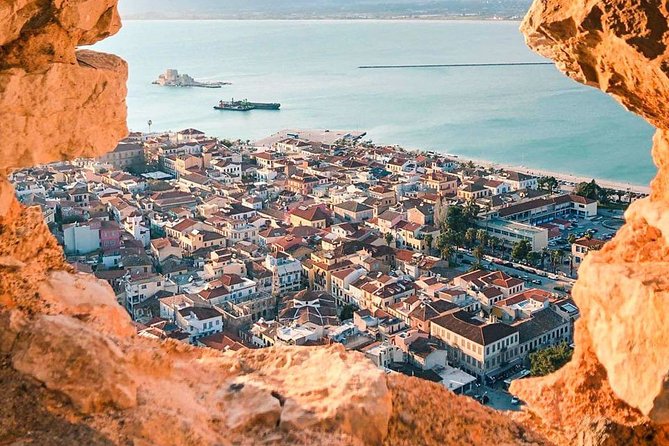
Nafplio offers a change of mood. The former capital of Greece sits at the north end of the Argolic Gulf and carries layers of Venetian, Ottoman, medieval, and modern Greek history. The scheduled stop is about 40 minutes, so think of it as a short walk and orientation stop rather than a full town visit.
Lunch follows in Tolo, a seaside town about seven kilometers east of Nafplio. The plan is to eat at a traditional family-owned restaurant with a view over the Saronic Gulf. Meals are not included, but this is one of the more pleasant places to pause before returning to the ruins.
More Mycenae and Epidaurus days:
- From Athens: Mycenae, Epidaurus & Nafplio Full Day Trip
★ 4.8 · 2,438 reviews - From Athens: Mycenae, Epidaurus & Nafplio Full-Day Tour
★ 4.5 · 1,580 reviews - 4-Day Classical Greece Tour: Epidaurus, Mycenae, Olympia, Delphi, Meteora
★ 4.5 · 732 reviews - Athens: Ancient Corinth & Nafplio Full Day Trip with Swim
★ 4.8 · 523 reviews
Mycenae, Agamemnon, and the Treasury of Atreus
Mycenae is the day’s great archaeological climax. Allow about an hour for the acropolis and the Treasury of Atreus, also called the Tomb of Agamemnon. The site was a center of power during the Late Bronze Age, from roughly the 16th to 11th centuries BC.
You enter through the Lion Gate and follow a steep route through the remains of the royal complex. The Cyclopean walls are enormous blocks of stone, later explained by myth as the work of giants. Greek legend places Agamemnon here, the leader of the Greek forces at Troy.
Mycenae is not a flat, effortless stop. The route includes uneven ground and a steep path, so sensible shoes matter. You also need to allow for heat, particularly during the warmer months. Entrance is extra.
After Mycenae, the road continues through the mountains to Olympia. The transfer is long, but it puts you in position for an early visit to the sanctuary the next morning. Overnight accommodation in Olympia is not part of the quoted price.
Olympia: The Birthplace of the Olympic Games
Olympia is the focus of the second morning. The archaeological site receives about 90 minutes, followed by 45 minutes in the museum. The ancient games began here in 776 BC in honor of Zeus, and the sanctuary still makes the connection between athletics, religion, and political life easy to grasp.
The Temple of Zeus was the largest temple in the Peloponnese and a model of Doric design. Earthquakes left it in ruins, but the scale of the fallen columns and foundations still gives you a sense of its former power.
The Temple of Hera is another important stop. It is one of Greece’s oldest monumental temples, and the Olympic flame is lit here every four years. That modern ritual gives the site a direct link to the games watched around the world today.
You also see the workshop of Pheidias, where the sculptor created the enormous gold-and-ivory statue of Zeus. The statue no longer survives, but the workshop helps make the artistic work feel less abstract.
The Archaeological Museum of Olympia is particularly strong in sculpture, bronze, and large terracotta pieces. Its displays cover the sanctuary from prehistoric times through the early Christian period. I would not skip the museum, even on a tight schedule, because it supplies the faces and details missing from the open-air ruins.
Admission to both the site and museum costs extra. The stated estimate for all tour admissions is 60 euros per adult, so confirm whether that figure covers every planned stop and whether prices have changed.
Crossing the Gulf of Corinth Toward Delphi
After Olympia, the route heads toward Delphi across the Gulf of Corinth region. One striking engineering sight is the Charilaos Trikoupis Bridge, which links Rio on the Peloponnese with Antirrio on the mainland. It opened in August 2004, just before the Athens Olympic Games, and carried the Olympic flame.
The bridge is not a formal sightseeing stop, but it gives the long transfer a clear landmark. You then pause at Nafpaktos, also known as Lepanto, for about ten minutes. Its old port sits in a sheltered bay, and the stop works mainly for photographs or coffee by the water.
Galaxidi gets about 20 minutes. This small port curves around a seafront hill and has narrow cobbled lanes leading to two harbors. It prospered through shipbuilding in the 19th century, when local families built handsome stone homes. The older harbor is known as Widows’ Port, a reminder of the sailors who never returned.
The route also passes Itea, a newer town founded in 1830. It is a resort and an important port for bauxite from nearby mines. These brief stops do not replace time in Delphi, but they break up the drive and show you a side of central Greece beyond sanctuaries and museums.
Delphi and the Slopes of Mount Parnassus
You spend the second night in Delphi, again at a hotel that you arrange and pay for separately. The modern town lies on the southwestern slope of Mount Parnassus, above the valley of Phocis.
Delphi was revered in Greek mythology as the navel of the earth. It became the home of the oracle of Apollo after the god defeated Python, the serpent guarding the sacred center. Even if you are less interested in mythology, the site’s mountain setting and political importance make it one of Greece’s most memorable ancient places.
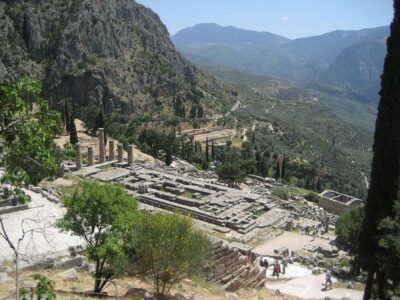
The main visit takes about 90 minutes and includes Castalia Spring, the Sanctuary of Apollo, the Treasury of the Athenians, the ancient theater, and the stadium. You also visit the Sanctuary of Athena Pronea and the gymnasium.
The path is not simply a series of rooms on level ground. Delphi climbs along the mountainside, so you should expect steps, slopes, and uneven paving. The setting rewards attention, but the pace may feel brisk if you want to read every inscription or pause for long views.
The Treasury of the Athenians is one of the clearest small buildings on the Sacred Way. The theater looks across the valley, while the stadium sits higher up the slope. The Sanctuary of Athena Pronea is separate from the main sanctuary and includes the gymnasium, making the stop feel spread out.
The Charioteer and the Delphi Museum
The Archaeological Museum of Delphi receives about 45 minutes. Its galleries cover the sanctuary from the eighth century BC through Late Antiquity, with architectural sculpture, statues, and smaller offerings.
The bronze Charioteer is the museum’s signature object. This carefully preserved figure is one of the finest surviving Greek bronzes, and it gives you a close look at the calm, controlled style that is harder to read from large fragments outdoors.
The museum is housed in a two-story building with fourteen exhibition rooms. Forty-five minutes is enough for the major works, but not enough for a slow reading of every display. If your driver is not acting as a site guide, consider requesting a licensed guide before the tour, especially if Delphi is your main reason for booking.
Arachova and Hosios Loukas
Arachova is about ten kilometers from Delphi and receives a 30-minute stop. The traditional mountain town combines old buildings with newer life around the slopes of Mount Parnassus. This is a short chance to walk, look around, and see a town rather than another archaeological enclosure.
The final major stop is Hosios Loukas Monastery, about 45 minutes. Founded by the Greek monk Loukas, who died in AD 953, it is not dedicated to Luke the Evangelist. His remains lie in the crypt.
Look up as you enter for the gold mosaic of the saint. The Katholikon and the smaller Theotokos church are decorated with well-preserved frescoes and mosaics. The architecture may recall Hagia Sophia in Istanbul or St. Mark’s Basilica in Venice, but the setting is quieter and the complex is smaller.
Admission is not included. Since this stop comes after several days of ruins and driving, it may be especially welcome for anyone interested in Byzantine art rather than classical Greece alone.
Drivers, Guides, and the Private Touring Style
The strongest practical feature is the private format. No unknown passengers join your group, and the vehicle is air-conditioned, maintained, and equipped with WiFi and bottled water. Pickup is offered, which is useful if you are staying in Athens.
Past customers singled out drivers including Panos and Michael for making the trip fun, handling questions, suggesting places to eat, and helping with practical needs. Frank is also associated with arranging private multi-day journeys. Driver assignments can vary, so treat those names as examples rather than a promise of who will be behind the wheel.
Your driver is not licensed to accompany you into the archaeological sites. That matters. You get a professional road companion, but not a formal explanation at each monument unless you pay for local guides. Three local licensed guides can be requested for an additional 620 euros, depending on availability.
What the Price Really Buys
At $2,388.27 for up to two people, the tour is not a budget excursion. The cost becomes easier to justify if you value a private car and schedule control more than the lowest possible fare.
The quoted price does not include hotel accommodation, meals, entrance fees, or airport transfers. Admission is estimated at 60 euros per adult, and the optional guides add a substantial amount. You should price two nights of hotels and meals before deciding.
The value is strongest for couples or a small private group that wants to cover places difficult to connect by public transport. It is less attractive if you prefer slow mornings, long museum visits, or a single-region holiday.
Cancellation terms are strict close to departure. Cancel at least six full days before the start for a full refund. Cancellation two to six full days ahead brings a 50 percent refund, while cancellation less than two full days ahead receives no refund.
Who Should Book This Greek Archaeology Loop
I would choose this tour if you want the major classical sites in one private journey and accept substantial driving. It suits first-time visitors who want Corinth, Mycenae, Olympia, and Delphi without organizing several separate transfers.
Families can benefit from the private vehicle, since the driver can adapt the experience to the group’s needs. The tour also suits couples who prefer not to share a coach and who want suggestions for lunch or short stops along the road.
I would hesitate if you need wheelchair-friendly information, since the supplied details do not address accessibility. I would also hesitate if your ideal trip means lingering at every ruin. The schedule is generous in coverage but tight in time.
Final Verdict: A Strong Choice for Ambitious Sightseeing
Book this tour if your priority is range. In three days, you see the Corinth Canal, Ancient Corinth, Epidaurus, Nafplio, Tolo, Mycenae, Olympia, Delphi, Arachova, and Hosios Loukas, with coastal villages and mountain roads between them.
The private vehicle, English-speaking driver, and flexible service are the real advantages. The main compromises are extra costs and a demanding schedule. Request licensed guides if you want detailed interpretation inside the sites, and reserve enough time and money for two hotel nights, meals, and admissions.
For an energetic first look at Greece’s most important ancient sanctuaries, this is a rewarding route. For a slow holiday, it is simply too much ground in too little time.
FAQ
Where does the Argolis Olympia and Delphi tour begin?
The tour is based in Athens, and pickup is offered.
How long does the tour last?
The experience lasts approximately three days.
Is the tour private?
Yes. Only your group participates, and no unknown passengers join the vehicle.
How many people can join at the listed price?
The listed price of $2,388.27 covers a group of up to two people.
What is included in the tour?
The tour includes bottled water, an air-conditioned vehicle, WiFi on board, private transportation, and a professional English-speaking driver.
Are admission tickets included?
No. Entrance fees are extra, with a stated total cost of 60 euros per adult.
Are hotels and meals included?
No. Hotel accommodation and all meals are not included.
Can I request licensed guides at the archaeological sites?
Yes. Three local licensed guides can be requested for an additional 620 euros, depending on availability.
What is the cancellation policy?
Cancel at least six full days before the start for a full refund. Cancellation two to six full days ahead receives a 50 percent refund. Cancellations less than two full days before the start are nonrefundable.
More Ancient Olympia trips
- 3-Day Classical Greece Tour: Epidaurus, Mycenae, Nafplion, Olympia, Delphi
★ 4.5 · 342 reviews - 4-Day Tour of Mycenae, Epidaurus, Olympia, Delphi & Meteora
★ 4.8 · 168 reviews - 4-Day Greece Highlights Tour: Epidaurus, Mycenae, Olympia, Delphi and Meteora
★ 5.0 · 79 reviews - Day tour to Ancient Olympia,Ancient Sparta Mycenae Including Meal
★ 5.0 · 54 reviews
Freshly added Athens trips
- Athens and Ancient Corinth Private from Athens★ 5.0 · 3 reviews
- Double Shore Dive (certified divers)★ 4.5 · 3 reviews
- From Athens: Mycenae and Epidaurus Private Tour★ 4.8 · 3 reviews
- Full day Meteora private tour★ 5.0 · 3 reviews
- Athens Hills: Mythology Treasure Hunt★ 5.0 · 3 reviews
- Sunset & swimming at Cape Sounio, Poseidon temple★ 5.0 · 3 reviews
- Philosophy Experience at Plato’s Academy Park – basic version★ 5.0 · 3 reviews
- Private Acropolis Tour – Ticket Included★ 5.0 · 3 reviews
Delphi Tours, compared.

Mythology of Delphi, Museum and Arachova Guided Tour
Read our review →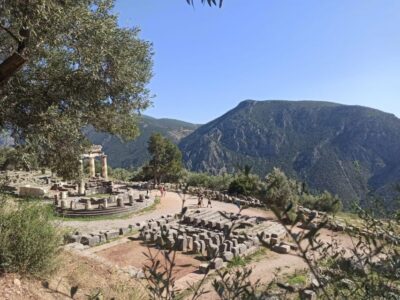
Small-Group Delphi, Museum & Arachova Day Trip
Read our review →
Delphi English Day Trip from Athens with Official Guide
Read our review →
Delphi Guided Trip with Optional Lunch and Entry
Read our review →
Historical Delphi One Day Tour with Arachova Stop & Expert Guide
Read our review →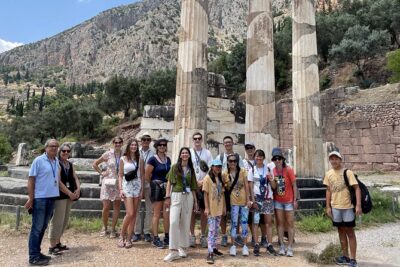
Premium Delphi Day Trip with an Expert Guide, Museum & Lunch
Read our review →
Browse the lists this tour appears in