
Reviewed · MYCENAE & EPIDAURUS TOURS
Ancient Sparta Ancient Corinth Private Tour from Athens/ Nafplio
Sparta is the surprise here. It is not a grand ruin city like Athens, but a quiet spread of ancient remains, a weathered theater, the tomb linked to King Leonidas, and a small museum that helps fill in the gaps. Add the Corinth Canal and Ancient Corinth, and you get a long but rewarding day across the Peloponnese.
I like the private car and flexible pace, especially when a good driver such as Christos, Takis, Nikolaos, or Philippe helps you choose lunch stops and photo breaks. I also like fitting Sparta and Corinth into one outing without renting a car or working out mountain roads yourself.
The catch is the distance. Ten hours is a full day, and Sparta’s ruins are modest. If you want a slow museum visit or a licensed archaeologist explaining every stone, you will need to plan carefully and pay extra for a specialist guide.
In This Review
- Key points to know before booking
- What this private Peloponnese day really offers
- The Corinth Canal gives you a fast first taste
- Sparta rewards the curious, not the checklist collector
- The Archaeological Museum of Sparta fills in the missing pieces
- Sparta’s theater is large in scale, quiet in mood
- The Leonidas Monument adds a human face to Sparta
- The olive oil museum offers a more everyday side of Greece
- Ancient Corinth is the strongest archaeological stop for many people
- The driver makes or breaks this long day
- Ten hours requires sensible expectations
- Pickup, vehicles, and extra costs
- Who should book this Athens to Sparta tour?
- Should you book it?
- FAQ
- How long is the private Sparta and Corinth tour?
- Is pickup included from my Athens hotel?
- Is an archaeologist guide included?
- Are entrance tickets included in the price?
- Is the olive oil museum included?
- Can I choose the vehicle size?
Key points to know before booking

- The Corinth Canal is a quick, dramatic first stop, with a pedestrian bridge and an 80-meter-high view.
- Sparta is atmospheric rather than monumental, with a compact archaeological area, ancient theater, museum, and Leonidas Monument.
- Ancient Corinth deserves your time, since the site and museum offer more to see than the short schedule may suggest.
- Your driver is not an archaeologist guide, but provides English commentary, documentary material, and historical information during the drive.
- The day is private and adjustable, with sedan, minivan, and minibus options for different group sizes.
- Check museum closing days before you go, especially if your date falls on a Tuesday.
What this private Peloponnese day really offers
This is a road trip with archaeological stops, not a guided excavation tour. You leave your Athens or Nafplio accommodation in a clean, air-conditioned vehicle and let someone else handle fuel, tolls, parking, and the long return drive.
That matters because Sparta is far from Athens. The private format also gives you room to adjust the day. You can stop for photographs, take a little longer at a site, or swap one planned stop for another if time permits. One outing even included a visit to Mystras instead of part of the original plan, though that kind of change depends on the driver and the clock.
The listed price is $265.50 per person, but the real value depends on your group. The cost changes with the vehicle and party size, so a family or small group may find the private arrangement more appealing than several individual seats on a large coach. Sedan service covers up to three adults or a family of four with two children, while larger minivans and minibuses are available.
Admission is extra. In summer, the stated entrance fees total €30 per adult if you visit Sparta’s museum, Ancient Corinth, and the olive oil museum. In winter, the total is €18 because the Sparta and Corinth prices are lower. Add the optional olive oil museum at €5, plus the listed €1 gratuity.
More Ancient Corinth and canal stops:
- From Athens: Ancient Corinth Day Trip with Canal & VR Guide
★ 4.6 · 1,073 reviews - Private Biblical Tour Ancient Corinth & Isthmus Canal from Athens
★ 5.0 · 762 reviews - Athens: Ancient Corinth & Nafplio Full Day Trip with Swim
★ 4.8 · 523 reviews
The Corinth Canal gives you a fast first taste
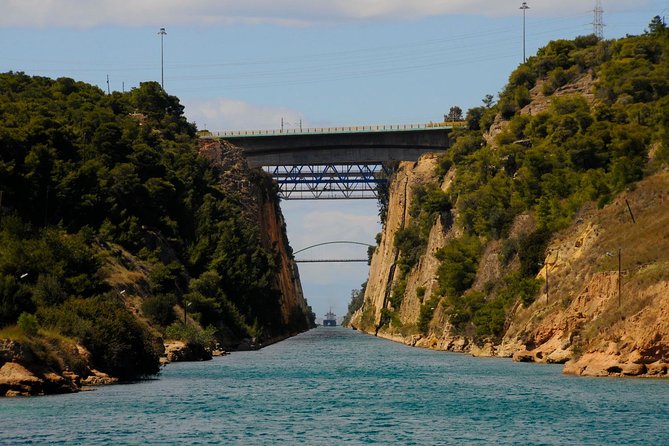
The Corinth Canal is usually the opening stop, and it is a good choice. After leaving Athens, you reach one of Greece’s clearest examples of human engineering: a narrow waterway cut through the Isthmus of Corinth to connect the Aegean and Ionian seas.
More than 2,500 workers spent twelve years digging the 6,400-meter canal between 1881 and 1893. From the bridge, you can look straight down at the steep sides and see why the canal photographs so well.
You get about 15 minutes here. That is enough for pictures and a short walk across the pedestrian bridge, but not enough for a relaxed stop. I would keep your camera ready and use the brief break to stretch your legs.
The 80-meter drop makes the canal more impressive in person than its short schedule suggests. Still, this is a photo stop, not a full attraction visit. If you need coffee, a longer pause, or time to study the engineering, ask your driver early in the day.
Sparta rewards the curious, not the checklist collector
Modern Sparta is a functioning town, while the ancient remains are spread through and around it. This is part of the appeal, but also the reason some people leave disappointed. You will not find a single spectacular ruin comparable to the Acropolis.
What you do find is a place connected to one of the most unusual societies in ancient Greece. Spartan institutions were organized around military training and physical strength. Society included full Spartan citizens, free residents involved in trade, non-Spartan men raised as Spartans, and helots, a subject population forced into labor.
That social order gives the stop more weight. The stones alone are limited, so you need some context to understand what made Sparta different. The driver’s books, audio documentary, and historical material during the drive help, but they do not replace a trained site guide.
You receive about 30 minutes for the general Sparta stop before moving to the museum and theater. That is enough to get a sense of the town and its ancient footprint. It is not enough for a leisurely study of every area.
The Archaeological Museum of Sparta fills in the missing pieces
The Archaeological Museum of Sparta occupies a neoclassical building constructed from 1874 to 1876. It is the oldest provincial archaeological museum in Greece, and its compact size makes it a practical addition to a busy day.
The museum helps you understand Sparta as a real society rather than a legend built only around warriors. Displays and objects give substance to the city’s daily life, art, religion, and public culture.
The usual visit lasts about 30 minutes. I would treat that as an introduction, not a full museum session. If museums are central to your trip, the private format gives you a better chance of asking for additional time, but you may need to shorten another stop.
Admission is not included. The stated general price is €10 in summer and €5 in winter. The museum closes every Tuesday, so check your date before booking. A Tuesday visit can leave a noticeable hole in the Sparta portion of the day.
More Mycenae and Epidaurus days:
- From Athens: Mycenae, Epidaurus & Nafplio Full Day Trip
★ 4.8 · 2,438 reviews - From Athens: Mycenae, Epidaurus & Nafplio Full-Day Tour
★ 4.5 · 1,580 reviews - 4-Day Classical Greece Tour: Epidaurus, Mycenae, Olympia, Delphi, Meteora
★ 4.5 · 732 reviews - Mycenae and Nafplion Day Trip from Athens with Official guide
★ 4.5 · 501 reviews
Sparta’s theater is large in scale, quiet in mood
The Acropolis and Ancient Theater of Sparta receive about an hour. The theater was built from local white marble during the Roman period, with construction dating to the late first century BC. It could hold an estimated 16,000 people and included a mobile stage.
The remains are worn. Much of the seating was damaged during the Byzantine period, and surviving marble and limestone have suffered from erosion. That means you should arrive with the right expectation: this is a place to picture rather than simply admire.
The quiet setting works in its favor. You can look across the remains and consider Thucydides’ observation that Sparta resembled a group of villages more than a grand, continuous city. The absence of towering monuments is part of the story.
Wear sensible shoes, since the ground around ancient sites can be uneven. The tour includes time to walk, but the driver does not accompany you as an archaeologist guide. If you want a detailed explanation of the theater’s design, arrange a licensed guide in advance. Availability is not guaranteed at the last minute, and an additional charge applies.
The Leonidas Monument adds a human face to Sparta
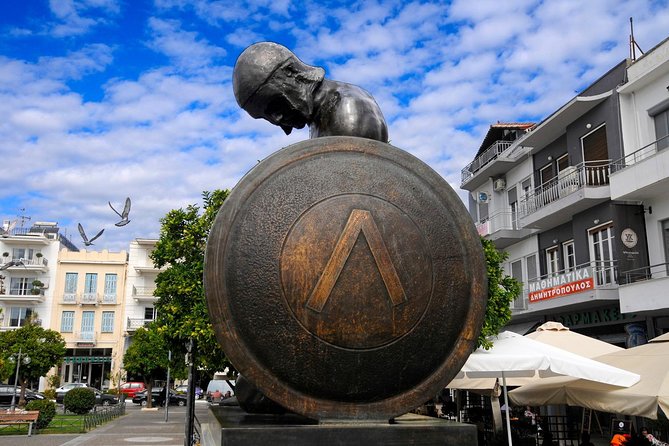
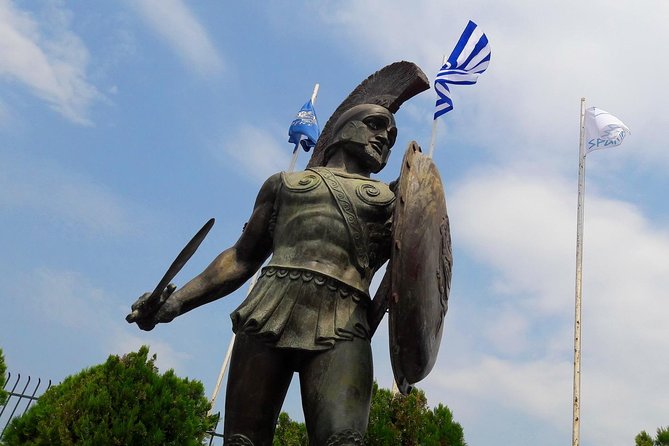
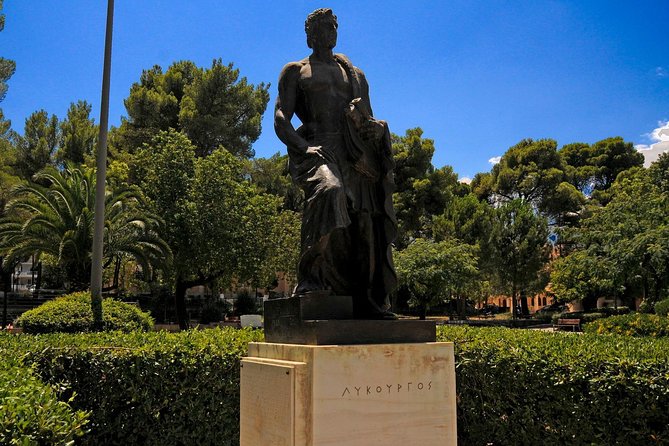
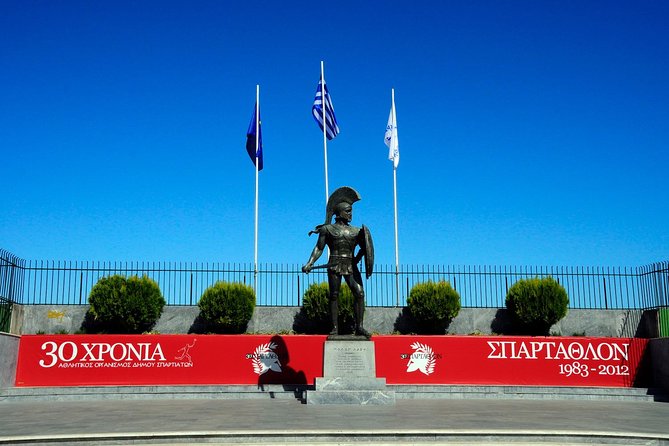
The Leonidas Monument is a brief 15-minute stop, but it gives the day a strong focal point. The statue presents the famous Spartan king in front of a stadium, recalling his defense at Thermopylae.
Nearby is a fifth-century BC structure excavated north of modern Sparta. Archaeologists first thought it was a small temple, but it is now often identified as the tomb of Leonidas. Its exact use is not fully confirmed, so you should treat the identification as a long-standing interpretation rather than an absolute fact.
The monument is easy to fit into the schedule and offers a clear connection between the ancient city and the later legend of Spartan courage. It also helps break up the ruins and museum visits with a simple outdoor stop.
The visit is short, so this is another place where a driver who knows the route makes a difference. Several drivers, including Takis and Makis, have been praised for explaining not only the monuments but also Greek culture, modern life, and the countryside along the way.
The olive oil museum offers a more everyday side of Greece

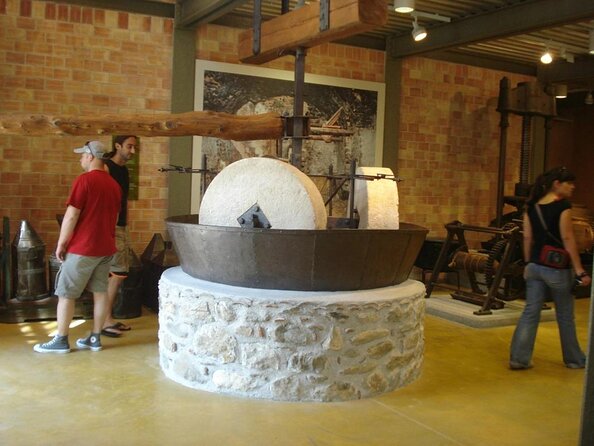
The Museum of the Olive and Greek Olive Oil is optional and lasts about 20 minutes. It shifts the focus from kings and armies to one of the products that has shaped Greek food, trade, religion, art, and technology.
The displays cover olive cultivation and oil production from prehistoric times to the early twentieth century. You can see information about fossilized olive leaves from Santorini, dated to roughly 50,000 to 60,000 years ago, along with replicas of fourteenth-century BC Linear B tablets that record early references to olives and oil.
This is a small but useful stop if you want to connect ancient Greece with a living part of the country’s culture. Some visits have also included an olive oil tasting at a local family business, though you should not assume a tasting is guaranteed from the tour description.
Time is the issue. The museum is optional, and your driver may skip it to protect time at Corinth or another stop. It also closes every Tuesday. Admission is €5.
Ancient Corinth is the strongest archaeological stop for many people
Ancient Corinth receives about 70 minutes, including the archaeological area and museum. I would pay close attention to the time here, because this site can easily hold your interest longer than the schedule allows.
Corinth was one of the largest cities in ancient Greece. Walking among its remains gives you a clearer sense of an organized ancient city than the scattered remains at Sparta. The site also carries Christian importance because the Apostle Paul visited Corinth and the New Testament includes First and Second Corinthians.
The combined ticket covers Ancient Corinth and its museum. The price is €15 in summer or €8 in winter. In winter, the museum is closed on Tuesday, though the site ticket details should be checked when you book because opening arrangements can change.
The museum is scheduled for about 30 minutes. It gives useful context before or after you walk among the ruins, and the combined ticket makes it easy to include both. A lunch stop near Corinth may be arranged, and one particularly memorable outing included a meal at a small cafe with a view toward the Temple of Apollo.
Do not let the short schedule rush you through Corinth. If you have to choose between extra time at the olive oil museum and extra time at Ancient Corinth, I would usually favor Corinth, especially if ancient architecture and city planning interest you.
The driver makes or breaks this long day
The tour’s strongest feature is the private driver. Drivers such as Christos, Nikolaos, Takis, Makis, and Philippe have been praised for safe driving, friendly conversation, clear English, and a willingness to adjust the pace.
The driver provides printed information and an audio documentary with historical details while you travel. Some drivers give much more personal commentary, discussing Greek politics, society, geography, culture, and the connection between the modern towns and ancient sites.
But be clear about the job. Your driver is not an archaeologist guide who walks through each museum and ruin with you. You explore the sites on your own unless you hire a licensed archaeological guide separately. That distinction is important, particularly at Sparta, where the remains need explanation to make full sense.
The roads to Sparta involve a long journey, but newer roads across the Peloponnese have made the trip more comfortable than some visitors expect. You can ask for restroom breaks and extra photo stops, and the private vehicle makes those requests easier than they would be on a fixed coach tour.
Ten hours requires sensible expectations
The advertised duration is about 10 hours. That includes the drive from Athens to the Peloponnese and back, so you should not expect ten hours of site visits.
The rough stop plan gives you:
- 15 minutes at the Corinth Canal
- 30 minutes around Sparta
- 30 minutes at the Archaeological Museum of Sparta
- 1 hour at the Acropolis and theater
- 15 minutes at the Leonidas Monument
- 20 minutes at the optional olive oil museum
- 1 hour and 10 minutes at Ancient Corinth
- 30 minutes at the Corinth Museum
That adds up to several hours of sightseeing, with the rest spent on the road and at lunch or rest stops. The day feels full, not rushed at every moment, but you will need to keep moving.
An 8:00 am start or earlier is recommended in winter. You can adjust the departure time, but leaving late may force you to cut a museum or shorten Corinth. Extending the tour costs €30 per hour for a sedan, €45 for a minivan, and €60 for a minibus.
Pickup, vehicles, and extra costs
Pickup and drop-off are offered at hotels or apartments in central Athens within 7 kilometers. A longer Athens pickup or drop-off costs an additional €15 each way. Piraeus Port and the cruise terminal carry the same stated surcharge, while airport and Lavrio Port transfers require prior agreement with the operator.
Nafplio pickup is also available, and the price changes because Sparta and Corinth are closer from Nafplio. This option can make much more sense if your trip already includes Nafplio, since it removes some of the repeated driving from Athens.
The vehicle choice matters. A sedan suits up to three adults, or two adults and two children. A minivan handles up to seven people, and a minibus handles up to 14. Two children up to age 12 can travel free under the stated family conditions, though the final price depends on the selected vehicle and group size.
The vehicle includes fuel, tolls, parking, air conditioning, and private transport. That all-inclusive road cost is useful when you compare the price with renting a car, especially if you do not want to drive unfamiliar roads after a long day of walking.
Who should book this Athens to Sparta tour?
I would choose this tour if you want to see several Peloponnese highlights in one day, prefer private transport, and are happy to explore ruins without a guide walking beside you.
It suits families because you can request stops, manage restroom needs, and avoid coordinating with a large group. It also works well for couples and small groups who want conversation with a local driver and the freedom to adjust lunch or sightseeing.
I would hesitate if Sparta is your main reason for going and you expect a large, intact ancient city. The remains are important, but modest. You may prefer a slower Sparta and Mystras outing, especially if you want time for the extensive hilltop ruins at Mystras.
If museums are a priority, avoid Tuesday. If Ancient Corinth interests you most, protect its scheduled time and ask about adding an hour before departure.
Should you book it?
Book this private tour if convenience, flexible timing, and a broad sample of the Peloponnese matter more to you than a slow, specialist-led archaeological day. The Corinth Canal, Leonidas Monument, Spartan theater, olive oil museum, and Ancient Corinth create a varied route, and an excellent driver can turn the long road sections into part of the experience.
Skip it if you dislike long drives, want every site fully explained by an archaeologist, or prefer to spend a whole day at one major ruin. For everyone else, this is a practical way to reach distant ancient sites from Athens without taking on the driving yourself. Free cancellation is available if you cancel at least 24 hours before the start time.
FAQ
How long is the private Sparta and Corinth tour?
The tour lasts approximately 10 hours, including transportation from Athens or Nafplio, sightseeing, rest stops, and the return journey.
Is pickup included from my Athens hotel?
Pickup and drop-off are included from hotels or apartments in central Athens within 7 kilometers. Locations farther away cost an additional €15 each way. Piraeus Port and the Piraeus Cruise Terminal also have an additional charge, while airport and Lavrio Port pickup require prior agreement.
Is an archaeologist guide included?
No. The English-speaking driver provides historical information, printed material, and an audio documentary during the drive, but does not accompany you through the archaeological sites as a licensed archaeologist. A specialist guide can be hired separately, subject to availability and an additional charge.
Are entrance tickets included in the price?
No. Ancient Corinth costs €15 in summer or €8 in winter, including its museum. The Archaeological Museum of Sparta costs €10 in summer or €5 in winter, and the optional Museum of the Olive and Greek Olive Oil costs €5.
Is the olive oil museum included?
The olive oil museum is optional and depends on the available time. It closes every Tuesday, and its €5 admission is not included. The stop covers the history and technology of olives and olive oil in Greece.
Can I choose the vehicle size?
Yes. Sedan, minivan, and minibus options are available. A sedan carries up to three adults or a family of four with two children, a minivan carries up to seven people, and a minibus carries up to 14. The price changes according to group size and vehicle type.
Freshly added Athens trips
- Athens and Ancient Corinth Private from Athens★ 5.0 · 3 reviews
- From Athens: Mycenae and Epidaurus Private Tour★ 4.8 · 3 reviews
- Full day Meteora private tour★ 5.0 · 3 reviews
- Double Shore Dive (certified divers)★ 4.5 · 3 reviews
- Athens Hills: Mythology Treasure Hunt★ 5.0 · 3 reviews
- Sunset & swimming at Cape Sounio, Poseidon temple★ 5.0 · 3 reviews
- Philosophy Experience at Plato’s Academy Park – basic version★ 5.0 · 3 reviews
- Private Acropolis Tour – Ticket Included★ 5.0 · 3 reviews
Mycenae & Epidaurus Tours, compared.

4-Day Classical Greece Tour: Epidaurus, Mycenae, Olympia, Delphi, Meteora
Read our review →
Ancient Corinth & Nafplio Full Day Trip with Swim
Read our review →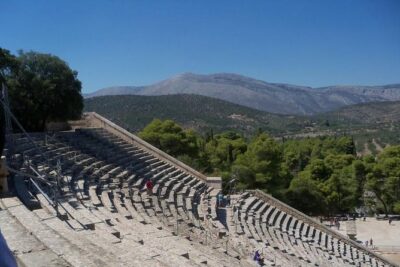
Mycenae and Nafplion Day Trip from Athens with Official guide
Read our review →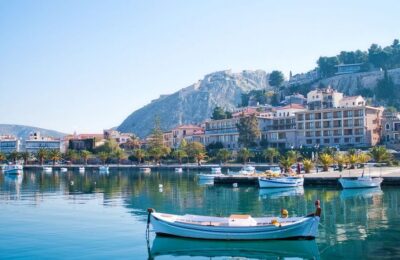
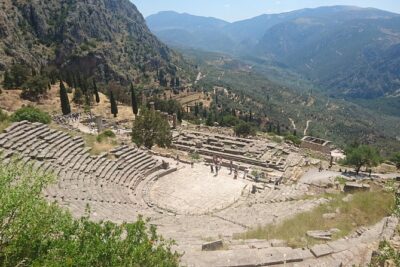
3-Day Classical Greece Tour: Epidaurus, Mycenae, Nafplion, Olympia, Delphi
Read our review →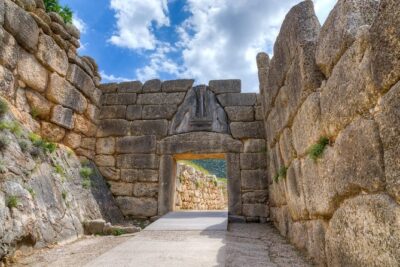
Mycenae, Epidaurus, Nafplio Full Day Private Tour from Athens
Read our review →Browse the lists this tour appears in