
Reviewed · ANCIENT OLYMPIA TOURS
Ancient Olympia Full-Day Private Tour from Athens
Ancient Olympia is where this long day earns its keep. After a scenic drive across the Peloponnese, you walk through the sanctuary where the ancient Olympic Games honored Zeus, then see the stadium, temples, training grounds, museums, and the village that serves the site today. The stop at Corinth Canal adds a striking engineering landmark to the same outing.
I like the private car and flexible pace. Your driver collects you in Athens, provides bottled water and onboard WiFi, and can stop when practical. I also like the human touch: drivers such as George have shared stories about passing towns, Greek life, and local sights, turning a long transfer into part of the day.
The trade-off is the clock. You spend roughly 2.5 hours getting from Corinth Canal to Olympia and another 3.5 hours returning to Athens. The driver does not enter the ruins with you, so you must arrange a licensed guide if you want detailed interpretation inside.
In This Review
- Key points to know before booking
- Why Ancient Olympia makes this a memorable day trip
- Athens pickup and the road to Corinth
- Corinth Canal in a 30-minute stop
- The long ride west to Olympia
- Walking through the sanctuary of Olympia
- Temple of Zeus and the lost wonder
- Stadium, Hera, and the Olympic flame
- Training grounds and ceremonial buildings
- The water system and Olympia museums
- Lunch and the market in Ancient Olympia
- Price, guide arrangements, and practical value
- Who should book this Olympia tour
- Should you book it?
- FAQ
- How long is the Ancient Olympia tour from Athens?
- Is hotel pickup included?
- Is the tour private?
- Is a licensed guide included?
- Are entrance tickets included?
- Is lunch included?
- What should I bring for the Olympia site?
Key points to know before booking
- Corinth Canal gives you a dramatic first stop: Spend about 30 minutes above the narrow channel, watching boats pass between steep limestone walls.
- Olympia requires stamina: The archaeological visit includes several open-air areas, with about three hours assigned to the main site and its surrounding sights.
- The driver is not an in-site guide: You receive English commentary in the vehicle, but a licensed guide is available upon request and subject to availability.
- The private format protects your time: Only your group participates, so you are not tied to a coach party’s pace.
- The total drive is substantial: This is a practical Athens day trip, not a leisurely stay in the western Peloponnese.
- Plan for heat and sun: Comfortable shoes, a hat, sunglasses, and sunscreen matter, especially in summer.
Why Ancient Olympia makes this a memorable day trip
Olympia is not just a collection of broken columns. It was a religious sanctuary, an athletic center, and a meeting place for Greek city-states. The ancient games began traditionally in 776 BC and continued for centuries in honor of Zeus.
Your visit takes place across a broad archaeological area, so the experience is partly about moving from one site to the next and letting the pieces fit together. You see where athletes trained, where ceremonies took place, where spectators watched contests, and where temples gave the games their religious purpose.
I find that the private vehicle helps most before and after the site. Olympia is far from Athens, and public transport would make this outing harder to arrange in one day. Here, you leave from your hotel or apartment entrance, settle into an air-conditioned car, and let someone else handle the road.
The price is listed at $330.44 per person. That is a serious expense, especially before admission and lunch, but the value improves if several people share the vehicle and want a private schedule. Group discounts are offered, and only your party joins the trip.
More Ancient Olympia trips:
- 4-Day Classical Greece Tour: Epidaurus, Mycenae, Olympia, Delphi, Meteora
★ 4.5 · 732 reviews - 3-Day Classical Greece Tour: Epidaurus, Mycenae, Nafplion, Olympia, Delphi
★ 4.5 · 342 reviews - 4-Day Tour of Mycenae, Epidaurus, Olympia, Delphi & Meteora
★ 4.8 · 168 reviews
Athens pickup and the road to Corinth
Pickup is arranged at your Athens hotel lobby. If you are staying in an apartment, the driver waits at the building entrance. You return to the same location unless you choose another suitable drop-off point.
The first drive takes about an hour. This is a useful transition from city streets to the Peloponnese, and your driver can point out places along the road and explain what you are passing. The included WiFi can help with maps, messages, or a little research before reaching the ruins.
The vehicle is air-conditioned and private, with bottled water provided. That matters on a 12-hour day. One particularly hot outing reached 109 degrees Fahrenheit, and the driver had a cooler of water ready. You should still bring your own sun protection, since the water does not solve the main problem: much of Olympia is exposed.
Corinth Canal in a 30-minute stop
The Corinth Canal cuts through the Isthmus of Corinth, linking the Gulf of Corinth with the Saronic Gulf. At sea level, it has no locks, and its steep limestone sides make the channel easy to understand from above.
The canal is about 6.4 kilometers long and only 21.4 meters wide at its base. That narrow width limits the modern ships that can use it, but you may still see vessels moving below during your stop.
You have about 30 minutes here. That is enough for the main view and a few photographs, but not for a long walk or an extended exploration. I consider it a smart addition because it breaks up the first leg of the journey with something very different from Athens and Olympia.
Do not expect Corinth Canal to be the main event. Think of it as a compact scenic and engineering stop before the longer run west. The best view comes from high above the water, where the depth of the cut and the separation of the Peloponnese from mainland Greece become clear.
The long ride west to Olympia
From the canal, the drive to Ancient Olympia takes about 2.5 hours. This is the part of the day you need to accept before booking. The route is scenic, and a good driver can make it more engaging by naming places along the way, but no commentary can erase the distance.
The private setup helps here. You can talk with your driver, rest, use the WiFi, or ask for a practical stop when needed. One advantage of a private trip is that you are not rushed every minute. Drivers may be able to add a brief stop, but you should discuss this early rather than assume extra detours are included.
The driver speaks English and can offer fascinating commentary, but this service is not the same as having an official archaeologist or licensed guide beside you. If the meaning of each building matters deeply to you, request the licensed guide option when booking and confirm availability.
A few more Athens days worth a look
- All Day Cruise -3 Islands to Agistri,Moni, Aegina with lunch and drinks included
★ 5.0 · 4,958 reviews - From Athens: Delphi Full Day V.R. Audio Guided Tour
★ 4.6 · 3,028 reviews - Athens Full Day Private Tour
★ 5.0 · 2,903 reviews - From Athens: Mycenae, Epidaurus & Nafplio Full Day Trip
★ 4.8 · 2,438 reviews
Walking through the sanctuary of Olympia
The archaeological site once held more than 70 significant buildings. Today, you move among surviving ruins, foundations, columns, athletic spaces, and sacred structures spread across the site.
The Pelopion is one of the more unusual features. It was linked to Pelops, the semi-mythical king whose name gave the Peloponnese its name. The tomb may preserve a connection to a figure that later Greek tradition treated as legend, making it a useful reminder that myth and physical remains often overlap in Greek archaeology.
The main archaeological visit is listed at about three hours. That gives you time to see the principal ruins without treating the whole place as a quick photo stop. Still, you should pace yourself. The site is open and sunny, and the heat can make even a flat walk tiring.
A map is useful. One practical frustration is that an entrance fee may not include a site map, so download or obtain orientation material before setting off if possible. Your driver can explain where the main sections are, but he or she will not walk the ruins with you.
Temple of Zeus and the lost wonder
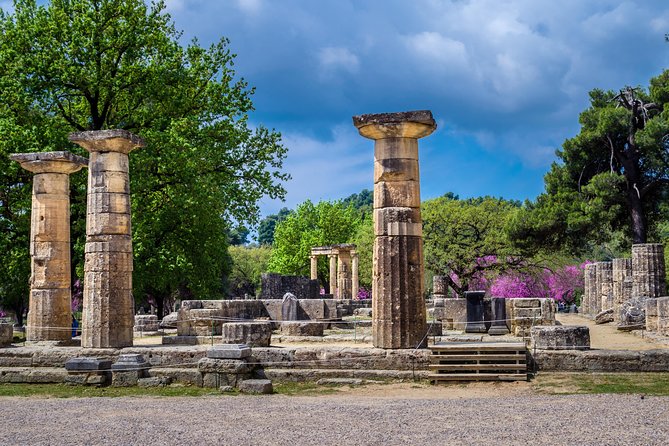
The Temple of Zeus was built in the second quarter of the fifth century BC and became the model of the mature Doric temple. Its scale and remaining columns help you picture the importance of Olympia, even though the building no longer has its roof or complete colonnade.
Inside once stood the famous gold-and-ivory statue of Zeus by Phidias. It was about 13 meters high and took roughly 13 years to complete. The statue was counted among the Seven Wonders of the Ancient World, but it no longer survives at Olympia.
The nearby workshop of Phidias adds another layer to the story. This is where the artist is traditionally associated with producing the statue, making the site more than a place to admire temple remains. You are also confronting the setting where one of classical Greece’s most celebrated works was made.
Stadium, Hera, and the Olympic flame
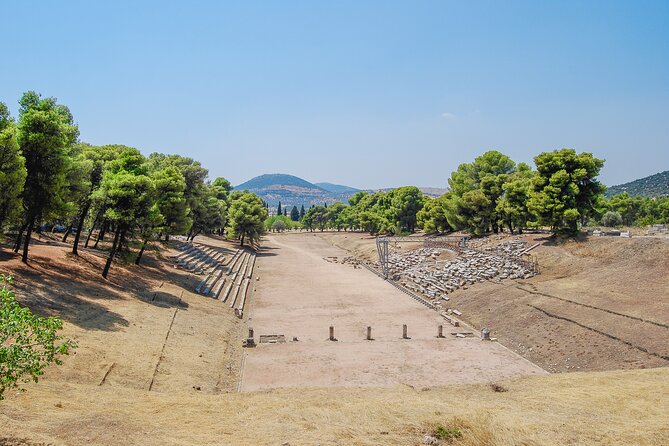
The stadium lies east of the sanctuary of Zeus. This is the place to picture the athletic contests that gave the Olympic Games their lasting name.
The open track is more powerful than a museum label because the space gives you a sense of distance and scale. You can imagine competitors running before spectators from Greek city-states, although the modern Olympic ceremony is not the same event as the ancient games.
The Temple of Hera is older than the Temple of Zeus and was originally shared by Hera and Zeus. Its altar is still associated with the lighting of the Olympic flame, which is carried around the world for the modern Games.
You are given about 15 minutes for the Hera Temple in the stated schedule. That is enough to see the key area, but the timing may feel tight if you want extensive photographs or a slow look at the ruins. Ask your driver how the day is being paced so you know where you can linger.
Training grounds and ceremonial buildings
The palaestra was a wrestling school and training ground. Athletes practiced wrestling, boxing, and pankration there. Pankration combined hand-to-hand fighting, grappling, kicking, and punching, with rules enforced by umpires and judges.
This section helps you see the games as a demanding athletic institution rather than a simple footrace. Training, discipline, penalties, and public competition were all part of the system.
The Philippeion offers a different story. This round Ionic memorial honored Philip II of Macedon and his family, including Alexander the Great. It was the only structure inside the Altis dedicated to a human rather than a god.
The Philippeion’s circular design, 18-column outer colonnade, and inner Corinthian details make it one of the site’s more distinctive buildings. The scheduled 15 minutes is brief, so you will likely focus on the form and historical importance rather than study every architectural detail.
The water system and Olympia museums
The Nymphaeum was built in the second century as a water-distribution structure for the crowds who came to the games. Its cisterns, channels, statues, and stonework show that Olympia had to solve ordinary practical problems as well as stage grand ceremonies.
That detail is easy to overlook, but I find it valuable. Thousands of people arriving for the games needed drinking water, and the site required an organized system to move it around. The Nymphaeum brings daily life into a place often remembered only for temples and athletes.
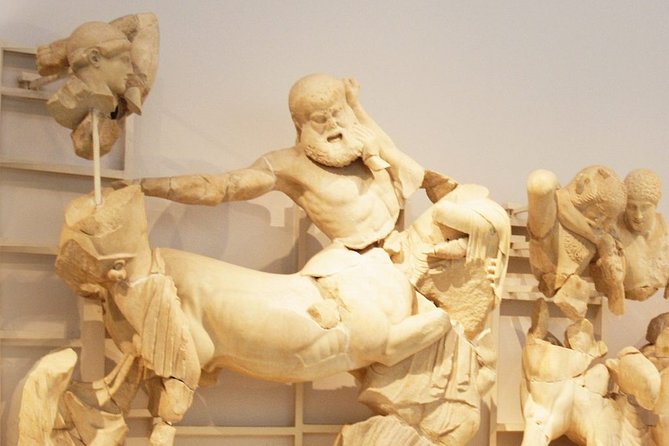
The Archaeological Museum of Olympia holds objects from the surrounding area, ranging from prehistoric times through Roman rule. Important works include Hermes and the Infant Dionysus, the Nike of Paionios, objects from the Temple of Zeus, and an oenochoe linked to Phidias.
The museum is especially strong in bronze objects. You have about 30 minutes assigned here, which allows a focused visit but not a slow study of every gallery.
The Museum of the Olympic Games explains the competitions, their connection to Zeus, and their traditional starting date in 776 BC. It also helps connect the ancient contests with the wider Greek world, where city-states sent representatives to Panhellenic festivals.
The Archimedes Museum is a separate stop dedicated to the mathematician, physicist, engineer, astronomer, and inventor. Its subject breaks up the Olympia focus and adds a look at ancient Greek work in science and technology.
The schedule gives about 30 minutes to each museum. That is useful if you want a broad introduction, but you should not expect a specialist-level museum visit in such short blocks.
Lunch and the market in Ancient Olympia
After the ruins and museums, you have about an hour in the village. This is your chance to eat at a traditional Greek taverna and browse shops for handmade souvenirs.
Lunch is not included, so budget for it separately. The village stop also gives your feet a break after the archaeological site. A meal at a local cafe, including the Ambrosia Café mentioned by one guest, can make the day feel less like a chain of monuments and more like time spent in a living Greek community.
Because the return drive takes about 3.5 hours, keep an eye on the departure time. The village is not simply extra free time without limits. It is the final stop before the long ride back to Athens.
Price, guide arrangements, and practical value
At $330.44 per person, this is best judged as a private transport and sightseeing package, not a bargain group excursion. You pay for hotel pickup, a private air-conditioned vehicle, WiFi, bottled water, an English-speaking driver, and the ability to keep the day within your own group.
Entry to the archaeological site and museums is not included. The stated admission is €12 per adult, though one account refers to paying €30 per person, so confirm the current combined ticket cost before departure. Lunch is also extra.
The driver can offer useful commentary and answer questions, but drivers do not enter the archaeological sites. That distinction is central to the price decision. If you want a detailed explanation of the Pelopion, Temple of Zeus, stadium, and museums as you walk, request a licensed guide and confirm the added cost.
The tour has a 4.7 rating from seven published ratings, but the small number means you should focus on the practical pattern: strong praise for the drivers, the pleasant long-distance ride, the water, and the relaxed private pace, alongside clear concern about the lack of in-site guiding and the high overall cost.
Free cancellation is available up to 24 hours before the start time. Changes or cancellations made inside that window are not accepted for a refund.
Who should book this Olympia tour
I would choose this trip if you have limited time in Athens and Ancient Olympia is high on your list. It is also a good fit for families or small groups who value a private car, hotel pickup, and freedom from a large bus schedule.
You should be comfortable with a very long day. The route includes about an hour to Corinth Canal, 2.5 hours to Olympia, three hours or more among ruins and museums, an hour for lunch and shopping, and 3.5 hours back to Athens.
I would hesitate if you dislike long rides, struggle in hot open-air sites, or want a full archaeological lecture while walking. In those cases, staying overnight near Olympia or choosing a tour with a confirmed licensed guide may give you a better experience.
Should you book it?
Book this tour if the chance to walk through the birthplace of the Olympic tradition matters more to you than travel time. The Corinth Canal is a worthwhile bonus, and a private driver such as George can make the road time friendly and informative.
Before paying, confirm three things: the exact admission total, whether a licensed guide is available, and how much free time you will receive in the village. With those details clear, this is a practical way to reach a remote but important Greek site from Athens in one ambitious day.
FAQ
How long is the Ancient Olympia tour from Athens?
The experience lasts approximately 12 hours. The schedule includes about one hour from Athens to Corinth Canal, 30 minutes at the canal, 2.5 hours to Olympia, time at the archaeological site and museums, one hour in the village, and about 3.5 hours back to Athens.
Is hotel pickup included?
Yes. The driver waits in your hotel lobby. If you stay in an apartment, the driver waits at the entrance of the building.
Is the tour private?
Yes. Only your group participates, and the driver returns you to the same place or to another point you prefer.
Is a licensed guide included?
No. The standard service includes an English-speaking professional driver, not a licensed guide inside the archaeological sites. A licensed guide can be requested, depending on availability.
Are entrance tickets included?
No. Admission to the Archaeological Site of Olympia and the museums is not included. The stated cost is €12 per adult, but you should confirm the current price before the tour.
Is lunch included?
No. Lunch is not included. You have about one hour in Ancient Olympia to eat at a traditional Greek taverna and browse the village shops.
What should I bring for the Olympia site?
Wear comfortable shoes and bring a hat, sunglasses, and sunscreen. These are especially important during summer, when the open-air ruins can become very hot.
Freshly added Athens trips
- Athens and Ancient Corinth Private from Athens★ 5.0 · 3 reviews
- From Athens: Mycenae and Epidaurus Private Tour★ 4.8 · 3 reviews
- Full day Meteora private tour★ 5.0 · 3 reviews
- Double Shore Dive (certified divers)★ 4.5 · 3 reviews
- Athens Hills: Mythology Treasure Hunt★ 5.0 · 3 reviews
- Sunset & swimming at Cape Sounio, Poseidon temple★ 5.0 · 3 reviews
- Philosophy Experience at Plato’s Academy Park – basic version★ 5.0 · 3 reviews
- Private Acropolis Tour – Ticket Included★ 5.0 · 3 reviews
Ancient Olympia Tours, compared.
4-Day Classical Greece Tour: Epidaurus, Mycenae, Olympia, Delphi, Meteora
Read our review →
3-Day Classical Greece Tour: Epidaurus, Mycenae, Nafplion, Olympia, Delphi
Read our review →
4-Day Tour of Mycenae, Epidaurus, Olympia, Delphi & Meteora
Read our review →
4-Day Greece Highlights Tour: Epidaurus, Mycenae, Olympia, Delphi and Meteora
Read our review →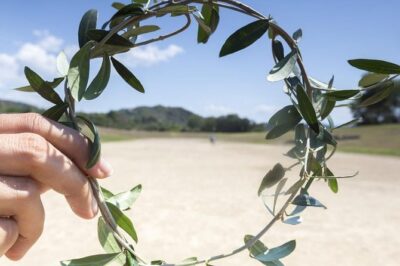
Ancient Olympia full day private tour from Athens
Read our review →
Day tour to Ancient Olympia,Ancient Sparta Mycenae Including Meal
Read our review →
5-Day Best of Peloponnese Private Tour: Nafplio/Olympia/Mycenae/Epidaurus/more
Read our review →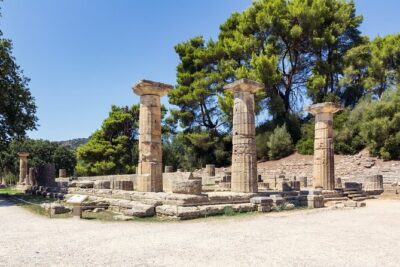
Ancient Olympia (birth place of Olympic Games) & Corinth Canal, Private Day Tour
Read our review →Browse the lists this tour appears in