
Reviewed · ATHENS
Panorama of Athens in 6 hours
The best thing about this Athens tour is its range. In roughly half a day, you can stand before the Parthenon, look across the city from Lycabettus Hill, watch the Evzones change guard, stroll through Plaka, and still fit in the Panathenaic Stadium and Ancient Agora. It is a fast, private overview of Athens, not a slow archaeological tour.
I like the hotel pickup and private vehicle, especially if you have only a few hours in town or are traveling with family. I also like the flexibility: drivers such as Andrew, Andreas, Alex, and Evangelos have tailored the route to interests, mobility needs, lunch plans, and available time. The main drawback is that the driver is not a licensed guide, so you explore the paid archaeological sites on your own unless you arrange a separate guide.
In This Review
- Key points to know before booking
- A half-day route built around the Acropolis
- Walking through the Acropolis and its monuments
- What the driver can and cannot do
- Zeus, the stadium, and the changing guard
- The Academy, University, and National Library
- Monastiraki, Plaka, and the Ancient Agora
- Timing, pace, and practical limits
- Who will get the most from this Athens tour?
- Should you book Panorama of Athens in 6 hours?
- FAQ
- How long does Panorama of Athens in 6 hours last?
- How many people can join the private tour?
- Is hotel pickup and drop-off included?
- Is an English-speaking guide included?
- Are Acropolis admission tickets included?
- Is the Panathenaic Stadium included in the price?
- What happens if bad weather cancels the tour?
Key points to know before booking
- A private route for up to three people: The $459.74 price covers the group, not each person, making it more attractive for a small party.
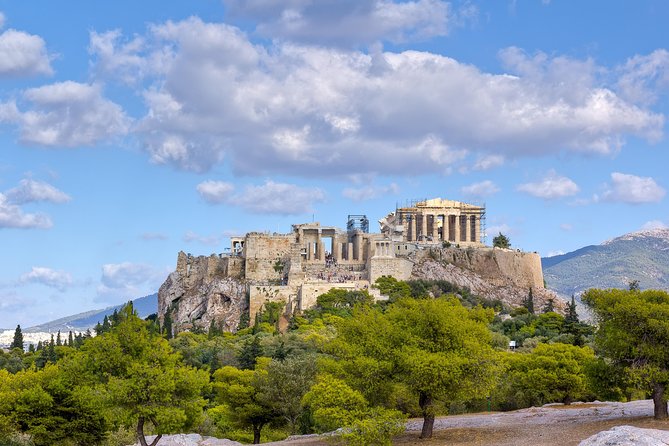
- The Acropolis is the centerpiece: You see the Parthenon, Erechtheion, Propylaea, Temple of Athena Nike, Theatre of Dionysus, and Odeon of Herodes Atticus.
- A driver, not a licensed site guide: Your driver provides historical commentary and transportation but cannot accompany you inside the archaeological sites.
- A strong citywide mix: The route adds Lycabettus Hill, the Panathenaic Stadium, the changing guard, Monastiraki, Plaka, and the Ancient Agora.
- Tickets need advance planning: Acropolis and slope admission is listed at €30 per person and must be purchased in advance, with free admission for those up to age 18.
- Best for a short stay: This works well when you want a broad first look at Athens rather than several hours at one museum or ruin.
A half-day route built around the Acropolis
Athens can feel scattered at first. The Acropolis rises above the old center, the stadium sits southeast of it, Lycabettus Hill offers a high view from another part of town, and the Agora and Monastiraki fill the streets below. A private car helps you connect these places without losing time to city navigation.
The tour lasts about five to six hours. That sounds generous, but the route covers a lot. Some places receive only a brief stop or photo pause, while the Acropolis and Agora deserve more of your walking time. You should think of this as a guided city sampler with transport, not a full archaeological study.
Pickup and drop-off at your hotel are included. The vehicle may be a Skoda Kodiaq SUV, a luxury vehicle, or a C Class taxicab, all with air-conditioning. Bottled water is included, which matters on a warm day when you are walking over exposed stone.
The advertised price is $459.74 for up to three people. Split three ways, that is about $153 per person before tickets. For a couple, it is a more serious expense, but you are paying for a private car, a flexible route, hotel transportation, and a driver focused only on your group. If you would otherwise arrange several taxis or hire separate transportation from a cruise port, the cost may make better sense.
Other days out people book around Athens:
- Athens: Acropolis & up to 5 Archaeological Sites Combo Pass
★ 4.4 · 12,619 reviews - Athens: Acropolis Ticket with Optional Audio or Live Guide
★ 4.2 · 11,055 reviews - Athens: Acropolis, Parthenon & Acropolis Museum Guided Tour
★ 4.8 · 9,316 reviews
Walking through the Acropolis and its monuments
The Acropolis takes about an hour in the planned schedule, though your actual visit depends on ticket lines, walking pace, and how much time you spend at each monument. You enter through the Propylaea, the monumental gateway designed during the building program of Pericles in the fifth century BC.
The gateway is more than an entrance. It sets the tone for the hill, with massive marble architecture framing the climb toward the temples. Nearby, the small Temple of Athena Nike is an early fully Ionic temple on the Acropolis, built around 420 BC and dedicated to Athena Nike.
The Parthenon gets about 20 minutes in the stated plan. That is enough for a clear look at its proportions, columns, and ongoing restoration work, but not enough for a leisurely architectural study. The temple was built between 447 and 438 BC for Athena Parthenos, the patron goddess of Athens.
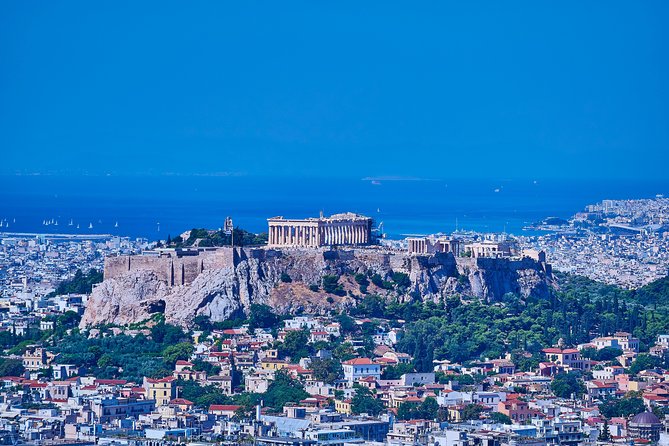
I would use your time here for the big picture first. Look at the temple against the sky, then turn outward for views across Athens and toward the port of Piraeus. The hill gives you a useful sense of how the modern city spreads around the ancient core.
The Erechtheion receives only about five minutes. Its uneven design and the famous Caryatid porch make it one of the most memorable buildings on the hill. The temple served several cults, including those connected with Athena, Poseidon-Erechtheus, Hephaistos, and Boutes.
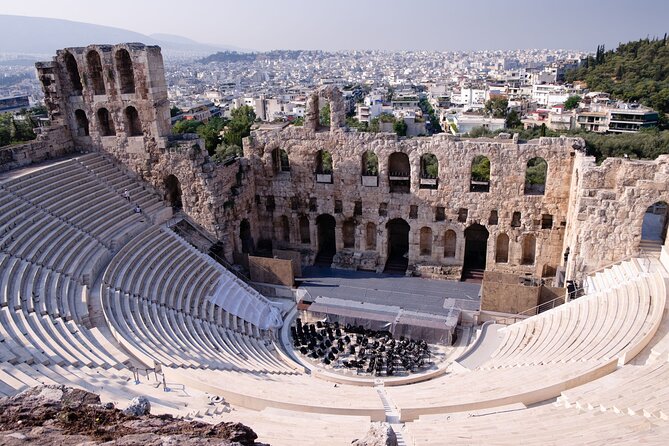
At the southern foot of the Acropolis, you can see the Theatre of Dionysus, often described as the oldest open-air theatre in the world. This is where works by Aeschylus, Sophocles, Euripides, and Aristophanes were presented. The nearby Odeon of Herodes Atticus is a Roman stone theatre still used for performances, though this tour offers a brief viewing rather than an event.
The Areopagus, also called Mars Hill, adds another useful viewpoint near the Acropolis. The stone surface can be uneven, so wear firm shoes. The tour requires a moderate level of physical fitness, and the Acropolis involves walking and slopes.
The paid Acropolis admission is not included. The supplied details list Acropolis and slope admission at €30 per person, with tickets to be purchased in advance, and free admission for people up to age 18. Because the ticket information uses both Acropolis and Acropolis and Slopes wording, check the booking link carefully before you go.
What the driver can and cannot do
This distinction matters more than it first appears. You get a professional driver with historical knowledge, but the driver is not licensed to accompany you inside the archaeological sites. You will receive commentary in the vehicle and help with the route, then walk through the Acropolis, Agora, and other paid areas independently.
That arrangement suits you if you enjoy setting your own pace. You can pause for photographs, skip a section, or move through the ruins without staying beside a group. It is less suitable if you want a formal explanation beside every temple, inscription, and statue.
The strongest part of the service is its personal attention. Andrew has been praised for using historical photographs to make the sites easier to understand. Alex has been described as helpful with parking, route choices, family interests, and lunch suggestions. Andreas and Evangelos have also been praised for adjusting the day to what the group wanted.
One especially useful detail is the attention to mobility. A guest with a broken knee was taken as close as possible to the sights, and Andrew helped arrange Acropolis elevator access. You should discuss mobility needs in advance, since the Acropolis remains a demanding place to walk even with good transport support.
Zeus, the stadium, and the changing guard
After the Acropolis, the route turns to several Athens landmarks that help connect ancient, Roman, royal, and modern Greece.
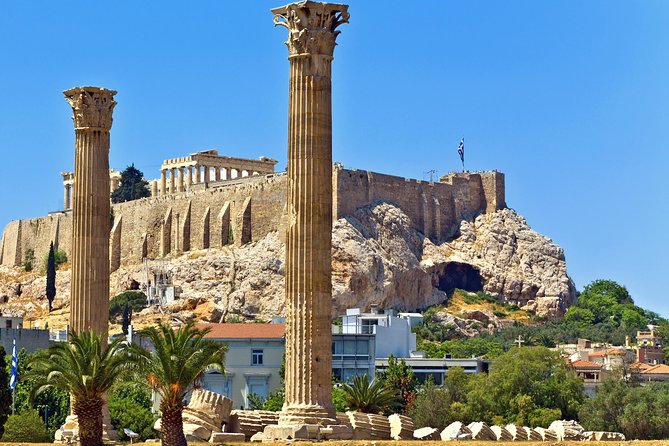
The Temple of Olympian Zeus is a dramatic field of surviving columns. Construction began in the sixth century BC and was completed under the Roman Emperor Hadrian in the second century AD. The original temple was colossal, and the remaining columns make its former scale easy to picture.
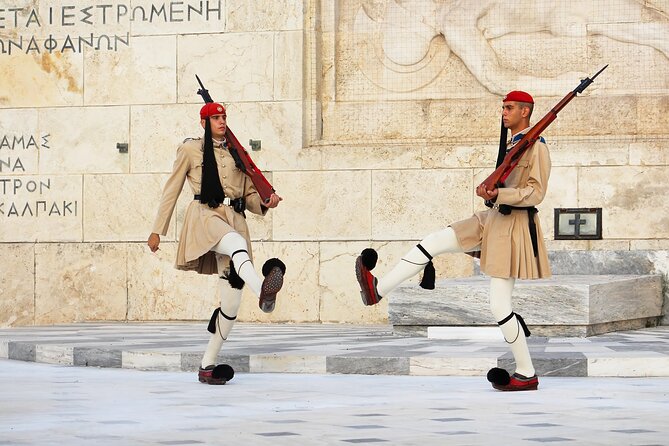
The changing of the guard takes about 15 minutes and is free. The Evzones, Greece’s ceremonial presidential guards, change every hour at the presidential mansion. This is a short stop, but it gives the tour a distinctly modern Greek moment after the ancient stones.
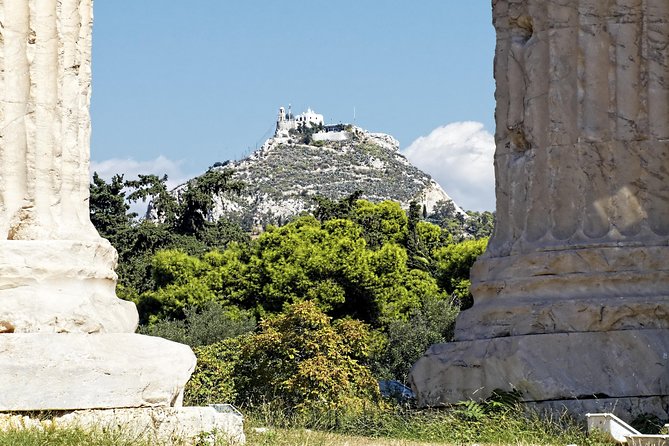
Lycabettus Hill is the highest point in central Athens, rising to 277 meters. The planned stop is about 15 minutes, enough to take in the view and orient yourself. I like this stop because the Acropolis looks different from above and across town. You can see how the ancient hill fits into the much larger capital.
The Panathenaic Stadium receives another 15 minutes. Unlike many ancient stadiums, it is not simply a ruin. Its marble form reflects the fourth-century BC stadium, with renovation carried out for the first modern Olympic Games in 1896 and financed by Georgios Averof.
Admission is not included, so you must decide if you want to enter or simply photograph the white marble exterior. A short visit works well for a first look, but anyone interested in the Olympic Games or stadium design may want more time than the schedule allows.
Same city, a completely different century:
- Athens: Cape Sounion & Poseidon Temple Sunset Half-Day Trip
★ 4.8 · 8,241 reviews - Athens: Acropolis and Parthenon Guided Walking Tour
★ 4.6 · 5,882 reviews - All Day Cruise -3 Islands to Agistri,Moni, Aegina with lunch and drinks included
★ 5.0 · 4,958 reviews - Athens, Piraeus, and Coastline: Blue Hop-On Hop-Off Bus
★ 3.9 · 4,849 reviews
The Academy, University, and National Library
The drive through central Athens includes the Academy of Athens, the University of Athens, and the National Library of Greece. These buildings help you see the nineteenth- and early twentieth-century capital, not just its ancient monuments.
The Academy was founded in 1926 as an institution for science, humanities, and fine arts. Its building is modeled on the Propylaea of the Acropolis, creating a deliberate visual link between modern Greek identity and classical Athens.
The University of Athens was founded in 1837 by King Otto, making it the first university in the liberated Greek state and the surrounding area of Southeast Europe. The National Library, founded by Ioannis Kapodistrias in 1832, focuses on collecting, organizing, describing, and preserving Greek cultural material.
These stops appear to be sightseeing points rather than long interior visits. That is useful if you want to understand the city from the car, but you should not book this tour expecting extended time inside the institutions.
Monastiraki, Plaka, and the Ancient Agora
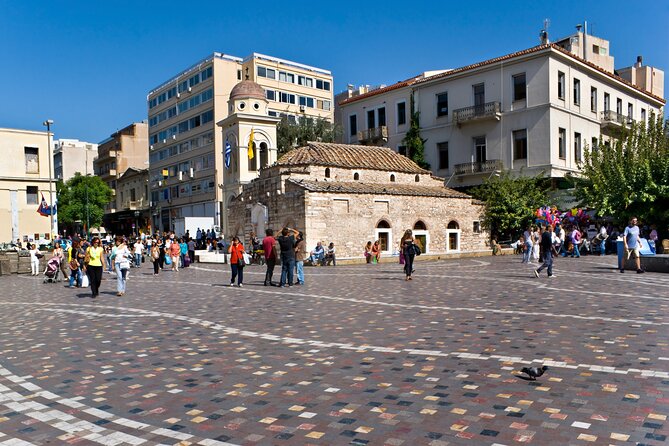
Monastiraki Flea Market gives you 30 minutes in one of the liveliest shopping areas in central Athens. The market surrounds Monastiraki Square and offers a mix of shops, souvenirs, and street activity. Half an hour lets you browse or grab a quick look, though it is not enough for a serious shopping session.
From here, the old neighborhoods under the Acropolis are easy to appreciate. Plaka occupies the slopes below the Sacred Rock, between Syntagma and Monastiraki. Its narrow streets, neoclassical buildings, cafes, souvenir stores, and museums give you a more intimate side of Athens than the grand monuments do.
The Plaka stop is listed at about ten minutes. That is enough for a short walk and photographs, but you may want to return later if you enjoy cafes, small shops, or unhurried wandering. This is one point where the private format helps: you can ask whether the route should favor more neighborhood time or more ruins.
The Ancient Agora receives about 20 minutes, with the Stoa of Attalos planned for another 30 minutes. The Agora was the political, commercial, administrative, social, religious, and cultural center of ancient Athens. It is the place to picture daily civic life, rather than only temples and grand monuments.
The reconstructed Stoa of Attalos dominates the north side of the Agora and houses the Agora Museum. The Temple of Hephaestus, also known as Thissio, is among the best-preserved ancient temples in Greece. Dedicated to Hephaestus, the god of fire, it gives you a strong comparison with the damaged Parthenon.
Both the Agora and Stoa require paid admission. The driver can bring you to the area and explain what you are seeing, but you will visit the site without the driver as a licensed guide. If these ruins are a priority, buy the needed tickets ahead and protect enough time for them.
Timing, pace, and practical limits
The listed stops add up quickly. The Acropolis alone includes several monuments, and the full route also includes the Agora, Stoa, stadium, Lycabettus, Plaka, Monastiraki, and central civic buildings. Traffic, parking, ticket checks, and walking can reduce the time available at any one place.
I would tell you to choose your top three priorities before pickup. For most first-time visitors, those might be the Acropolis, Ancient Agora, and Lycabettus Hill, or the Panathenaic Stadium instead of the hill. The driver can then shape the day around what matters most.
The tour is offered in English. Confirmation arrives at booking, and it is a private activity for your group alone. Food and drinks are not included, though one past itinerary included a lunch suggestion and a meal stop. Treat that as an example of possible flexibility, not a promised part of the tour.
Airport pickup and drop-off are not included. Hotel pickup and drop-off are included, so you should confirm that your accommodation fits the service area and tell the provider exactly where you need to be collected.
This experience requires good weather. If weather forces cancellation, you are offered another date or a full refund. Otherwise, you can cancel for a full refund up to 24 hours before the start time. Changes or cancellations inside that window are not refunded.
Who will get the most from this Athens tour?

I would choose this tour if you have a short stay, a cruise-day stop, older family members, or a small group that values private transport. It also suits you if you want an English-speaking driver who can adjust the route rather than a fixed group schedule.
Families may appreciate the private vehicle and the chance to keep the day moving. Couples can use it as a first orientation before returning to the Acropolis or Plaka on their own. The vehicle and nearby drop-offs may also help if walking is difficult, though the archaeological sites themselves still have uneven paths and slopes.
I would hesitate if your main goal is an expert archaeological lecture. Since a licensed guide is not included, you should either arrange one separately or prepare to read and explore on your own. I would also hesitate if you prefer slow meals, long museum visits, or a single neighborhood explored in detail.
The perfect match is someone who wants to see Athens in broad strokes and make the most of limited time. You get context in the car, independent time at the sites, and a route that joins famous monuments with everyday city streets.
Should you book Panorama of Athens in 6 hours?
Book it if you want private transportation and a wide-ranging Athens overview in five to six hours. The price is reasonable for three people who would otherwise hire several taxis and manage the route themselves, though entrance fees add to the total.
Before paying, set aside the €30-per-person Acropolis admission listed for the tour, check the ticket instructions, and decide whether you need a licensed guide inside the ruins. Ask for your preferred priorities, especially if the Acropolis and Ancient Agora matter more to you than quick photo stops.
Skip it if you want an unhurried day at the archaeological sites or a formal guide beside you at every monument. For a short visit, though, this is a practical way to see the Parthenon, stadium, guard ceremony, city views, old neighborhoods, and Agora without wasting much time on transport.
FAQ
How long does Panorama of Athens in 6 hours last?
The experience lasts approximately five to six hours.
How many people can join the private tour?
The price covers one private group of up to three people.
Is hotel pickup and drop-off included?
Yes. Hotel pickup and drop-off are included. Airport pickup and drop-off are not included.
Is an English-speaking guide included?
The experience is offered in English, and you receive a professional driver with historical knowledge. A licensed tour guide is not included, and the driver is not licensed to accompany you inside the archaeological sites.
Are Acropolis admission tickets included?
No. Acropolis and slope admission is listed at €30 per person and must be purchased in advance. Admission is free for those up to 18 years old, according to the supplied tour information.
Is the Panathenaic Stadium included in the price?
No. Admission to the Panathenaic Stadium is not included. The tour provides a planned stop there for about 15 minutes.
What happens if bad weather cancels the tour?
If the experience is canceled because of poor weather, you are offered a different date or a full refund. For other cancellations, you must cancel at least 24 hours before the start time to receive a full refund.
Freshly added Athens trips
- Athens and Ancient Corinth Private from Athens★ 5.0 · 3 reviews
- From Athens: Mycenae and Epidaurus Private Tour★ 4.8 · 3 reviews
- Full day Meteora private tour★ 5.0 · 3 reviews
- Double Shore Dive (certified divers)★ 4.5 · 3 reviews
- Athens Hills: Mythology Treasure Hunt★ 5.0 · 3 reviews
- Sunset & swimming at Cape Sounio, Poseidon temple★ 5.0 · 3 reviews
- Philosophy Experience at Plato’s Academy Park – basic version★ 5.0 · 3 reviews
- Private Acropolis Tour – Ticket Included★ 5.0 · 3 reviews