

Reviewed · CITY TOURS
Athens City of Rebellion Small-Group Walk
Athens’ rebellious spirit comes into focus on this walk, which links Ottoman rule, Nazi occupation, student activism, and today’s social struggles. I like the way it connects ordinary streets to major turning points, and I especially like the final move into Exarchia, where politics, street art, and community action still shape daily life.
The small group, capped at six, should make it easier to ask questions and follow a thoughtful discussion. I also like that the route fills the gap between ancient Athens and the modern city. The main drawback is pace: 2.5 hours on foot is a long stretch for anyone with walking trouble, and some visitors may find the political subject matter more demanding than a standard sightseeing tour.
In This Review
- Key points to know before you book
- Why this Athens walk feels different
- Monastiraki and the Ottoman chapter
- Syntagma Square, royal power, and occupation
- The university and the role of students
- Navarinou Park and a citizen-made space
- Exarchia, Athens’ present-day center of resistance
- Guide style and the value of a six-person group
- Timing, walking demands, and practical details
- Who will get the most from this experience
- Should you book the City of Rebellion walk?
- FAQ
- How long is the Athens City of Rebellion walk?
- Where does the tour begin?
- Where does the tour end?
- How many people can join the tour?
- What does the tour cost?
- Is the tour suitable for people with walking difficulties?
- Is the tour available in poor weather?
- Can I cancel for a full refund?
Key points to know before you book
- A bridge from Ottoman Athens to today: The route explains the years often skipped between classical Greece and the modern capital.
- Six people maximum: A very small group allows more conversation than a large city walk.
- Syntagma Square has several layers: Royal power, Nazi occupation, military ceremony, and popular resistance all meet here.
- Exarchia is the grand finale: You see the neighborhood’s street art and learn about activism, policing, gentrification, and community projects.
- Maelle brings a personal touch: The guide most often named in the available feedback is praised for her warmth, organization, and ability to make recent history clear.
- A good value at $46.29: For a 150-minute walk with free-entry outdoor stops, the price is fair if modern Greek society matters to you.
Why this Athens walk feels different
Many Athens tours begin with the Acropolis and stay in the ancient world. This one starts at Monastiraki Square, but its real subject is the city that grew around and after the monuments.
That makes the experience useful for you if the timeline of Greek history feels broken. How did Greece move from Ottoman rule to independence? Where did the royal family come from? How did students, workers, and citizens challenge later governments and occupations? The walk aims to connect those pieces.
I like that the tour treats resistance as a long thread rather than a single heroic event. You hear about individuals who became national legends, but also about large public movements and local initiatives. The result is less about memorizing dates and more about seeing Athens as a city shaped by pressure, argument, and civic action.
The price is $46.29 per person. Since the route lasts about two and a half hours and limits the group to six, I consider that a reasonable price for travelers who want a focused guide rather than a quick introduction. You are not paying admission to major monuments here. You are paying for the explanations that tie public squares, churches, universities, and neighborhoods together.
More Athens walking tours:
- Athens: Acropolis and Parthenon Guided Walking Tour
★ 4.6 · 5,882 reviews - Greek Food Walking Tour in Athens
★ 5.0 · 4,740 reviews - Acropolis: Acropolis and Parthenon Guided Walking Tour
★ 4.7 · 3,442 reviews
Monastiraki and the Ottoman chapter
The meeting point is Pl. Monastirakiou 2, on Monastiraki Square. Your guide welcomes you here, giving the group a clear starting point in one of central Athens’ best-known public spaces.
The first stop takes about ten minutes. Admission is free, as it is throughout the route. Monastiraki works well as an opening because it immediately places you in a part of Athens where different periods sit close together.
From there, you walk to the Tzisdarakis Mosque. This ten-minute stop looks at the Ottoman past of Greece and the beginning of the Greek revolution against Ottoman rule. The discussion includes the striking idea of an Acropolis topped by a minaret, a reminder that Athens has not always looked the way it does in postcards.
This is a useful correction to the usual ancient-world focus. You begin to see the Acropolis not only as a classical monument, but also as part of a city that passed through Ottoman rule and revolutionary change. If you have wondered how modern Greece emerged from that period, this section gives you a starting framework.
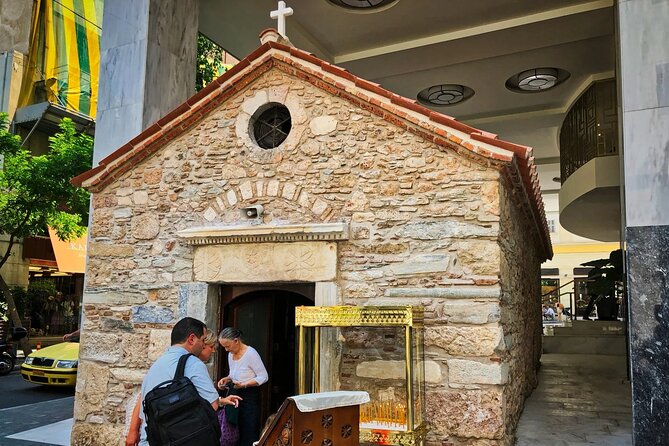
The route then reaches the Holy Church of the Sacred Power, or Ayìa Dynami. The stop lasts about ten minutes and centers on the church’s connection to members of the Greek resistance during the Ottoman occupation.
I appreciate the choice of this site. A famous square can tell you about public movements, but a small church can suggest how resistance also survived through less obvious places. This is the sort of stop that rewards a guide who can provide context, since the building itself may not explain its full political importance.
Syntagma Square, royal power, and occupation
The walk continues to Syntagma Square, the symbolic center of resistance in Athens. The group spends about fifteen minutes here, though the guide also uses nearby buildings and monuments to extend the story.
Syntagma brings several eras together. You learn about the former royal palace, the Tomb of the Unknown Soldier, and the Nazi headquarters that once occupied a building now used as a luxury hotel. That contrast is one of the tour’s sharpest points: a place can change function while still carrying the memory of what happened there.
The stop also covers stories of resistance linked to the square. I like this part because Syntagma is easy to pass through as a visitor focused on shopping, traffic, or the changing of the guard. The tour asks you to read the square as a civic stage where power and protest have repeatedly faced each other.
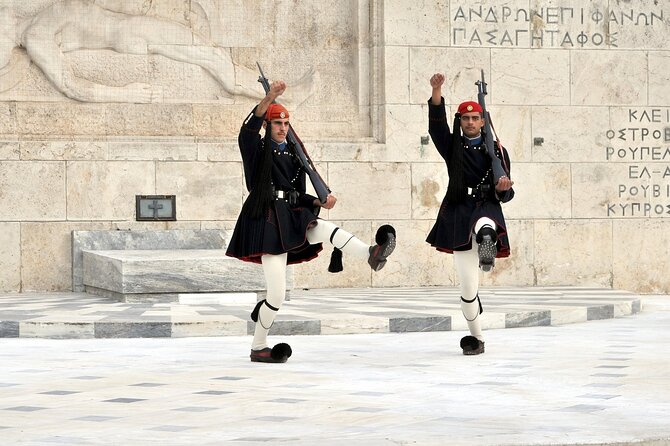
The Monument to the Unknown Soldier receives a separate, shorter stop of about five minutes. You see the Evzones, the ceremonial soldiers who guard the tomb, and learn about their distinctive uniforms.
This is not simply a photo stop. The clothing and ceremony connect modern national identity with military tradition and public memory. It also gives you a chance to watch one of Athens’ most recognizable rituals while understanding what it represents.
Nearby, you also hear the story of the old palace of the first king of Athens after the Greek victory in the revolution. The details help explain how the new state presented itself after independence and how royal power became part of the capital’s identity.
The Syntagma section is strong for travelers who want more than ancient ruins. It shows how national symbols are built, displayed, and contested. The limitation is that the route covers a lot of political ground in a short time, so you may want to ask questions if one period interests you most.
The university and the role of students
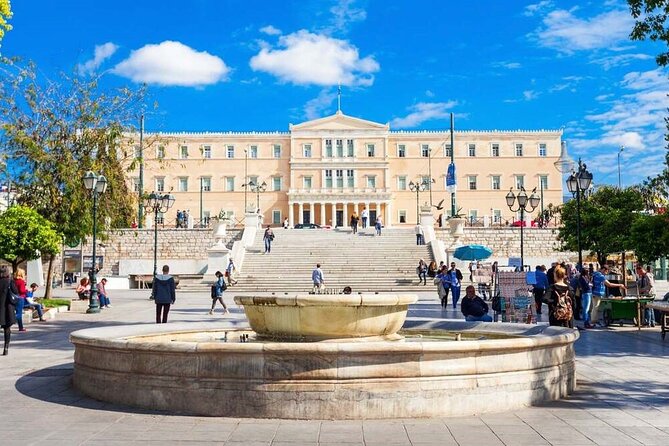
The next major stop is the National and Kapodistrian University of Athens. The group spends about ten minutes learning how students and universities became important in the fight for citizens’ liberties.
This stop gives the tour a younger and more organized form of resistance. Earlier sections focus on occupation, revolution, royal power, and national memory. At the university, the story turns toward citizens demanding rights and challenging authority through collective action.
I find this connection especially helpful because universities can look like ordinary institutions when you walk past them. Here, the building becomes part of a broader story about education, political speech, and public pressure. You get a better sense of why students have played such a visible role in modern Athens.
The tour does not treat rebellion as a relic. That is one of its strongest qualities. The route keeps asking how earlier struggles influenced the city you see now, rather than ending with the creation of the modern Greek state.
A few more Athens days worth a look
- Athens: City Sightseeing Hop-On Hop-Off Bus Tour
★ 4.3 · 4,520 reviews - City Sightseeing Athens, Piraeus & Beach Riviera Hop-On Hop-Off Bus Tours
★ 4.0 · 1,887 reviews - Athens:City Pass with Acropolis, Museums, Hop-On Hop-Off Bus
★ 3.9 · 586 reviews - Athens: City Highlights Bike tour
★ 4.9 · 453 reviews
Navarinou Park and a citizen-made space
From central Athens, the route heads toward Navarinou, a small park with a distinctive civic story. The stop lasts around ten minutes and focuses on a citizen initiative in Exarchia.
This is an important change in scale. At Syntagma, resistance takes place in one of the country’s most symbolic squares. At Navarinou, the focus is a neighborhood space shaped by local action. The point is not only what governments build, but also what residents create, defend, or reshape for themselves.
For you, this stop offers a practical way to understand Exarchia before entering its streets in greater detail. It introduces the idea that activism can involve public space, neighborhood decisions, and everyday community life, not only marches or dramatic confrontations.
Because the park is tied to a citizen-led effort, it also gives the tour a more grounded tone. You are moving from national history toward questions about who controls a neighborhood and how residents respond when official plans do not fit local needs.
Exarchia, Athens’ present-day center of resistance
The final part takes place in Exarchia, ending at Themistokleous 68, near Exarchia Square. The tour spends about twenty minutes at several points in the neighborhood.
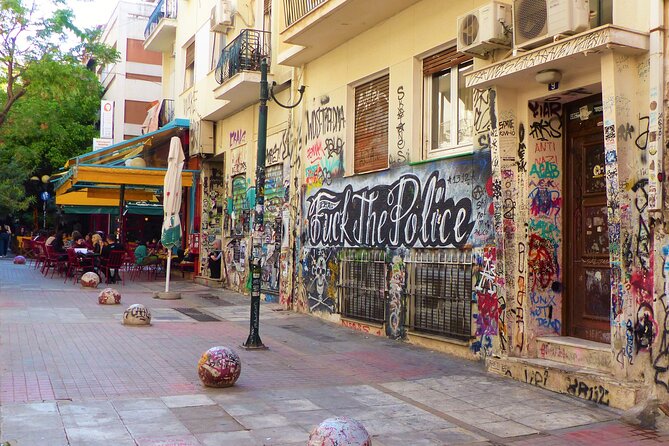
Exarchia is presented as a current center of resistance and activism. The discussion includes the economic crisis, police violence, gentrification, and citizen initiatives. You also see expressive street art and learn about a community associated with anarchists, refugees, queer people, and artists.
This is the section most likely to make the tour memorable. Ancient Athens is easy to recognize, but Exarchia asks you to think about the city as it is now. Its walls, parks, businesses, and public spaces reflect arguments about housing, policing, migration, identity, and who gets to shape central Athens.
I like that the neighborhood is not reduced to a simple label. The tour presents its rebellious reputation alongside the people and groups who use it as a place for art, organizing, and mutual support. At the same time, the subject is not lightweight. If you prefer tours that avoid current politics, this may feel too pointed.
The short scheduled time in Exarchia also means you should keep your expectations realistic. You get an introduction to the area and its role in social justice, not a full neighborhood survey. The value comes from the guide’s interpretation and from learning how earlier resistance connects to present-day concerns.
Guide style and the value of a six-person group
A small group can change the feel of a walking tour. With a maximum of six people, you are less likely to be lost at the back of a crowd, and it should be easier to stop for questions without interrupting a large group.
The available feedback repeatedly highlights Maelle as warm, organized, passionate, and clear. One especially useful description compares her approach to time travel, which fits the route’s structure: you move through the city while shifting between Ottoman rule, independence, occupation, student action, and present-day activism.
I would choose this tour for a curious group that enjoys conversation. The topic needs explanation, and the best experience will come when you ask how the periods connect. A six-person limit gives the guide room to adjust the discussion, though the exact balance will depend on the group’s interests.
This is not the right choice if you mainly want a fast list of monuments. The tour’s appeal is its argument about Athens. You spend time listening, comparing eras, and looking at ordinary sites in a new way.
Timing, walking demands, and practical details

The walk lasts approximately 2 hours and 30 minutes. It begins at Monastiraki and ends in Exarchia, so you should plan to continue from the final stop rather than return to the starting point.
The route uses public streets and squares, with free admission at the listed stops. It is near public transportation, which helps at both ends of the experience. A mobile ticket is available, and confirmation is provided when you book.
You need to be comfortable walking for the full duration. The tour is not recommended for people with walking difficulties. Since it takes place outdoors and requires good weather, a cancellation caused by poor conditions leads to a choice of another date or a full refund.
Service animals are allowed, and most people can participate. Still, I would wear comfortable shoes and bring water, especially in warm weather. The subject matter may be serious, but the practical challenge is simple: you are on your feet for a long urban walk.
You can cancel for a full refund up to 24 hours before the start time. Changes or cancellations made inside that period are not accepted and are not refunded, so keep the local cut-off time in mind.
Who will get the most from this experience
I would recommend the walk to you if you have already seen the Acropolis and want to understand the city beyond ancient Greece. It is also a good fit if modern political history, public protest, street art, or social justice interests you.
The tour suits first-time visitors who feel uncertain about the bridge between classical Athens and the modern nation. It also works for returning visitors who want a different reading of familiar places such as Monastiraki and Syntagma.
Families with older children may find the topic worthwhile, but the pace and serious themes may not suit young kids. Anyone who has trouble walking should choose another activity. The route is also less suitable for visitors who want interior monuments, formal museum interpretation, or a purely neutral sightseeing overview.
At $46.29, the tour offers good value for a very small group and a subject that can be hard to understand alone. If you are comparing it with a basic orientation walk, this costs more, but it also gives you a clearer sense of how Athens became the politically charged city it is today.
Should you book the City of Rebellion walk?
Book it if you want modern Athens explained through real places, not just a procession of famous names. The route handles a wide span, from Ottoman rule and Greek independence to Nazi occupation, student activism, and Exarchia’s current struggles.
I would especially choose it after an ancient-history tour. That combination gives you a fuller picture of Athens, from the classical past to the debates shaping its streets now.
Skip it if you dislike political discussion, cannot manage two and a half hours of walking, or want a tour built around major interiors and archaeological sites. For everyone else, the six-person limit, the strong guide presence associated with Maelle, and the final visit to Exarchia make this a thoughtful use of an afternoon.
FAQ
How long is the Athens City of Rebellion walk?
The tour lasts approximately 2 hours and 30 minutes.
Where does the tour begin?
It begins at Pl. Monastirakiou 2, Athina 105 55, Greece, in Monastiraki Square.
Where does the tour end?
The walk ends at Themistokleous 68, Athina 106 81, Greece, near Exarchia Square.
How many people can join the tour?
The group has a maximum of six people.
What does the tour cost?
The listed price is $46.29 per person.
Is the tour suitable for people with walking difficulties?
No. The experience is not recommended for travelers with walking difficulties.
Is the tour available in poor weather?
The experience requires good weather. If poor weather causes cancellation, you are offered another date or a full refund.
Can I cancel for a full refund?
Yes. You can cancel at least 24 hours before the experience start time for a full refund. Cancellations or changes made less than 24 hours before the start time are not accepted or refunded.
Freshly added Athens trips
- Athens and Ancient Corinth Private from Athens★ 5.0 · 3 reviews
- From Athens: Mycenae and Epidaurus Private Tour★ 4.8 · 3 reviews
- Full day Meteora private tour★ 5.0 · 3 reviews
- Double Shore Dive (certified divers)★ 4.5 · 3 reviews
- Athens Hills: Mythology Treasure Hunt★ 5.0 · 3 reviews
- Sunset & swimming at Cape Sounio, Poseidon temple★ 5.0 · 3 reviews
- Philosophy Experience at Plato’s Academy Park – basic version★ 5.0 · 3 reviews
- Private Acropolis Tour – Ticket Included★ 5.0 · 3 reviews
City Tours, compared.
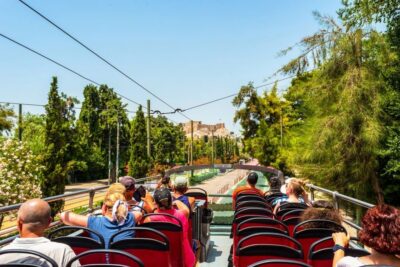

City Sightseeing Athens, Piraeus & Beach Riviera Hop-On Hop-Off Bus Tours
Read our review →
City Pass with Acropolis, Museums, Hop-On Hop-Off Bus
Read our review →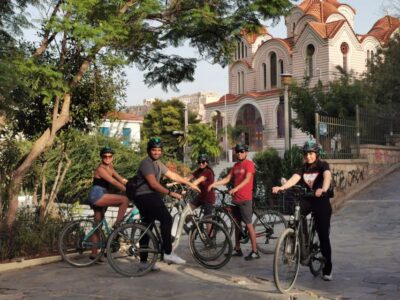
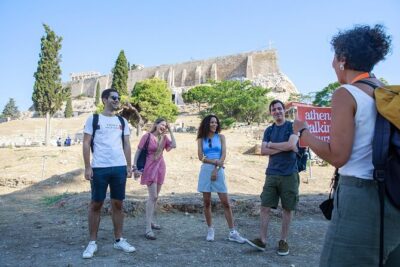
The Acropolis, Athens Walking City Tour and Acropolis Museum
Read our review →
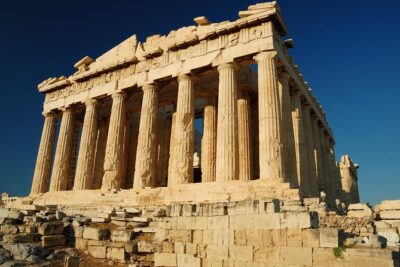
Acropolis Walking Tour, Including Syntagma Square & City Center
Read our review →
Athens Off the Beaten Track Private City Walking Tour
Read our review →Browse the lists this tour appears in