
Reviewed · ANCIENT CORINTH TOURS
Ancient Corinth, Temple of Hera, Blue Lake full day private tour from Athens
The Corinth Canal is the quick visual hook here: from the bridge, you look down at a narrow blue cut between steep limestone walls while boats creep through far below. Then the day moves from Roman ruins and Saint Paul connections to a quiet lakeside sanctuary and the old fortress of Acrocorinth. It packs a lot of north Peloponnese into one day.
I like the freedom of a private car and adjustable pickup, especially when you are traveling with family or want hotel, airport, or port service. I also like the mix of big sights and quieter stops: Ancient Corinth gives you the major archaeological setting, while Heraion and Blue Lake bring in a calmer side of Greece. The tradeoff is simple: this is a long day with several stops, and the driver does not enter the sites as a licensed guide.
In This Review
- Key points at a glance
- Why this private Corinth day works
- Looking down through the Corinth Canal
- Ancient Corinth and the world of Saint Paul
- The museum’s smaller, sharper stories
- Acrocorinth above the ancient city
- Blue Lake and the Corinthian Gulf
- Heraion of Perachora beside a small cove
- Drivers, guiding, and the value of private transport
- Who should book this day trip?
- Should you book the Ancient Corinth and Blue Lake tour?
- FAQ
- How long does the tour last?
- Is the tour private?
- Where can pickup and drop-off take place?
- Is the pickup time fixed?
- Is a licensed tour guide included?
- What entrance fees must I pay?
- What is included in the tour price?
- Can I cancel for a full refund?
Key points at a glance
- The Corinth Canal starts the day with a dramatic view: Spend about 30 minutes above the 6.4-kilometre waterway, watching boats pass through the narrow channel.
- Ancient Corinth gets the most archaeological time: Allow 1 hour 30 minutes for the ruins, followed by another hour in the on-site museum.
- Acrocorinth adds height and history: The fortress sits on a huge rock above the ancient city and once guarded the route into the Peloponnese.
- Heraion of Perachora is the quietest stop: This sanctuary of Hera sits beside a small cove on the Corinthian Gulf, away from the main city ruins.
- Your driver provides commentary but does not guide inside: George, Notis, and Tom are among the drivers named in the supplied material, and all were praised for their help and historical explanations.
- The €15 entrance fee is extra: Ancient Corinth and its archaeological museum are paid on site, while the listed transport, bottled water, Wi-Fi, and pickup service are included.
Why this private Corinth day works
This tour is best understood as a countryside day rather than a single museum visit. Athens is only the starting point. Once you leave the city, you follow the route across the Isthmus of Corinth and into a part of Greece where ancient trade, Christian history, fortified hills, beaches, and small coastal roads all meet.
The private format matters. Your group travels alone in an air-conditioned vehicle, and the pickup time can be adjusted on request. You can be collected at a hotel, apartment, airport arrival hall, or port gate, then returned to the same place or another point you choose. That is useful if your time in Athens is tied to a flight or cruise schedule.
The tour lasts about eight to nine hours. The listed sightseeing time adds up to more than six hours before driving, so this is not a rushed two-stop outing. It is a full day, and you should expect a fair amount of sitting between sites. The reward is variety without having to arrange several separate transfers.
I would choose this trip if you want to see beyond Athens but do not want to rent a car. I would think twice if you prefer one archaeological site studied in great detail. Ancient Corinth deserves time, and the surrounding stops make the day fuller, but the schedule naturally gives you an overview rather than a specialist archaeological visit.
More Ancient Corinth and canal stops:
- From Athens: Ancient Corinth Day Trip with Canal & VR Guide
★ 4.6 · 1,073 reviews - Private Biblical Tour Ancient Corinth & Isthmus Canal from Athens
★ 5.0 · 762 reviews - Athens: Ancient Corinth & Nafplio Full Day Trip with Swim
★ 4.8 · 523 reviews
Looking down through the Corinth Canal
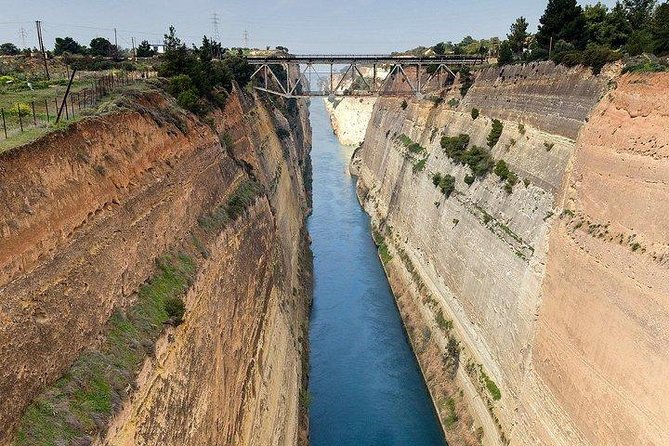
The first stop is the Corinth Canal, where the road reaches a high viewpoint over the Isthmus. The canal links the Gulf of Corinth, part of the Ionian Sea, with the Saronic Gulf in the Aegean. By cutting through the narrow isthmus, it separates the Peloponnese from mainland Greece and makes the peninsula feel almost like an island.
The scale is easy to grasp from above. The canal runs for 6.4 kilometres, but its base is only 21.4 metres wide. It has no locks because it was dug at sea level. That narrow width also explains why many modern ships cannot use it.
You get about 30 minutes here, with no admission charge. That is enough for the main view and photographs, though not enough for a long walk or an extended stop. I like having this near the start of the day because it gives you a clear geographic sense of where you are going. You are not simply driving to Corinth. You are crossing the old gateway between central Greece and the Peloponnese.
Ancient Corinth and the world of Saint Paul
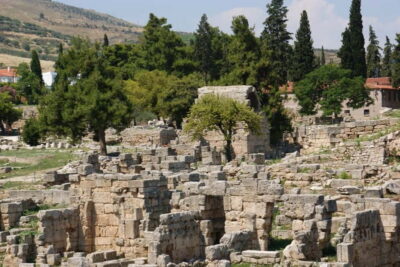
Ancient Corinth is the central historical stop. The ruins sit roughly five kilometres southwest of the modern city, on the isthmus between Athens and Sparta. In 400 BC, Corinth was one of Greece’s largest city-states, with a population given as about 90,000. Its position made it wealthy and important, since roads and sea routes met here.
The city was destroyed by the Romans in 146 BC and rebuilt in 44 BC. Under Roman rule, it became the provincial capital of Greece. That change is important when you walk among the remains: Corinth is not only a classical Greek site. It also tells a Roman story, and it is closely tied to early Christianity.
The New Testament letters known as First and Second Corinthians are addressed to this city. The Acts of the Apostles also places Saint Paul in Corinth during his missionary travels. Your driver can explain this setting on the way, but you will need to explore the ruins on your own unless you request a licensed guide.
The planned visit lasts about 1 hour 30 minutes. That is a useful amount of time for seeing the principal remains, but you should keep an eye on your watch if you want to enter the museum and continue to Acrocorinth without stretching the day.
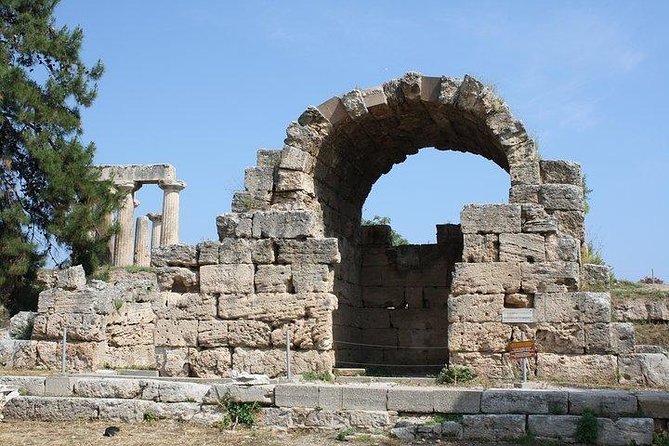
Look for the major features spread through the archaeological site: the Agora, Lechaion Road, the Fountain of Peirene, the Stoa, the Basilica, the Theatre, and the Odeon. The old road and open marketplace help you picture Corinth as a working city rather than a collection of broken stones.
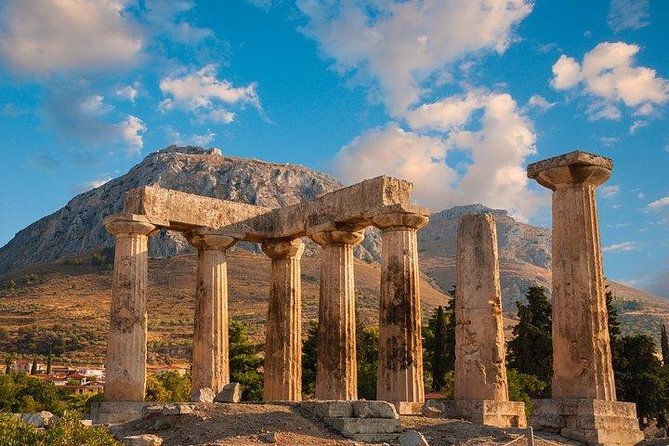
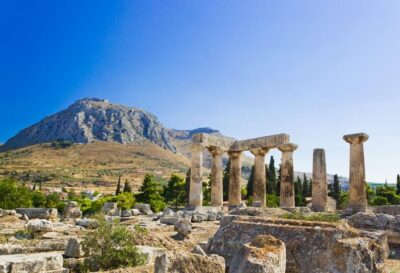
The Temple of Apollo is a key sight. Built in 550 BC, its surviving columns are among the most recognizable remains here. The separate stop is listed as 15 minutes, although it is part of the wider Ancient Corinth experience. That short pause is mainly for orientation and photographs, not a long study of the temple.
Ancient Corinth charges an entrance fee, and the archaeological museum is not included in the tour price. The supplied cost is €15 per person for Ancient Corinth and the museum, purchased on site. Bring this extra amount in your budget. The listed price of $220.73 per person covers private transport and the service package, not every admission.
The museum’s smaller, sharper stories
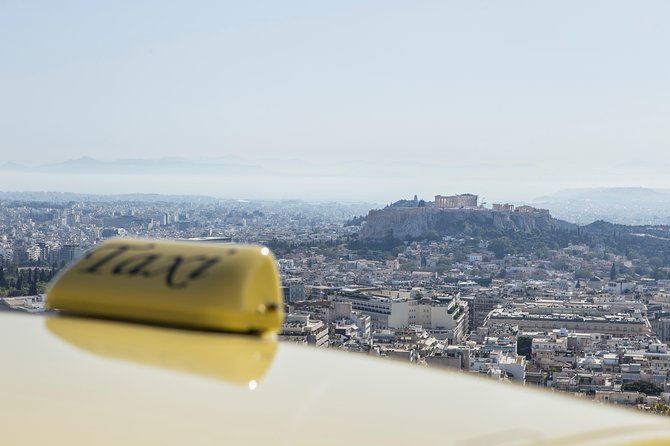
The Archaeological Museum of Ancient Corinth sits within the archaeological site. It was built in 1931 and 1932 to display objects found during recent excavations. The planned visit is one hour, and I consider it important rather than optional if you want the ruins to make more sense.
Open-air remains show you the size and layout of Corinth. The museum gives you the objects and details that explain how the city functioned. It also helps connect the Greek and Roman periods instead of leaving you with the impression that all the ruins belong to one age.
The site includes the Hadgimoustafa spring, the Basilica, the Fountain of Peirene, the Stoa, Agora, Odeon, Theatre, Lechaion Road, and other temples. You will not study every feature in depth during a standard one-hour visit, but the combination of ruins and museum gives you a solid introduction.
The driver can answer questions and provide commentary in fluent English, but the official arrangement is clear: drivers are not licensed guides and do not accompany you inside the archaeological sites. If you want formal guiding among the ruins and museum displays, a licensed guide may be requested, depending on availability. That extra service is worth considering if Ancient Corinth is the main reason you are booking.
A few more Athens days worth a look
- All Day Cruise -3 Islands to Agistri,Moni, Aegina with lunch and drinks included
★ 5.0 · 4,958 reviews - From Athens: Delphi Full Day V.R. Audio Guided Tour
★ 4.6 · 3,028 reviews - Athens Full Day Private Tour
★ 5.0 · 2,903 reviews - From Athens: Mycenae, Epidaurus & Nafplio Full Day Trip
★ 4.8 · 2,438 reviews
Acrocorinth above the ancient city

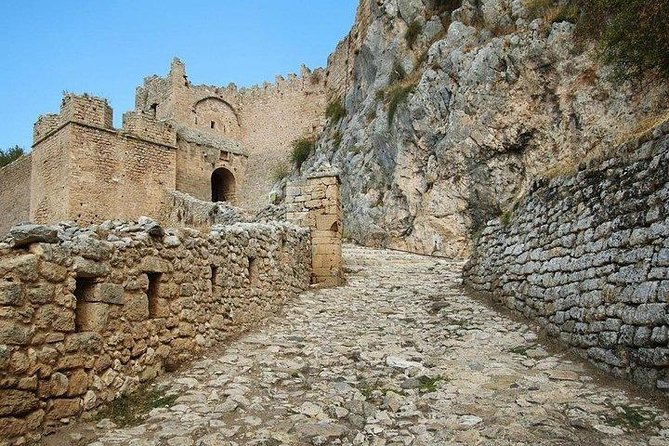
Acrocorinth means Upper Corinth, and its position explains its importance. The acropolis occupies a massive rock overlooking the ancient city and the Isthmus. From this height, the fortress controlled movement into the Peloponnese, making it a final defensive position for southern Greece.
You are scheduled for about an hour here. The attraction is not only the fortification itself. It is the relationship between the high stronghold and the lower city. Ancient Corinth was a commercial and political center; Acrocorinth was its defensive shield.
The supplied information lists the stop without an admission charge. It does not promise a fully guided walk, so you should expect to explore at your own pace after receiving directions and background from the driver. Wear practical shoes and take care on uneven ground. The fortress is on a high rocky site, and anyone with walking limitations should discuss the exact route with the provider before booking.
This is also where the day can feel physically demanding. The itinerary includes several archaeological areas, outdoor walking, and a hilltop fortress. One useful detail from the provided experience is that driver Tom helped a mother with walking disabilities see the sights. That is encouraging, but it is not a guarantee that every part of Acrocorinth or Heraion will suit every mobility level. Ask for a realistic site-by-site assessment.
Blue Lake and the Corinthian Gulf
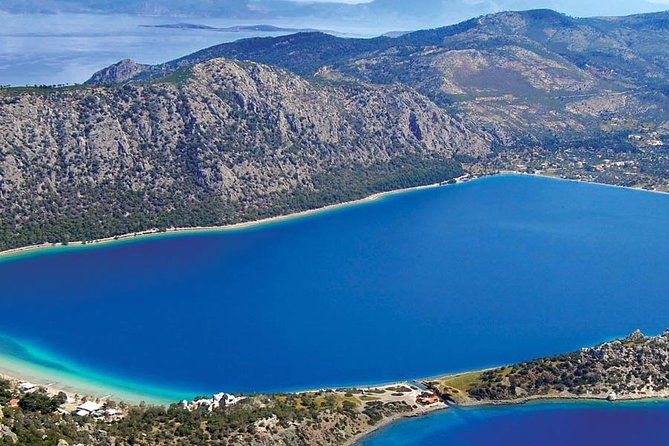
After the major ruins, the route changes mood at Limni Vouliagmeni, commonly called Blue Lake. This is a lagoon about 16 kilometres northwest of Loutraki, close to Perachora and the Heraion. It reaches roughly two kilometres in length and one kilometre in width, with a maximum depth of about 40 metres.
The lake connects with the Corinthian Gulf through a very narrow channel, no wider than about six metres. That opening explains the lagoon’s character: it is linked to the sea but remains visually distinct. The sandy beach also differs from the more familiar beach setting at Loutraki.
You have about 30 minutes here, with no admission charge. Use it for photographs, a short look at the water, and a pause between archaeological stops. The tour does not promise swimming time or a beach meal, so I would not book it as a water-sports outing. It is a scenic interlude within a history-focused day.
The place has an ancient name too. It was once called Eschatiotis and also Gorgopis, after Gorgi, daughter of Megareas, who was said to have drowned in the lake. Archaeological traces near the narrow channel show human settlement dating to the Early Helladic period, around the third millennium BC.
Heraion of Perachora beside a small cove

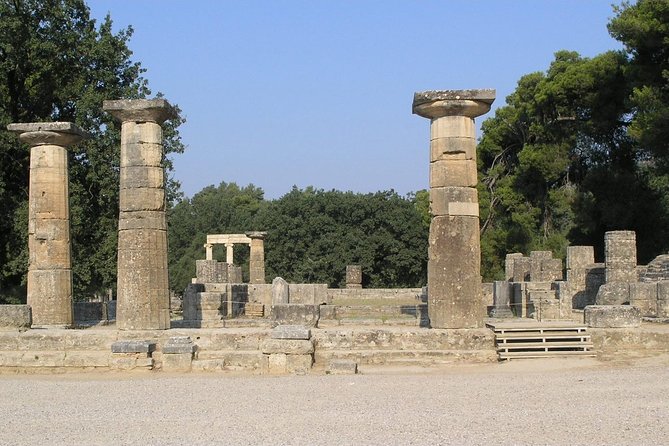
The Heraion is the most unusual stop on the route. This sanctuary of Hera sits in a small cove at the end of the Perachora peninsula, facing the Corinthian Gulf. The setting gives the ruins a sense of distance from the large city below, even though the sanctuary was tied to the power of Corinth.
The remains include a temple of Hera, an L-shaped stoa, a large cistern, dining rooms, and a possible second temple. The temple’s design and age make the site important for understanding early Greek temple building and rural religious practice.
Cult activity probably continued from around the ninth century BC until 146 BC, when the Roman general Mummius sacked Corinth during the war with the Achaean League. During the Roman period, domestic buildings replaced the sanctuary’s earlier religious role. That shift gives you a useful glimpse of how sacred places could change purpose over time.
The visit lasts about an hour and has no listed admission fee. I like this stop because it prevents the tour from becoming only a sequence of famous ruins. You get a smaller sanctuary, a coastal setting, and a chance to think about how ancient religion worked outside a major urban center.
The road to the peninsula also takes time, which is one reason the private vehicle is useful. You are not simply adding another nearby monument. You are reaching a more remote part of the Corinthian Gulf, then returning to Athens after a long day.
Drivers, guiding, and the value of private transport
The strongest personal touch in this experience comes from the drivers. George is described as helpful and good at explaining Greek history. Notis, also called Panajotis, is praised for making the country drive informative. Tom is noted for helping with mobility needs and allowing enough time to see the sights and have lunch by the water.
Those names matter because the official service is driver-led, not guide-led. Your driver can offer historical commentary in fluent English and answer questions, but will not enter Ancient Corinth, the museum, or other archaeological sites with you. You should see this as a transport and orientation service with a human history component, not a traditional guided archaeological tour.
Wi-Fi is available in the vehicle, and bottled water is included. The vehicle is air-conditioned, a real comfort during a long day with outdoor ruins and exposed viewpoints. Private transportation also means you are not tied to the pace of an unknown group. If your group wants more time at Ancient Corinth and less time at Blue Lake, you can discuss that with the driver, within the limits of the day.
Lunch is not listed as included. The provided experience allows time for lunch by the water, so ask the provider how the stop fits your preferred schedule. Do not assume meals, drinks beyond the supplied bottled water, or entrance fees are covered.
At $220.73 per person, the value depends heavily on your group size. You are paying for a full private vehicle, flexible pickup and return, air conditioning, Wi-Fi, an English-speaking driver, and a long route that would be awkward to arrange by public transport in one day. Group discounts are offered, which can make the private setup more attractive for families and small groups.
For one person, the price is a serious expense. For a group splitting the vehicle cost, it can compare well with arranging several taxis or a private transfer plus separate transport to Perachora. Add the €15 per person entrance charge for Ancient Corinth and the museum, and remember that a licensed guide is extra if requested.
Who should book this day trip?
I would recommend it to you if you have already seen Athens and want a broad, comfortable day outside the capital. It suits history fans who also want scenery, families who value door-to-door service, and cruise or airport visitors who need flexible pickup and drop-off.
It is also a sensible choice if you want to combine Ancient Corinth with places that are difficult to connect on your own, especially Heraion and Blue Lake. The private vehicle turns a complicated route into one organized day.
I would not choose it if you want a slow archaeological study. The driver cannot guide you inside the sites, and the number of stops means you will sample several places rather than spend half a day at one. Visitors with significant mobility concerns should ask specific questions about Acrocorinth, Heraion, walking surfaces, and the distance from the vehicle to each site.
The cancellation terms are friendly but firm: cancel at least 24 hours before the start time for a full refund. Changes or cancellations within 24 hours are not accepted for a refund.
Should you book the Ancient Corinth and Blue Lake tour?
Book this tour if your ideal day mixes ancient sites, coastal views, and private flexibility. The Corinth Canal, Ancient Corinth, museum, Apollo temple, Acrocorinth, Blue Lake, and Heraion create a varied route that reaches well beyond the standard Athens sights.
Before paying, confirm three things: the exact pickup time, the availability and price of a licensed guide, and how much walking your group can comfortably manage. If your main goal is a deep explanation of every ruin, add the licensed guide. If your priority is seeing a lot of Corinth and its surroundings without driving yourself, the private format offers strong practical value.
FAQ
How long does the tour last?
The tour lasts approximately eight to nine hours.
Is the tour private?
Yes. Only your group participates in the activity.
Where can pickup and drop-off take place?
Pickup and drop-off can be arranged at a hotel, apartment, airport, or port. You can return to the same place or request another preferred point.
Is the pickup time fixed?
No. The pickup time is adjustable upon request.
Is a licensed tour guide included?
No. The driver provides English-language commentary but is not licensed to accompany you inside the archaeological sites. A licensed guide can be requested, depending on availability.
What entrance fees must I pay?
Ancient Corinth and the Archaeological Museum of Corinth require an entrance fee of €15 per person, paid on site. This fee is not included in the tour price.
What is included in the tour price?
The price includes bottled water, an air-conditioned vehicle, Wi-Fi on board, private transportation, an English-speaking professional driver, and hotel, airport, or port pickup and drop-off.
Can I cancel for a full refund?
Yes, if you cancel at least 24 hours before the experience start time. Cancellations or changes made less than 24 hours before the start time are not eligible for a refund.
Freshly added Athens trips
- Athens and Ancient Corinth Private from Athens★ 5.0 · 3 reviews
- From Athens: Mycenae and Epidaurus Private Tour★ 4.8 · 3 reviews
- Full day Meteora private tour★ 5.0 · 3 reviews
- Double Shore Dive (certified divers)★ 4.5 · 3 reviews
- Athens Hills: Mythology Treasure Hunt★ 5.0 · 3 reviews
- Sunset & swimming at Cape Sounio, Poseidon temple★ 5.0 · 3 reviews
- Philosophy Experience at Plato’s Academy Park – basic version★ 5.0 · 3 reviews
- Private Acropolis Tour – Ticket Included★ 5.0 · 3 reviews
Ancient Corinth Tours, compared.
Ancient Corinth Day Trip with Canal & VR Guide
Read our review →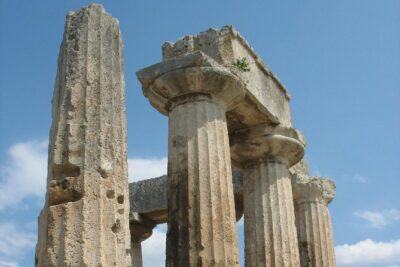
Private Biblical Tour Ancient Corinth & Isthmus Canal from Athens
Read our review →
Ancient Corinth & Nafplio Full Day Trip with Swim
Read our review →
Private Tour of Apostle Paul’s Footsteps in Ancient Corinth
Read our review →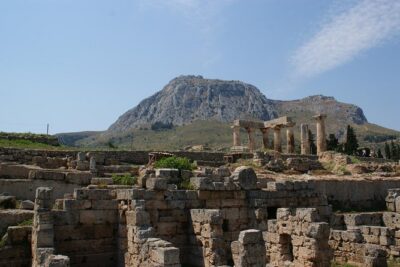
Corinth Half-Day Trip from Athens with Entrance Tickets
Read our review →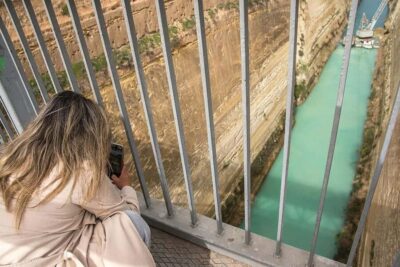
Browse the lists this tour appears in