
Reviewed · DELPHI TOURS
4-Day Classical Tour Greece: Epidaurus, Mycenae, Olympia, Delphi, Meteora
The biggest appeal here is simple: in four packed days, you reach the ancient theatre at Epidaurus, Mycenae, Olympia, Delphi, and the monasteries of Meteora without arranging a car, hotels, meals, or a maze of regional bus connections. You also cross much of mainland Greece, from the Corinth Canal to Thermopylae.
I like the strong historical focus and the practical comfort of having a professional guide, driver, entrance fees, three breakfasts, and three dinners handled for you. I also like the route itself, which links famous classical sites with the very different Byzantine world of Meteora. The tradeoff is time: long road stretches and visits often limited to roughly an hour or two can make the experience feel rushed.
In This Review
- Key points to know before booking
- What $781.09 buys you in four days
- Day 1: From the Corinth Canal to Mycenae
- Day 2: Olympia, the Gulf bridge, and Delphi
- Day 3: Delphi and the road to Kalambaka
- Day 4: Meteora monasteries and Thermopylae
- The guide, group size, and pace
- Who will get the most from this trip
- Practical details that make the days easier
- Should you book the 4-Day Classical Tour Greece?
- FAQ
- Where does the tour start?
- Is hotel pickup available?
- Where does the tour end?
- Is the tour offered in English?
- Are entrance fees included?
- Are meals included?
- How physically demanding is the tour?
Key points to know before booking
- Five major sites in four days: Epidaurus, Mycenae, Olympia, Delphi, and Meteora form the core of a very ambitious route.
- Meteora adds a striking change of pace: Two Byzantine monasteries perched on tall rock formations bring medieval Greece into a tour otherwise centered on antiquity.
- Long drives are part of the deal: You cover the Peloponnese, western Greece, central Greece, and the return route to Athens.
- The guide gives the sites meaning: Historical explanations help you understand what you are seeing instead of simply walking among ruins.
- The group can reach 50 people: This keeps the trip organized and affordable, but it may feel less personal than a small-group outing.
- Extra shopping stops may appear: Pottery, silversmith, wine, or art stops can provide breaks, but they reduce time at archaeological sites.
What $781.09 buys you in four days
At $781.09 per person, this is not a cheap day tour repeated four times. It is a bundled mainland Greece trip, and the price covers a professional licensed guide, transport, hotel accommodation, entrance fees for archaeological sites and museums, three breakfasts, three dinners, and taxes and fees listed by the operator.
That bundle matters. You are not paying only for admission to Epidaurus or Delphi. You are also paying to move between places that are spread across a large part of Greece, with overnight stops in Olympia, Delphi, and Kalambaka. Organizing this route independently would require several hotel bookings, a rental car or a mix of buses, separate entrance payments, and careful planning around driving times.
The value is strongest if you want to see a lot in a short period and prefer not to drive. It is weaker if you want long, quiet visits at each site or if you already have hotels and transport arranged. Drinks, water, personal expenses, tips, and city tax are extra. The city tax is listed as €5 per room per night at a three-star hotel or €10 per room per night at a four-star hotel, paid directly to the hotel.
The accommodation is described as nice, and a pool may be available at one of the hotels. That can be welcome after a hot afternoon among ruins, though you should think of the hotels as comfortable overnight bases rather than the main attraction.
More Delphi day trips:
- Athens: Mythology of Delphi, Museum and Arachova Guided Tour
★ 4.6 · 4,008 reviews - From Athens: Delphi Full Day V.R. Audio Guided Tour
★ 4.6 · 3,028 reviews - From Athens: Small-Group Delphi, Museum & Arachova Day Trip
★ 4.8 · 2,476 reviews
Day 1: From the Corinth Canal to Mycenae
Pickup begins at 8:30 a.m. from the meeting point at Leof. Vasilisis Amalias 22-24 in central Athens. Hotel pickup is offered only from hotels in the center of Athens, so you need to confirm the nearest available pickup location if your hotel is elsewhere.
The first road run follows the coastal side of Attica toward the Corinth Canal. The canal stop is brief, mainly for coffee and photographs. It is a useful first pause, but do not expect a full visit or a long explanation on site. You are looking at an impressive engineering cut through the land, then getting back on the road.
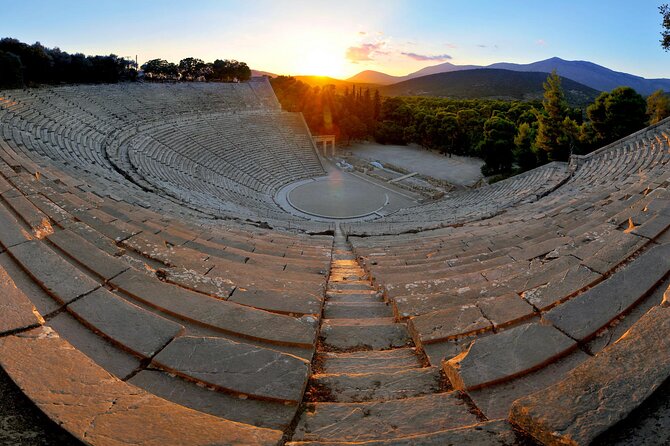
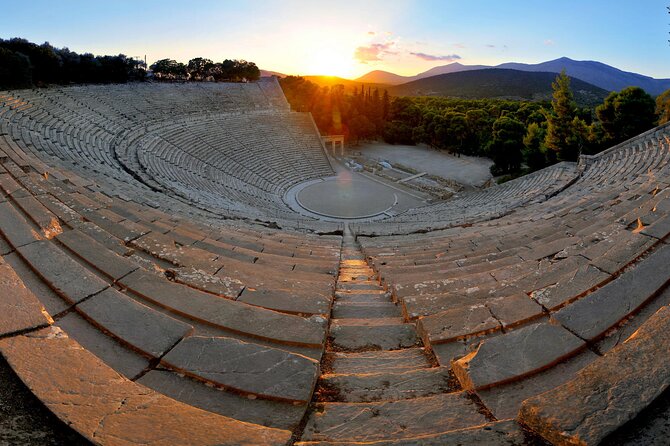
Epidaurus is the first major stop. The ancient theatre is famous for its acoustics and its carefully designed form. The visit lasts about an hour, with admission included. That is enough to see the theatre and understand why it matters, but not enough for a leisurely exploration of every nearby feature.
I would pay close attention here to how the guide explains the theatre’s purpose and design. The setting can seem calm and almost too perfect, but the place was part of a wider sanctuary connected with healing and worship. The guide’s context is especially useful because the theatre itself is so visually complete that it can be easy to focus only on taking a photograph.
Next comes a short stop in Nafplion, also called Nauplion. This colorful town sits below a rocky hill and has old fortifications and elegant buildings. The scheduled visit is only about 20 minutes, so treat it as a quick look and a chance to stretch your legs, not as a proper town visit.
Mycenae is the day’s major archaeological stop. You visit the site and the Tomb of Agamemnon, then continue across the central Peloponnese through Tripolis and Megalopolis toward Olympia. The Mycenaean world belongs to Greece’s Bronze Age, far earlier than the classical period most people picture when they think of Athens.
The famous entrance and massive stonework give the site real force, but the visit is short at about an hour. The guide’s historical explanation helps connect the citadel, royal tomb, and legendary Agamemnon to the wider story of early Greek civilization. The tomb is often called the Tomb of Agamemnon, but the name comes from tradition rather than proven identification, a useful distinction for a good guide to explain.
You spend the night in Olympia, with dinner included. This first day is demanding. You visit three significant places and cover a long road distance, so comfortable shoes, water, and a willingness to keep moving are essential.
Day 2: Olympia, the Gulf bridge, and Delphi
Olympia is more than a famous sports venue. It was a major sanctuary dedicated to Olympian Zeus, and the site includes the ancient stadium as well as other remains tied to the Olympic Games. The visit lasts about two hours and includes the archaeological site and museum.
This is one of the better-balanced stops in the program because two hours gives you time to see the principal remains and museum displays without feeling quite as compressed as Epidaurus or Mycenae. Still, the site is broad, and you will need to follow the guide’s route rather than wander at length.
I especially like the way Olympia changes the rhythm of the trip. At Epidaurus and Mycenae, the focus is on theatre, power, and Bronze Age society. Olympia lets you consider athletics, religious ceremony, civic identity, and the shared Greek world that gathered here. The ancient stadium is a highlight, but the sanctuary and museum help explain why the games were only one part of the story.
After Olympia, the road continues through the plains of Ilia and Achaia to the bridge across the Corinthian Gulf, linking Rion and Antirion. You pass Nafpaktos, known historically as Lepanto, and Itea before reaching Delphi for dinner and the night.
This is a scenic travel day, but much of it is viewed from the vehicle. The bridge crossing and coastal towns break up the drive, yet the schedule leaves little room for extended stops. If you prefer a slow trip with long meals and local wandering, this will feel too quick. If you want to connect distant sites efficiently, the organized transport is a major advantage.
Day 3: Delphi and the road to Kalambaka
Delphi receives about two hours, including the museum and archaeological site. Its location on the slopes of Mount Parnassus gives the visit a powerful setting, but it also means uphill walking and stairways.
You should expect moderate physical effort here. The site is not presented as a flat stroll, and anyone who is not in good shape may find the slopes tiring, especially after two previous days of sightseeing. Good walking shoes are more useful than stylish ones, and you should keep water close.
Delphi was regarded in ancient Greece as a major sacred center, associated with the oracle of Apollo. The museum makes the ruins easier to understand by showing important works found at the site, while the archaeological area gives you the terraces, columns, and mountain views. Two hours is enough for the main path, but not for every corner at a slow pace.
The guide is most valuable at Delphi because the remains can look scattered without a clear explanation. You need help linking the sanctuary buildings, the sacred route, and the role of the oracle. A strong commentary also separates myth, religious belief, and what archaeology can actually establish.
After Delphi, you travel to Kalambaka, a small town at the foot of Meteora. The road portion is another long one, and the evening is mainly for dinner and rest. This overnight location makes the early Meteora visit practical, but it also means the third day has less sightseeing variety than the first two.
The physical and mental pace is worth considering. By this point, you have already spent hours on foot at several sites and several more hours on the road. The trip is designed for people who would rather keep moving than settle into one region.
More Meteora trips from Athens:
- Athens: Meteora Monasteries Day Trip with Caves and Lunch
★ 4.7 · 2,964 reviews - Athens: Meteora Monasteries Day Tour with Lunch
★ 4.8 · 2,196 reviews - Athens: Meteora Tour with Local Guide and Greek Lunch
★ 4.8 · 1,561 reviews - Athens: Meteora Monasteries, Caves & Coastal Stopovers with Lunch
★ 4.5 · 1,432 reviews
Day 4: Meteora monasteries and Thermopylae
Meteora is the visual surprise of the tour. Huge rock formations rise above the town, with Byzantine monasteries built on top of them. The combination of stone, height, and religious architecture feels entirely different from the classical sanctuaries earlier in the route.
The visit includes two Byzantine monasteries and rare Byzantine artifacts. The schedule allows about two hours, which gives you a strong introduction but not a full study of the entire complex. You will need to handle steps and uphill sections, and the exact effort can vary by monastery and route.
Modest clothing may be important at religious sites, though the supplied details do not specify a dress code. It is sensible to ask the guide before entering. The monasteries are working religious places as well as historic sites, so respectful behavior matters.
Meteora is a good reason to choose this trip instead of a classical-only circuit. You see how Greek culture continued into the Byzantine era, with faith, art, and architecture shaped by a very different setting. The monasteries also provide some of the most memorable views of the whole four-day route.
The return to Athens goes through Trikala and Lamia, with a brief stop at the Monument of Leonidas in Thermopylae. This is a short historical pause rather than a full archaeological visit. It connects the route to the famous battle and gives you one final chance to step out, take photographs, and stretch before the Athens arrival.
You should expect to reach Athens in the early evening. The activity ends back at the central meeting point, making it possible to continue with an evening plan, though I would avoid booking anything with a strict start time.
The guide, group size, and pace
A licensed professional guide leads the tour, with a driver handling the long road sections. The historical explanations are one of the strongest parts of the experience. The tour is built around context, so you do not have to arrive already knowing the difference between Mycenaean, classical, and Byzantine Greece.
The maximum group size is 50 people. That is a fairly large coach group, and it affects the feel of the trip. You gain a structured route and a likely lower price than a private tour, but you may wait for people to regroup and have less chance to ask extended questions.
The operator’s response to one piece of criticism is worth keeping in mind: shopping or craft stops may be included at pottery shops, silversmiths, wine tastings, or art studios. These breaks can provide shade, a bathroom stop, or a chance to buy something local. They can also feel like an unwanted interruption when your main goal is archaeology.
If you care most about the ancient sites, ask before departure how much time is planned for these stops. The schedule already moves quickly, and even a short commercial visit can feel costly when you would rather have another 20 minutes at Mycenae or Delphi.
Who will get the most from this trip
I would recommend this tour to you if you have limited time in Greece and want to see the major mainland highlights in one organized sweep. It suits first-time visitors who want historical guidance, do not want to drive, and are comfortable with early starts, long road journeys, and a fixed schedule.
It also works well for anyone who wants more than classical ruins. Meteora brings Byzantine monasteries into the picture, while Nafplion, the Corinth Canal, the Gulf bridge, and Thermopylae add variety between the main stops.
I would hesitate to recommend it if you want a relaxed holiday, long museum visits, or free time in Nafplion and Olympia. A private or slower regional itinerary would serve you better. You should also think carefully about the uphill paths and stairs at Delphi and Meteora.
The tour is available in English. Most people can participate, but the physical note about Delphi is important. You are not simply sitting on a coach and stepping out for photographs.
Practical details that make the days easier
Wear supportive shoes and bring water. Water and drinks during meals are not included, and the combination of heat, hills, and long walks makes hydration your responsibility.
Pack lightly for the three overnight stays. You will be moving each day, and a smaller bag is easier to manage than a large suitcase. Bring sun protection and a light layer for changing conditions, though the tour information does not promise a particular type of weather.
Central Athens pickup is available, but not from every Athens hotel. You can provide your preferred pickup location and be told the closest available point. Confirmation is sent within 48 hours of booking, subject to availability.
The tour requires suitable weather. If poor weather forces cancellation, you are offered a different date or a full refund. Otherwise, you can cancel for a full refund up to 24 hours before the start time. Changes or cancellations inside that window are not accepted.
Should you book the 4-Day Classical Tour Greece?
Book it if your priority is maximum coverage with minimum planning. For $781.09, the combination of transport, hotels, meals, guide service, and entry fees offers useful value for a four-day route that would be complicated to arrange alone.
Go in with realistic expectations. This is a fast survey of mainland Greece, not a slow archaeological study. The standout strengths are the range of sites, the historical explanations, and the chance to pair ancient sanctuaries with Meteora’s monasteries. The main weaknesses are long drives, a group of up to 50, brief stops, and possible shopping visits.
If you can accept the pace, this is a practical way to see a large share of Greece beyond Athens. If you want time to sit in one place and let the country unfold slowly, choose a less ambitious plan.
FAQ
Where does the tour start?
The listed meeting point is Leof. Vasilisis Amalias 22-24, Athina 105 57, Greece. The start time is 8:30 a.m.
Is hotel pickup available?
Pickup is available only from hotels located in the center of Athens. You can provide your preferred pickup location and receive advice about the closest available point.
Where does the tour end?
The activity ends back at the central Athens meeting point.
Is the tour offered in English?
Yes. The tour is offered in English.
Are entrance fees included?
Yes. Entrance fees for the archaeological sites and museums, along with listed taxes and fees, are included.
Are meals included?
Three breakfasts and three dinners are included. Water, drinks, beverages during meals, personal expenses, and tips are not included.
How physically demanding is the tour?
Most people can participate, but Delphi is on the slopes of Mount Parnassus and includes uphill sections and stairs. The Meteora visit also involves visiting monasteries on top of large rock formations, so you should be ready for walking and steps.
More Ancient Olympia trips
- 3-Day Classical Greece Tour: Epidaurus, Mycenae, Nafplion, Olympia, Delphi
★ 4.5 · 342 reviews - 4-Day Tour of Mycenae, Epidaurus, Olympia, Delphi & Meteora
★ 4.8 · 168 reviews - 4-Day Greece Highlights Tour: Epidaurus, Mycenae, Olympia, Delphi and Meteora
★ 5.0 · 79 reviews - Day tour to Ancient Olympia,Ancient Sparta Mycenae Including Meal
★ 5.0 · 54 reviews
More Mycenae and Epidaurus days
- From Athens: Mycenae, Epidaurus & Nafplio Full Day Trip
★ 4.8 · 2,438 reviews - From Athens: Mycenae, Epidaurus & Nafplio Full-Day Tour
★ 4.5 · 1,580 reviews - 4-Day Classical Greece Tour: Epidaurus, Mycenae, Olympia, Delphi, Meteora
★ 4.5 · 732 reviews - Athens: Ancient Corinth & Nafplio Full Day Trip with Swim
★ 4.8 · 523 reviews
Freshly added Athens trips
- Private Half Day to Ancient Corinth★ 5.0 · 3 reviews
- Full day Mycenae – Nafplio – Epidavros private tour★ 5.0 · 3 reviews
- From Athens: 2-Day Meteora Trip with Tansportation & Hotel★ 5.0 · 3 reviews
- Athens Half Day Small Group Shopping Tour★ 5.0 · 3 reviews
- Athens & Corinth: Guided Christian Tour in Paul’s Footsteps★ 4.0 · 3 reviews
- Nemea wine roads, The most famous wine tour in Greece★ 4.5 · 3 reviews
- Athens: Greek Wine & Olive Oil Tasting at Brettos Plaka★ 4.5 · 3 reviews
- Santorini Dinner Class with Margarita in Athens★ 5.0 · 3 reviews
Delphi Tours, compared.

Mythology of Delphi, Museum and Arachova Guided Tour
Read our review →
Small-Group Delphi, Museum & Arachova Day Trip
Read our review →
Delphi English Day Trip from Athens with Official Guide
Read our review →
Delphi Guided Trip with Optional Lunch and Entry
Read our review →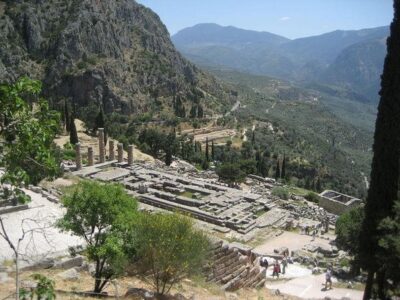
Historical Delphi One Day Tour with Arachova Stop & Expert Guide
Read our review →
Premium Delphi Day Trip with an Expert Guide, Museum & Lunch
Read our review →
Browse the lists this tour appears in