Reviewed · HALF-DAY
St. Paul in Athens half-day private tour 4.5 hours – With Tickets
Athens makes a powerful backdrop for a tour about St. Paul. At Areopagus, or Mars Hill, you can look across the ancient city while standing near the place where Paul preached about the unknown god. The tour then links that Christian story to the Acropolis, Ancient Agora, and the modern center of Athens.
I like the private vehicle and hotel pickup, which save time in a city where traffic can slow you down. I also like the chance to shape the outing around your group, especially if you are arriving from a cruise ship or have only one morning in Athens. The main caution is time: the Acropolis can easily absorb the whole tour, particularly if you add a separate guide on the hill.
In This Review
- Key points
- A Christian story set beneath the Acropolis
- Starting early at the Acropolis
- The Parthenon, Erechtheion, and Acropolis monuments
- Mars Hill and the words of St. Paul
- Driving through Zeus, Syntagma, and the modern city
- Kallimarmaro and Athens’ Byzantine layer
- The Ancient Agora and the public life of Athens
- What the private format really gives you
- Is $275.16 per person good value?
- Who should book this Athens tour?
- My advice before you go
- Should you book it?
- FAQ
- What is included in the tour price?
- Is a licensed tour guide included?
- Where can pickup take place?
- What time does the tour start?
- Can cruise ship passengers book this tour?
- How long is the experience?
Key points
- Paul’s Athens begins at Mars Hill: Visit the Areopagus, the rocky court where Paul delivered his famous sermon.
- Acropolis entry is included: See the Parthenon, Erechtheion, Propylaea, and Temple of Athena Nike.
- Ancient Agora adds daily life: Spend about 90 minutes in the civic and commercial heart of ancient Athens.
- Private pickup keeps the morning efficient: Meet at your Athens hotel, Airbnb, or Piraeus port and return to the same place.
- The driver is not the same as a licensed guide: An English-speaking driver is included, while a licensed guide costs an additional €269.
- Plan your priorities before starting: A long Acropolis visit means some later sights may be viewed from the vehicle.
A Christian story set beneath the Acropolis
This is not a tour of churches alone. Its main appeal is the way it places St. Paul’s preaching inside the much larger story of classical Athens.
According to the Acts of the Apostles, Paul came to Athens and spoke at the Areopagus after seeing altars dedicated to various gods, including one to an unknown god. The tour takes you to that hill, just outside the Acropolis exit, then carries the story into the Ancient Agora, where public debate, trade, politics, and philosophy shaped Athenian life.
You also see the monuments most people hope to visit in Athens: the Parthenon, Erechtheion, Temple of Athena Nike, and Propylaea. The result is a compact introduction to both Christian heritage and ancient Greek civilization.
The 4.5-hour format is useful, but it calls for discipline. The planned Acropolis visit takes about 75 minutes, and the Ancient Agora about 90 minutes. Add driving, pickup, drop-off, and short exterior stops, and you have little spare time. I would decide in advance that your main priorities are the Acropolis, Areopagus, and Agora, with the modern city sights treated as a scenic bonus.
A few more Athens days worth a look
- Athens: Cape Sounion & Poseidon Temple Sunset Half-Day Trip
★ 4.8 · 8,241 reviews - Cape Sounion and Temple of Poseidon Half-Day Small-Group Tour from Athens
★ 4.5 · 3,205 reviews - Athens Half-Day Sightseeing Tour with Tickets of Acropolis
★ 4.0 · 1,402 reviews
Starting early at the Acropolis
Pickup begins at 8:00 a.m. from your hotel or Airbnb in Athens. Cruise ship passengers meet the driver outside the terminal exit, with the driver holding a sign bearing the name supplied at booking.
The vehicle heads directly toward the Acropolis to reduce the effect of traffic and crowds. That early start matters. The Acropolis is the part of Athens where time disappears fastest, and beginning there gives you the best chance of seeing the major monuments before the day becomes more demanding.
The Acropolis is a rocky citadel above Athens, crowned by buildings from the great fifth-century BC rebuilding program led by Pericles. Your driver explains the setting and history, but remember that the included service is an English-speaking tour driver, not a licensed archaeological guide.
That distinction matters if you want detailed interpretation of the sculptures, building methods, religious rituals, and political meaning of each monument. You can add a licensed English-speaking guide for €269, an important extra cost for a small group. Without that addition, expect useful historical commentary from the driver and independent time at the monuments rather than a formal guided walk through every room and feature.
The Parthenon, Erechtheion, and Acropolis monuments
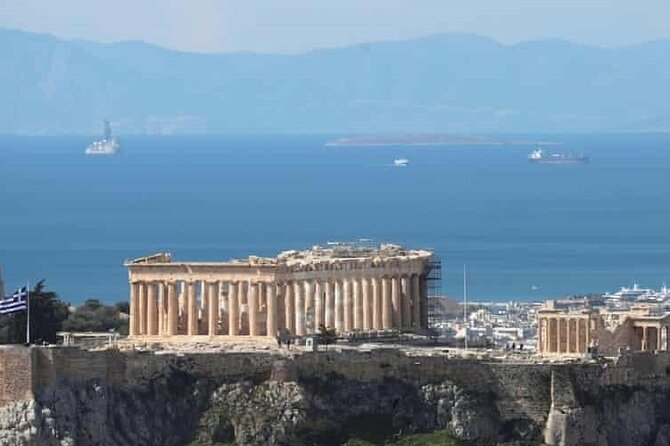
The Parthenon receives the longest planned stop, about 75 minutes. Built between 447 and 438 BC, it was dedicated to Athena Parthenos, the city’s patron goddess. Its architects were Ictinus and Kallikrates, while Pheidias directed the sculpture and larger artistic program.
You will see the temple as both an architectural achievement and a political statement. It was built when Athens had enormous influence among the Greek city-states, after victory over Persia and during the years when democratic institutions, philosophy, drama, and public art flourished.
The building is not intact, of course. Scaffolding and restoration work can affect the view, and the hill requires uphill walking over uneven stone. One visitor specifically warned about the amount of climbing, so wear firm shoes and avoid treating this as a ride-and-look sightseeing stop.
The Erechtheion is smaller and more intricate. Built between 421 and 406 BC, it served several cults and was associated with the mythical king Erechtheus. It also relates to the contest between Athena and Poseidon for control of Athens.
Its south porch is famous for the six female figures commonly called the Caryatids. The statues on the building are casts, while five originals are in the Acropolis Museum and one is in the British Museum. That is a useful detail to know before you arrive, since the porch looks ancient but the figures visible there are not the original sculptures.
At the entrance, the Propylaea frames the approach to the sacred precinct. The monumental gateway was built between 437 and 432 BC under the architect Mnesicles, though the original plan was never completed. The structure replaced earlier gates and was damaged during the Persian attack on Athens.
The small Temple of Athena Nike sits on a bastion near the entrance. Built between 426 and 421 BC, it honored Athena as Nike, or Victory. The older temples beneath it recall the long religious use of the Acropolis before the famous classical monuments were built.
The tour information gives five minutes for both the Propylaea and Temple of Athena Nike, so these are likely brief explanations and photo stops rather than extended visits. If one of these monuments matters greatly to you, tell the driver early that you need time there.
Mars Hill and the words of St. Paul
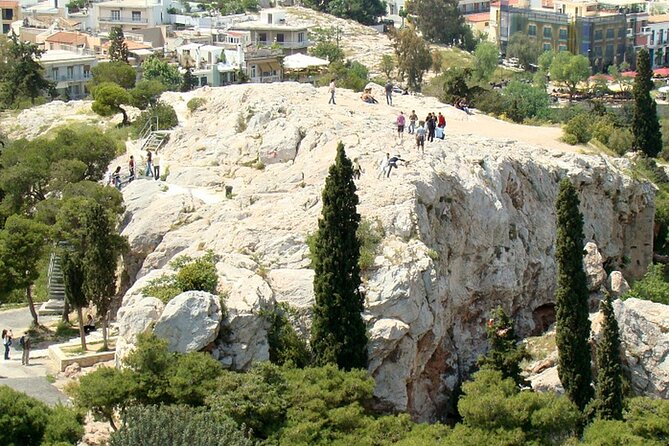
The Areopagus is the spiritual center of this experience. It lies just to the right of the Acropolis exit and is also called the Hill of Ares.
In classical Athens, the Areopagus was linked to the council of nobles and a court that handled serious crimes, especially homicide. Greek myth placed the trial of Ares here for the killing of Poseidon’s son, and another story connected the hill with the trial of Orestes.
For a Christian visitor, the important event is Paul’s sermon. He spoke to Athenians about the altar to an unknown god and used that familiar religious reference to introduce his message. A bronze plaque at the foot of the rock commemorates the speech.
The rock itself is not a calm museum setting. You will be outdoors, with stone underfoot and a climb onto a naturally uneven surface. Take care, especially if the rock is wet. The reward is the location: you are looking over the same ancient city where Paul encountered a culture shaped by Socrates, Plato, Aristotle, and public debate.
I like this stop because it gives the tour a clear purpose. The Parthenon can feel like a checklist item on a first visit. Mars Hill explains why Athens mattered to Paul and why his message took the form it did.
Same city, a completely different century:
- Athens: Acropolis & up to 5 Archaeological Sites Combo Pass
★ 4.4 · 12,619 reviews - Athens: Acropolis Ticket with Optional Audio or Live Guide
★ 4.2 · 11,055 reviews - Athens: Acropolis, Parthenon & Acropolis Museum Guided Tour
★ 4.8 · 9,316 reviews - Athens: Acropolis and Parthenon Guided Walking Tour
★ 4.6 · 5,882 reviews
Driving through Zeus, Syntagma, and the modern city
After the Acropolis and Areopagus, the vehicle passes a string of important Athens sights. Some are short stops, while others are viewed from the road. The pace is quick, but it helps you connect the ancient city to the modern capital.
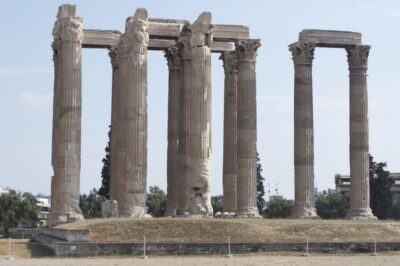
The Temple of Olympian Zeus, or Olympeion, was one of the largest ancient temples in Greece. Its sanctuary was associated with Zeus, and the site also included the sanctuary of Apollo Delphinios and a court linked with Theseus. It is a strong reminder that Athens was not just a hilltop citadel. Religious sites spread through the lower city as well.
The National Garden offers a very different view of Athens. Created in 1839 by order of Queen Amalia, the former royal gardens cover more than 160,000 square meters and contain hundreds of plant varieties. You may see it as a green pause between major monuments rather than as a full garden visit.
At Syntagma Square, the tour reaches the heart of modern Greek public life. The square faces the former royal palace, now home to the Hellenic Parliament. Its name means Constitution Square, referring to the uprising of September 3, 1843, when King Otto agreed to a constitution.
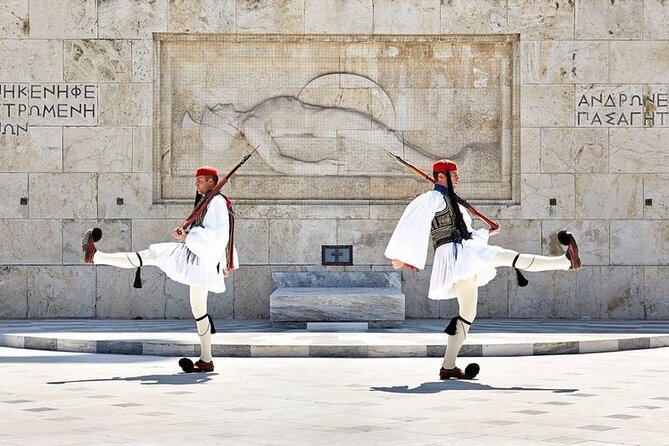
In front of Parliament is the Tomb of the Unknown Soldier, guarded by Evzones of the Presidential Guard. The memorial honors Greek soldiers killed in war. If your timing is right, you may see the ceremonial guard routine, but the supplied details do not promise a scheduled changing-of-the-guard stop, so do not book this tour solely for that event.
Kallimarmaro and Athens’ Byzantine layer
The Panathenaic Stadium, known as Kallimarmaro, is a fifteen-minute photo stop. The name means beautiful marble, and the stadium is built from Pentelic marble, the same stone used for major monuments on the Acropolis and the Temple of Olympian Zeus.
The stadium hosted the first modern Olympic Games in 1896. Its pale marble changes tone in different light, appearing cooler in the morning and warmer later in the day. You do not need a long visit to appreciate its sweeping shape, but the stop gives the tour a welcome connection to modern Greek history.
The Athens Metropolitan Cathedral is another possible sight. This three-aisled, domed basilica was built between 1842 and 1862 and contains decorative pieces from older Byzantine churches. It also houses marble shrines connected with Agia Filothei and Patriarch Gregorius V.
The cathedral has undergone maintenance after the 1999 earthquake, and services were temporarily being held at the Church of St. Dionysius in Kolonaki. Treat this as an exterior or brief city stop unless the driver confirms that an interior visit is possible.
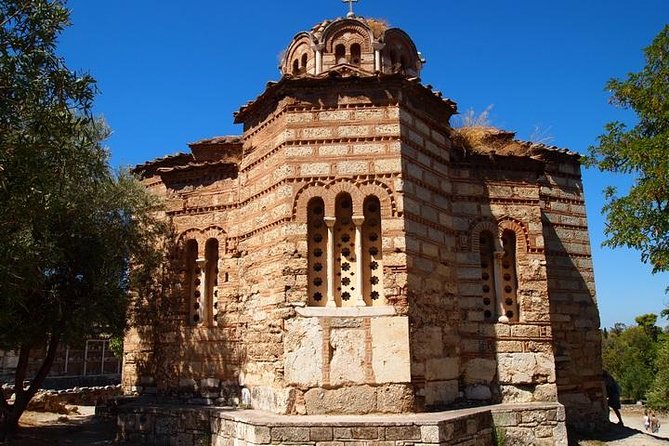
On Ermou Street, the small Panagia Kapnikarea church offers a striking contrast to the surrounding shops and high-rise buildings. Founded around 1050, it is one of Athens’ oldest churches. Its location on a busy shopping street makes it easy to miss, which is exactly why a driver who points it out adds value.
The route may also include Thissio, a pleasant area southwest of Monastiraki with cafes, restaurants, boutiques, and views toward the Acropolis. These stops help you see Athens as a living city rather than a collection of isolated ruins.
The Ancient Agora and the public life of Athens
The Ancient Agora receives about 90 minutes, making it nearly as important as the Acropolis in the day’s schedule. The site lies northwest of the Acropolis, below Areopagus and near the hill called Agoraios Kolonos, or Market Hill.
An agora was a gathering place, marketplace, political center, and social meeting ground. Athens’ Agora remained in use for roughly 5,000 years, with layers from Archaic, classical, Roman, and Byzantine periods.
This is the place to picture how ancient Athenians lived together. The Acropolis represented sacred and civic glory above the city. The Agora was where ordinary public business happened: debate, commerce, legal matters, and the daily exchange of ideas.
For a St. Paul-focused tour, the Agora provides essential context. Paul’s message was not delivered to an abstract civilization. It entered a city where philosophical discussion and religious argument were part of public life.
The entry ticket to the Ancient Agora is included, along with the Acropolis ticket. The listed stop description also notes that the drive from the Acropolis takes about 20 minutes. Since the overall schedule is tight, use the Agora time carefully. Focus on the central ruins and the setting rather than trying to inspect every stone.
What the private format really gives you
The private arrangement means only your group participates. That gives you room to ask questions, adjust the route, and spend more or less time at selected sights. Customization is specifically offered within the Athens itinerary, and the experience can also be arranged around a cruise arrival.
Transportation is in an air-conditioned vehicle suited to the size of your party. Bottled water, road tolls, and local taxes are included. Pickup and return are available at Athens hotels, Athens Airbnb properties, and Piraeus port.
This is particularly useful if you have a short port call. You must provide your ship name, docking time, disembarkation time, and re-boarding time when booking. Airport pickup and drop-off are not included, though Athens International Airport transfers can be arranged for an extra charge.
The driver service has received strong praise for personal attention and punctuality. Demetris was described as kind and welcoming, while Christos was praised for being prompt, flexible, and good at giving an overall view of the city. Those details matter because the driver is doing more than transporting you between ruins. The quality of the morning depends on clear timing and sensible decisions.
Still, do not expect the same experience as a private archaeological tour led by a licensed guide. The included driver has a good grasp of Greek history and culture, but the licensed guide is an optional €269 addition. For a family or church group that wants detailed biblical and classical interpretation, that extra may be worthwhile. For a group that mainly wants efficient transport, entry tickets, and orientation, the driver-only format may be enough.
Is $275.16 per person good value?
At $275.16 per person, this is not a budget sightseeing tour. The price makes more sense for a private group than for a solo visitor or couple comparing it with a standard shared excursion.
You are paying for a private vehicle, pickup and drop-off, an English-speaking driver, bottled water, local taxes, and admission to both the Acropolis and Ancient Agora. You also avoid the work of arranging transport between sites and fitting a major visit into a limited morning.
The value improves when several people share the vehicle, especially if you are coming from Piraeus and want a direct return to the port. Group discounts are available, so check the final rate for your party rather than judging the per-person figure alone.
The optional licensed guide changes the calculation. Adding €269 is a serious increase, but it may be justified if your purpose is close study of the Acropolis or a more formal St. Paul interpretation. If you add the guide, protect time at Mars Hill and the Agora, since a three-hour Acropolis visit can crowd out nearly everything else.
One useful lesson comes from the experience of a group that hired another guide on the Acropolis and spent three hours there. They received a good city overview but had to drive past several planned stops. The solution is simple: agree on a firm Acropolis limit before you begin.
Who should book this Athens tour?
I would choose this experience if you want the following:
- A private, Christian-themed introduction to Athens
- A fast first look at the Acropolis and Ancient Agora
- Hotel or cruise-port pickup without arranging taxis
- A flexible morning for a family, church group, or small party
- A driver who can connect biblical, classical, Byzantine, and modern Greek sites
I would look elsewhere if you want a slow archaeological study, extensive museum time, or a full day on foot. The route covers a lot, but several stops are brief or viewed from the vehicle.
You should also be comfortable walking uphill at the Acropolis and across uneven stone. The tour is designed for most participants, but the physical demands are real. Start early, wear practical shoes, carry water, and keep your expectations realistic about how many monuments you can explore in 4.5 hours.
My advice before you go
Tell the company your top three priorities before pickup. For this tour, mine would be the Acropolis, Areopagus, and Ancient Agora.
Ask how much time is planned at each site and confirm whether you are adding the licensed guide. If you want to stop inside the Metropolitan Cathedral or spend longer at Panagia Kapnikarea, say so at the beginning rather than hoping the schedule will open up.
Keep the morning moving at the Acropolis. The Parthenon deserves attention, but the Erechtheion, Propylaea, Temple of Athena Nike, and Areopagus each add something different. A balanced visit will serve you better than spending nearly the whole tour at one monument.
The provider offers free cancellation up to 24 hours before the start time. Changes or cancellations inside that window are not accepted for a refund. The tour starts at 8:00 a.m. and returns you to the same pickup point.
Should you book it?
Book this tour if St. Paul’s connection to Athens is central to your visit and you want a private vehicle to link Mars Hill with the city’s major ancient sites. It is also a practical choice from Piraeus port or for a first morning in Athens.
Skip it if you prefer to explore slowly and independently, or if the $275.16 price per person feels high before the optional licensed guide is added. The best value comes when your group shares the cost, sets clear priorities, and treats the Acropolis as one major part of the tour rather than the entire morning.
FAQ
What is included in the tour price?
The price includes an English-speaking tour driver, an air-conditioned vehicle, road tolls, local taxes, bottled water, Acropolis admission, Ancient Agora admission, and private pickup and drop-off in Athens or at Piraeus port.
Is a licensed tour guide included?
No. The included professional is a tour driver with knowledge of Greek history and culture. An English-speaking licensed guide can be added for €269.
Where can pickup take place?
Pickup is available from hotels and Airbnb properties in Athens, as well as Piraeus port. Airport pickup and drop-off are not included but can be arranged for an additional cost.
What time does the tour start?
The tour starts at 8:00 a.m. Pickup takes place at the main entrance of your hotel or at the specified cruise-port meeting point.
Can cruise ship passengers book this tour?
Yes. Cruise passengers must provide the ship name, docking time, disembarkation time, and re-boarding time when booking. The driver meets you outside the terminal exit with a sign bearing your name.
How long is the experience?
The tour lasts approximately 4 hours and 30 minutes. It ends with drop-off at the same place where you were picked up.
Freshly added Athens trips
- Athens and Ancient Corinth Private from Athens★ 5.0 · 3 reviews
- From Athens: Mycenae and Epidaurus Private Tour★ 4.8 · 3 reviews
- Full day Meteora private tour★ 5.0 · 3 reviews
- Double Shore Dive (certified divers)★ 4.5 · 3 reviews
- Athens Hills: Mythology Treasure Hunt★ 5.0 · 3 reviews
- Sunset & swimming at Cape Sounio, Poseidon temple★ 5.0 · 3 reviews
- Philosophy Experience at Plato’s Academy Park – basic version★ 5.0 · 3 reviews
- Private Acropolis Tour – Ticket Included★ 5.0 · 3 reviews
Half-Day, compared.
Cape Sounion & Poseidon Temple Sunset Half-Day Trip
Read our review →
Cape Sounion and Temple of Poseidon Half-Day Small-Group Tour from Athens
Read our review →
Athens Half-Day Sightseeing Tour with Tickets of Acropolis
Read our review →
Temple of Poseidon & Cape Sounion Half-Day Tour
Read our review →
Corinth Half-Day Trip from Athens with Entrance Tickets
Read our review →
Half-Day Morning Catamaran Cruise with Meal & Drinks
Read our review →