Reviewed · VIP
Private Luxury Tour: Unveiling the Sacred Mysteries of Eleusis
The most unusual part of this private tour is that you do not simply arrive at Eleusis and inspect a ruin. You follow the Sacred Way from Athens, tracing the route once used by pilgrims heading to the Eleusinian Mysteries. I like the small ancient bridge remains along the way, and I like how drivers such as Pericles and Demetrios explain the journey before you reach the sanctuary itself.
The main thing to consider is that your driver is not a licensed guide inside the archaeological sites. Admission costs are also extra, and the advertised schedule is fairly tight once you include the drive from Athens. Still, the private vehicle, hotel or port pickup, Wi-Fi, and freedom to move at your group’s pace make this a useful choice for travelers who want context rather than a quick trip straight to Eleusis.
In This Review
- Key points at a glance
- Why the journey to Eleusis matters
- Starting on the Iera Odos near Athens
- Walking a second stretch of the Sacred Way
- Daphni Monastery and a change of era
- The Sanctuary of Aphrodite at Skaramagkas
- The Roman bridge near Eleusis
- Entering the Archaeological Site of Eleusis
- The Telesterion, the heart of the Mysteries
- The Great Propylaea and the entrance to the sacred world
- The Kallichoron Well and the story of Demeter
- The Ploutonion and the underworld connection
- The Archaeological Museum of Eleusis
- What the private vehicle adds
- Price, timing, and what you actually receive
- Who should book this Eleusis tour
- Should you book it?
- FAQ
- How long does the private Eleusis tour last?
- What is included in the tour price?
- Are entrance fees included?
- Is a licensed guide included inside Eleusis?
- What type of vehicle is used?
- Is hotel pickup available?
- Is cruise port pickup available?
- Is airport pickup included?
- Can I visit the Sanctuary of Aphrodite on weekdays?
- What should I bring?
- Is the tour private?
- What is the cancellation policy?
Key points at a glance
- Follow the ancient route: See surviving sections of the Iera Odos and ancient bridge remains before reaching Eleusis.
- Travel privately: Groups of one to four use a luxury sedan, while groups of five to seven travel in a minivan.
- Add Daphni Monastery: The UNESCO-listed Byzantine monastery gives the day a striking change of period and mood.
- Understand the Mysteries: The driver-guide explains Demeter, Persephone, initiation rites, and the meaning of the sanctuary as you travel.
- Watch the access details: The Sanctuary of Aphrodite can be entered on weekends, but weekday visits are limited to an exterior stop.
- Budget for admission: Site and museum entrance fees are not included, with the listed charge at €10 per person.
Why the journey to Eleusis matters
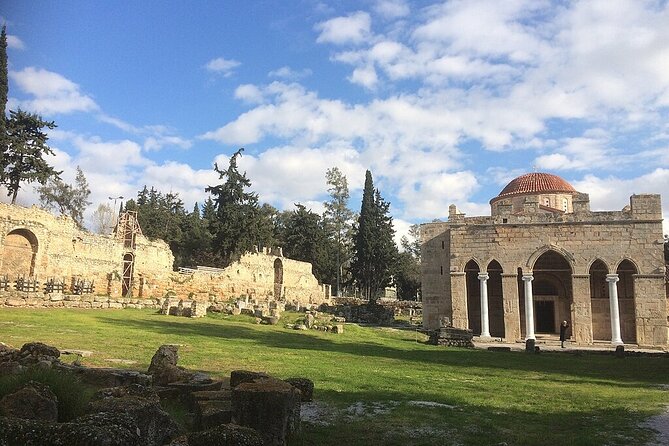
Eleusis is not just another ancient Greek site outside Athens. It was the home of the Eleusinian Mysteries, a secret religious tradition centered on Demeter and Persephone. Initiates came to the sanctuary seeking spiritual insight and hope connected with death, renewal, and the return of Persephone.
The mystery is part of the appeal. The ceremonies were private, and the secrets were guarded so carefully that modern visitors cannot recreate the experience. What you can do is follow the route, see the buildings that shaped the ritual, and understand how a simple journey from Athens became a sacred act.
That is why I prefer this tour to a basic point-to-point transfer. The stops along the old road help you picture thousands of pilgrims walking west from Athens. By the time you reach the sanctuary, the Telesterion and its surrounding precinct have more meaning.
The tour lasts about four to five hours, including time spent traveling between locations. You should expect short stops at several places rather than long, leisurely visits at each one. The final site and museum receive more attention, but the individual stops are often around 10 minutes.
A few more Athens days worth a look
- Best of Athens Half Day Private Tour
★ 5.0 · 3,714 reviews - Athens Full Day Private Tour
★ 5.0 · 2,903 reviews - Athens Airport Private Arrival Transfer with Meet & Greet
★ 4.5 · 1,495 reviews
Starting on the Iera Odos near Athens
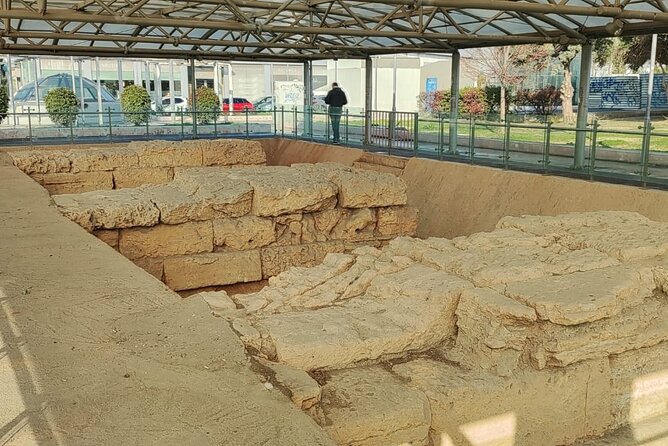
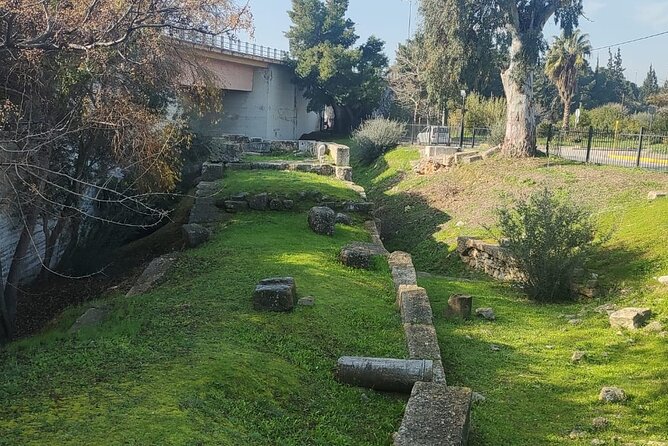
The first stop is a surviving section of the Sacred Way near the modern Eleonas Metro Station. During construction, workers found remains of an ancient bridge over the Kifisos River. Three piers survive, suggesting a bridge with at least five arches.
This is a modest archaeological stop, not a grand monument. You will spend about 10 minutes here, and there is no admission charge. Its value comes from the setting and the story: this was a practical crossing used by people traveling between Athens and Eleusis, including pilgrims making the sacred procession.
I like this opening because it puts the route into physical terms. The Mysteries were not only an idea held inside a temple. They involved a real road, a river crossing, and a long procession beyond the city walls.
The modern surroundings can make the remains easy to overlook. Keep your expectations sensible. You are seeing fragments, not a complete bridge, but those fragments are an important part of the day’s larger story.
Walking a second stretch of the Sacred Way
The next Iera Odos stop is in Aigaleo, where you see another section of the route connecting Athens with Eleusis. This is where the tour’s theme becomes clearer. Ancient pilgrims carried sacred objects, sang hymns, and moved toward the sanctuary dedicated to Demeter and Persephone.
Again, the stop lasts about 10 minutes and admission is free. You will not spend hours walking a continuous ancient road, since the route has been interrupted by the modern city. Instead, the driver helps connect separate surviving pieces.
This is one of the places where an English-speaking driver-guide adds real value. Demetrios is praised for making several stops and giving his group a sense of the full initiation journey. That approach suits this experience better than racing directly to the main ruins.
The stop may feel brief if you want a long archaeological walk. I see it as a visual introduction. The main historical work happens through explanation and by comparing these scattered remains with the route you will follow by car.
Daphni Monastery and a change of era
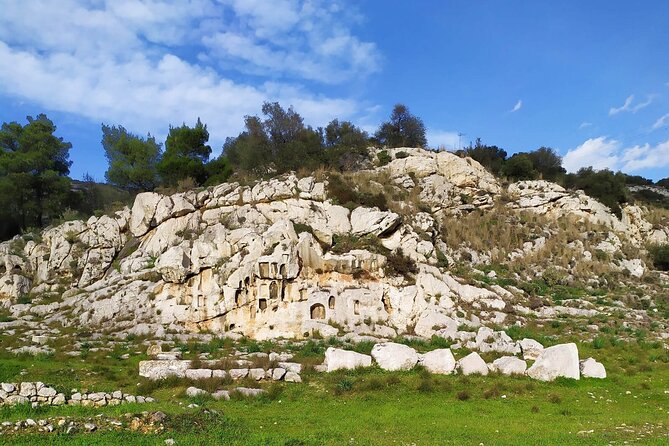
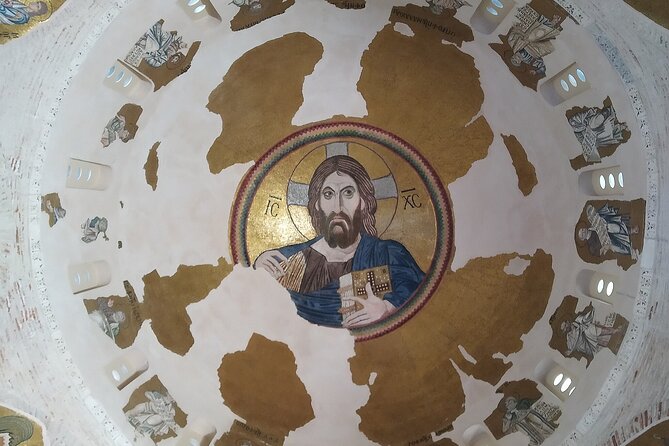
The Monastery of Daphni is one of the strongest stops on the route. It sits along the Sacred Way and dates from the 11th century, placing it many centuries after the Eleusinian sanctuary. Its Byzantine mosaics, especially the image of Christ Pantocrator in the dome, provide a sharp contrast to the pagan Greek and Roman remains elsewhere.
The monastery is a UNESCO World Heritage Site and is listed as a free-admission stop on this tour. You have about 30 minutes here, enough to see the main artistic focus without turning the visit into a long architectural study.
I like this pause because it prevents the day from becoming a single repeated sequence of broken columns and stones. The cypress trees, quiet religious setting, and gold Byzantine mosaics offer a different way to think about sacred space.
Access to historic religious buildings can vary, so follow the driver’s instructions on the day. The tour information does not promise a full guided visit inside every part of the monastery. Treat the 30-minute stop as a chance to see its principal features, not as a complete Byzantine art tour.
Same city, a completely different century:
- Athens: Acropolis & up to 5 Archaeological Sites Combo Pass
★ 4.4 · 12,619 reviews - Athens: Acropolis Ticket with Optional Audio or Live Guide
★ 4.2 · 11,055 reviews - Athens: Acropolis, Parthenon & Acropolis Museum Guided Tour
★ 4.8 · 9,316 reviews - Athens: Cape Sounion & Poseidon Temple Sunset Half-Day Trip
★ 4.8 · 8,241 reviews
The Sanctuary of Aphrodite at Skaramagkas
The Sanctuary of Aphrodite is a short stop near the Sacred Way. It was connected with worship of Aphrodite, goddess of love and beauty, and formed part of the wider religious world encountered along the road to Eleusis.
The important practical detail is access. On weekends, the sanctuary is open to the public, so you can enter and explore the remains. On weekdays, the tour makes a brief exterior stop instead, with time for photographs and a look at the site from outside.
That difference can affect how satisfying the stop feels. If entering the sanctuary matters to you, schedule the tour for a weekend and confirm the arrangements when booking. On a weekday, consider it a historical roadside view rather than a full archaeological visit.
The natural surroundings add a quiet quality, but do not expect a large preserved complex. The appeal is in seeing another religious site connected with the route and understanding that the Sacred Way included more than the main sanctuary at Eleusis.
The Roman bridge near Eleusis
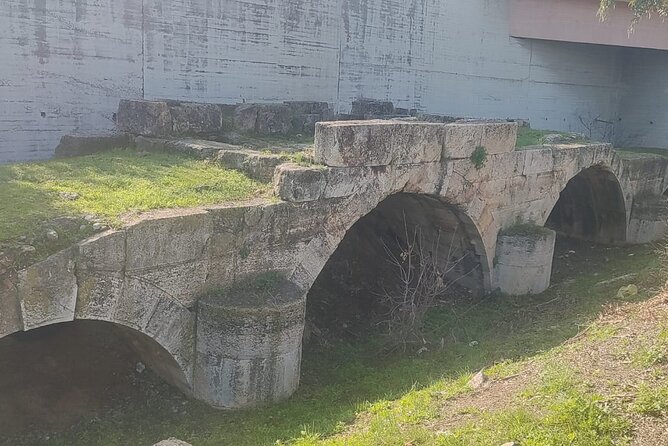
About one kilometer east of the Sanctuary of Demeter, the tour pauses at a Roman bridge dating to the reign of Emperor Hadrian, around 125 AD. Built from Piraeus limestone, it measures about 50 meters long and 5.30 meters wide.
The central section has four arches, with two wider arches in the middle and narrower ones at the ends. Inclined approaches complete the structure. You have about 10 minutes here, with no admission fee.
This stop is particularly good for readers interested in engineering. The bridge shows how Roman construction supported the route used by people traveling toward Eleusis. It also helps explain the relationship between the Sacred Way and the Eleusinian Kephisos River.
As with the earlier bridge remains, this is a quick look rather than a long visit. Wear shoes that handle uneven ground, and do not plan on lingering here if you also want enough time inside the main archaeological site and museum.
Entering the Archaeological Site of Eleusis
The main archaeological site is the reason to book this excursion. It was the sanctuary where the Eleusinian Mysteries were held, and it includes the remains of gateways, sacred buildings, walls, wells, and ritual spaces.
The scheduled visit is about 30 minutes, followed by several focused stops within the site. Admission is not included. The supplied information lists the archaeological site and museum entrance at €10 per person, so include that extra cost in your planning.
Thirty minutes can pass quickly at Eleusis. If you enjoy ancient sites, you will likely want to slow down and examine the remains. The advantage of a private tour is that your group can ask questions and avoid being tied to strangers, but the overall four to five-hour limit still shapes the pace.
The site also provides views toward the Saronic Gulf and the hills around Eleusis. Those views help explain why the sanctuary was connected to a specific place, not just to a myth preserved in books.
The Telesterion, the heart of the Mysteries
The Telesterion was the great hall where initiations took place. It was the central building of the Eleusinian sanctuary and the most important stop for understanding the Mysteries.
Today, you see the remains rather than a complete hall. Even so, the scale of the structure and the surrounding walls give you a sense of the ceremony’s importance. The tour sets aside about 10 minutes for this feature, though your exact time may depend on site conditions and the pace of the group.
A driver-guide cannot provide the same formal interpretation as a licensed guide inside the site. That is the main limitation of this arrangement. On the other hand, Demetrios is described as preparing his group with the background needed to appreciate the Telesterion and Temple of Demeter, and Pericles is also praised for his historical explanations.
I would pay close attention during the drive before arrival. The route explanation may be just as useful as the short stop at the ruins because the actual ritual details are difficult to grasp from foundations alone.
The Great Propylaea and the entrance to the sacred world
The Great Propylaea was the monumental entrance to the sanctuary. Built in the second century CE under Emperor Marcus Aurelius, it echoed the Propylaea of the Acropolis and marked the passage from ordinary life into a sacred precinct.
Its large stone structure and Doric columns remain one of the most impressive architectural sights at Eleusis. The scheduled stop lasts about 10 minutes and requires the same site admission fee.
I find this feature helpful because entrances often tell you how a place wanted to be experienced. The Great Propylaea was not a casual doorway. It announced that initiates were crossing into a special religious world.
The ruins cannot reproduce the original procession, of course. Still, standing near the gateway while knowing that pilgrims passed through it gives the site emotional weight without requiring you to accept every ancient myth literally.
The Kallichoron Well and the story of Demeter
The Kallichoron Well is tied to the story of Demeter’s search for Persephone. Ancient tradition says Demeter rested here, and the name means well of the beautiful dances. Local women were said to have danced at the well to comfort the grieving goddess.
The stop lasts about 10 minutes and is included within the archaeological site admission. It is a smaller feature than the Propylaea or Telesterion, but it gives the mythology a precise location.
This is where the tour’s storytelling can be most effective. Instead of hearing only a general account of Demeter and Persephone, you connect the story to a well, a place of rest, and a communal act of dance.
Do not expect a dramatic monument. The well is symbolic rather than visually grand. Its importance comes from the way it links myth, ritual, and the daily movement of people through the sanctuary.
The Ploutonion and the underworld connection
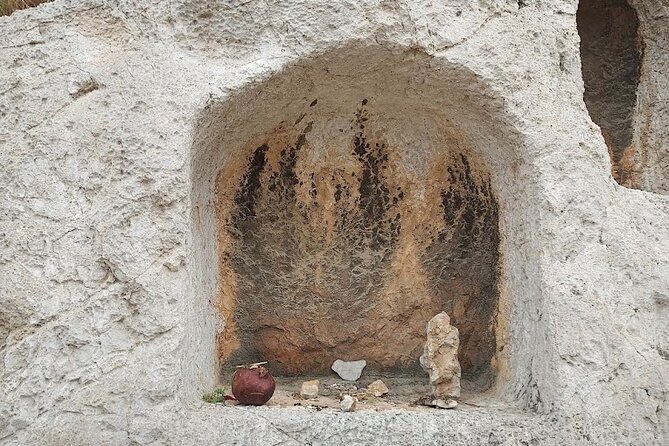
The Ploutonion is a cave associated with Hades, also called Plouton. Ancient belief connected it with an entrance to the Underworld and with Persephone’s descent.
You spend about 10 minutes here. The rocky setting is a useful counterpoint to the formal architecture of the Great Propylaea. The cave helps explain why the Eleusinian Mysteries dealt so closely with death, return, and the hope of renewal.
This is another place where imagination matters more than preservation. You will not see a fully intact ritual chamber. You will see a sacred natural feature interpreted through ancient belief.
For me, the Ploutonion completes the mythic arc begun at the Kallichoron Well. Demeter searches and mourns, Persephone descends and returns, and the sanctuary turns those stories into a religious experience that lasted for centuries.
The Archaeological Museum of Eleusis
The Archaeological Museum of Eleusis is within the ancient site and gives you a chance to see objects removed from the ruins. Its collection includes statues of Demeter and Persephone, sacred offerings, and reliefs connected with the Eleusinian Mysteries.
The planned museum visit lasts about 30 minutes, with admission not included in the tour price. I recommend using this time to make sense of the buildings you have just seen. Sculpture and reliefs can clarify which figures mattered and how the sanctuary expressed its religious ideas.
The museum is not an optional extra in the intellectual sense. It brings the site’s fragments together. After seeing the Telesterion, the Propylaea, the well, and the cave, you can look at the surviving objects with a better sense of place.
Still, thirty minutes is not a long museum visit. If you read every label carefully, you may need to choose a few highlights. The tour works best when you see the museum as a final chapter, not as an exhaustive study of Eleusinian religion.
What the private vehicle adds
Pickup is available from hotels, apartments, and selected cruise ports. For port pickup, the driver meets you in the arrival area with a sign bearing your name. Airport pickup is available for an additional charge.
Groups of one to four use a luxury sedan. Groups of five to seven use a minivan. Both options include air conditioning, bottled water, private transportation, and Wi-Fi.
These details matter in warm Greek weather. You can cover a spread-out route without arranging several taxis, and you have a place to rest between short outdoor stops. Wi-Fi is useful for keeping connected, though you should not expect it to replace a full mobile data plan.
The private format also makes it easier to ask about Demeter, Persephone, Daphni, or the route itself. The strongest praise for the experience centers on kind, well-prepared drivers who do not rush the journey. Pericles and Demetrios are the names associated with that personal approach.
Price, timing, and what you actually receive
At $192.23 per person, the price is easiest to judge by group size. For one person, it is a substantial private-tour cost. For a group of four sharing a sedan, the transportation and dedicated driver-guide can make better financial sense than separate taxis and a self-guided trip.
The price includes private transport, the vehicle, Wi-Fi, water, pickup and drop-off, and an English-speaking driver with extensive historical knowledge. It does not include a licensed guide inside the archaeological sites, entrance fees, airport pickup, or tips.
The tour is booked an average of 55 days in advance, so I would reserve early if your Athens schedule is fixed. Free cancellation is available until 24 hours before the start time. Poor weather can also lead to a change of date or a full refund, according to the stated policy.
Wear comfortable walking shoes. Bring a hat and sunscreen, since several stops are outdoors and Greek weather can be hot and bright.
Who should book this Eleusis tour
I recommend it most strongly if you have already seen Athens’s headline monuments and want a focused half-day connected to mythology, ancient religion, and the route beyond the city.
It also suits cruise passengers who want pickup at the port, families or friends who prefer a private vehicle, and anyone who would rather learn through conversation than join a large group. The private format is especially useful for a small group that wants to ask questions as the day develops.
You may want a different arrangement if your priority is detailed academic interpretation inside every ruin. A licensed guide is not included, and the short scheduled visits will not satisfy everyone who wants to study every stone.
Should you book it?
Book this tour if you want Eleusis to feel like a journey, not just a destination. The Sacred Way, Daphni Monastery, ancient bridges, and short mythology-based stops give the sanctuary a stronger setting than a direct drive from Athens.
Skip it if you want a slow, site-by-site archaeological tour or if the extra admission cost and private-tour price do not fit your budget. For most small groups with an interest in Demeter and Persephone, the value comes from the route, the convenience, and drivers such as Pericles or Demetrios who make the ancient procession understandable.
FAQ
How long does the private Eleusis tour last?
The experience lasts approximately four to five hours, including the time spent traveling between the stops.
What is included in the tour price?
The price includes an air-conditioned vehicle, private transportation, Wi-Fi, bottled water, an English-speaking driver-guide, and hotel or cruise ship pickup and drop-off.
Are entrance fees included?
No. Entrance fees for the archaeological sites and museums are not included. The listed entrance charge is €10 per person.
Is a licensed guide included inside Eleusis?
No. The driver provides historical information, but a licensed guide to accompany you inside the archaeological sites is not included.
What type of vehicle is used?
Groups of one to four people travel in a luxury sedan. Groups of five to seven use a comfortable minivan.
Is hotel pickup available?
Yes. For hotel or apartment pickup, the driver waits outside your location.
Is cruise port pickup available?
Yes. The driver meets you in the arrival area with a sign displaying your name. Port options can be selected during checkout.
Is airport pickup included?
Airport pickup is available at an additional cost. It is not included in the standard tour price.
Can I visit the Sanctuary of Aphrodite on weekdays?
On weekends, the sanctuary is open to the public for interior visits. On weekdays, the tour makes a brief exterior stop for photographs and views of the site.
What should I bring?
Wear comfortable footwear and bring a hat and sunscreen. The tour includes outdoor archaeological stops, and the weather can be warm and sunny.
Is the tour private?
Yes. Only your own group participates in the activity.
What is the cancellation policy?
You can cancel up to 24 hours before the experience for a full refund. Changes or cancellations made less than 24 hours before the start time are not accepted or refunded. If poor weather causes the tour to be canceled, you are offered another date or a full refund.
Freshly added Athens trips
- Athens and Ancient Corinth Private from Athens★ 5.0 · 3 reviews
- From Athens: Mycenae and Epidaurus Private Tour★ 4.8 · 3 reviews
- Full day Meteora private tour★ 5.0 · 3 reviews
- Double Shore Dive (certified divers)★ 4.5 · 3 reviews
- Philosophy Experience at Plato’s Academy Park – basic version★ 5.0 · 3 reviews
- Athens Hills: Mythology Treasure Hunt★ 5.0 · 3 reviews
- Sunset & swimming at Cape Sounio, Poseidon temple★ 5.0 · 3 reviews
- Private Acropolis Tour – Ticket Included★ 5.0 · 3 reviews
VIP, compared.

Luxury Catamaran Cruise from Athens with Traditional Greek Meal and BBQ
Read our review →
Hydra, Poros and Egina Day Cruise from Athens with Optional VIP Upgrade
Read our review →
Athens Pub Crawl with 1hr Open Bar & VIP Nightclub Access
Read our review →
Half Day Best Of Athens Highlights Luxury Private Tour 4Hou
Read our review →
Private Luxury Biblical Tour: Apostle Paul in Athens & Corinth
Read our review →
Athens AirPort To Athens Hotels Luxury Private Transfer Service
Read our review →
Private Luxury Biblical Tour: Apostle Paul’s Footsteps – Corinth
Read our review →