
Reviewed · 1-DAY TOURS
From Athens: Ancient Sparta and Mystras Private Day Trip
Mystras is the star here: a Byzantine city scattered across a steep hillside, with churches, palaces, homes, monasteries, and a citadel above the plain. You also reach ancient Sparta, the city of Leonidas and his 300 soldiers, after a scenic drive through the Peloponnese. I like the private van and the freedom it gives you, plus the rare chance to combine Byzantine and ancient Greek sites in one outing.
The catch is the distance. This is a very long day from Athens, and the included driver cannot guide you inside the archaeological sites. Mystras requires uphill and downhill walking, while Sparta has fewer visible remains than its famous name may suggest.
In This Review
- Key points to know before you book
- From Athens to the Corinth Canal in 15 minutes
- Mystras, a Byzantine city on a hillside
- Lunch in the village of Mystras
- Ancient Sparta and the limits of the ruins
- The archaeological and olive oil museums
- What the private van adds
- Who will enjoy this day most
- Should you book the Sparta and Mystras trip?
- FAQ
- How long is the tour?
- Is hotel pickup included?
- Is the tour private?
- Is transportation air-conditioned?
- Does the driver guide you inside the archaeological sites?
- How much are the entrance fees?
- Is lunch included?
- Is the tour wheelchair accessible?
Key points to know before you book
- Mystras is the main event: Explore a fortified Byzantine city with churches, palaces, ordinary houses, and broad views from its citadel.
- The Corinth Canal is a quick but worthwhile stop: You get about 15 minutes for photos and a walk across the pedestrian bridge.
- Sparta feels modest beside its reputation: The ancient citadel, theater, Leonidas Monument, and museums help explain the city, but much of the ancient settlement is still being revealed.
- Your driver is not a site guide: An English-speaking driver shares information during the drive, but a licensed guide costs an additional €380.
- The private format adds comfort: Hotel pickup, bottled water, and a private air-conditioned van make the long route easier.
- Budget for extras: Entrance fees are €34 per person, and lunch and drinks are not included.
From Athens to the Corinth Canal in 15 minutes
The day begins with pickup outside your Athens hotel or accommodation. You travel in a private, air-conditioned van, which matters on a route that reaches far into the southern Peloponnese. A private group also means you are not tied to strangers’ pace or forced into a large coach schedule.
The route follows the coast at first, with Greek seaside villages along the way. You also pass views toward Salamis Island, linked with the famous naval battle between the Athenians and Persians. This is a passing view rather than a full stop, so keep your expectations clear.
The first proper break is the Corinth Canal. The canal has operated since 1892, cutting through the isthmus and separating the Peloponnese from mainland Greece while linking the Saronic Gulf with the Corinthian Gulf. Its narrow cut through the rock is the point of the stop, not a long visit to a museum or historic town.
You get about 15 minutes here. Walk across the pedestrian bridge, take in the steep walls, and snap your photos. Bungee jumping may be available on some days, but it is an optional activity, not a core part of the tour.
I like this stop because it breaks up the drive and gives you a clear sense of the geography ahead. Still, 15 minutes goes quickly. If you want a leisurely coffee or a long canal walk, this tour does not provide that.
A few more Athens days worth a look
- Athens: Cape Sounion & Poseidon Temple Sunset Half-Day Trip
★ 4.8 · 8,241 reviews - Athens: Meteora Monasteries Day Trip with Caves and Lunch
★ 4.7 · 2,964 reviews - From Athens: Small-Group Delphi, Museum & Arachova Day Trip
★ 4.8 · 2,476 reviews
Mystras, a Byzantine city on a hillside
After the canal, the van turns toward the southern Peloponnese. The road moves through mountainous countryside before reaching Mystras, a fortified settlement built on the slopes above the modern village.
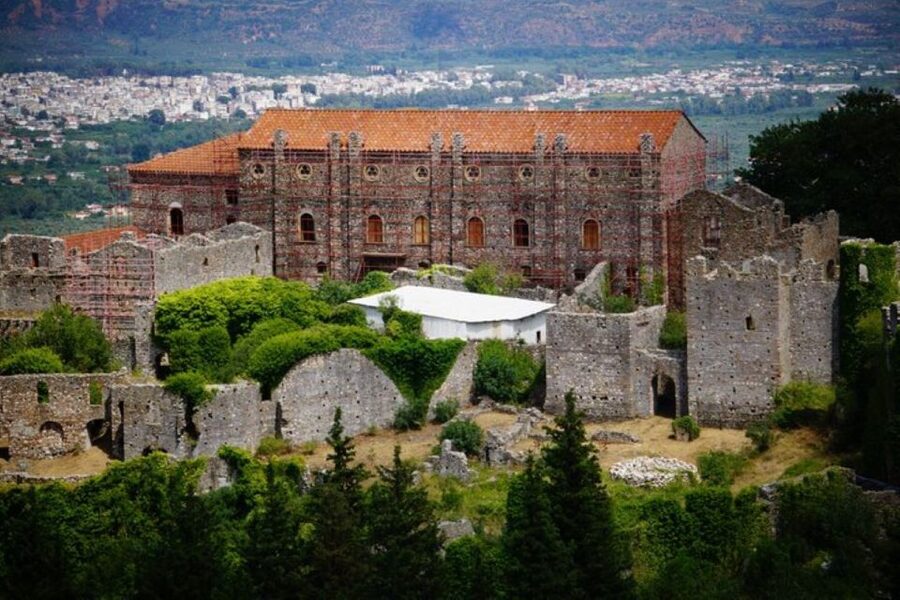
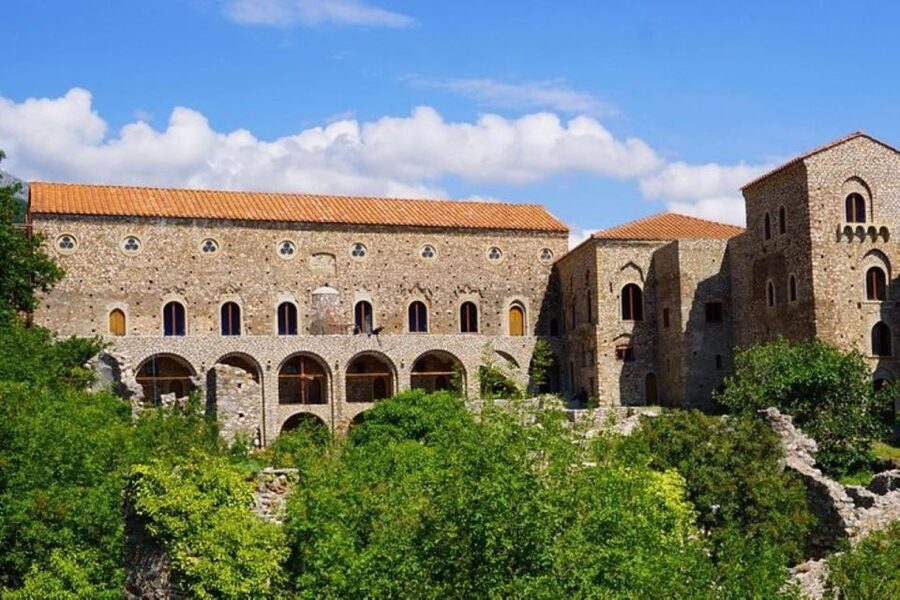
Mystras is often called a ghost city, but that name can mislead you. You are not walking through an empty ruin field. The site preserves churches, houses, mansions, palaces, monasteries, and defensive structures from the Byzantine period, with Frankish influence visible in parts of the architecture.
The main visit lasts about 1.5 hours, followed by roughly 30 minutes at Mystras Castle. In practice, you should expect uneven ground, slopes, stairs, and a route that moves between the upper and lower parts of the site. The most demanding section is reaching the citadel and then walking downhill through the remains.
The reward is the view. From the upper area, you look across the surrounding plain and understand why this hill was chosen for defense. As you move down, the site changes from fortress country to royal and religious spaces, including palaces and courtyards.
The churches are especially important. Their surviving decoration gives you a sense of Byzantine worship in a way that bare foundations cannot. Some monasteries remain in use, and the monks may show you parts of their small religious community. Dress and behave respectfully, since these are not only archaeological remains.
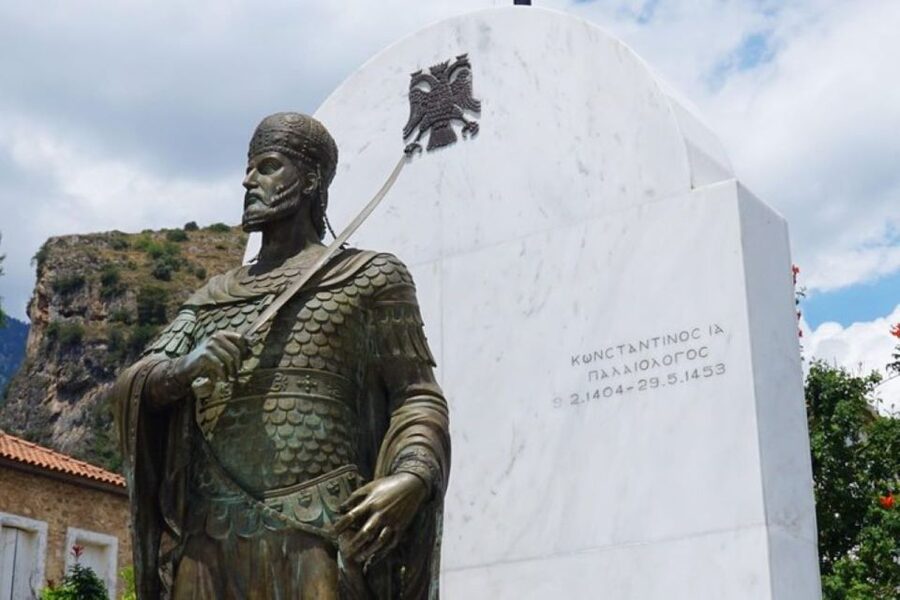
One of the most memorable details is at the chapel of St. Demetrios. A two-headed eagle, the symbol of Byzantium, survives on the floor. Constantine Palaiologos knelt on this plaque before being crowned the last Byzantine emperor. Details like this give Mystras a human scale. You are not simply looking at old stone. You are seeing a place tied to the final chapter of the Byzantine Empire.
The time allowed here may feel tight. Mystras is larger than many people expect, and the combination of uphill and downhill walking takes time. If Byzantine art and medieval history are your main interests, you may wish you had longer. The private format can help somewhat, since your driver may be able to adjust the day, but do not count on unlimited time at each stop.
Lunch in the village of Mystras
Before continuing to Sparta, you stop at a traditional Greek tavern in the small village of Mystras. Food and drinks are not included, so you pay for lunch directly.
This is a useful pause after walking the site. It also gives you a chance to eat away from Athens and try a local tavern setting rather than relying on a roadside snack. The exact menu and cost are not specified, so ask your driver about timing and choices when you set out.
Do not treat lunch as a long, leisurely restaurant visit unless your schedule allows it. The route still has Sparta and the return drive to Athens ahead.
Ancient Sparta and the limits of the ruins
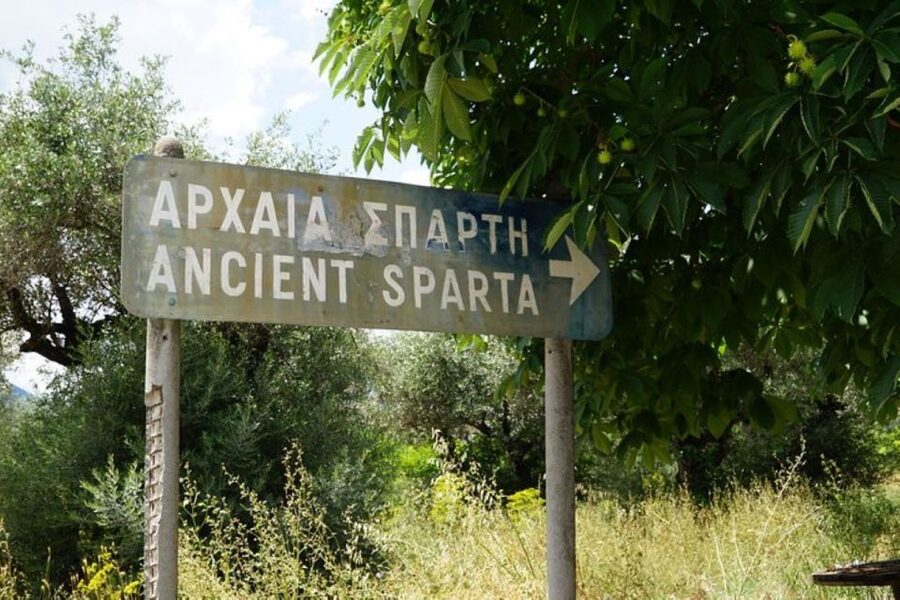
Sparta carries enormous name recognition, but the physical remains can surprise you. This was the rival of democratic Athens, a city ruled by two kings and shaped around military discipline. It was also linked with Helen of Troy and Menelaus in the Mycenaean period, before becoming the military society remembered from the classical age.
Leonidas and his 300 Spartans marched from Sparta to face the Persian army at Thermopylae in 480 BCE. That story gives the place emotional weight, but the modern visit is more restrained than the legend.
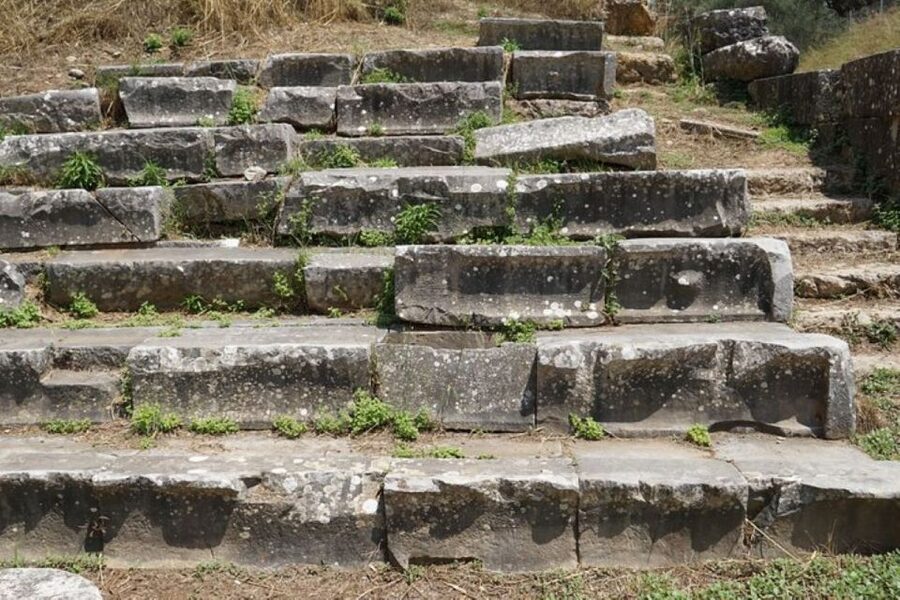
At the ancient citadel, you see the theater gradually revealed among the remains. The archaeological area is not presented as a fully rebuilt ancient city. Signage is limited, and the site can feel minimalist if you arrive expecting grand temples or extensive reconstruction.
This is where the lack of a licensed guide matters most. Your driver can explain the route and the history while you travel, but cannot accompany you into the sites as an official guide. You can walk independently, or add a licensed guide for €380. For a group that cares deeply about classical history, that extra cost may be worthwhile. For a casual visit, the added fee is significant.
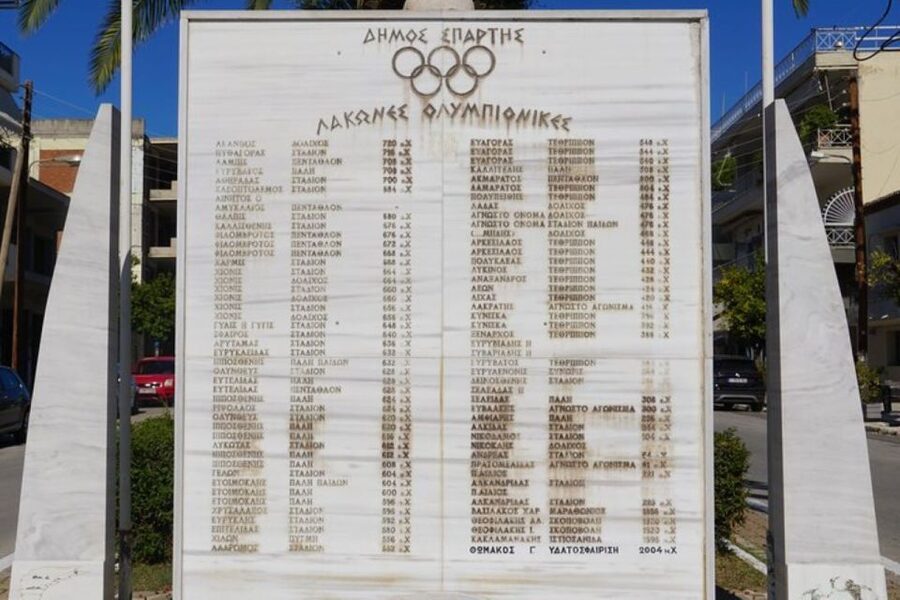
The tour also takes you past the stadium, where a statue of King Leonidas marks the ending point of the Spartathlon race from Athens to Sparta. The race covers 245.3 kilometers, and the monument connects modern endurance with the city’s ancient military image.
You should allow yourself a little patience at Sparta. Mystras offers a strong visual experience almost immediately. Sparta asks you to use your imagination and pay attention to context. If you are passionate about ancient Greek history, that can be rewarding. If you mainly want dramatic ruins, Sparta may feel underwhelming.
Same city, a completely different century:
- Athens: Acropolis & up to 5 Archaeological Sites Combo Pass
★ 4.4 · 12,619 reviews - Athens: Acropolis Ticket with Optional Audio or Live Guide
★ 4.2 · 11,055 reviews - Athens: Acropolis, Parthenon & Acropolis Museum Guided Tour
★ 4.8 · 9,316 reviews - Athens: Acropolis and Parthenon Guided Walking Tour
★ 4.6 · 5,882 reviews
The archaeological and olive oil museums
The program includes a visit to the archaeological museum of Sparta, followed by the Museum of the Olive and Greek Olive Oil. The listed timing gives 30 minutes for the olive oil museum, while the wider description includes the Sparta museum without a separate duration.
The archaeological museum can help fill in what the open-air ruins do not show. Objects and displays provide more context for Spartan life, art, and the ancient settlement. If you have limited interest in museum collections, you may prefer more time outdoors, and the private format gives you a better chance of discussing that preference with your driver.
The olive oil museum adds a different layer to the day. Olive cultivation and oil production are central parts of Greek food culture, and this visit connects an everyday product with the region’s economy and traditions. It is a practical stop after the ancient sites, especially if you want something beyond temples, fortifications, and heroic stories.
There is one scheduling point to confirm before departure. A previous outing missed this museum after the driver said it closed at 3 pm, despite different online opening information. Since opening hours can change, ask the operator or driver to confirm the stop on your date. This is not a reason to reject the tour, but it is a good reason to clarify the plan early.
What the private van adds
At $566 per person, this is not a low-cost day trip. The price includes hotel pickup and drop-off, private transportation, an air-conditioned van, bottled water, and a driver. It does not include the €34 entrance fees, food, drinks, or the optional €380 licensed guide.
The value depends heavily on your group size and priorities. A private vehicle is useful for a route this long. You avoid a large coach, keep your own group together, and may have some room to adjust the balance between Mystras, Sparta, and the museums. The driver also handles the road, which lets you focus on the scenery and conserve energy for the sites.
The best feedback has centered on the drivers. Giannis was praised for being kind and helpful, with good conversation about Greek culture and history. Panos was described as an excellent host and safe driver who explained places along the route. Manos received particular praise for his enthusiasm, stories, timing, and willingness to adjust the day so a museum visit received more attention.
Those names come from specific outings, so they do not guarantee who will drive your group. They do show what a strong version of this experience can offer: a safe driver who turns the long road into part of the visit rather than dead time.
The weaker experience came when the driver was doing the route for the first time and gave little commentary. That is an important distinction. This is not automatically a guided archaeological tour. You are paying for private transport with an English-speaking host or greeter, not a licensed historian walking you through every monument.
For a group of several people, the private price may make more sense when divided among the group. For one or two people, the total cost is harder to justify unless Mystras and Sparta are high priorities.
Who will enjoy this day most
I would choose this outing if you have already spent time in Athens and want a full day devoted to the Peloponnese. It suits people who enjoy history, long scenic drives, Byzantine churches, ancient ruins, and regional food culture.
It is also a good match if you value privacy and do not want to rent a car. The driver takes care of the route while you move between Corinth, Mystras, and Sparta in one day.
You should think twice if you dislike long drives, steep archaeological sites, or self-guided visits. Mystras demands active walking, and Sparta may not deliver the grand ruins you picture from the story of Leonidas. The day also leaves limited room for delays.
At a minimum, wear sturdy shoes, carry water even though bottled water is supplied, and budget for entrance tickets and lunch. Ask in advance about the museum schedule and whether a licensed guide is important for your group.
Should you book the Sparta and Mystras trip?
Book it if Mystras is high on your list and you want to pair it with the story of Sparta in one private day. The Byzantine churches, hillside citadel, royal courtyards, and St. Demetrios chapel give the day its strongest moments. The Corinth Canal is a quick bonus, while the olive oil museum adds a useful local angle.
Be more cautious if you expect a fully guided tour. The included driver cannot accompany you inside the sites, and the extra €380 for a licensed guide changes the total cost considerably. Sparta also requires realistic expectations: its importance is greater than the amount of visible monument remains.
For history-minded visitors who accept a long day, this is a memorable way to reach a part of Greece that is difficult to fit into a short Athens stay. For a relaxed holiday outing, choose something closer to the capital.
FAQ
How long is the tour?
The activity lasts one day, with pickup and return in Athens. Starting times depend on availability.
Is hotel pickup included?
Yes. Your driver waits outside your hotel or accommodation in Athens and returns you there.
Is the tour private?
Yes. The transportation and tour are for a private group.
Is transportation air-conditioned?
Yes. The tour uses an air-conditioned van, and bottled water is included.
Does the driver guide you inside the archaeological sites?
No. The driver is not licensed to accompany you inside any site. A licensed guide can be requested for an additional €380.
How much are the entrance fees?
Entrance fees are €34 per person and are not included in the tour price.
Is lunch included?
No. Food and drinks are not included. The route includes a stop at a traditional Greek tavern in the village of Mystras.
Is the tour wheelchair accessible?
Yes, the activity is listed as wheelchair accessible. Mystras itself includes uphill and downhill walking, so confirm the practical access arrangements before booking.
Freshly added Athens trips
- Athens and Ancient Corinth Private from Athens★ 5.0 · 3 reviews
- From Athens: Mycenae and Epidaurus Private Tour★ 4.8 · 3 reviews
- Full day Meteora private tour★ 5.0 · 3 reviews
- Double Shore Dive (certified divers)★ 4.5 · 3 reviews
- Athens Hills: Mythology Treasure Hunt★ 5.0 · 3 reviews
- Sunset & swimming at Cape Sounio, Poseidon temple★ 5.0 · 3 reviews
- Philosophy Experience at Plato’s Academy Park – basic version★ 5.0 · 3 reviews
- Private Acropolis Tour – Ticket Included★ 5.0 · 3 reviews
1-Day Tours, compared.
Cape Sounion & Poseidon Temple Sunset Half-Day Trip
Read our review →
Meteora Monasteries Day Trip with Caves and Lunch
Read our review →
Small-Group Delphi, Museum & Arachova Day Trip
Read our review →

Delphi English Day Trip from Athens with Official Guide
Read our review →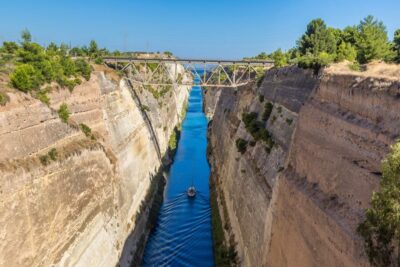
Peloponnese Highlights Day Trip and V.R. Audio Guide
Read our review →
Historical Delphi One Day Tour with Arachova Stop & Expert Guide
Read our review →
Premium Delphi Day Trip with an Expert Guide, Museum & Lunch
Read our review →Browse the lists this tour appears in