
Reviewed · WORKSHOPS
Athens: Traditional Greek Pastry Workshop
Portokalopita is one of those Greek sweets that looks simple until you learn what makes it work. In this small Athens workshop, Chef Maria shows you how to dry and arrange the phyllo, mix the orange batter, bake the cake, and pour over its fragrant syrup. I like the hands-on cooking and the chance to learn a recipe you can repeat at home.
I also like the personal scale. With no more than six people, Maria can guide each step, while hosts Oral and Sarisoy add local conversation and help with questions. The main thing to consider is timing: the cake needs to bake, so part of the 2.5-hour session involves waiting. You taste prepared cake and coffee during that pause, then take your own creation with you, but the exact take-home arrangement could use clearer instructions.
In This Review
- Key points to know
- Portokalopita gives the workshop a real Greek focus
- Starting at Psyri Square
- Meeting Maria, Oral, and Sarisoy
- Making the orange cake from start to finish
- The baking pause is part of the plan
- Greek coffee and the reward at the table
- Taking your dessert home
- Why the group size changes the experience
- Is $106 a fair price?
- Who should book this pastry workshop?
- What I like, and what I would clarify
- Should you book the Traditional Greek Pastry Workshop?
- FAQ
- Where does the Greek pastry workshop meet?
- How long does the workshop last?
- How much does the workshop cost?
- What dessert will I make?
- Who teaches the pastry class?
- Is the workshop conducted in English?
- How many people are in the group?
- What is included in the price?
- What should I wear?
Key points to know
- Portokalopita is the star: You make a traditional orange cake with phyllo dough, oil, eggs, sugar, oranges, and syrup.
- Chef Maria leads the cooking: She explains the recipe from start to finish and supervises the work without taking over.
- The group is capped at six: This gives you room to ask questions and work directly with the pastry chef.
- You meet at Psyri Square: Transfers are not included, so you make your own way to the central Athens meeting point.
- Greek coffee completes the lesson: You taste cake and coffee while your own dessert bakes.
- Bring clothes that can get dirty: This is a working kitchen session, not just a demonstration.
Portokalopita gives the workshop a real Greek focus
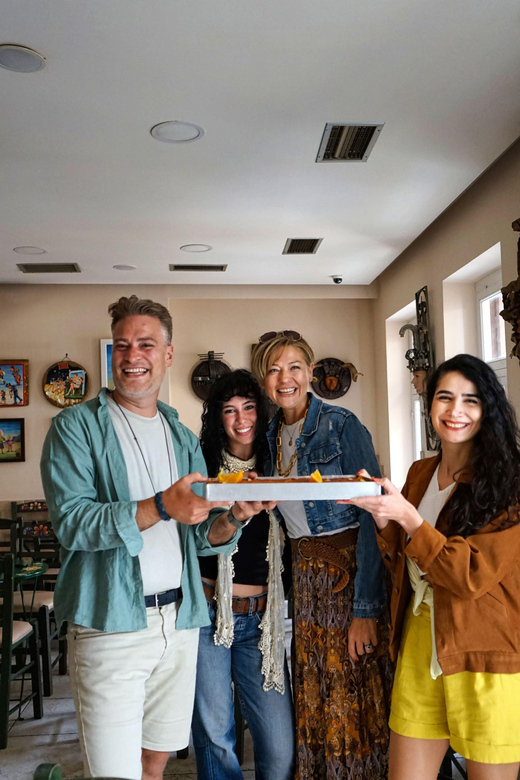
Many cooking classes promise local food and then settle for a broad menu. This one stays with a single dessert: Portokalopita, also called Greek orange pie or orange cake. It is a siropiasto, a Greek sweet soaked in syrup after baking.
That focus is useful. You are not rushing through several recipes or watching a chef handle every task. Instead, you follow the logic of one dessert from raw ingredients to finished cake. You learn why the phyllo must be handled in a certain way, how the orange flavor enters the mixture, and how the syrup changes the texture after baking.
The finished dessert combines crisp and soft textures. Phyllo gives the cake its structure, while the orange syrup makes it moist and fragrant. The recipe also offers a practical souvenir. You do not need a suitcase full of cooking tools or unusual ingredients to try it again for friends and family.
I especially like that the workshop teaches a sweet closely tied to the flavors you encounter in Greece. Oranges, syrup, phyllo, and Greek coffee make a more memorable lesson than a generic baking class. You leave with a clearer idea of how Greek pastry differs from the cakes and pies you may know at home.
A few more Athens days worth a look
- Athens: Classic Cooking Class with Market Visit and Wine
★ 5.0 · 1,101 reviews - Athens: Food Market Visit and Cooking Class with Wine
★ 4.9 · 1,087 reviews - Greek Cooking Class in Athens Including Rooftop Dinner with Acropolis View
★ 5.0 · 826 reviews
Starting at Psyri Square
The meeting point is Psyri Square, in central Athens. You do not receive a transfer, so plan your route before the starting time and allow a little margin for finding the pastry shop.
The workshop takes place in a colorful neighborhood at a traditional Greek pastry shop. That setting matters. You are not cooking in a polished hotel classroom designed to look Greek for the afternoon. You are stepping into a working sweets business, where the subject of the lesson fits the surroundings.
The meeting point also makes this easy to pair with other time in central Athens. You can schedule the class as a break from museums and ancient sites, though the 2.5-hour length means you should not squeeze it into a narrow gap between timed reservations.
The information provided does not give a precise walking time from Psyri Square to the shop. Follow the meeting instructions closely, and ask for clear directions if needed. Sarisoy has helped with directions in the past, which is useful if you are unfamiliar with the neighborhood.
Meeting Maria, Oral, and Sarisoy
Chef Maria leads the pastry work. Her approach is practical and patient. You get a step-by-step explanation, then perform the task yourself while she watches and helps where needed.
That balance is important. A cooking class can become frustrating if the chef grabs the bowl every time something goes wrong. Here, Maria supports the process while allowing you to mix, arrange, and prepare the cake with your own hands. You get a real sense of how the recipe works rather than a polished show with a tasting at the end.
Oral helps make the session social and informative. He shares local knowledge, talks with you about travel, and helps with questions and photographs. Sarisoy has also served as a friendly guide for participants, including a nine-year-old grandchild and an older family member.
The language is English. Since the group is limited to six, you should have a reasonable chance to speak with the hosts and ask about ingredients or technique. The small group also makes this more comfortable for families and for anyone who does not want to cook in front of a large class.
Making the orange cake from start to finish
The workshop begins with an introduction to local sweets and the pastry shop. You get a look at the kinds of desserts associated with Greek baking before turning to Portokalopita.
Then Maria takes you through the recipe. You prepare the orange-flavored mixture and work with the phyllo dough. One useful detail is the way the phyllo is treated. You do not simply stack neat sheets as you might for a conventional layered pie. You roll or arrange the phyllo so it can absorb the liquid mixture properly.
You also learn how to whip the oil, eggs, and sugar until the mixture becomes foamy. That step helps bring air into the batter. It is the kind of small technique that can be easy to miss when you only eat the finished dessert in a café.
The orange syrup is another key lesson. The cake is baked first, then the syrup is added so it can soak into the pastry. The process explains why Portokalopita is so moist and aromatic. You are not just following a list of ingredients. You are learning how texture develops.
Maria supervises each stage, so the class suits beginners. At the same time, the recipe has enough technique to interest people who already enjoy baking. You can ask why a step matters instead of copying motions without context.
Same city, a completely different century:
- Athens: Acropolis & up to 5 Archaeological Sites Combo Pass
★ 4.4 · 12,619 reviews - Athens: Acropolis Ticket with Optional Audio or Live Guide
★ 4.2 · 11,055 reviews - Athens: Acropolis, Parthenon & Acropolis Museum Guided Tour
★ 4.8 · 9,316 reviews - Athens: Cape Sounion & Poseidon Temple Sunset Half-Day Trip
★ 4.8 · 8,241 reviews
The baking pause is part of the plan
A 2.5-hour pastry workshop cannot spend every minute on active mixing. Your cake needs time in the oven, and that creates a natural pause.
During the wait, you taste orange cake and enjoy Greek coffee. The supplied details also refer to tea in one family’s account, but Greek coffee is the listed inclusion, so coffee is the treat you should count on. This pause gives you time to chat with Maria and the hosts, ask follow-up questions, and learn more about Greek sweets.
The waiting period is pleasant if you know to expect it. It is less suitable if you want a nonstop cooking lesson with several dishes. I would treat the baking time as part of the social side of the class, not as dead time.
The workshop is also a good change from a standard sightseeing schedule. Instead of moving from one monument to another, you sit down, work with food, and share the result. Families can work side by side, and children may enjoy the physical tasks more than a long museum visit.
The class has been suitable for a nine-year-old, but the available information does not set a formal minimum age. If you are booking for a young child, confirm the age policy first.
Greek coffee and the reward at the table
The tasting is simple, which is part of its appeal. You have the orange cake with Greek coffee after working through the recipe.
This is not a full meal, and you should not book it as one. The included food is the pastry you prepare, along with coffee. If you need lunch or dinner, plan that separately.
Still, the tasting gives the class a clear finish. You can compare the prepared cake with the dessert you made, notice the effect of the syrup, and ask questions while the flavors are fresh. Greek coffee also places the sweet in a familiar local setting. Portokalopita is not presented as an isolated recipe. It is treated as something to share.
The atmosphere has been described as relaxed and welcoming. That matters for a hands-on class because mistakes are part of baking. You can work at a comfortable pace without feeling that every movement is being graded.
Taking your dessert home
A takeaway tray is included, and the plan is for you to take the rest of your dessert with you. This adds value to the workshop because the recipe becomes both a tasting and a physical souvenir.
There is one practical point to clear up before booking. At least one participant found that the take-home arrangement was not as clear as it could have been. Ask the host how the baked cake will be packaged and when you will receive it, especially if you have a long journey after the class.
The dessert may also need careful handling. The supplied information does not specify the tray size, packaging, or storage instructions, so do not assume it will be ready for a long trip across town or an airplane journey. The safest view is that you will take it with you after the workshop and enjoy it soon.
Even with that small uncertainty, the take-home element is a strong feature. You can share the cake with family, photograph the result, or use the recipe later as a reminder of Athens.
Why the group size changes the experience
Six participants is a useful limit for pastry work. Everyone should have a chance to handle the ingredients rather than watch from the back of a room.
A small group also changes the social tone. You can talk with the hosts about Greek food and travel without shouting across a crowded classroom. Oral’s willingness to exchange travel stories adds to that informal feel.
The class is not private, however. If you book six places, you will be sharing the work area with other people. The available details do not explain the exact table layout or how many ovens and workstations are used, so you should expect a shared workshop rather than an individual lesson.
For solo visitors, this can be an easy way to meet people without signing up for a large group tour. For couples and families, it offers a shared task. A family member with mobility concerns has also found the hosts accommodating, but you should tell the provider about your needs in advance because the formal accessibility details are limited.
Is $106 a fair price?
The price is $106 per person. That is not a budget snack stop, so the value depends on what you want from your Athens food time.
You are paying for 2.5 hours, a professional pastry chef, the ingredients, the cooking instruction, Greek coffee, and a takeaway tray. The group is small, and the class takes place in a traditional pastry shop rather than a large commercial venue. For someone who wants a personal cooking lesson and a recipe to repeat at home, those details make the price easier to justify.
The value is weaker if you mainly want to taste Greek sweets. You could spend far less on a pastry and coffee in Athens. This class earns its price through participation, guidance, conversation, and the chance to make the dessert yourself.
I would also compare it with the cost of a general food tour. A food tour may give you more dishes and more neighborhood coverage. This workshop gives you less variety but more skill. If your priority is learning one Greek recipe well, the focused format works in your favor.
The reserve now and pay later option keeps your plans flexible, and cancellation is free up to 24 hours before the activity for a full refund. Those terms reduce some of the booking risk, but the central question remains simple: do you want a pastry lesson, or do you only want a sweet?
Who should book this pastry workshop?
I would recommend it to several kinds of visitors:
- Families with school-age children: The tasks are hands-on, and a nine-year-old has taken part successfully.
- Home bakers: You receive a recipe and learn techniques that can be used again.
- Food-focused visitors: The class links a specific dessert with Greek coffee and a local pastry shop.
- Solo visitors and couples: Six places keeps the group personal and gives you a natural setting for conversation.
- People seeking a slower Athens activity: The workshop replaces sightseeing on foot with a shared kitchen task.
You may want to skip it if you dislike baking, have only a short window in central Athens, or want a full meal. It is also not the best choice if you need a highly structured accessibility plan and cannot confirm the physical details in advance.
Bring comfortable clothes that can get dirty. Baking involves oil, syrup, eggs, and flour, and the class is meant for working rather than dressing up.
What I like, and what I would clarify
The strongest part is the direct instruction from Maria. You learn the recipe by doing it, and she remains available without taking the job out of your hands.
I also like the human scale and the local setting. Oral and Sarisoy add conversation and help connect the food with Athens beyond the pastry itself. The class feels less like a staged tasting and more like time spent with people who want you to understand a Greek sweet.
The points I would clarify before paying are practical. Confirm the exact directions from Psyri Square, ask about the take-home packaging, and check any mobility requirements or child age rules. None of these concerns cancels the activity, but clear answers will make the afternoon smoother.
Should you book the Traditional Greek Pastry Workshop?
Book it if you want to learn one distinctly Greek dessert and prefer participation over passive tasting. The small group, patient chef, Greek coffee, and takeaway cake give the 2.5-hour session a clear purpose.
I would especially choose it for a family day, a rainy afternoon, or a break between Athens sights. The $106 price is fair for a personal pastry lesson with ingredients and a take-home result, but it is high if you only want coffee and cake.
For most food lovers, this is a warm, practical way to spend part of a day in Athens. Just confirm how you will carry the finished Portokalopita home, then arrive ready to mix, bake, and get a little flour on your clothes.
FAQ
Where does the Greek pastry workshop meet?
The meeting point is Psyri Square in central Athens.
How long does the workshop last?
The activity lasts 2.5 hours.
How much does the workshop cost?
The price is $106 per person.
What dessert will I make?
You will make Portokalopita, a traditional Greek orange cake made with phyllo dough and soaked in orange syrup.
Who teaches the pastry class?
Chef Maria leads the pastry instruction. Oral and Sarisoy also assist with hosting, conversation, directions, and questions.
Is the workshop conducted in English?
Yes. The listed language for the instructor and activity is English.
How many people are in the group?
The group is limited to six participants.
What is included in the price?
The price includes the recipe ingredients, supervision from a professional pastry chef, the cooking workshop, Greek coffee, and a takeaway tray.
What should I wear?
Wear comfortable clothes that can get dirty. Transfers and anything extra are not included.
Freshly added Athens trips
- Athens and Ancient Corinth Private from Athens★ 5.0 · 3 reviews
- From Athens: Mycenae and Epidaurus Private Tour★ 4.8 · 3 reviews
- Full day Meteora private tour★ 5.0 · 3 reviews
- Double Shore Dive (certified divers)★ 4.5 · 3 reviews
- Athens Hills: Mythology Treasure Hunt★ 5.0 · 3 reviews
- Sunset & swimming at Cape Sounio, Poseidon temple★ 5.0 · 3 reviews
- Philosophy Experience at Plato’s Academy Park – basic version★ 5.0 · 3 reviews
- Private Acropolis Tour – Ticket Included★ 5.0 · 3 reviews
Workshops, compared.
Classic Cooking Class with Market Visit and Wine
Read our review →
Food Market Visit and Cooking Class with Wine
Read our review →
Greek Cooking Class in Athens Including Rooftop Dinner with Acropolis View
Read our review →
Greek Small-Group Athens Cooking Class & Dinner
Read our review →
Greek Cuisine Cooking Class and 3-Course Dinner
Read our review →
Traditional Greek cooking class and lunch or dinner with an Acropolis view
Read our review →
Athens Airport Private Transfer by Mercedes-Benz E Class Wagon to City Center
Read our review →Browse the lists this tour appears in