
Reviewed · CYCLING TOURS
Athens Historical Center: Explore by Bike
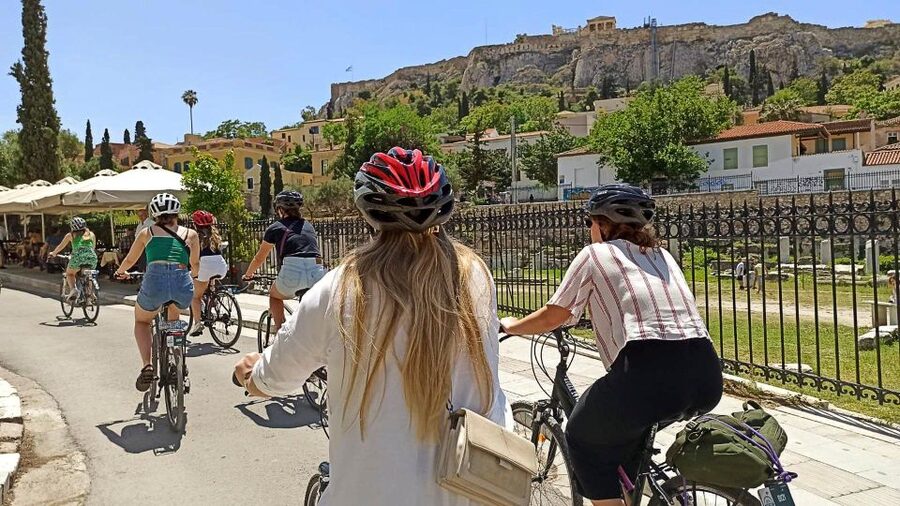
Athens reveals itself quickly from a bicycle. In 2.5 hours, you move from the ancient Kerameikos Cemetery to the food market, Plaka, the Panathenaic Stadium, and the Acropolis area, with a short walk up Filopappou Hill for a wide view over the city. It is a smart way to connect major sights without spending the whole day underground or in a tour bus.
I like the small group of no more than 10 and the easy pace. I also like the guide-led storytelling, especially with a guide such as Stavros, who is praised for answering questions patiently and bringing Athens history to life. The main consideration is that many stops are photo stops or pass-bys, so this is a sightseeing ride rather than a ticketed museum and monument tour.
In This Review
- Key points to know before you ride
- Why a bike is a good way to see central Athens
- From Thessalonikis 140 to Kerameikos Cemetery
- Psirri, the market, and Monastiraki
- The Agora and the Tower of Winds
- Plaka and Syntagma Square
- A calm ride through the National Garden
- The Panathenaic Stadium and the Temple of Zeus
- The Acropolis area and the walk to Pnyka
- What the $39.52 price really gets you
- Who will get the most from this Athens bike tour
- Should you book it?
- FAQ
- Where does the Athens bike tour start?
- Where does the tour finish?
- How long does the tour last?
- Is a guide included?
- Are bikes and helmets provided?
- Do I need to know how to ride a bike?
Key points to know before you ride
- A broad Athens route in 2.5 hours: Cover Kerameikos, the Agora area, Monastiraki, Plaka, Syntagma, the National Garden, the Panathenaic Stadium, the Temple of Zeus, and the Acropolis area.
- A small English-speaking group: The group is limited to 10 people, making it easier to hear the guide and ask questions.
- An easy-paced ride: The tour uses a 28-inch Trekking Bike, with a helmet and a half-liter bottle of water provided.
- A useful panoramic pause: You leave the bikes briefly to reach Pnyka on Filopappou Hill for views across Athens.
- A central start and finish: Meet at the Flat Tyres Psycling Club shop at Thessalonikis 140, close to a Metro station about 150 meters away.
- Basic cycling ability is required: You must already know how to ride a bike, and the tour does not run in heavy rain.
Why a bike is a good way to see central Athens
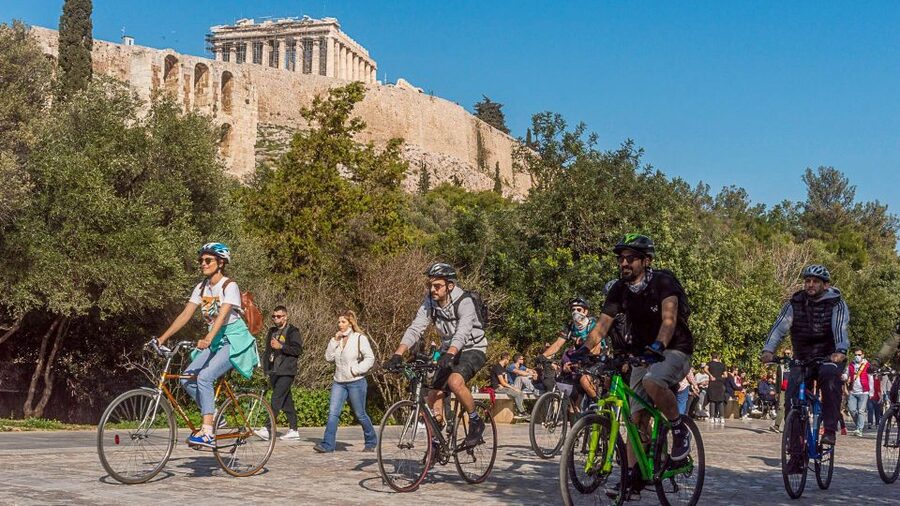
Athens can feel spread out when you connect its ancient monuments, central squares, markets, and royal-era buildings on foot. A bicycle gives you a useful middle ground. You cover more ground than a walking tour, yet you still move slowly enough to notice streets, neighborhoods, and changes in the city around you.
The route begins on the metropolitan Athens bike lane before moving through central districts. That matters because you are not simply pedaling from one isolated sight to another. The ride links the old cemetery district, commercial Athens, the historic center, the government quarter, and the monuments around the Acropolis.
You will not spend long inside each archaeological site. The value comes from seeing how the sites relate to one another. The Ancient Agora, Roman Agora, Plaka, the Acropolis Museum, and the sacred rock of the Acropolis all form part of the same historic center, but each occupies a different place in modern Athens.
The small group helps here. With a maximum of 10 people, the guide can keep the pace together and respond to questions. The strongest praise for the experience centers on Stavros, described as patient, friendly, and an engaging storyteller. That is important on a city ride, where a good explanation can turn a quick photo stop into a useful piece of history.
More Athens bike days:
- Athens Scenic Bike Tour with an Electric or a Regular Bike
★ 5.0 · 2,702 reviews - Athens Electric Bike Tour
★ 5.0 · 836 reviews - Athens: Old Town Highlights Guided E-Bike Tour
★ 4.9 · 834 reviews
From Thessalonikis 140 to Kerameikos Cemetery
You meet at Thessalonikis 140, looking for the Flat Tyres Psycling Club shop. The tour ends at the same place, which keeps the logistics simple. A Metro station is about 150 meters away, useful if you are arriving by public transport or heading onward after the ride.
The first major stop is Kerameikos Cemetery. This ancient burial ground gives you an immediate sense of Athens beyond the famous Acropolis. The area was tied to the city’s old roads and gates, and its location helps explain how ancient Athens extended beyond the central monuments most people know.
Here, the tour is listed as a photo stop and pass-by rather than a lengthy archaeological visit. You should expect a short introduction and a chance to see the setting from the route, not a detailed excavation tour or a long indoor stop.
That is a recurring feature of this experience. You get a connected overview, with the guide pointing out what matters and helping you place it on the map. If your goal is to examine every monument at length, you will need separate visits later.
Psirri, the market, and Monastiraki
From Kerameikos, the ride heads through Psirri. The route is designed to let you get lost in the district for a short time, using the character of the streets as part of the experience. You also pass Athens Town Hall and the Central Municipal Athens Market, known locally as Varvakios.
The market is the city’s biggest traditional food market. You are not given a meal or a dedicated food tasting, so keep your expectations clear. This is a visual and cultural stop, a chance to see an everyday side of central Athens rather than another columned ruin.
That contrast is one of the tour’s better choices. Ancient sites can seem disconnected when viewed one by one. Passing from archaeological remains to a working market shows you Athens as a living city, not just an open-air museum.
Monastiraki Square follows. It is one of the central meeting points in Athens, and it places you close to the old commercial heart of the city. The stop is mainly for photos and orientation. Your guide can help connect the square with the surrounding Ancient Agora, Roman Agora, and pedestrian streets.
Because this is a bicycle tour, you should be prepared for brief pauses rather than a long stay in each location. The reward is the sequence. You see the market, square, ruins, and neighborhood streets in one continuous ride.
The Agora and the Tower of Winds
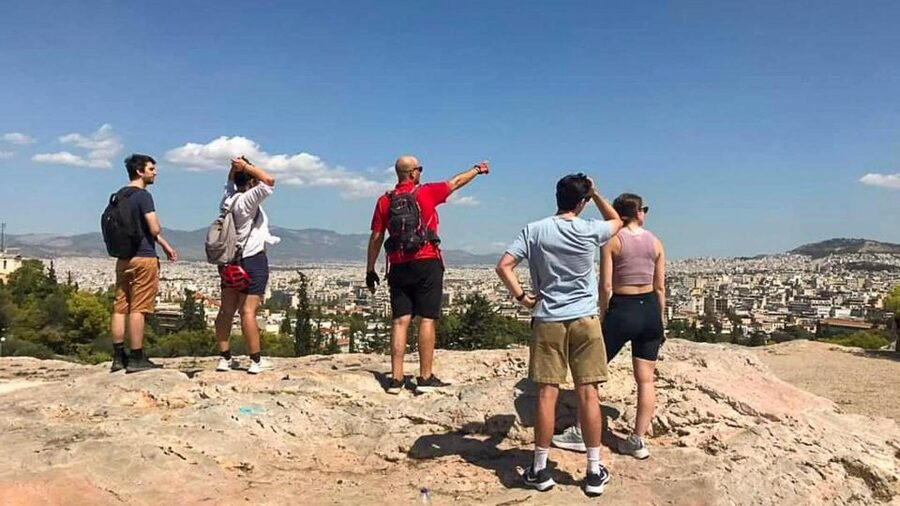
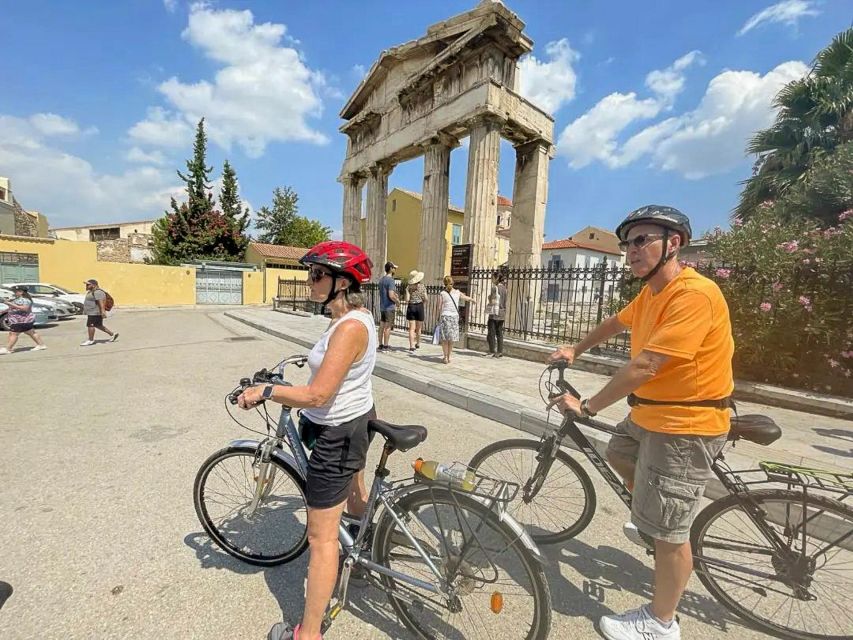
The route continues near the Ancient Greek Agora and the Roman Agora. These were different centers of public life in different periods, and the ride gives you a look at both without asking you to spend the whole morning inside an archaeological enclosure.
The Roman Agora is home to the Tower of Winds, one of Athens’ most distinctive ancient structures. Its unusual shape and surviving details make it a worthwhile point of reference as you pass through the historic center.
You should understand the trade-off here. The tour brings you near important sites, but the supplied details identify these sections as cycling and photo opportunities rather than included admission visits. If you want to walk through the Agora grounds, study the monuments, or see the Tower of Winds up close, plan a separate ticket and more time.
Still, the guide’s role adds real value. A ride past ruins can be forgettable without context. With an English-speaking leader explaining what you are seeing, the short stop can give you a clear framework for returning later on your own.
More ancient history days in Athens:
- Historical Delphi One Day Tour with Arachova Stop & Expert Guide
★ 4.5 · 1,247 reviews - Historic Athens: Small Group Electric Bike Tour
★ 4.9 · 740 reviews - The History of Athens: Greek Mythology Private Tour
★ 5.0 · 138 reviews - Athens Highlights by E-Bike: Small-Group Historic Tour
★ 5.0 · 131 reviews
Plaka and Syntagma Square
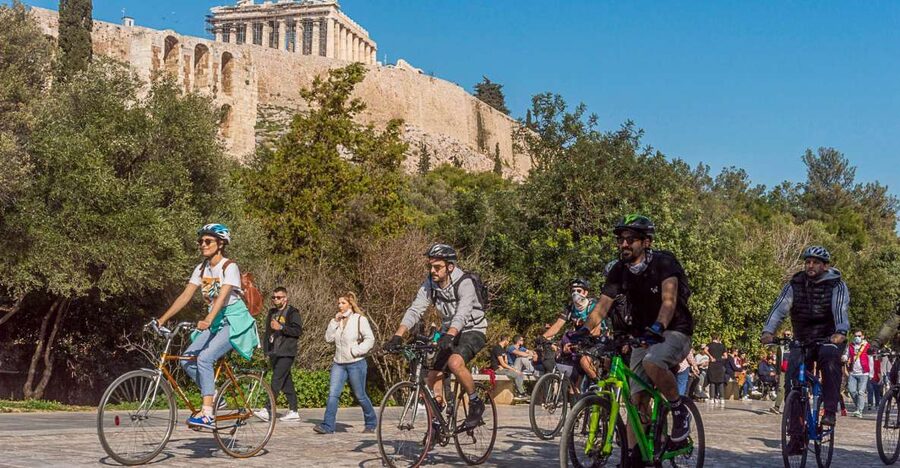
The route then enters Plaka, often called the Neighborhood of the Gods. Its narrow, picturesque paths bring you beneath the Acropolis area and away from the larger traffic routes. This is one of the parts I would most want on a first-day city ride because it gives you a feel for the historic center at street level.
The ride continues toward Syntagma Square and the Hellenic Parliament. Here you pause for photographs and see the Evzones guards, the ceremonial soldiers associated with the Parliament. The stop gives the tour a useful change of mood: ancient Athens gives way to the modern Greek state.
The guide can point out the role of the Parliament and explain the Evzones tradition, but do not expect a full ceremonial presentation unless one happens to coincide with your visit. The schedule allows a break and a photo stop, not a guaranteed extended guard ceremony.
Syntagma is also a practical landmark. It is one of the easiest places in central Athens to recognize, and seeing it from the bike helps you understand how the historic core connects to the city’s modern center.
A calm ride through the National Garden
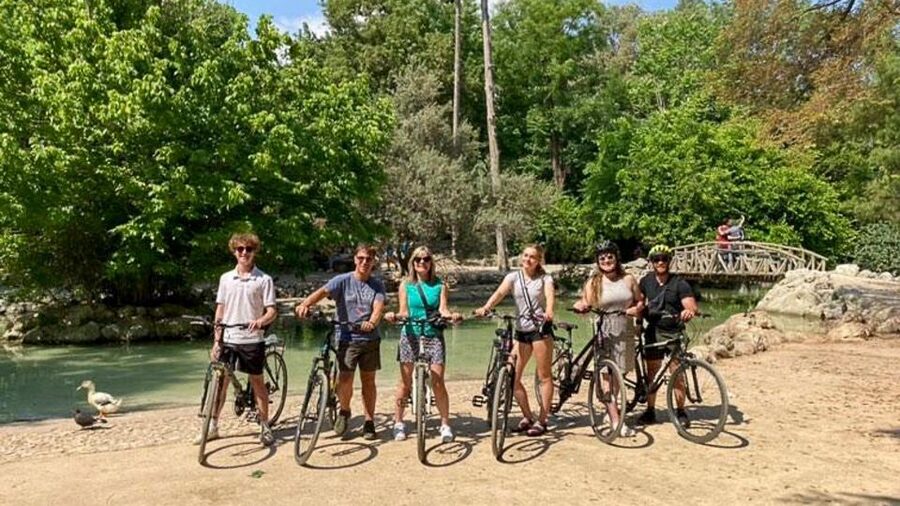
After Syntagma, you ride through the National Garden. This section offers a break from stone monuments and busy central streets. The Garden is included as a visit and photo stop, although no detailed description of the route through it is provided.
I like its place in the schedule. By this point, you have already seen markets, squares, ruins, and government buildings. A green stretch gives your eyes a rest and keeps the ride from feeling like a checklist of monuments.
The pace is described as smooth and easy, but you still need to be comfortable controlling a bicycle around other people and changing surfaces. The tour requires every participant to know how to ride. It is not a lesson for beginners.
The Panathenaic Stadium and the Temple of Zeus
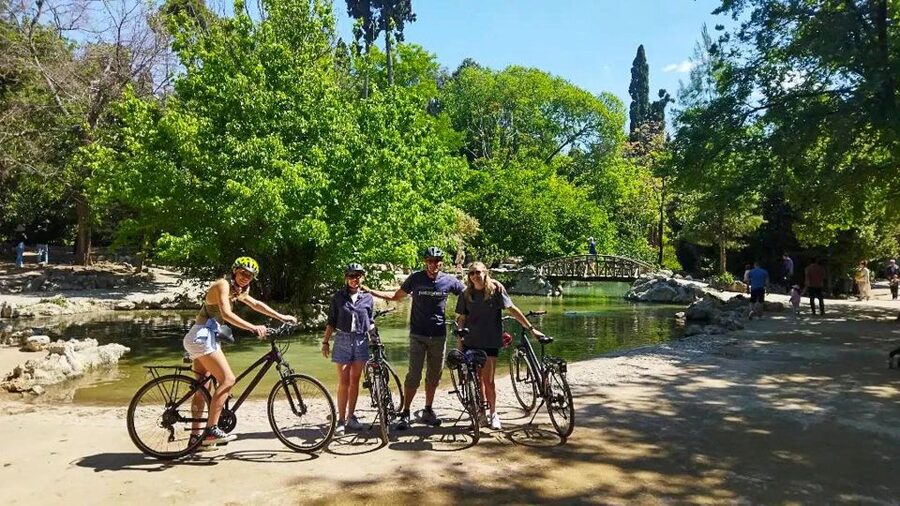
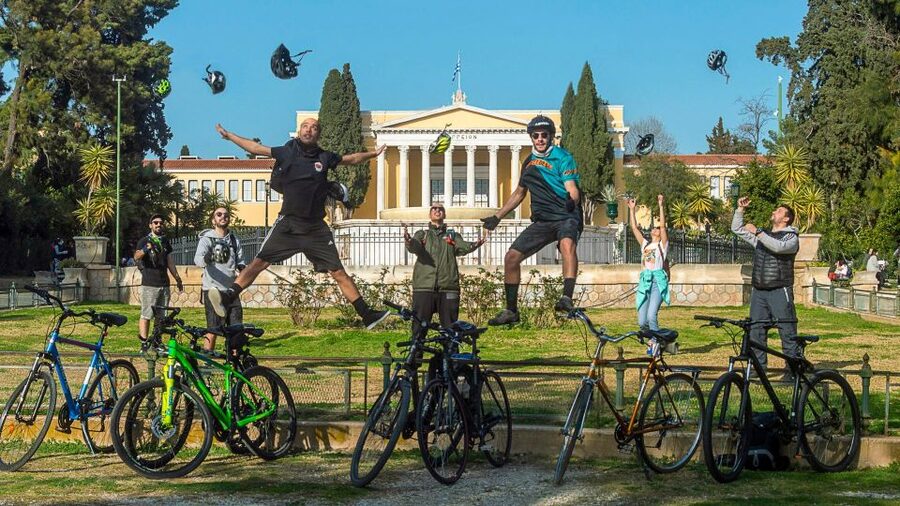
A few turns bring you to Zappeion Hall and the Panathenaic Stadium. The stadium hosted the first modern Olympic Games in 1896, giving the route a powerful link between ancient Greek ideals and the modern Olympic movement.
The stadium is listed as a visit and photo stop. No admission fee is specified as included, so you should not assume the price covers entry inside. The route may provide a good exterior view and an explanation from the guide, while a separate visit would let you explore the seating and interior at greater length.
Next comes the Temple of Olympian Zeus, usually called the Temple of Zeus. The surviving columns make it easy to grasp the enormous scale of the ancient project, even from outside. The tour treats it as a photo stop and pass-by, so the guide’s explanation is likely to be more important than the time spent on site.
Hadrian’s Arch is also part of this section, although it is not listed as a separate itinerary stop. It helps mark the transition between older Greek Athens and the Roman-era expansion of the city.
Together, the stadium, temple, and arch give you three different historical angles in a short stretch. One represents modern sport, one ancient religious ambition, and one Roman power.
The Acropolis area and the walk to Pnyka
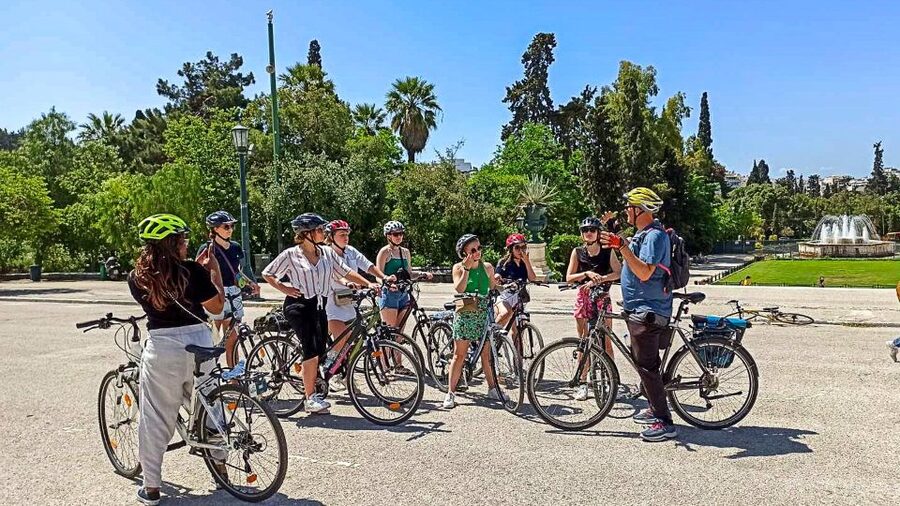
The bicycle route follows one of Athens’ best-known pedestrian roads toward the Acropolis Museum. The museum sits directly below the sacred rock of the Parthenon, so this is a strong point for understanding the relationship between the modern museum building and the ancient site above it.
The tour does not include entry to the Acropolis Museum or the Acropolis itself. You see the museum location, ride through the surrounding area, and take in scenic views along the way. That makes this experience a good introduction before a separate Acropolis visit, but not a replacement for one.
The bikes are left behind briefly for a walk of a couple of minutes through Filopappou Hill to Pnyka. This short walking section is one of the most valuable parts of the experience. Pnyka offers a panoramic view over Athens, giving you a chance to pause and see the city as a whole after moving through its individual districts.
You should wear comfortable shoes for this portion. The information provided does not describe the surface or incline in detail, but it is a walk on a hill, not a ride all the way to the viewpoint.
After the view, you cycle down the rest of the pedestrian road and return to Thessalonikis 140. Ending at the original meeting point makes it easier to collect anything you left behind and continue your day from a familiar location.
What the $39.52 price really gets you
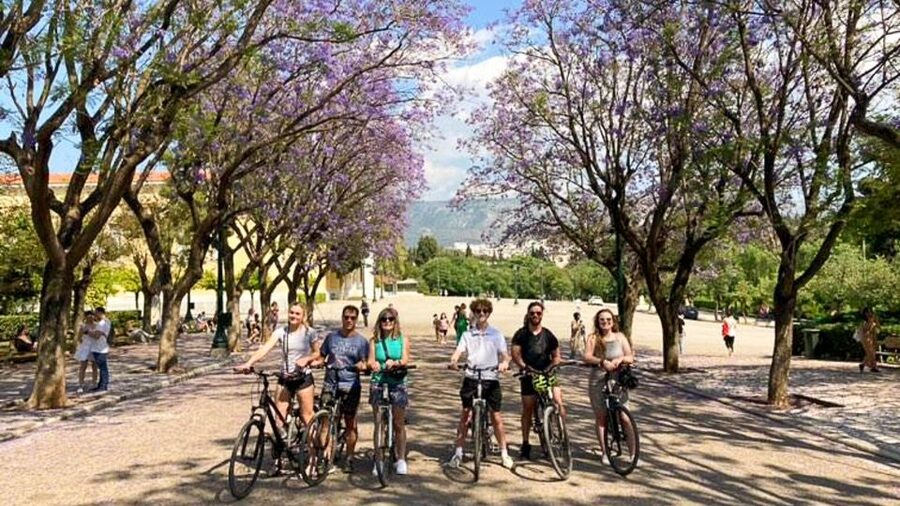
At $39.52 per person, the tour is priced as a guided overview rather than an admission-heavy history excursion. Your fee covers the bike leader or guide, a 28-inch Trekking Bike, a helmet, a half-liter bottle of water, and taxes.
The price is reasonable if you want a structured introduction to central Athens and prefer not to arrange a bike, route, and timing yourself. The guide is the main part of the value. A bicycle alone would let you move around, but it would not explain the meaning of Kerameikos, the Agora, the Evzones, or the Olympic stadium as you go.
Food and drinks are not included. That is not a major issue because the route passes the traditional municipal market and central districts where you can make your own food plans, but you should bring or buy anything beyond the supplied water.
Hotel pickup and drop-off are not included. You make your own way to Thessalonikis 140, though the nearby Metro station keeps the meeting point fairly practical.
The flexible booking terms also help. You can cancel up to 24 hours before the activity for a full refund, and the reserve-now, pay-later option lets you hold a place without paying immediately. Heavy rain is the main weather concern, since the tour will not operate in those conditions.
Who will get the most from this Athens bike tour
I would choose this ride if you have limited time in Athens and want to see the shape of the historic center before deciding where to return on foot. It also suits people who enjoy hearing local stories while moving, rather than spending a full morning in one museum or archaeological site.
The tour works well for:
- First-time visitors who want a city orientation
- Confident cyclists who prefer an easy sightseeing pace
- Couples, friends, and solo riders who like small groups
- People who want a guide’s historical context without a full-day commitment
- Anyone who wants a panoramic view from Pnyka included in the route
It is less suitable if you do not know how to ride a bike, need a cycling lesson, or want extensive time inside the Acropolis, Agora, Temple of Zeus, or Panathenaic Stadium. It is also not a good weather backup for a wet day because heavy rain cancels the ride.
The 28-inch Trekking Bike may not suit every rider, and the provided information does not specify height requirements or other bike-fit details. If that matters to you, ask the provider before booking.
Should you book it?
Book this Athens Historical Center bike tour if you want a compact, friendly introduction to the city with a maximum of 10 people and a guide who can answer questions along the way. The route is especially useful for connecting places that can otherwise feel scattered: Kerameikos, the market, Monastiraki, Plaka, Syntagma, the National Garden, the stadium, the Temple of Zeus, and the Acropolis area.
Skip it if your priority is entering monuments and spending quiet time examining archaeological remains. This is a moving overview with photo stops, not a series of long site visits.
For the right cyclist, the combination of history, everyday Athens, an easy pace, and the Pnyka viewpoint makes the $39.52 fee a fair use of 2.5 hours.
FAQ
Where does the Athens bike tour start?
The tour starts at Thessalonikis 140. Look for the Flat Tyres Psycling Club shop.
Where does the tour finish?
The activity ends back at the meeting point at Thessalonikis 140.
How long does the tour last?
The tour lasts 2.5 hours. Starting times vary, so check availability when booking.
Is a guide included?
Yes. A bike leader or tour guide is included, and the tour is conducted in English. Stavros is one of the guides associated with the experience.
Are bikes and helmets provided?
Yes. A 28-inch Trekking Bike, helmet, and a 0.5-liter bottle of water are included.
Do I need to know how to ride a bike?
Yes. Every participant must already know how to ride a bike. The tour does not take place in heavy rain.
Freshly added Athens trips
- Athens and Ancient Corinth Private from Athens★ 5.0 · 3 reviews
- From Athens: Mycenae and Epidaurus Private Tour★ 4.8 · 3 reviews
- Full day Meteora private tour★ 5.0 · 3 reviews
- Double Shore Dive (certified divers)★ 4.5 · 3 reviews
- Athens Hills: Mythology Treasure Hunt★ 5.0 · 3 reviews
- Sunset & swimming at Cape Sounio, Poseidon temple★ 5.0 · 3 reviews
- Philosophy Experience at Plato’s Academy Park – basic version★ 5.0 · 3 reviews
- Private Acropolis Tour – Ticket Included★ 5.0 · 3 reviews
Cycling Tours, compared.
Athens Scenic Bike Tour with an Electric or a Regular Bike
Read our review →

Historic Athens: Small Group Electric Bike Tour
Read our review →
Acropolis & Parthenon Tour and Athens Highlights Bike tour
Read our review →
Athens Acropolis Official E-Scooter Guided Tour Fat E-Bike
Read our review →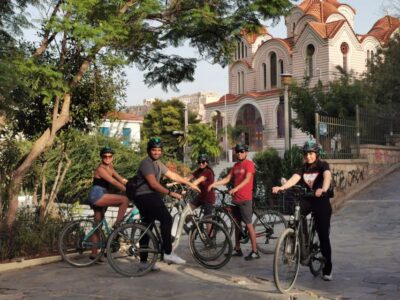
Browse the lists this tour appears in