
Reviewed · FOOD & DRINK
8 Days Peloponnese: Sightseeing, Historical & Tasting Private Tour from Athens
The best thing about this eight-day Peloponnese tour is its range. In one trip, you move from the Corinth Canal and Mycenaean palaces to Byzantine ruins, Venetian castles, olive-oil culture, remote Mani villages, and the vineyards of Nemea. The route also makes room for sunrise and sunset photography, not just quick postcard stops.
I like the personal scale and the way the tour uses scenic back roads through Aroania, Foloi, the Mani, and the coast near Pylos. I also like having a driver with photography experience. Nikolaos is described as a professional artist, photographer, and portrait painter, so you can expect help with viewpoints and timing, not only directions.
The main consideration is pace. Eight days cover a great deal of ground, and several days include long drives plus multiple historic sites. Your driver is not a licensed archaeological guide, so you’ll need to hire a specialist guide separately if you want detailed commentary inside the ruins and museums.
In This Review
- Key points to know before booking
- From Athens to Kalavryta and the Vouraikos Gorge
- Cave lakes, oak forest, and Olympia
- Nestor, Voidokilia, and the castles of Pylos
- Methoni Castle and the stone villages of Mani
- Remote Mani at Cape Tainaron
- Monemvasia, Sparta, and Byzantine Mystras
- From mountain Arcadia to Nafplio
- Nafplio, Nemea wine, and the return to Athens
- What the $2,659.81 price really covers
- Who should book this Peloponnese tour?
- FAQ
- How long is the tour?
- Where can pickup and drop-off take place?
- What time does the tour start?
- Is this a private tour?
- What type of vehicle is used?
- Is accommodation included?
- What happens if I arrange my own hotels?
- Is the driver an archaeological guide?
- Are entrance fees included?
- Are train tickets included?
- Can I pay a deposit?
- Is the tour refundable if I cancel?
Key points to know before booking
- Eight days, one private group: You travel by air-conditioned sedan, minivan, or minibus, with pickup and drop-off in Athens or Piraeus.
- Photography shapes the schedule: The route includes sunrise and sunset opportunities, scenic viewpoints, villages, castles, beaches, and mountain roads.
- Nikolaos leads from behind the wheel: He brings professional photography experience, though he is not a licensed archaeological guide.
- The route reaches remote southern Mani: Cape Tainaron, Vathia, Gerolimenas, and Porto Kagio add scenery and old stone architecture rarely seen on a short Peloponnese visit.
- Hotels cost extra: Accommodation can be arranged from about €100 to €130 per double room per night, depending on the town and date.
- Admission fees are separate: Museums and archaeological sites cost extra, with full prices generally applying from April through October.
From Athens to Kalavryta and the Vouraikos Gorge
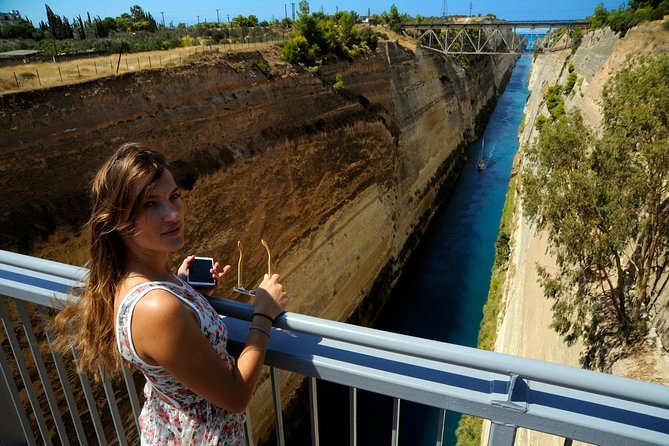
Your first morning begins at about 8:00 a.m. with pickup at your Athens or Piraeus hotel, apartment, or another agreed location. The first stop is the Corinth Canal, where a pedestrian bridge gives you a high view over the narrow man-made cut. The canal is about 6.4 kilometers long and took 12 years to build between 1881 and 1893.
The canal stop is brief, about 15 minutes, but it makes a useful opening image. You see how sharply the Peloponnese is separated from mainland Greece, even though the peninsula remains linked by roads and bridges.
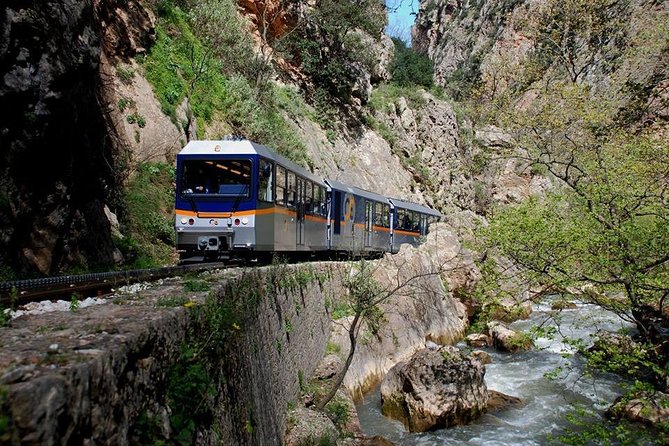
The route then reaches Diakopto, a coastal town at the lower end of the Vouraikos Gorge. The itinerary includes time connected with the rack railway and Zachlorou station, with train tickets listed separately at €10 per person. Confirm the exact train plan before departure, since the schedule and available seats matter on a tightly timed day.
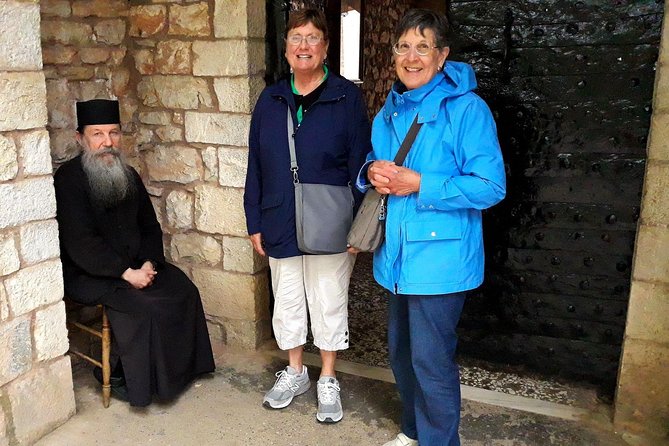
From Zachlorou, you continue by car to Mega Spileo Monastery. Built into a huge cliffside cave, the monastery combines dramatic scenery with old religious tradition. Its story reaches back to the early Christian centuries, and the cave was known even in antiquity. The setting is the real draw: rock, gorge, and monastery architecture come together in a single view.
Agia Lavra adds an important chapter in modern Greek history. The monastery is linked with the 1821 War of Independence and the raising of the revolt’s flag. Its past has been marked by repeated destruction and rebuilding, including fires during Ottoman campaigns and World War II. The present structure reflects that long cycle of loss and repair.
You spend the night in Kalavryta. This mountain town is a sensible base after a full first day, and the overnight stop gives you time to see it beyond a roadside photo. Kalavryta has medieval, Byzantine, Ottoman, and independence-era associations, so it sets the tone for a trip that keeps shifting between periods of Greek history.
More food stops in Athens:
- Greek Food Walking Tour in Athens
★ 5.0 · 4,740 reviews - Athens: Street Food Tasting Tour
★ 4.9 · 2,557 reviews - Small Group Greek Traditional Food Tour in Athens 20+ Tastings
★ 5.0 · 1,759 reviews
Cave lakes, oak forest, and Olympia
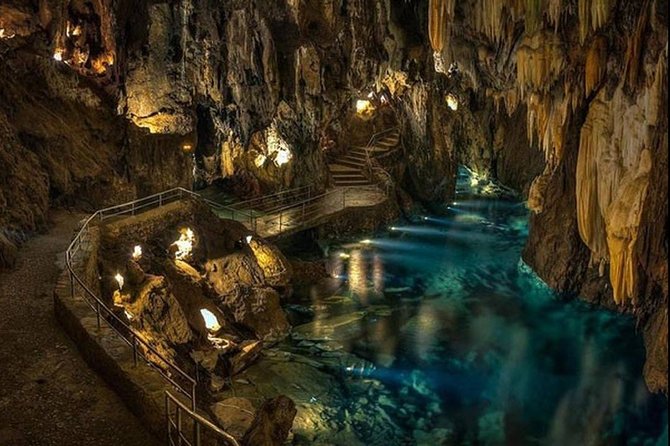
Day two begins with the Cave of the Lakes near Kastria, about 17 kilometers from Kalavryta. The cave formed from an underground river and has three levels. In winter, melting snow can turn it into a flowing river with waterfalls. In summer, the water recedes and leaves 13 lakes.
The cave admission is not included. Listed prices are €9 for adults and €4.50 for children and people over 65. Opening hours vary by season, with a stated daily schedule of 9:30 a.m. to 4:30 p.m. and longer hours in summer. Check the current times before setting out, especially if your date falls near a seasonal change.
The drive through the Aroania Mountains is one of the tour’s stronger scenic sections. Mount Chelmos reaches 2,355 meters and is known for its plants, birds, caves, rivers, and mountain settlements. You have about two hours for the mountain route, though much of that time is driving rather than a formal hike.
Lampeia provides a quieter village stop at about 800 meters above sea level. Then comes the Foloi oak forest, a protected Natura 2000 site and one of Greece’s unusual woodland areas because it lies on relatively flat ground. The forest is tied to the myth of the centaur Pholus and Hercules, a small but memorable example of how Greek mythology remains attached to ordinary places.
The afternoon belongs to Ancient Olympia. Allow three hours for the archaeological site. Olympia was the sanctuary where the ancient Olympic Games were held every four years, beginning in 776 BCE. Its ruins spread through a wooded valley, with the stadium, temples, training areas, and other remains separated by open paths.
I would not rush this stop. The site is broad, and its meaning becomes clearer when you picture it as a religious center and festival ground, not simply as the birthplace of modern sport. The nearby Museum of the Olympic Games adds useful context about the contests, ancient records, and the first recorded winner, Koroibos of Elis.
Olympia is another overnight stop. Hotel arrangements are extra, with listed rates from €110 per double room and higher rates on weekends and holidays. If you book your own lodging, the driver needs a separate room. That detail affects the real cost, so settle the arrangement early.
Nestor, Voidokilia, and the castles of Pylos
Day three moves west toward Messenia and the Palace of Nestor. The Mycenaean palace lies about 17 kilometers north of Pylos and is associated with Nestor, the king described in Homer’s Odyssey and Iliad. Raised walkways help you see the plan of the complex, even though only low wall sections remain.
The palace is a good example of why this tour suits people who want history in sequence. You have already seen classical Olympia, but here the clock moves back to the Bronze Age. Admission is separate.
Voidokilia Beach is one of the finest scenery stops on the route. Its curved sand resembles the Greek letter omega, with Gialova Lagoon behind it. The area is protected under Natura 2000, and the lagoon provides an important stop for migratory birds. Above the beach are Nestor’s Cave, a Frankish castle, and an ancient tomb linked with Nestor’s son.
You then have time at Divari Beach for photos and lunch near the water. This is an important pause in a schedule otherwise crowded with ruins. Bring sun protection and suitable footwear for uneven ground, since the itinerary is built around outdoor viewpoints as much as formal museum visits.
Navarino Bay brings the story forward to 1827, when British, French, and Russian forces defeated an Ottoman and Egyptian fleet during the Greek War of Independence. The battle helped make Greek independence more likely. A short stop at the bay lets your driver connect the geography with the event.
At the New Castle of Pylos, also called Niokastro, you see a major fortress built by the Turks in 1573 and later controlled by the Venetians. Its position above the bay explains why Pylos mattered for trade and military control. Admission is not included.
The overnight is in Methoni, where you can use the evening for sunset photography. This is one of the tour’s best scheduling choices. Instead of visiting a castle at midday and leaving, you sleep nearby and can return to Methoni Castle early the next morning.
Methoni Castle and the stone villages of Mani
Methoni Castle is a fortified city on a rocky point surrounded by sea on three sides. Venetians built it after 1209, and a moat separates the fortress from the mainland. An octagonal tower on a small fortified islet adds a striking detail to the view.
Give yourself time to walk rather than simply photograph the entrance. The scale of the site becomes clearer as you follow the walls toward the water. Admission is extra, and the exposed setting can be hot in summer.
The route then passes through Kalamata, the Peloponnese’s second-largest city after Patras. The stop is short, about an hour, so think of it as a break and orientation point rather than a full city visit.
Kardamili is more leisurely. This seaside village has stone homes, cypress trees, olive groves, a harbor, and views across the Messinian Gulf. Two hours here allow room for photos, a meal, and a slower look at Mani’s architecture.
The Caves of Diros offer a different kind of visit. You travel by boat through an underground lake among stalactites and stalagmites. The boat ride takes about half an hour, and steps lead down to the entrance. Commentary may be in Greek only, so ask in advance if an English-speaking cave guide is available.
The day ends in Areopoli, a historic Mani town filled with stone lanes and tower houses. These towers were built for both family life and defense. Areopoli is closely tied to the Greek struggle against Ottoman rule, and its central square features a statue of Petrompeis Mavromichalis, a leading figure from the Mavromichali family.
Accommodation in Methoni or Areopoli can be arranged from about €100 per double room, with higher weekend and holiday rates. The driver’s room is complimentary when the operator handles the accommodation, but you still need to include your own room in the budget.
More ancient history days in Athens:
- Historical Delphi One Day Tour with Arachova Stop & Expert Guide
★ 4.5 · 1,247 reviews - Historic Athens: Small Group Electric Bike Tour
★ 4.9 · 740 reviews - The History of Athens: Greek Mythology Private Tour
★ 5.0 · 138 reviews - Athens Highlights by E-Bike: Small-Group Historic Tour
★ 5.0 · 131 reviews
Remote Mani at Cape Tainaron
Day five is the most remote part of the trip. Gerolimenas, once a fishing center known as the Old Harbour, gives you a short coastal stop. Until the 1970s, it was reached mainly by boat, which helps explain its isolated character.
Vathia is the day’s strongest architectural photo stop. Its old tower houses sit on a hill, while abandoned homes, chapels, and towers spread across the surrounding slopes. Your driver guides you through the village, but this is not a polished museum complex. Expect worn stone, open views, and a quiet sense of a place that has lost much of its population.
Cape Tainaron is the southernmost point of mainland Greece. Ancient tradition placed an entrance to Hades near the cape, and the area also contains remains associated with a temple of Poseidon and a later Christian church. The route gives you about an hour here, enough for a walk and photographs if conditions are comfortable.
Porto Kagio follows with a longer two-hour stop. The harbor was known in antiquity as Psamathous and later served Venetian and Ottoman interests. Its sheltered water and remote setting make it a good place to slow down before the next long road section.
This day depends heavily on weather and road conditions. The stops are free, but the peninsula’s narrow, winding roads and distance from major towns mean you should not expect a quick in-and-out excursion. The reward is a side of Greece built around stone, sea, and distance from city life.
Monemvasia, Sparta, and Byzantine Mystras
Day six begins at Monemvasia, the famous medieval settlement on a rocky island joined to the mainland by a short causeway. Its name means single entrance, a fitting description of a fortified town reached through one narrow gateway.
The old town’s walls and Byzantine churches remain, while the plateau rises above the settlement. Monemvasia is best appreciated on foot, so wear shoes suited to stone lanes and slopes. Two hours gives you a useful introduction, though people who love medieval architecture may wish they had longer.
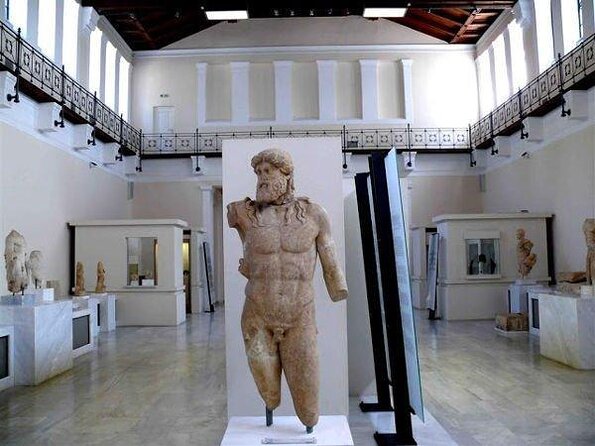
Sparta offers a very different kind of historic experience. The Archaeological Museum occupies a neoclassical building from 1874 to 1876 and charges a listed general admission of €3. The ancient acropolis and theater are included in the day’s route, with about an hour for the site.
Ancient Sparta can surprise you. It is famous in popular culture for military discipline, but the surviving remains are less monumental than Athens or Olympia. I would treat the stop as a chance to understand the city’s setting and political importance rather than expect a complete ancient city preserved above ground.
The Archaeological Site of Mystras is one of the tour’s most memorable historic visits. Built around a fortress established in 1249, the medieval city became a major Byzantine center before later Turkish and Venetian control. It was abandoned in 1832, leaving churches, palaces, walls, and streets spread across a hillside.
Mystras requires walking on uneven ground and slopes. The listed admission is €8 in summer and €4 in winter. Plan your energy carefully because the site comes after Sparta and before the Olive and Greek Olive Oil Museum.
The olive-oil museum explains how the olive shaped food, trade, religion, technology, and daily life from prehistoric times into the early 20th century. It makes a welcome change from ruins, especially if you want the trip to include living Greek culture as well as ancient monuments.
You spend the night in Sparta. Hotel prices are listed from about €120 per double room, with higher rates on weekends and holidays.
From mountain Arcadia to Nafplio
Day seven crosses toward Argolis. Agios Petros Kynourias is a mountain village at about 950 meters on Mount Parnonas. The stop offers fresh air, traditional buildings, and local tavernas, though the itinerary allows only an hour.
Paralio Astros feels more coastal and island-like, with narrow lanes, tiled houses, fishing boats, and a hilltop medieval fortress. The port is also linked with the Second National Assembly of Greece, held in 1823. You have about an hour to look around.
Palamidi Castle in Nafplio deserves its two-hour visit. The Venetian fortification was built mainly between 1711 and 1714 and remains remarkably complete. The hill gives broad views over Nafplio and the Gulf, though the climb and uneven surfaces can be demanding.
Nafplio itself is a highlight. It served as the first capital of the modern Greek state from 1827 to 1834, and its old town carries Venetian, Frankish, Ottoman, and Greek traces. You sleep here, giving you an evening to enjoy the town rather than treating it as a quick photo stop.
Nafplio, Nemea wine, and the return to Athens
The final morning begins with the Archaeological Museum of Nafplio in a well-preserved Venetian building on Syntagma Square. Admission is separate. Then you visit Akronafplia, the oldest fortress above the town, where parts of the defenses reach back to the Bronze Age.
Ancient Nemea continues the sports and wine theme. The Sanctuary of Zeus hosted the Nemean Games, and the site includes the temple area, stadium, baths, and other remains. Allow about an hour, with admission extra.
The Cooperative Winery of Nemea introduces Agiorgitiko, the region’s native red grape. The cooperative began in 1937 and now works with more than 500 growers. This is a useful tasting stop because it connects the drink in your glass with the local soil, farming, and regional economy.
The Monastery of the Dormition at Rock Nemea offers a short visit and wide views over vineyards. Finally, Loutraki provides a coastal stop before returning to Athens. The town is known for mineral springs, thermal bathing, and Greece’s first casino, opened there in 1928.
What the $2,659.81 price really covers
The advertised price is $2,659.81 per person, but it does not cover your hotel rooms or entrance fees. It does include private transport, fuel, tolls, parking, an air-conditioned vehicle, pickup and drop-off, and an English-speaking driver with photography experience.
The value is strongest for a small private group that wants one vehicle, a flexible route, and help finding good viewpoints. It is less compelling if you want a conventional guided archaeology tour or prefer to arrange budget hotels yourself.
Site and museum fees add up. From April through October, many admissions are listed at €20 per person per site. From November through March, the rate is generally reduced, and some locations list their own prices. Add the Cave of the Lakes, Diros Caves, Mystras, Sparta’s museum, the rack railway, meals, and hotel rooms before comparing the total with other tours.
The operator asks for booking at least two weeks ahead, especially in July and August. Payment can be made in full by credit card or split into a 50 percent deposit and 50 percent cash payment to the driver on the tour date. The cancellation policy is strict: the experience is non-refundable and cannot be changed after booking.
Who should book this Peloponnese tour?
Book it if you want one long, private circuit that blends ancient sites, medieval towns, sea views, mountain villages, food, wine, and photography. It suits couples, families, and small groups who value a dedicated vehicle and do not want to manage the Peloponnese road system themselves.
Skip it if you need a licensed guide at every ruin, dislike long drives, or want plenty of unscheduled beach and town time. Before paying, confirm the assigned driver, since the tour information names Nikolaos while past arrangements have also used drivers named Christos and Nikolaus. Also confirm the hotel plan, train section, current entrance fees, and which meals or tastings are included.
FAQ
How long is the tour?
The tour lasts approximately eight days and begins and ends with transport connected to Athens.
Where can pickup and drop-off take place?
Pickup and drop-off are offered at hotels or apartments in Athens and Piraeus. Another location may be requested.
What time does the tour start?
The stated start time is 8:00 a.m.
Is this a private tour?
Yes. Only your group participates in the activity.
What type of vehicle is used?
Transport is provided in an air-conditioned sedan, minivan, or minibus, depending on the group size.
Is accommodation included?
No. Accommodation is an additional cost. The operator can arrange selected boutique or three-star and four-star hotels with breakfast.
What happens if I arrange my own hotels?
You need to reserve an extra room for the driver if you make your own hotel bookings.
Is the driver an archaeological guide?
No. The driver is not a licensed archaeological guide. You can hire an archaeologist separately in advance if you want guided visits inside archaeological sites and museums.
Are entrance fees included?
No. Admission fees for archaeological sites and museums are separate. Listed prices vary by season and by location.
Are train tickets included?
No. Rack railway tickets are listed separately at €10 per person.
Can I pay a deposit?
Yes. You can pay a 50 percent deposit by credit card, with the remaining 50 percent payable in cash to the driver or tour leader on the tour date.
Is the tour refundable if I cancel?
No. The experience is non-refundable and cannot be changed for any reason after booking.
Freshly added Athens trips
- Athens and Ancient Corinth Private from Athens★ 5.0 · 3 reviews
- From Athens: Mycenae and Epidaurus Private Tour★ 4.8 · 3 reviews
- Full day Meteora private tour★ 5.0 · 3 reviews
- Double Shore Dive (certified divers)★ 4.5 · 3 reviews
- Athens Hills: Mythology Treasure Hunt★ 5.0 · 3 reviews
- Sunset & swimming at Cape Sounio, Poseidon temple★ 5.0 · 3 reviews
- Philosophy Experience at Plato’s Academy Park – basic version★ 5.0 · 3 reviews
- Private Acropolis Tour – Ticket Included★ 5.0 · 3 reviews
Food & Drink, compared.


Small Group Greek Traditional Food Tour in Athens 20+ Tastings
Read our review →
Food Market Visit and Cooking Class with Wine
Read our review →
Athens Authentic Greek Food Walking Tour (Small Group)
Read our review →


Browse the lists this tour appears in